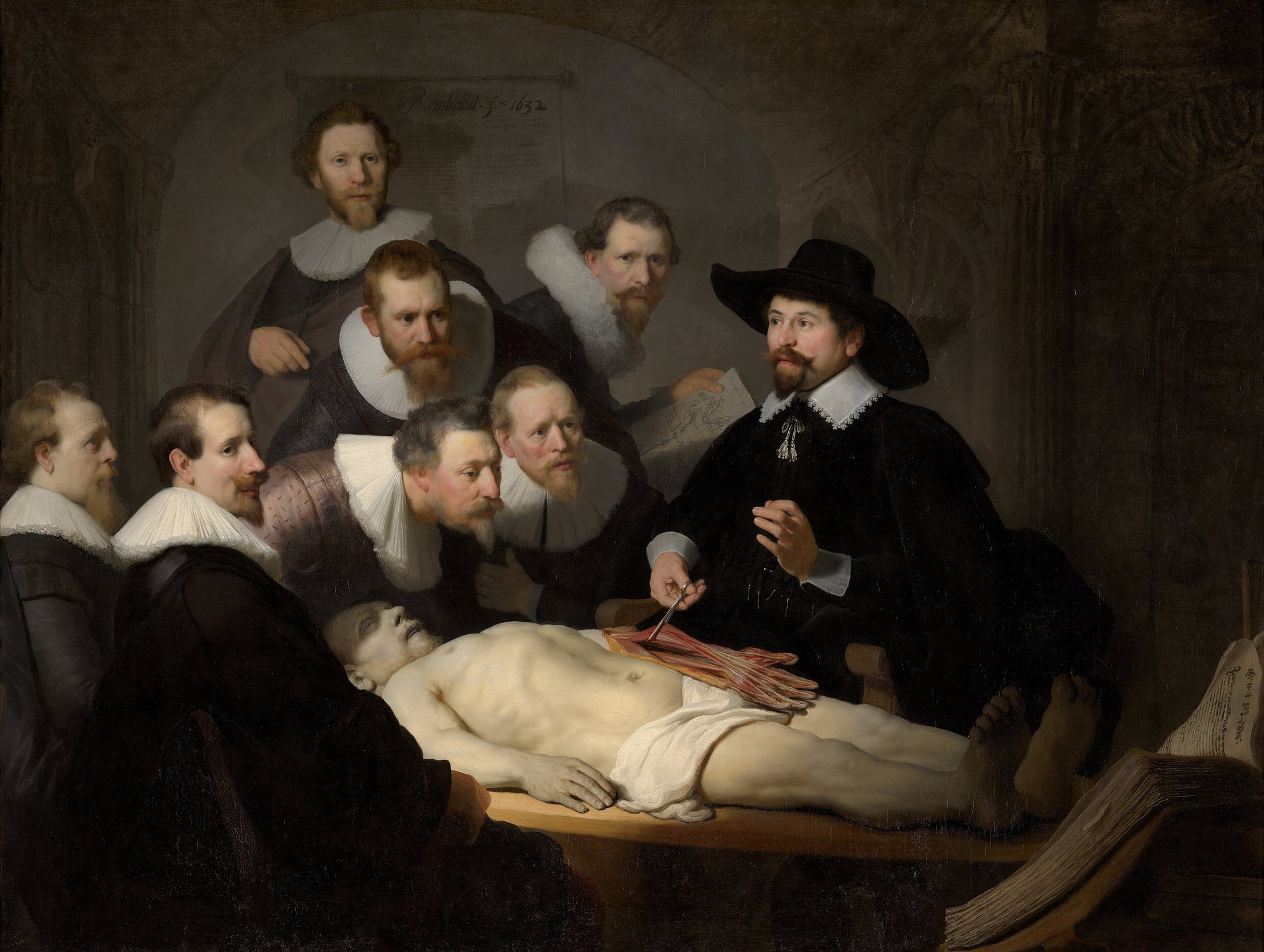
In the last days of January 1632, a thief named Aris Kindt was hanged in Amsterdam. His body went to the city’s surgeons, who were allowed one public dissection a year, always on an executed criminal, and who charged admission. Somewhere in that winter crowd, very probably, stood a young painter just arrived from Leiden, hired to turn the event into a group portrait. The result is the painting we now call The Anatomy Lesson. Rembrandt was twenty-five.
The Anatomy Lesson of Dr Nicolaes Tulp is the picture that made him. It was his first big commission in Amsterdam and his first group portrait, and within a few years he was the most sought-after portraitist in the city. Today it hangs in the Mauritshuis in The Hague, a few rooms from Vermeer’s Girl with a Pearl Earring. And it is stranger than it looks. Every living man in it paid to be there. One of them may have been painted by somebody else. The paper that once listed their names now shows a drawing of an arm. And the arm on the table, the most famous dissection in art, is not quite an arm any anatomist has ever found.
The Anatomy Lesson of Dr Nicolaes Tulp at a glance
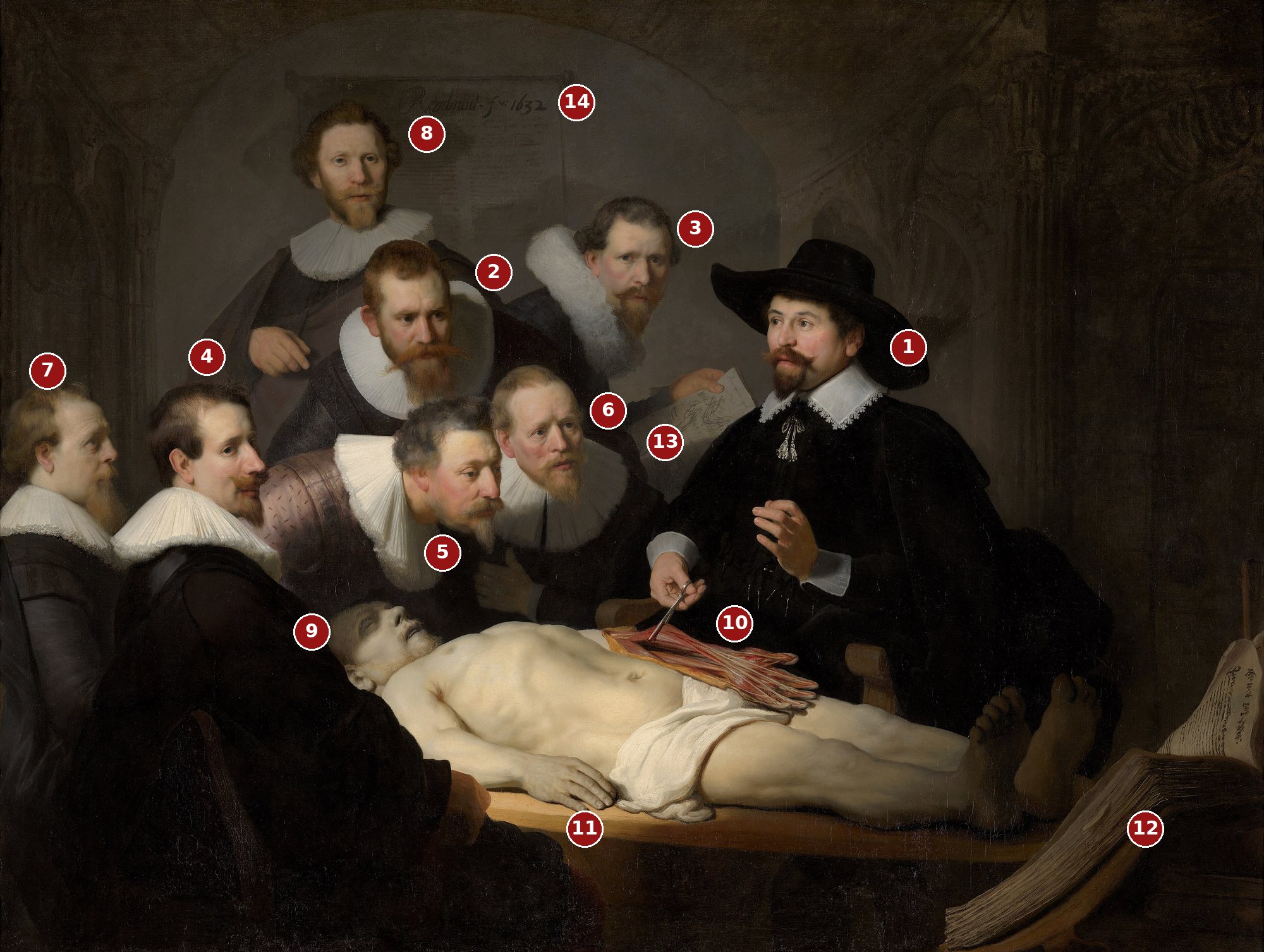
The numbers on the image match this key. They are ours, not the old numbers once painted beside the sitters. The names follow the standard identifications used by the Mauritshuis and by medical historians, and where scholars disagree the table says so.
| # | Figure | Who it is | Where to find him |
|---|---|---|---|
| 1 | The lecturer | Dr Nicolaes Tulp, praelector of the Amsterdam surgeons’ guild | Right, in black, the only man wearing a hat |
| 2 | The man behind | Jacob Block | Center, big red moustache, looking toward Tulp’s hand |
| 3 | The man with the paper | Hartman Hartmansz | Back right, in a soft fur-edged ruff, looking at you |
| 4 | The man checking the book | Adriaen Slabbraen | Second from left, eyes sliding toward the open book |
| 5 | The man leaning in | Jacob de Witt | Center, bent forward over the dissected arm |
| 6 | The closest listener | Mathijs Kalkoen | Nearest to Tulp, staring at the doctor’s raised hand |
| 7 | The man in profile | Jacob Koolvelt, probably added later | Far left, listening to Tulp |
| 8 | The man at the top | Frans van Loenen | Top of the pyramid, looking straight out |
| 9 | The corpse | Aris Kindt, born Adriaen Adriaensz, hanged for robbery | On the table, face half in shadow |
| 10 | The dissected forearm | The left forearm, flayed to show the finger flexors | Under Tulp’s forceps |
| 11 | The intact hand | First painted as a stump, according to X-rays | Resting on the sheet in the foreground |
| 12 | The book | Possibly Vesalius’s Fabrica, possibly a later anatomy | Lower right, propped at the dead man’s feet |
| 13 | The paper | A list of names painted over a drawing of an arm | In Hartmansz’s hand |
| 14 | The signature | ”Rembrant. f. 1632” | On the back wall, above van Loenen |
Who is who in The Anatomy Lesson: Rembrandt starts with the hat
Start with the hat, because Rembrandt did.
Nicolaes Tulp was thirty-eight that winter. He was born Claes Pieterszoon in Amsterdam in 1593, and he studied medicine at Leiden. In the early 1620s, when tulips were the luxury object of every Dutch merchant, he took a tulip as his emblem, hung one on the sign of his house on the Keizersgracht, and changed his name to match. Tulp is Dutch for tulip. In 1628 the surgeons’ guild made him its praelector anatomiae, the lecturer who ran the annual public dissection. Later he served four terms as one of the city’s burgomasters. He was a strict Calvinist with a sense of theater, and the painting gives him both.
He sits apart, on the right, alone in his own half of the canvas. The seven surgeons are packed together on the left. He wears a broad black hat. Nobody else does. In a seventeenth-century group portrait that is not a fashion choice. It is rank. The hat says that this man is the master and the others are his audience.
There was nearly a second hat. Infrared and X-ray studies show that the man at the very top, Frans van Loenen, was first painted wearing one, and that it was later painted out. A faint shadow still marks where it sat. The usual reading is the obvious one: two hats meant two masters, and there could only be one.
The seven surgeons who paid to watch
The men on the left were not the guild’s elite. They were members who paid to be in the picture, and medical historians have noted that several of them were relatively minor surgeons who joined to share the cost. The name everyone remembers is Tulp. The names that paid most of the bill are the ones you have to look up.
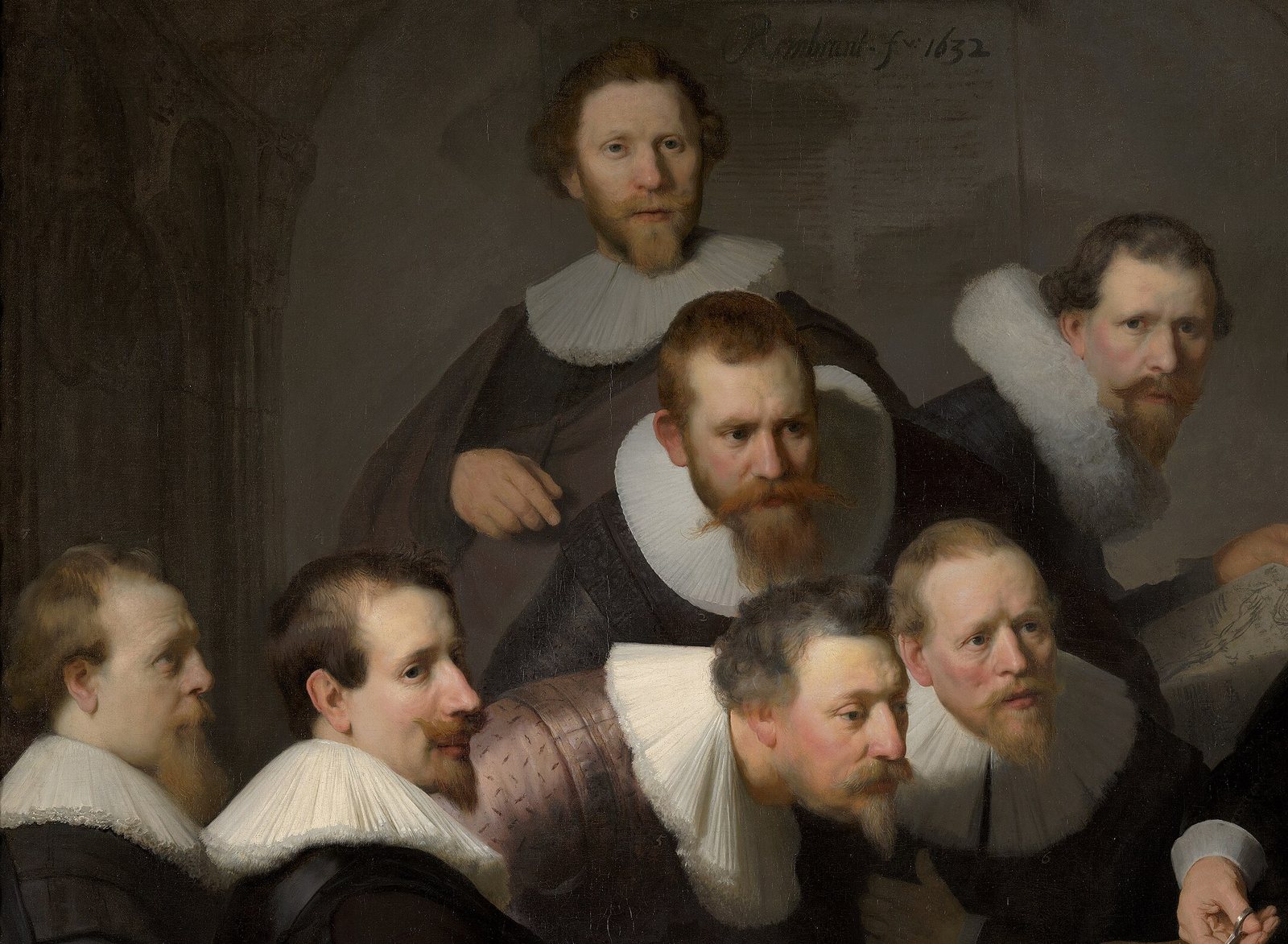
Earlier anatomy portraits in Amsterdam, like Aert Pietersz’s lesson of 1603, lined the surgeons up in rows facing the viewer, a team photo with a body in it. Rembrandt stacked his men into a pyramid and made almost all of them look somewhere else. Each one is caught at a different point in the same thought.
Jacob de Witt, number five, leans so far forward over the arm that his ruff tilts. He is looking at the muscle. Mathijs Kalkoen, number six, the man nearest Tulp, is not looking at the arm at all. He is staring at Tulp’s raised left hand. Jacob Block, number two, behind them, with the great red moustache, follows the same line. Adriaen Slabbraen, number four, seems to glance across to the big book at the dead man’s feet, the way any anatomy student checks the textbook against the body.
Then the pyramid closes. Frans van Loenen, at the top, and Hartman Hartmansz, with the paper, look straight out of the picture at you. They are the hinge between the lesson and the room. You are in the audience now.
The surgeon who may not be by Rembrandt
Jacob Koolvelt, number seven, at the far left, is the odd man out. He is in strict profile, listening, and he is painted more flatly and stiffly than the faces next to him. Most technical studies conclude that he was added after the first composition was laid in, and several writers have argued that another painter added him. Some accounts say the same of van Loenen at the top. The evidence for the later additions is good. The evidence for another hand is a matter of style, and scholars still argue about it.
Why add a man? The likeliest answer is money. A group portrait was paid for by its sitters, and a late subscriber meant a late face. The Night Watch, ten years later, worked on exactly the same economics, which is why one of its musketeers is a man who was already dead.
The paper that used to have names on it
Look at the sheet in Hartman Hartmansz’s hand, number thirteen. Today you can see faint lines on it, the outline of an arm with its muscles. It has not always looked like that.
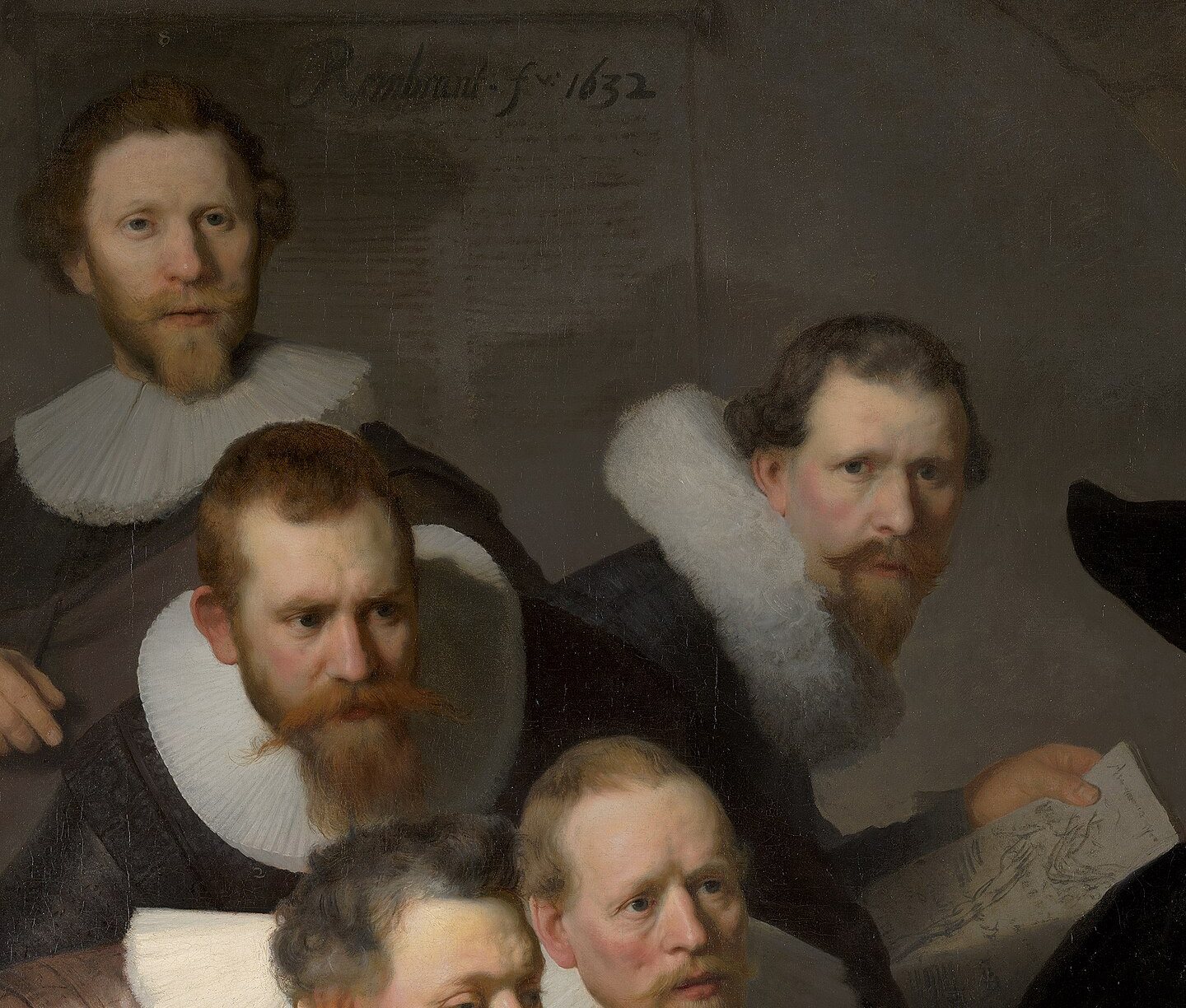
Early in the eighteenth century, according to the Mauritshuis, someone numbered the sitters and painted their names onto Hartmansz’s paper as a list. For about two centuries the paper was a roll call, and the drawing Rembrandt had put there was buried underneath. A later restoration took most of that overpaint off the sheet, and the arm came back. The sheet was meant to echo the arm on the table: a drawing in the surgeon’s hand, a body in front of him, and a book at the end of the table.
Without that eighteenth-century inscription, the seven surgeons would be seven anonymous ruffs.
Now look above van Loenen’s head, number fourteen. On the wall, Rembrandt signed his name: “Rembrant. f. 1632,” the f standing for fecit, he made it. He had been signing with a monogram, RHL, for Rembrandt Harmenszoon of Leiden. This is among the very first paintings he signed with his first name alone, and he was still settling the spelling. He added the d the next year and kept it for the rest of his life. A young man from out of town, signing the biggest picture of his career, was deciding what to call himself.
The thief on the table
The body belongs to Aris Kindt, number nine, and he is the only person in the painting who did not choose to be there.
Kindt was born Adriaen Adriaensz, a Leiden man with a long record of theft and violence. Accounts differ on his age; one tradition makes him twenty-eight, another forty-one. His last crime, the story goes, was an attempt to rob a man of his coat in Amsterdam. Most accounts date the dissection to January 31, 1632. Some say he was hanged that same morning, others a few days earlier. Either way the timing suited the surgeons. Dissections happened in winter, when a body kept.
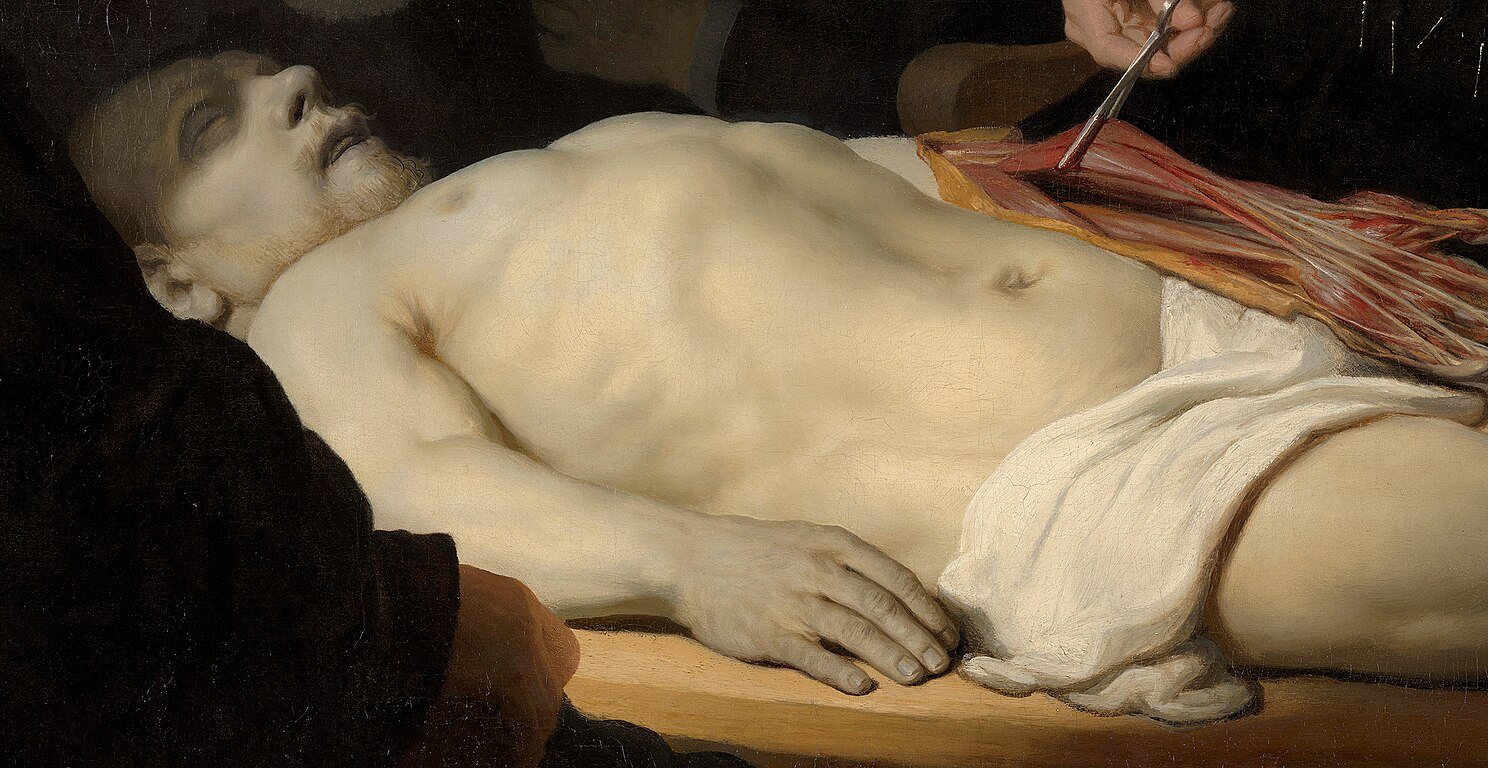
Rembrandt put a shadow across his face. Art historians call it the umbra mortis, the shadow of death, and it does a quiet kindness: the body stays a body rather than a person.
Then there is the hand, number eleven. It rests on the sheet in the foreground, whole and relaxed. X-rays of the canvas show that Rembrandt first painted a stump there, and painted the hand over it afterwards. Nobody knows why. Kindt may really have lost a hand to an earlier punishment, or the stump may have been a first idea that someone thought too grim. Either way, the finished picture gave the thief back the hand the city had taken.
The anatomical error in the forearm
Now the arm, number ten. It is the reason doctors have argued about this painting for a century.
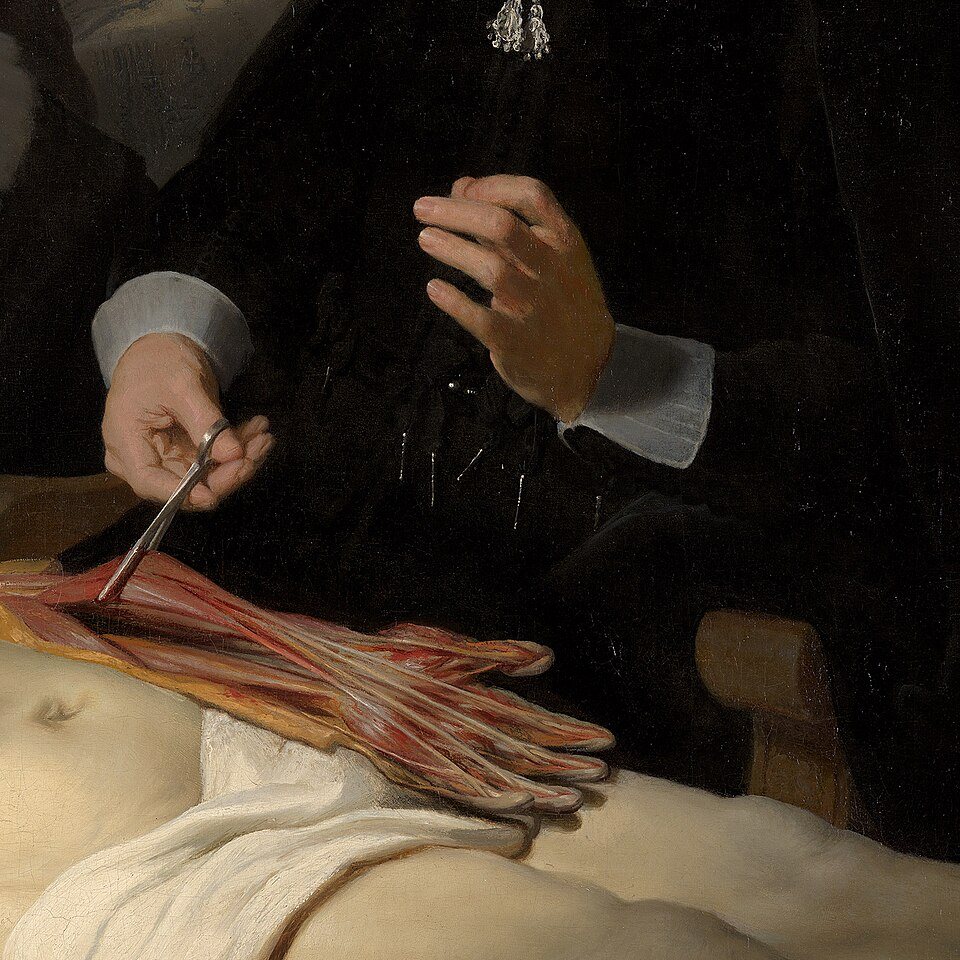
Tulp is lifting the muscles that bend the fingers, the flexors, with a pair of forceps in his right hand. With his left hand he shows what those muscles do. His fingers curl at the middle joints while the knuckles stay straight. He is not making a speaker’s gesture. He is demonstrating a movement, and the next second, you feel, he will pull on the tendon and the dead man’s fingers will curl the same way. That is why Kalkoen is watching the doctor’s hand and not the corpse.
The trouble is where the muscles start. In the painting the flexors seem to spring from the outer side of the elbow. In a real arm they start on the inner side. In 2006, for Rembrandt’s four-hundredth birthday, a team of Dutch surgeons led by Frank IJpma dissected the left forearm of a male cadaver to compare it with the painting, and concluded that the picture does not match: muscles in the wrong place, structures that should not be visible, a mysterious white cord along the little-finger side. Other specialists pushed back. Some argued that Tulp has already freed the muscle from the bone to lift it, which would explain its odd origin. A 2007 study identified the white cord as the tendon of a rare variant muscle, not a mistake at all.
The arm also looks too big for the body, and many writers think Rembrandt painted it from a separately dissected arm or an anatomy book. The novelist W. G. Sebald went further. In The Rings of Saturn, he argued that the dissected hand is a right hand set on a left arm, and read the error as Rembrandt siding with the dead man against the doctors. Not every anatomist agrees, but once you have heard it, you will look twice.
And no real anatomy lesson in 1632 began with the arm. The guts went first, because they rotted first. In the painting the belly is untouched. This is not a record of the dissection. It is a portrait of a man who wanted to be remembered in a particular pose.
The pose Tulp borrowed from Vesalius
That pose has a source. In 1543, the Flemish anatomist Andreas Vesalius published De humani corporis fabrica, the book that founded modern anatomy. Its portrait of the author shows him standing beside a cadaver, holding up a dissected forearm and hand and lifting the finger flexors.
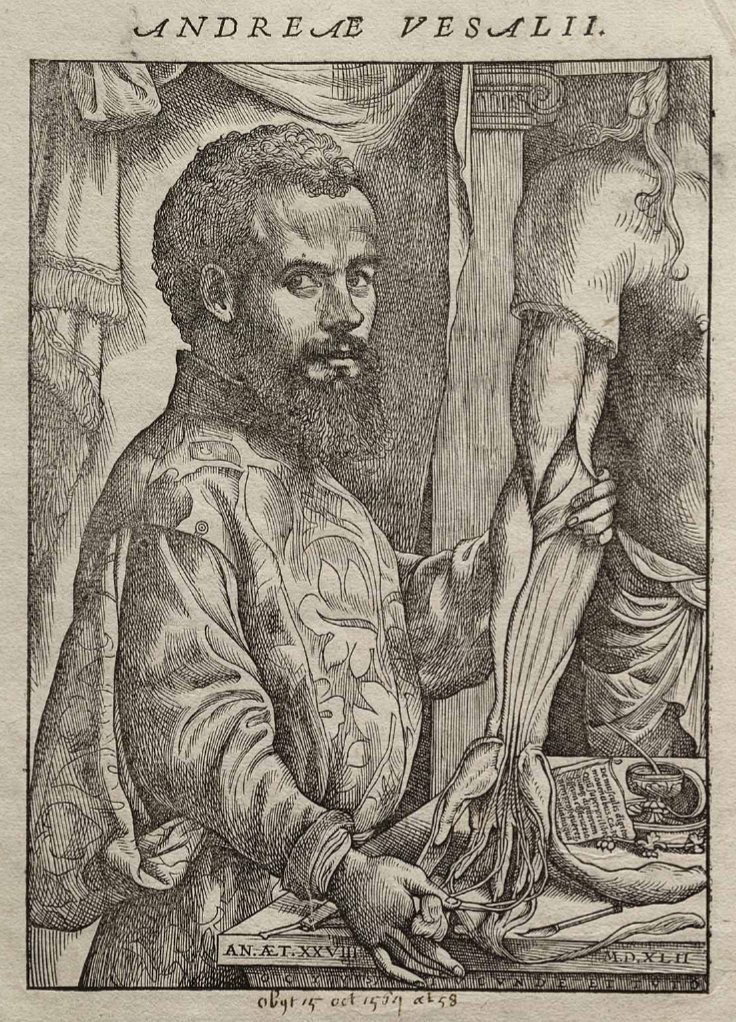
Tulp knew it. Every anatomist did. He is often described as wanting to be seen as Vesalius’s heir, and the painting makes the claim visual: the same arm, the same muscles, the same lifted hand, a hundred years later in Amsterdam. The giant book at the lower right, number twelve, may be the Fabrica itself; some historians think it is a more recent anatomy published in 1627. Either way it is there as a credential.
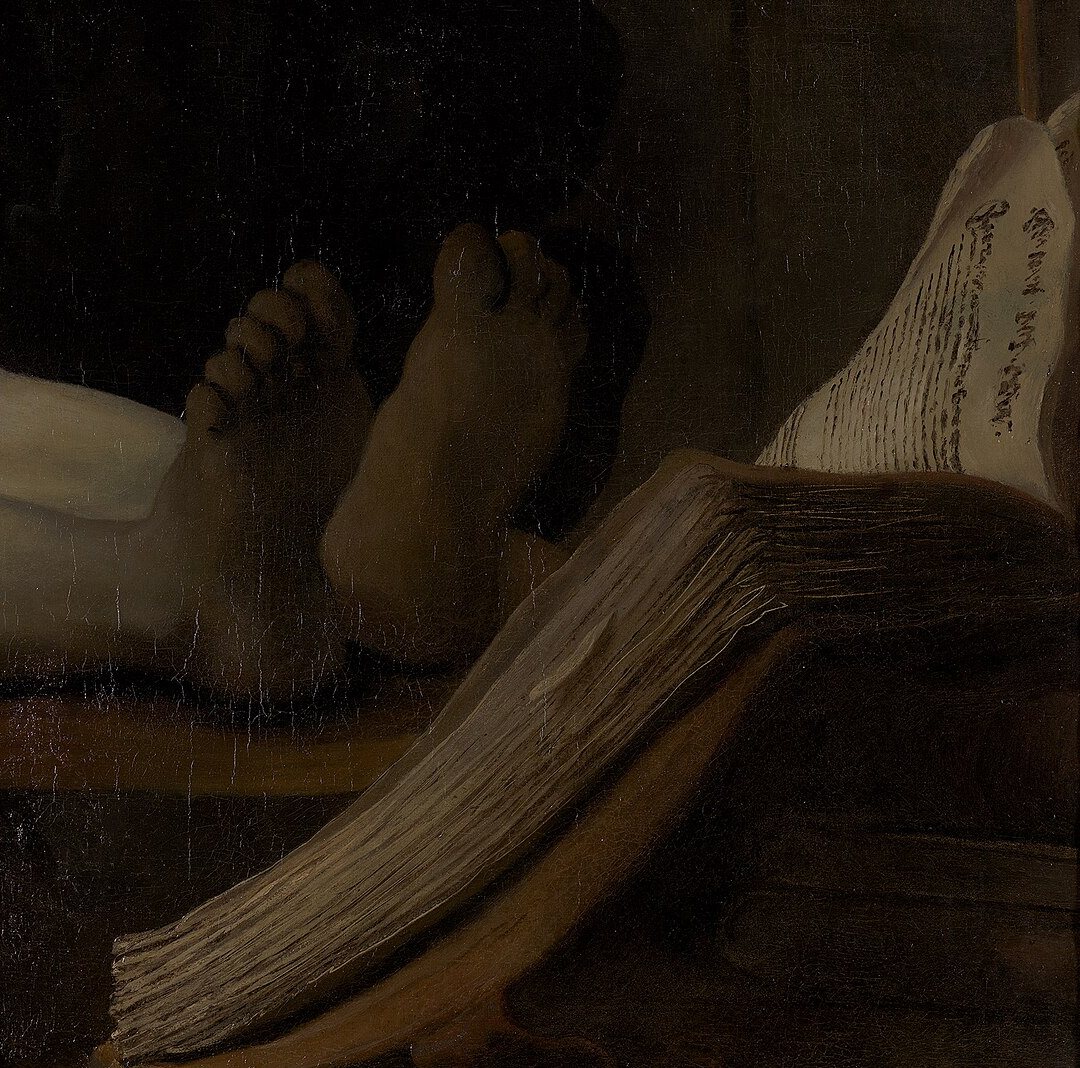
So the painting holds three arms: the real one on the table, the drawn one on Hartmansz’s paper, and the printed ones inside the book. Rembrandt built the whole picture around a single forearm.
From the guild room to the Mauritshuis
The surgeons hung the painting in their guild room in the Waag, the old city gate on Amsterdam’s Nieuwmarkt that the guild shared with other trades. It stayed with the guild and then with the surgeons’ widows’ fund for almost two centuries. In 1828 the fund put it up for sale. King William I blocked the auction, and the Dutch state bought it for 32,000 guilders and sent it to his new royal picture gallery in The Hague. It has been there ever since.
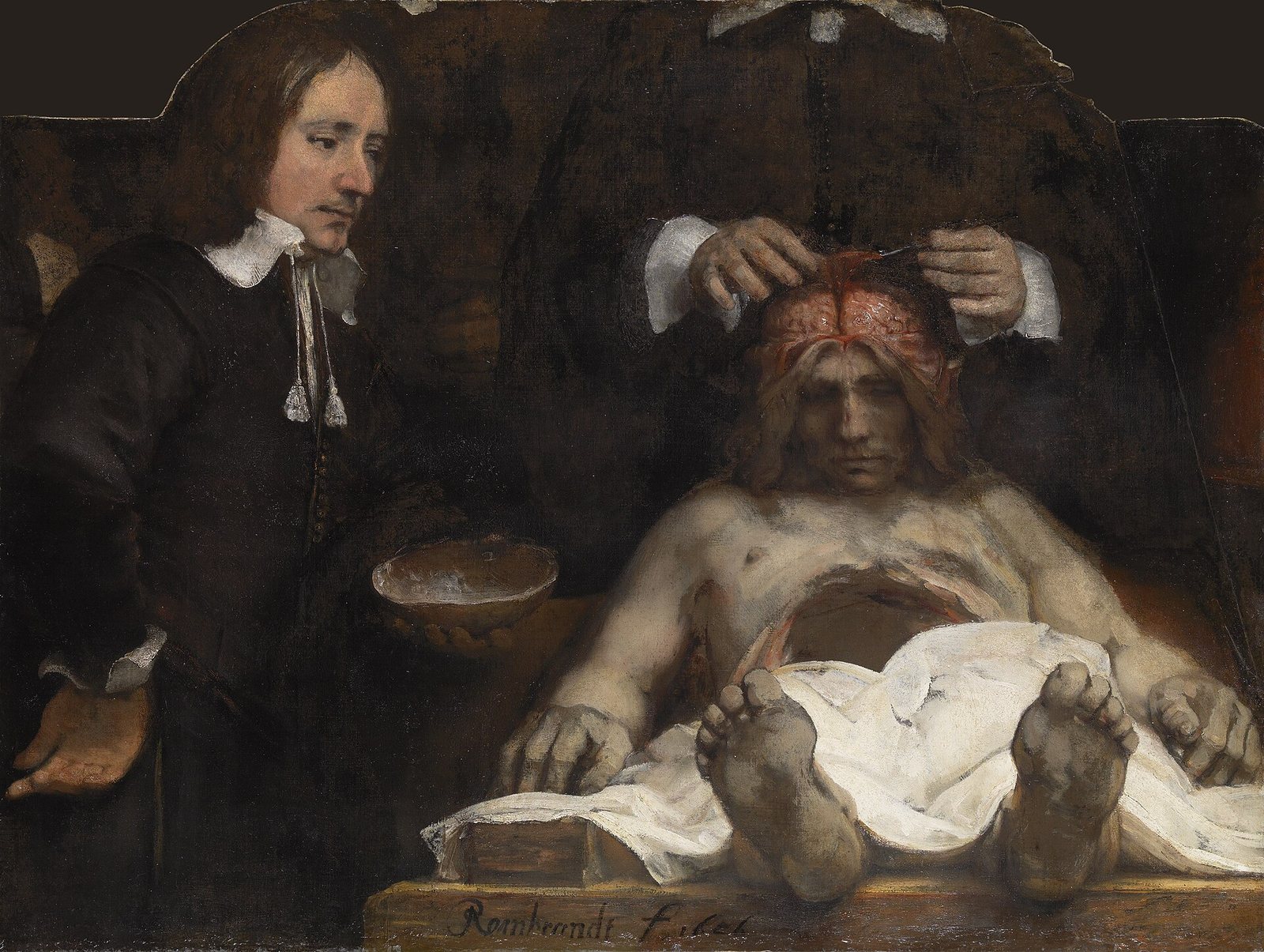
Rembrandt painted one more anatomy lesson for the same guild, in 1656, of Tulp’s successor, Dr Jan Deijman, opening the skull of an executed tailor named Joris Fonteijn. That picture was badly burned in a fire in the guild room in 1723. Only a central fragment survives, in the collection of the Amsterdam Museum.
Anatomy Lesson FAQ
Who are the people in The Anatomy Lesson of Dr Nicolaes Tulp?
Dr Nicolaes Tulp, the lecturer, and seven Amsterdam surgeons: Jacob Block, Hartman Hartmansz, Adriaen Slabbraen, Jacob de Witt, Mathijs Kalkoen, Jacob Koolvelt and Frans van Loenen. The corpse is Aris Kindt, a thief hanged in January 1632.
Where is The Anatomy Lesson by Rembrandt?
In the Mauritshuis, the royal picture gallery on the Plein in The Hague, next to the Dutch parliament buildings. At the time of writing the museum lists it in Room 9.
How big is The Anatomy Lesson of Dr Tulp?
The canvas measures 169.5 by 216.5 centimeters, about five and a half feet high and seven feet wide. The figures are close to life size.
How old was Rembrandt when he painted The Anatomy Lesson?
He was twenty-five when the dissection took place in January 1632 and turned twenty-six that July, so both ages appear in books. It was his first group portrait and his first major Amsterdam commission.
Is the anatomy in the painting accurate?
Mostly, but not entirely. The finger flexors appear to start on the wrong side of the elbow, and a 2006 dissection by Dutch surgeons found other discrepancies, though some specialists argue Tulp has simply detached the muscle to lift it.
What does The Anatomy Lesson mean?
It is a group portrait first and a science lesson second. It presents Tulp as a new Vesalius and the surgeons as men of learning, and it quietly reminds you, in the shadow on the dead man’s face, who paid the real price for the lesson.
What to look for, and where to see it
The Mauritshuis is at Plein 29 in The Hague, about a five-minute walk from Den Haag Centraal station. It is open daily from 10 a.m. to 6 p.m., and from 1 p.m. on Mondays. A standard ticket is 21 euros, visitors under nineteen go free, and since January 2026 the museum has offered four-euro admission in the last two hours of the day. Hours and prices change, so check the museum’s site before you go.
The room is small, so you can stand close. Give it three looks.
First, from the doorway, find the light. It falls from the upper left onto the surgeons’ faces, the white ruffs and the body, and leaves Tulp in his black clothes half in shadow. The brightest thing in the painting is the corpse.
Second, step in and follow the eyes. De Witt at the arm, Kalkoen at the hand, Slabbraen at the book, van Loenen and Hartmansz at you. Then look at Tulp’s left hand and imagine the fingers on the table curling to match. With Chiaro playing at this distance, the story of the stump under the painted hand comes while your eyes are still on the sheet, which is the only way to make sense of a change you cannot see.
Third, look up and to the left. Find the faint shadow where van Loenen’s hat used to be, and above it the signature with the missing d.
The stop on our Mauritshuis page covers the painting in a few minutes. If you like reading crowded pictures this way, Rembrandt’s Night Watch uses the same paying-sitter arithmetic ten years later, on a much bigger canvas. For another painter who studied dead bodies to paint them, see Géricault’s Raft of the Medusa, built partly from limbs he brought home from a hospital morgue. And the whole series of paintings decoded figure by figure is collected in Famous Paintings, Every Figure Identified.
Eight men paid to be remembered in this picture, and the guild later wrote their names on a sheet of paper so nobody would forget. The paper went back to being a drawing of an arm. The name most visitors leave with is the one that was never on it: Aris Kindt, the thief on the table, with his face in shadow and a hand Rembrandt gave back to him.