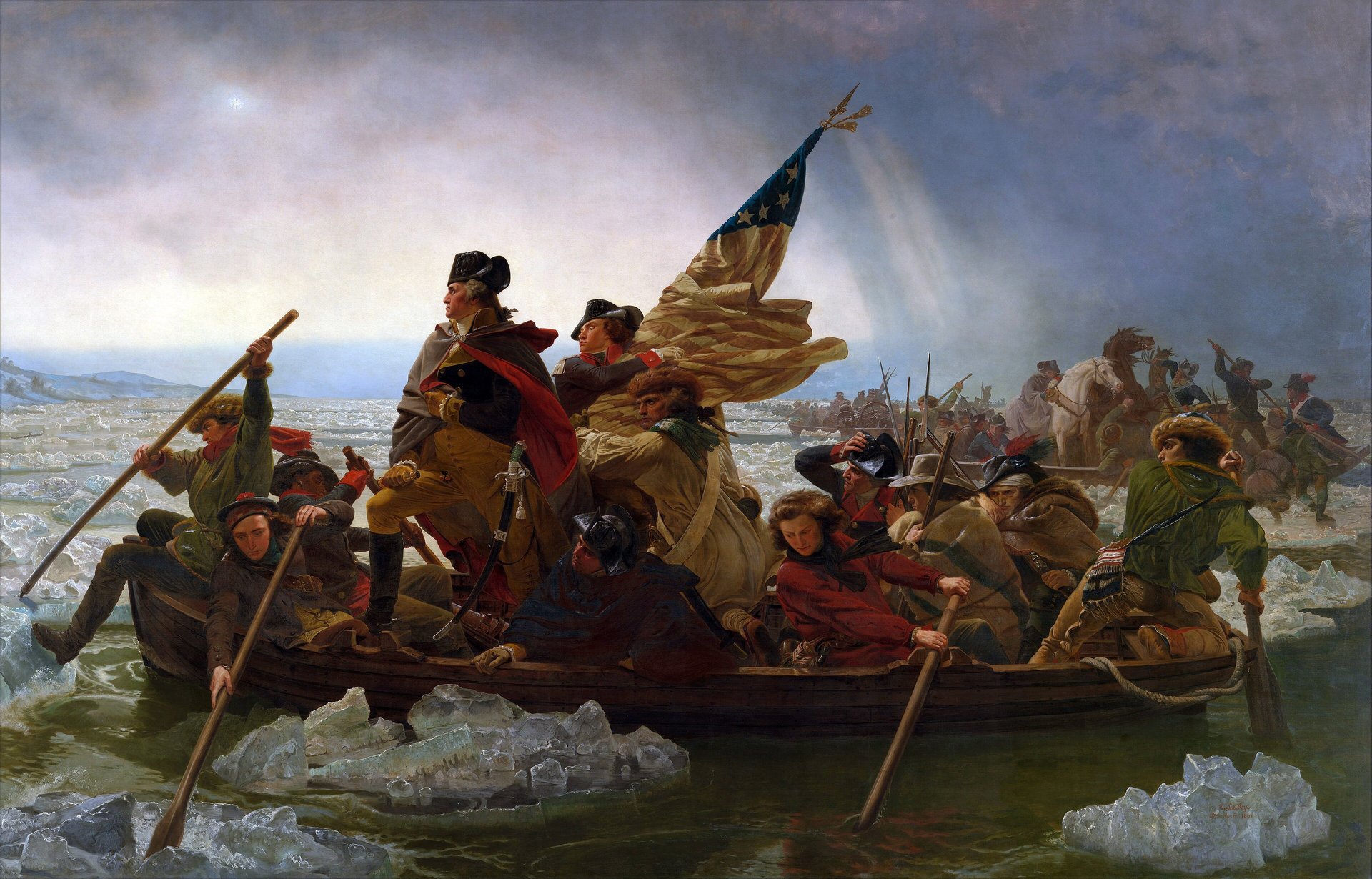
Sometime in 1850, in a studio in Düsseldorf, a young American painter named Worthington Whittredge put on a borrowed general’s uniform and climbed onto a box. He stood there with one knee bent and his chin up while his friend Emanuel Leutze painted him. Then, the story goes, he changed clothes and posed again, this time as the man steering the boat. The most American picture ever painted was made in Germany, on the banks of the Rhine, by a German-born artist using whatever Americans happened to be in town.
Washington Crossing the Delaware is the painting your history textbook used for the American Revolution, the one parodied in a thousand cartoons. It is also enormous. The canvas at the Metropolitan Museum of Art is about twelve and a half feet high and more than twenty-one feet wide, and almost nobody who has seen it in a book could tell you who is in the boat besides the general. There are about a dozen people on board, and nearly every one was chosen to make an argument.
Washington Crossing the Delaware, the boat at a glance
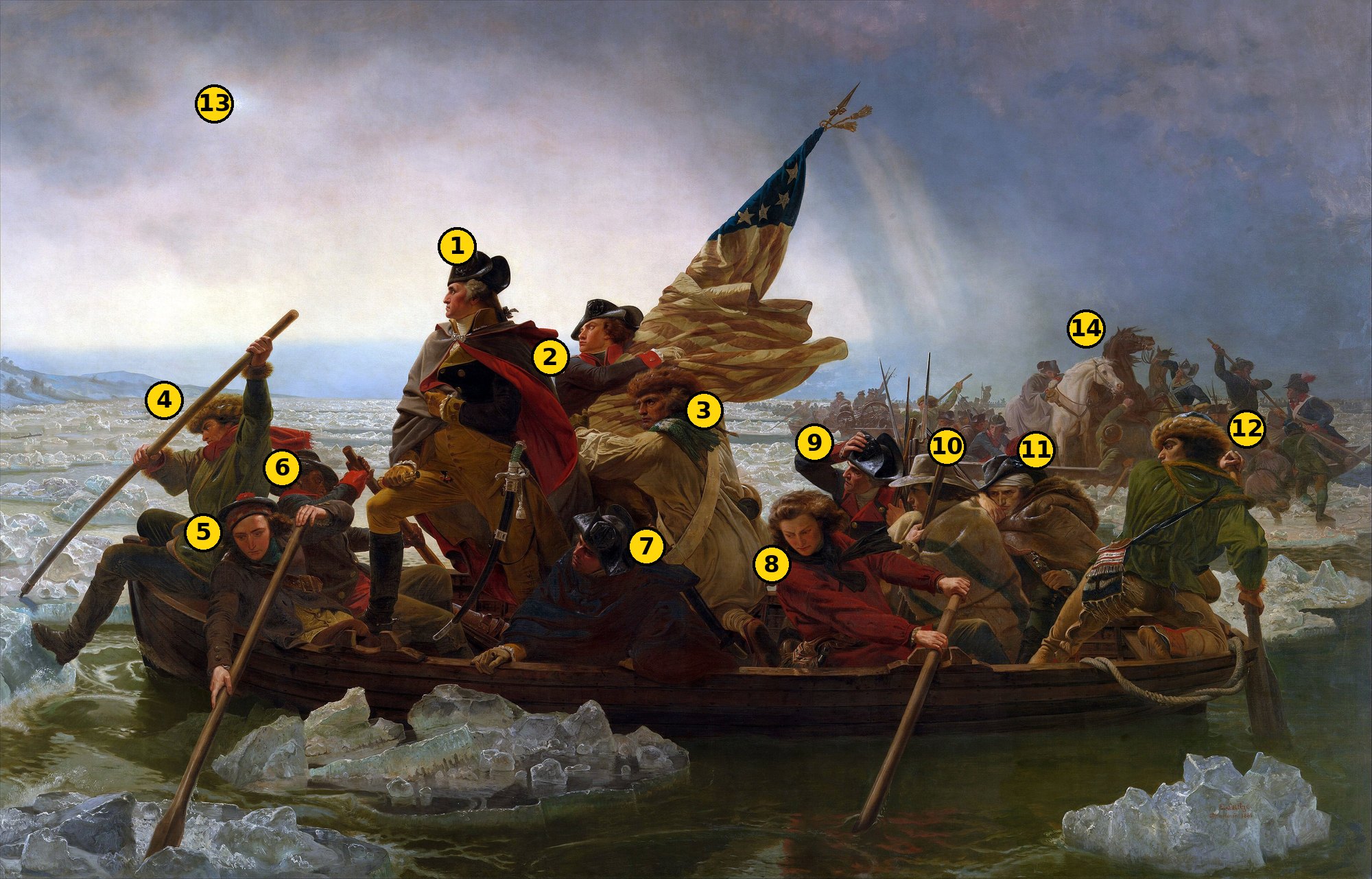
The numbers on the image match this key. Only two people in the boat have names attached with any confidence, and even those come from tradition and an early exhibition catalogue rather than anything Leutze wrote on the canvas. The descriptions of the others follow the historian David Hackett Fischer, whose book Washington’s Crossing reads the boat figure by figure.
| # | Figure | Who it is | Where to find him |
|---|---|---|---|
| 1 | The general | George Washington, aged forty-four | Standing at the center, one knee raised, in a dark cloak lined with red |
| 2 | The flag bearer | Lieutenant James Monroe, the future fifth president | Just behind Washington, gripping the flagstaff |
| 3 | The man at the flagstaff | Unnamed; a frontiersman in a fur cap and hunting shirt | Below the flag, helping hold it against the wind |
| 4 | The bow rifleman | Unnamed; a western rifleman | Far left, poling the boat off the ice |
| 5 | The Scot | Unnamed; a recent immigrant in a Balmoral bonnet | Front, rowing, in a blue cap with a red bobble |
| 6 | The Black oarsman | Unnamed; often linked, without evidence, to Prince Whipple | Next to the Scot, in a seaman’s jacket and broad hat |
| 7 | The man in the helmet | Not identified | Below Washington, in a dark cloak and leather helmet |
| 8 | The rower in red | Not identified; possibly a woman | Center right, pulling an oar, long hair blowing |
| 9 | The officer holding his hat | Not identified with certainty | Behind the rower in red, a grey-haired man in a red-faced coat |
| 10 | The farmer | Unnamed; a Pennsylvania or New Jersey farmer | Broad-brimmed hat, blanket coat, a gun upright |
| 11 | The wounded man | Unnamed | Head bound in a bandage, wrapped in a fur-trimmed cloak |
| 12 | The steersman | Unnamed; posed, by tradition, by Worthington Whittredge | Stern, in a green hunting shirt, fur cap and beaded pouch |
| 13 | The star | The morning star, or a symbol of one | Upper left, breaking through the clouds |
| 14 | The rest of the army | Boats, horses and artillery | Right background, following across the river |
The general who should be sitting down
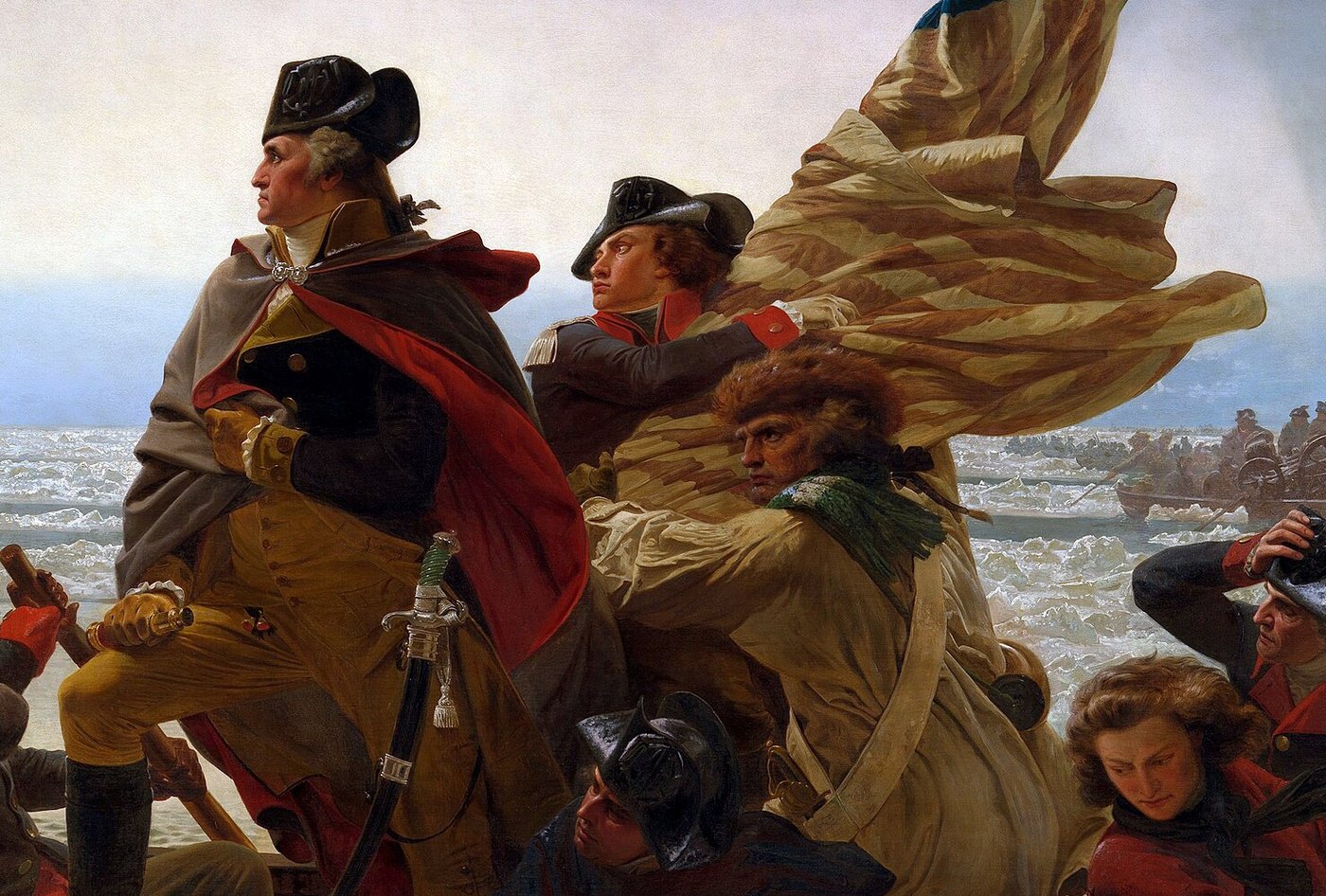
Start with number one, because Leutze built the whole picture to point at him. George Washington stands a little forward of the middle of the boat, his left knee raised on a thwart, his right hand resting on the hilt of his sword, his face catching the only clear patch of light in the sky. He is forty-four. A week before Christmas of 1776, he had written to his brother that he thought “the game is pretty near up.” His army had been chased out of New York and across New Jersey, and most enlistments ran out on the last day of the year.
What happened was the crossing. On the night of December 25, 1776, about twenty-four hundred men gathered at McConkey’s Ferry on the Pennsylvania side of the Delaware and went over in a storm of snow and sleet. They landed hours behind schedule, marched nine miles in the dark, and at about eight in the morning hit the Hessian garrison at Trenton. Roughly nine hundred Hessians were taken prisoner. It was a small battle with a very large effect.
Now the problem. A man standing like that in a small rowboat on an icy river would go over the side. The defense, which Fischer makes, is that the real boats were not little rowboats at all. They were Durham boats, long, flat-bottomed cargo boats built to haul iron ore, with high sides and a beam of about eight feet. In boats like that, with freezing water sloshing in the bottom, standing up was the sensible thing to do. So the pose is less absurd than it looks. The boat around it is the fiction.
James Monroe and the flag that didn’t exist yet
Behind Washington, gripping a staff in both hands, is number two. An early exhibition catalogue identified him as Lieutenant James Monroe, and the name stuck. In December 1776 Monroe was eighteen, an officer in the Third Virginia Regiment, and he really was at Trenton. He crossed with an advance party under Captain William Washington, a distant cousin of the general, and during the attack he was shot in the shoulder. A musket ball cut an artery, and he nearly bled to death. Forty years later he was president. He was not, as far as anyone knows, in the general’s boat.
The flag he holds is the painting’s most famous mistake. It is the Stars and Stripes, with thirteen stars in a circle on a blue field. That design did not exist on Christmas night of 1776. The Continental Congress only adopted a flag of thirteen stripes and thirteen stars on June 14, 1777, six months later.
Leutze wanted the flag anyway. It is the biggest single shape in the painting, and it is not flying straight. It is twisted, half furled, still being raised. The nation is being put up in a gale, and it is not finished.
Number three, the man below the flag in a fur cap and a pale hunting shirt, is helping Monroe hold it steady. He has no name. His job is to tie the flag to the men doing the rowing.
The Scot and the oarsman at the bow
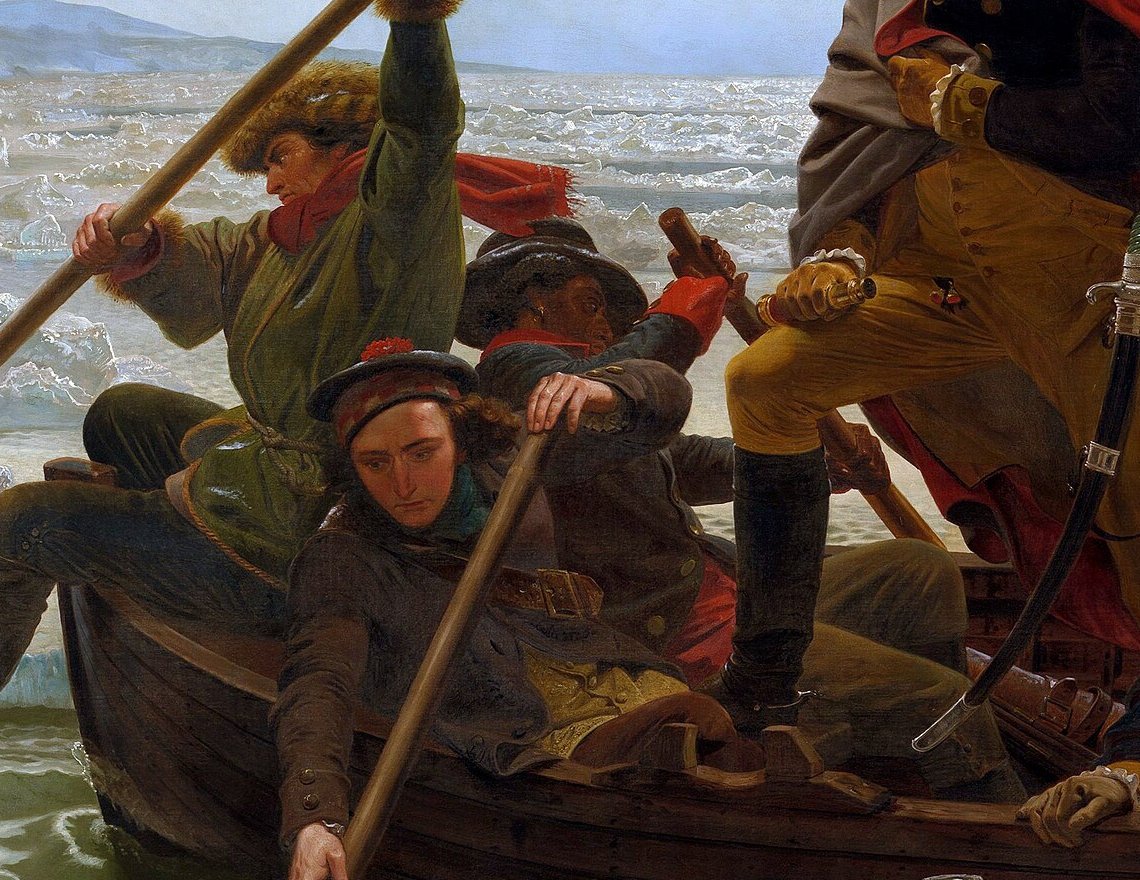
Number four is at the very bow, braced with one foot over the side, ramming a pole into the ice. He wears a fur cap and a long green coat. Fischer calls the men at the bow and stern “hard-faced western riflemen,” the backcountry hunters who were the army’s sharpshooters.
Number five is the young man rowing in the front, in a blue cap with a red bobble on top. That is a Scottish bonnet, and Fischer reads him as a recent Scottish immigrant. Leutze, born in Schwäbisch Gmünd in 1816 and brought to America as a child, was an immigrant himself, and he puts a newcomer at the front of the national boat.
Number six sits beside the Scot, leaning into his oar, and he is the figure people ask about most. He wears a broad hat and what Fischer describes as the short tarpaulin jacket of a New England seaman. He is Black. Fischer is direct about it: the presence of an African American in the boat was not an accident, because Leutze was a strong abolitionist.
For more than a century, this man has been called Prince Whipple. Prince Whipple was real. He was an enslaved man from New Hampshire, held by William Whipple, a signer of the Declaration of Independence, and he did serve in the war and was freed. The idea that he crossed with Washington goes back to the abolitionist writer William Cooper Nell, who published it in 1852, a year after the painting was finished. There is no sign that Leutze had ever heard of Prince Whipple, and William Whipple, his enslaver, was in Baltimore with the Continental Congress that December, not on the Delaware. Fischer concludes that all the evidence says Prince Whipple was not in the boat.
What the evidence does support is better than the legend. Fischer argues that the man’s dress marks him as one of John Glover’s Marblehead men, the Massachusetts regiment of fishermen and sailors who rowed the army across that night. Glover’s regiment was racially mixed, with Black and white seamen serving together. So the man in the tarpaulin jacket is something more accurate than a legend: one of the anonymous sailors without whom nobody would have reached New Jersey.
The rower in red, and the people Leutze put in the middle
Number seven sits just below Washington, half hidden in a dark cloak, wearing a black leather helmet with a crest. He has never been convincingly identified. The helmet looks like a cavalryman’s cap, and that may be all Leutze meant: one more kind of soldier.
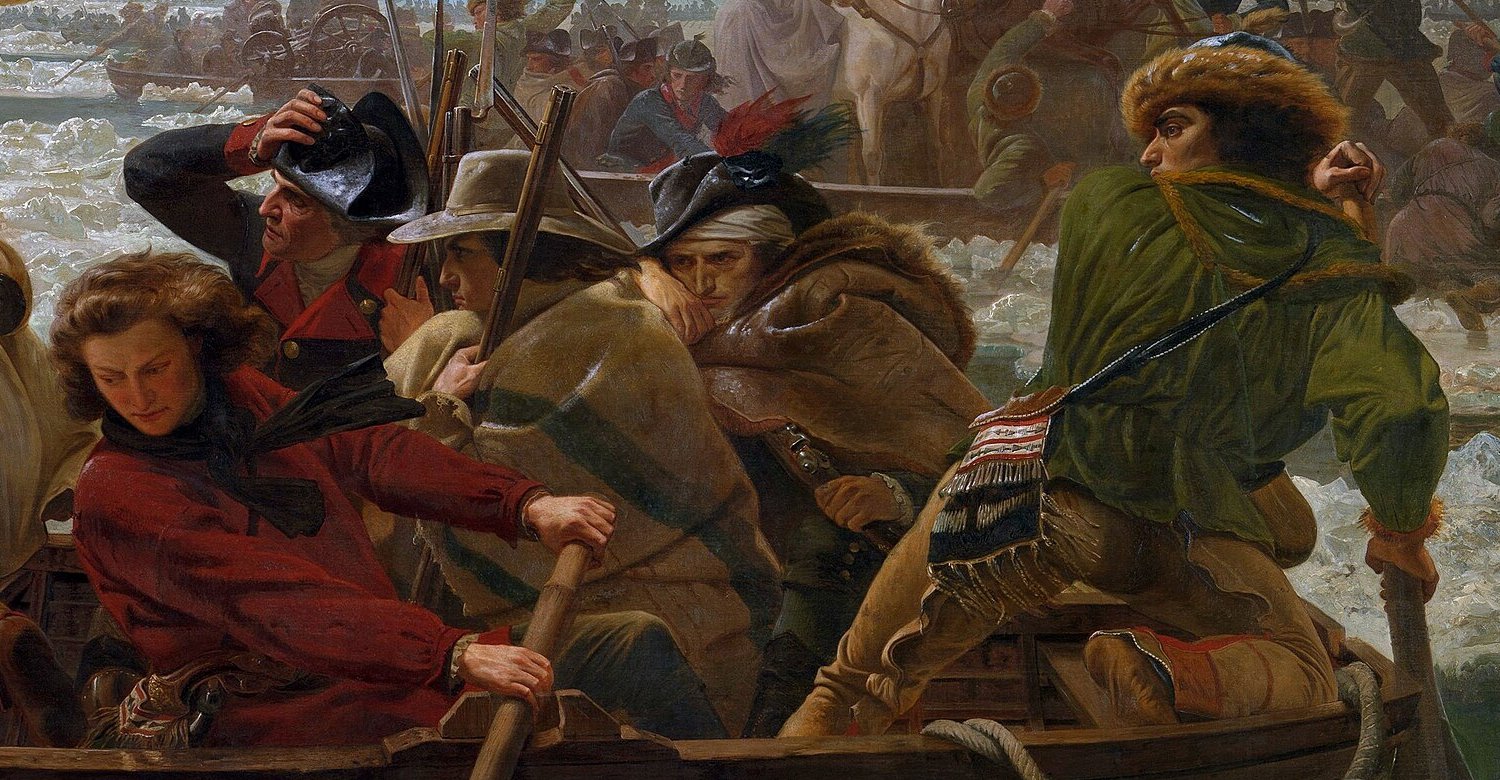
Number eight is the strangest figure on board. In the middle of the boat, pulling hard on an oar, is someone in a loose red coat, with long brown hair blowing across a smooth, downturned face. Fischer calls this “an androgynous figure,” and adds that it may be a woman in men’s clothing. Leutze left no key. What we know is that women did follow and serve the Continental Army, and that some historians point to women on its ration lists. Leutze may have meant a very young man, or exactly the ambiguity you feel looking at the face.
Behind the rower in red, number nine is a grey-haired man in a coat with red facings, gripping his black hat against the wind. He looks like an officer. Some accounts, citing an exhibition catalogue from 1853, say the painting includes General Nathanael Greene leaning over the side and Colonel Edward Hand seated and holding his hat. If that catalogue is right, this may be Hand. It is a reasonable reading, not a certain one.
Numbers ten and eleven are Fischer’s farmers from Pennsylvania and New Jersey, in blanket coats and broad-brimmed hats. One holds a gun upright, which Fischer identifies as a countryman’s double-barreled shotgun. The other, deeper in the shadow, has his head wrapped in a bandage under his hat and looks, in Fischer’s words, very ill. These are the militia, men who came from their farms for a few weeks at a time. Nobody in this part of the boat is posing.
Number twelve is the steersman at the stern, the last figure you reach. He wears a fur cap, a green hunting shirt, leggings, and a fringed and beaded pouch on a strap across his body. Some writers read his dress as Native American. Fischer reads him as the second of the two western riflemen, one at each end of the boat. By most accounts, including Whittredge’s own recollections, this was his second turn as a model: the man who posed as Washington also posed as the man keeping the general’s boat on course.
Add it up and the boat is a sampler of the country Leutze wanted his viewers to see: a Virginia planter, a teenage officer, frontiersmen, a Scot, a Black sailor from New England, farmers, a wounded man, and a figure who might be a woman. Fischer sums up the idea in a phrase: they were all in the same boat.
The wrong river, the wrong hour, the wrong ice
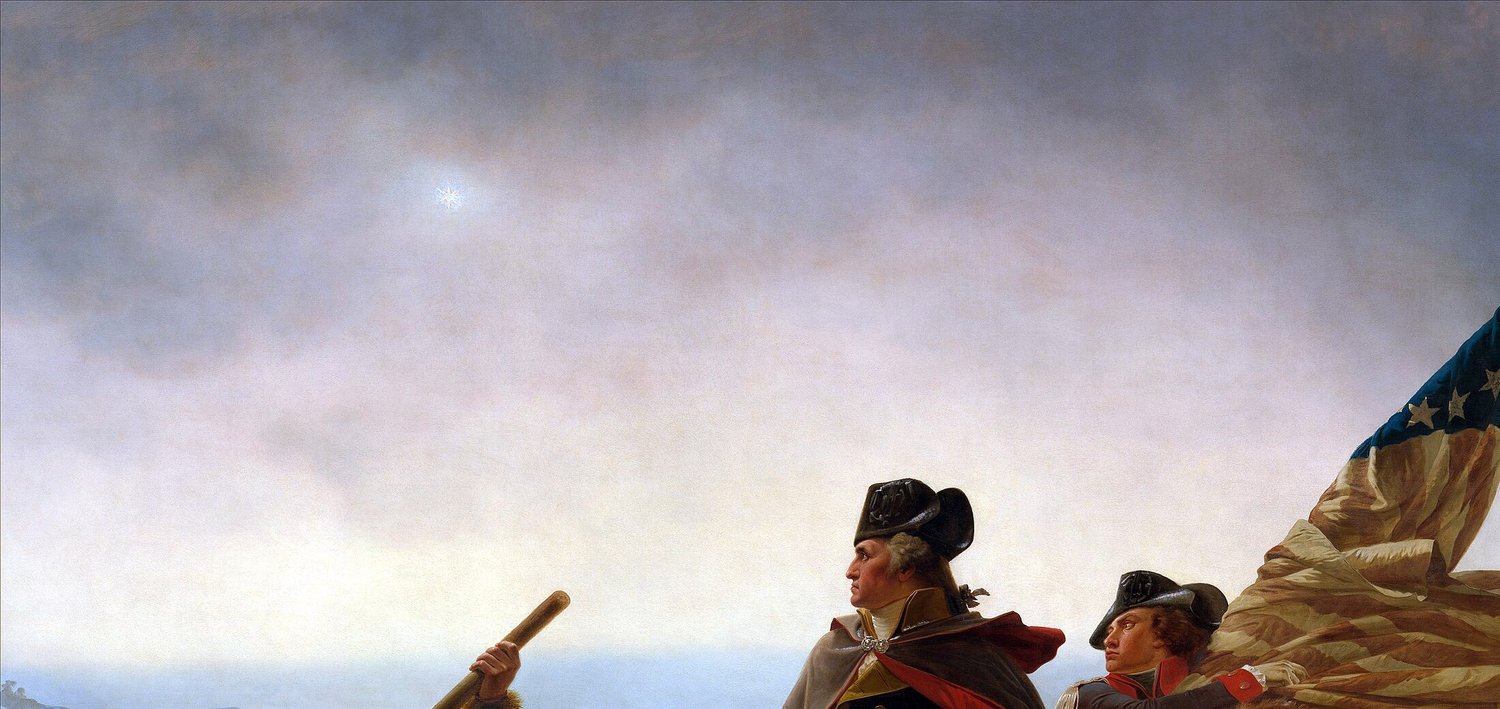
The famous errors in the Washington Crossing the Delaware painting are worth listing, because each one turns out to be a choice.
The time is wrong. The crossing happened in the dark, from early evening until about three in the morning, in a storm. Leutze paints first light, with a clearing sky over the far shore. Up in the left corner, at number thirteen, there is a single bright star breaking through the clouds. Fischer calls it a “prophetic star.” This is dawn as a promise, not as a time of day.
The river is wrong. Leutze painted in Düsseldorf, and the broad river with the low hills behind it looks a lot more like the Rhine than the narrow Delaware at McConkey’s Ferry. The ice is wrong too, or at least overdone. Critics have said that real river ice would have been worn smooth by the current, not stacked in glassy blocks like the ones in the foreground. Those glassy blocks are there to show you how hard this was.
Behind the general’s boat, at number fourteen, other boats carry men, rearing horses and cannon. The real crossing took eighteen field guns and their horses over the river. That part, at least, is true.
Here is why the errors don’t sink the picture. Leutze conceived it after the revolutions of 1848 failed across Germany, and he wanted to show European liberals what a successful revolution had looked like: desperate, improvised, made by ordinary people in terrible weather. Fischer’s verdict is that the critics were right about some details, but the larger ideas in the painting are true to the history.
Painted twice: the Bremen fire and the copy that crossed the Atlantic
The picture at the Met is not the first version. Leutze finished a full-size canvas in 1850, and on November 5, 1850, a fire in his studio damaged it. The damaged painting was repaired and eventually went to the Kunsthalle in Bremen, in northern Germany. It was destroyed during the Second World War, when Allied bombing hit the city. Most accounts date its loss to a raid in 1942.
Before that canvas was even repaired, Leutze began a second, full-size replica with his assistants. Whittredge later remembered painting large stretches of the sky in an all-night session. That second version is the one in New York. In October 1851 it went on show on Broadway, at the Stuyvesant Institute, and more than fifty thousand people came to see it. The businessman Marshall O. Roberts bought it for ten thousand dollars, an extraordinary price for an American painting then. In 1897 John Stewart Kennedy gave it to the Met.
There is also a much smaller version, made in Leutze’s studio as the model for an engraving, apparently with the help of a young Eastman Johnson. It hung in the West Wing of the White House for years, went to the Minnesota Marine Art Museum in Winona, and in May 2022 it sold at Christie’s for forty-five million dollars.
The frame with an eagle on top
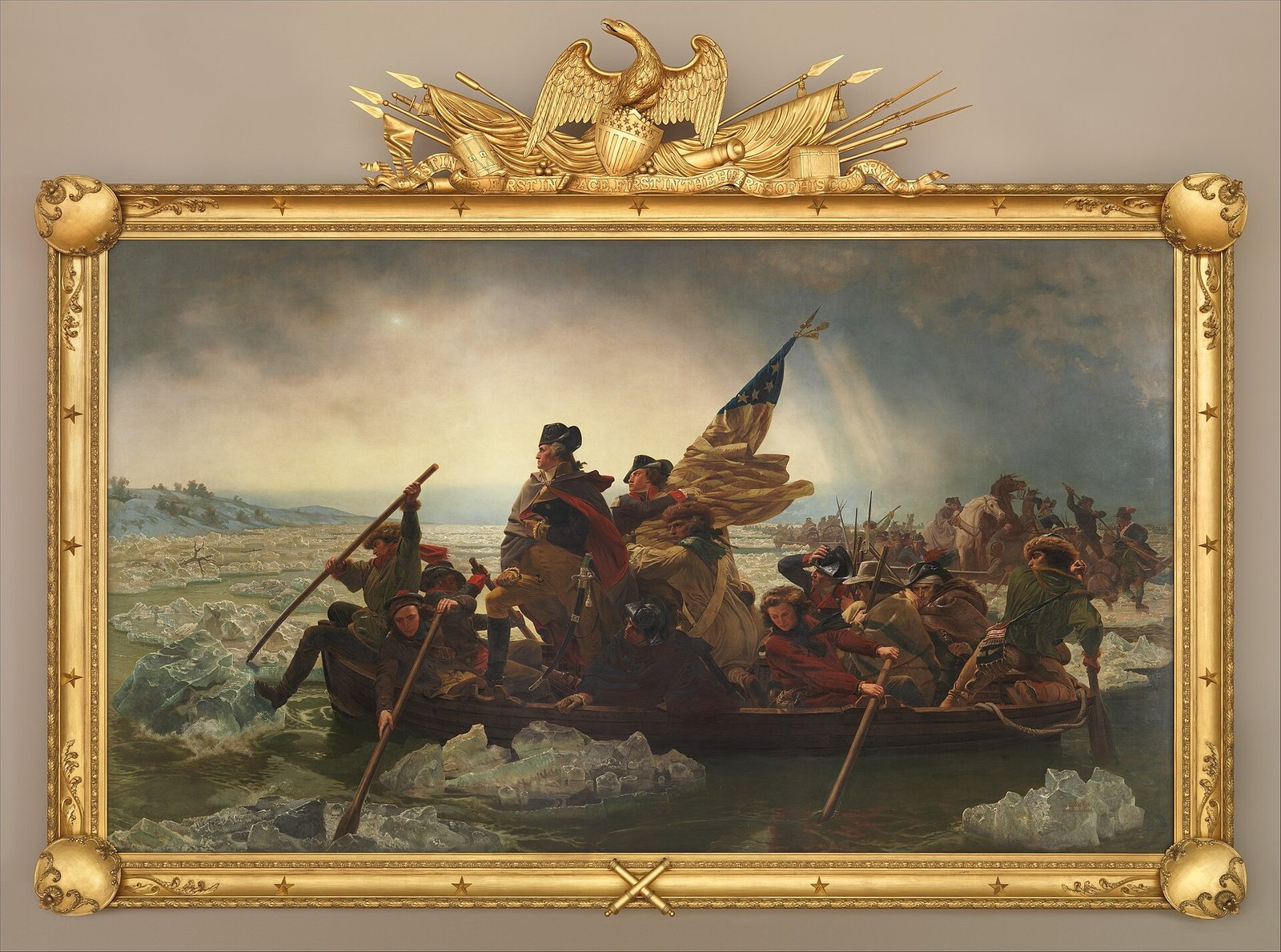
For most of the twentieth century the painting hung in a plain frame. Then, in 2007, the Met curator Carrie Rebora Barratt was looking through an album at the New-York Historical Society and found a photograph by Mathew Brady from 1864. It showed the painting at a New York fair for Union soldiers, in a gilded frame topped by a carved eagle.
The Met had the frame remade from that photograph by Eli Wilner and Company. The carved crest alone is about fourteen feet wide: an eagle with spread wings over flags, pikes, a drum and a shield, with a ribbon quoting Henry Lee’s eulogy for Washington, first in war, first in peace, and first in the hearts of his countrymen. The painting and its new frame went back on view when the Met’s renovated American Wing galleries reopened in January 2012.
Washington Crossing the Delaware FAQ
Who is in the boat in Washington Crossing the Delaware?
George Washington and about a dozen others. Tradition names the young officer with the flag as James Monroe. The rest are types rather than portraits: riflemen, farmers, a Scottish immigrant, a Black seaman, and a rower in red who may be a woman.
Where is Washington Crossing the Delaware?
The painting is at the Metropolitan Museum of Art in New York, in the American Wing, Gallery 760. The museum has owned it since 1897.
How big is the Washington Crossing the Delaware painting?
It is 149 by 255 inches, or 378.5 by 647.7 centimeters. That is about twelve and a half feet high and twenty-one feet wide, before the frame.
Is the Black man in the boat Prince Whipple?
Probably not. The Whipple story was first published in 1852, after the painting was finished, and the historian David Hackett Fischer concluded that Prince Whipple was not at the crossing. The figure is more likely meant as one of John Glover’s Marblehead sailors, a regiment that included Black seamen.
What is historically wrong with Washington Crossing the Delaware?
The Stars and Stripes was not adopted until June 1777, the crossing happened at night in a storm, the real boats were large Durham boats, and the river looks like the Rhine. Most of these were deliberate choices, not ignorance.
What to look for at the Met
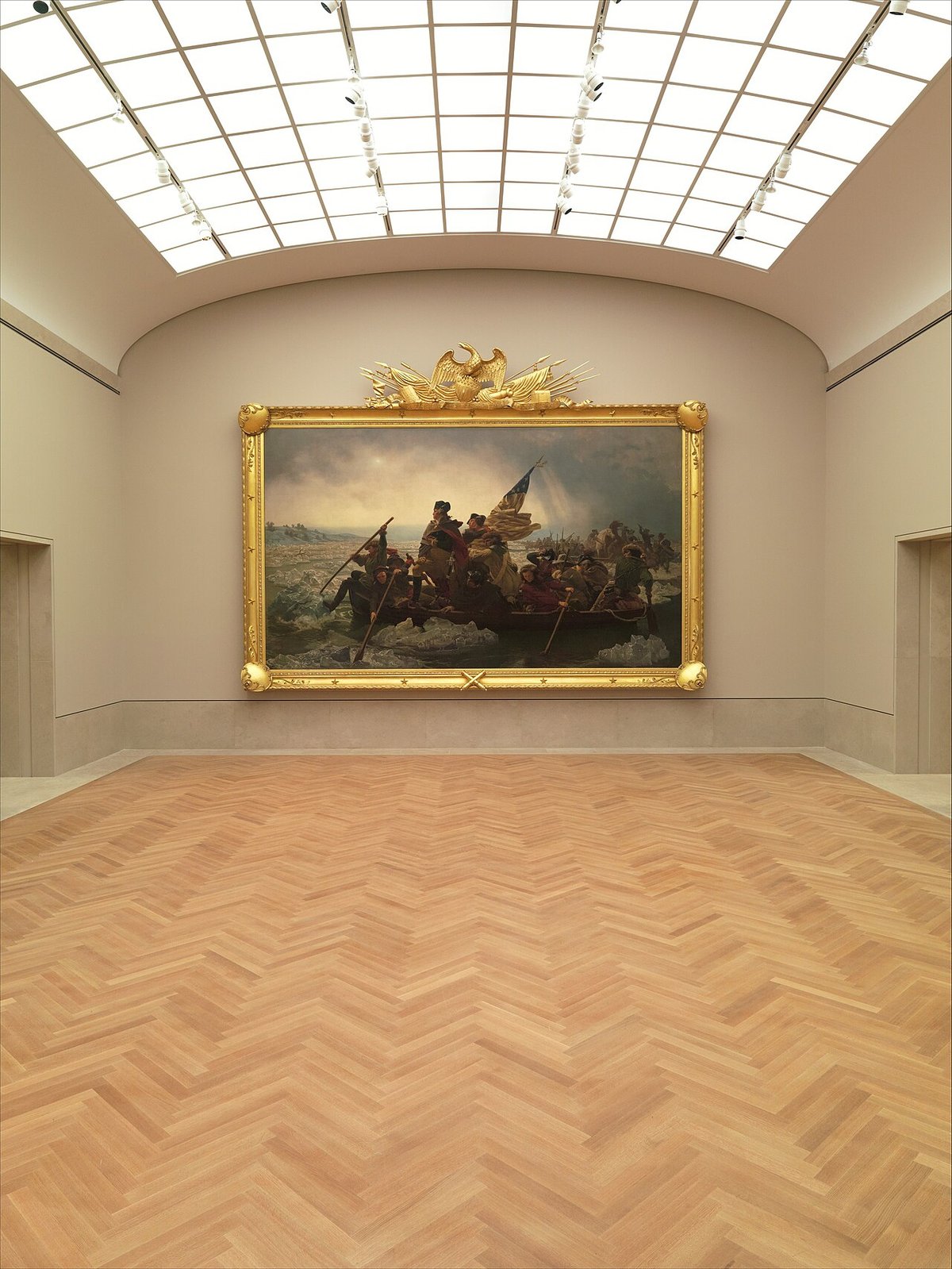
Washington Crossing the Delaware hangs in Gallery 760 of the American Wing, on the second floor of the Met’s Fifth Avenue building. The Met is closed on Wednesdays and open late on Fridays and Saturdays, but hours and ticket prices change, so check the museum’s site before you go. The gallery is long enough to do what you can’t do with a reproduction: walk toward it.
Start at the far end of the room. From there you see the flag, the general, the light breaking over his head, and nothing else.
Then walk forward slowly and let the boat break apart into people. Find the Scot’s red bobble. Find the Black oarsman’s hand on his oar. Find the face of the rower in red. At this distance, with Chiaro running, the story of Glover’s Marblehead sailors plays while you are looking straight at the man in the tarpaulin jacket, and the anonymous figure becomes the one who got everyone across.
Last, go right up to the ice. Look at the blocks in the foreground, glassy and green. Then look up to the left for the star. Leutze put the hard part and the hope in opposite corners.
If you like reading a crowded picture person by person, the same approach works for Delacroix’s Liberty Leading the People, another revolution painted as a cross-section of a nation, and for Rembrandt’s Night Watch, where the men who paid got the best spots. David’s Coronation of Napoleon shows what happens when a painter puts people into a historic moment they never attended. The full series is collected in Famous Paintings, Every Figure Identified. And the Met’s own page on our site has Leutze’s painting as an audio stop, along with the rest of the museum.
Whittredge, the friend on the box, became a well-known landscape painter in his own right and lived until 1910. For the rest of his life he could say something nobody else could: he had been both George Washington and the man at the back of the boat steering him. Look at the boat one last time. The general is the only man in it with nothing to do. Everyone else, including the man who also played the general, is pulling him across.