
Photo by Jonas Jaeken on Unsplash
You walk in through the west door, and the first thing that happens is that you look up. Everyone does. The nave rises so high that the vault seems to float, and the light comes from everywhere at once. Then, after a minute, most people do a slow lap, take a photo of the rose window and leave, without knowing what they just walked through.
A Gothic cathedral is built to be read. Every part of it, from the shape of the arches to the carvings hidden under the choir seats, was put there for a reason. Here is what to look for, in the order you’ll meet it, walking from the door to the far end.
First, why it looks like this
Gothic architecture started in France in the 1140s, when Abbot Suger rebuilt the choir of the abbey church of Saint-Denis, just north of Paris, and filled it with light. Three ideas made it possible, and once you can spot them you can read any Gothic church.
The pointed arch. A round arch pushes hard sideways. A pointed one sends more of the weight down, so it can go higher, and it can span different widths at the same height.
The rib vault. Instead of a solid stone ceiling, the vault is a skeleton of stone ribs with thin panels filled in between. The ribs carry the weight down to the piers.
The flying buttress. Outside the building, arms of stone lean against the walls and take the outward push of the vault. With the push handled outside, the walls no longer have to hold the roof up. They can be glass.
That’s the whole trick. Everything you see inside follows from it.
The nave: look up, then count the levels

Photo by Greg Willson on Unsplash
The nave is the long central hall from the west door to the crossing. It’s built to make you feel small and pull your eye upward. At Amiens the vault is about 42 metres above the floor. Beauvais tried to go higher still, and its choir vault collapsed in 1284, a reminder that the builders were working at the edge of what stone could do.
Now look at the wall of the nave, from the floor up. In most Gothic cathedrals it has three levels:
- The arcade at the bottom: the big pointed arches opening onto the side aisles.
- The triforium in the middle: a narrow band of small arches, often a passage inside the wall.
- The clerestory at the top: the tall upper windows that light the nave.
Over time the clerestory gets taller and the wall thinner. Compare an early cathedral with a later one and you can watch the stone retreat and the glass take over.
The vault: follow the ribs

Photo by JOHN TOWNER on Unsplash
Stand under the middle of the nave and look straight up. The ribs spring from the tops of the piers, cross diagonally, and meet at a carved boss in the centre of each bay. Follow one rib down with your eye and you’ll see it continue as a thin shaft all the way to the floor. It’s one line from the ground to the ceiling, and it’s what makes the building look like it’s growing rather than standing.
Later Gothic vaults got more elaborate: extra ribs, star patterns, fans. If the vault over your head looks like a net or a star, you’re in a later building, or a later part of an older one.
The windows: a Bible you read from the bottom up
The glass is where the building talks. Medieval windows are made of small scenes, usually set in round or diamond-shaped frames, stacked up the height of the window. They’re generally read from the bottom up. Don’t try to read every window. Pick one near you, start at the bottom, and follow it up a few scenes.
Look at the bottom of the window too. Many have a small panel showing who paid for it: a guild of bakers or butchers or wine merchants at work, or a kneeling noble. At Chartres, dozens of windows carry these trade signatures. They’re the medieval equivalent of a donor plaque, and some of the liveliest scenes in the building.
The most extreme version of all this is the Sainte-Chapelle in Paris, where the walls are almost nothing but glass. We tell its story in the story of the stained glass in Sainte-Chapelle.
The rose windows
Most big French cathedrals have three rose windows: one in the west front, and one at each end of the transept, the arms that cross the nave to make the building a cross. Stand at the crossing, where the arms meet, and you can often see two or all three.
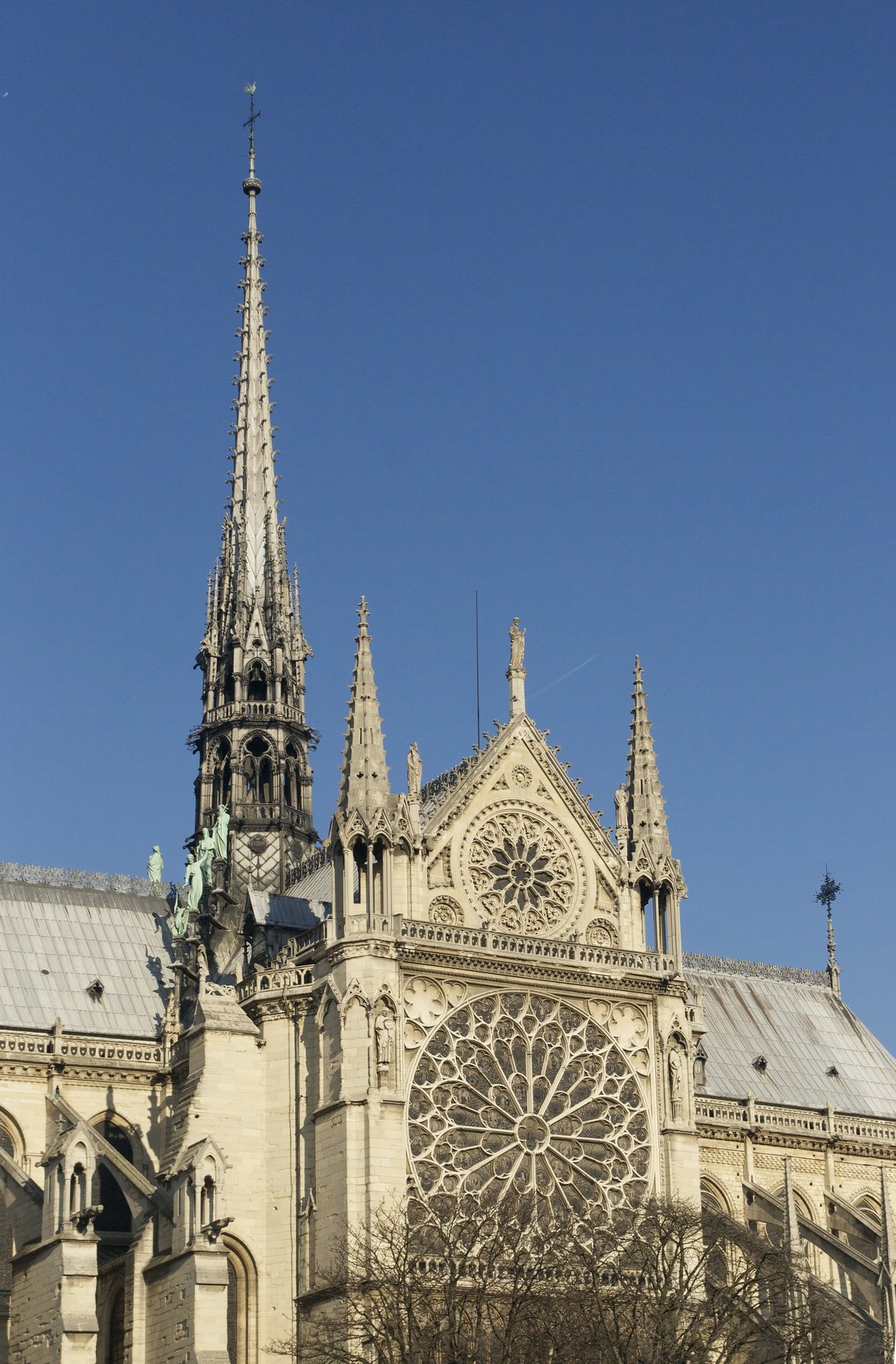
The rose windows of Notre-Dame de Paris are among the largest of the 13th century, nearly 13 metres across, and much of their glass survived both the Revolution and the 2019 fire. A rose usually has Christ or the Virgin at the centre, with prophets, apostles, saints or the signs of the zodiac arranged around them like the spokes of a wheel. Our Notre-Dame post covers what happened to the cathedral and how it was rebuilt.
The floor: look for a labyrinth
Look down at the nave floor. A few French cathedrals still have a labyrinth set into the paving. The most famous is at Chartres, from the early 13th century: a single winding path to the centre, with no dead ends. It’s often covered by chairs, so check whether it’s uncovered on the day you visit.
At Amiens, the labyrinth is octagonal, and the stone at its centre recorded the year building began, 1220, along with the names of the bishop and the three master builders. It’s a signature, in the floor, by the people who made the building.
The choir: where the clergy sat
Past the crossing is the choir, where the clergy sang the daily services. In the Middle Ages it was usually closed off from the nave by a carved stone screen, a jubé in French, so that the public in the nave could hear the services but barely see them. Most screens were taken down in the 17th and 18th centuries. Albi Cathedral, in the south of France, is one of the few French cathedrals that still has one.
Even where the screen is gone, look for the wall around the choir. At Chartres, the choir is wrapped in a stone enclosure carved over two centuries with scenes from the life of the Virgin and of Christ, almost a sculpture gallery in its own right.
Then look under the seats. If the choir stalls are open, lift your eyes to the wooden seats and look for misericords: small ledges under the hinged seats that let the clergy lean while appearing to stand through long services. The carvings on them were out of sight most of the time, and the carvers knew it. You’ll find animals, jokes, monsters, everyday life and the occasional rude scene.
The ambulatory and the chapels
Walk around the back of the choir. The aisle that curves around the east end is the ambulatory, built so that pilgrims could circulate past the relics without disturbing the services. Off it open the radiating chapels, small chapels arranged like the petals of a flower, each with its own altar, saint and, often, its own windows.
The east end, the apse, usually points east, toward the rising sun. Go in the morning and the light comes through the apse windows. Go in the evening and the sun is behind the west rose.
Then go outside

Photo by Chris Linnett on Unsplash
You’ve only seen half the building. Walk around the outside, especially along the sides and the east end, and look up at the flying buttresses, the stone arms holding the walls in place. Once you’ve seen them from outside, the glass inside makes sense: those arms are why the walls can be windows.
Look along the roofline, too, for gargoyles. Strictly speaking, a gargoyle is a waterspout, carved to throw rainwater clear of the walls. The non-spouting monsters are grotesques. The famous chimeras peering over Paris from the towers of Notre-Dame were added in the 19th-century restoration, not in the Middle Ages.
How Chiaro helps inside a cathedral
A cathedral is the place where you most need someone beside you saying “look at that”. Chiaro does that.
Point it at anything. A window, a capital, a tomb, a chapel, the whole nave. Chiaro recognizes what you’re looking at and tells you what it is, who made it and why it matters, out loud, within seconds, so your eyes stay on the building.
Ask whatever you want. “Which saint is in this window?” “Why is this chapel here?” “When was this part rebuilt?” Type or say it, and Chiaro answers out loud. When the answer depends on today, like whether the choir is open to visitors or the labyrinth is uncovered, it checks the web.
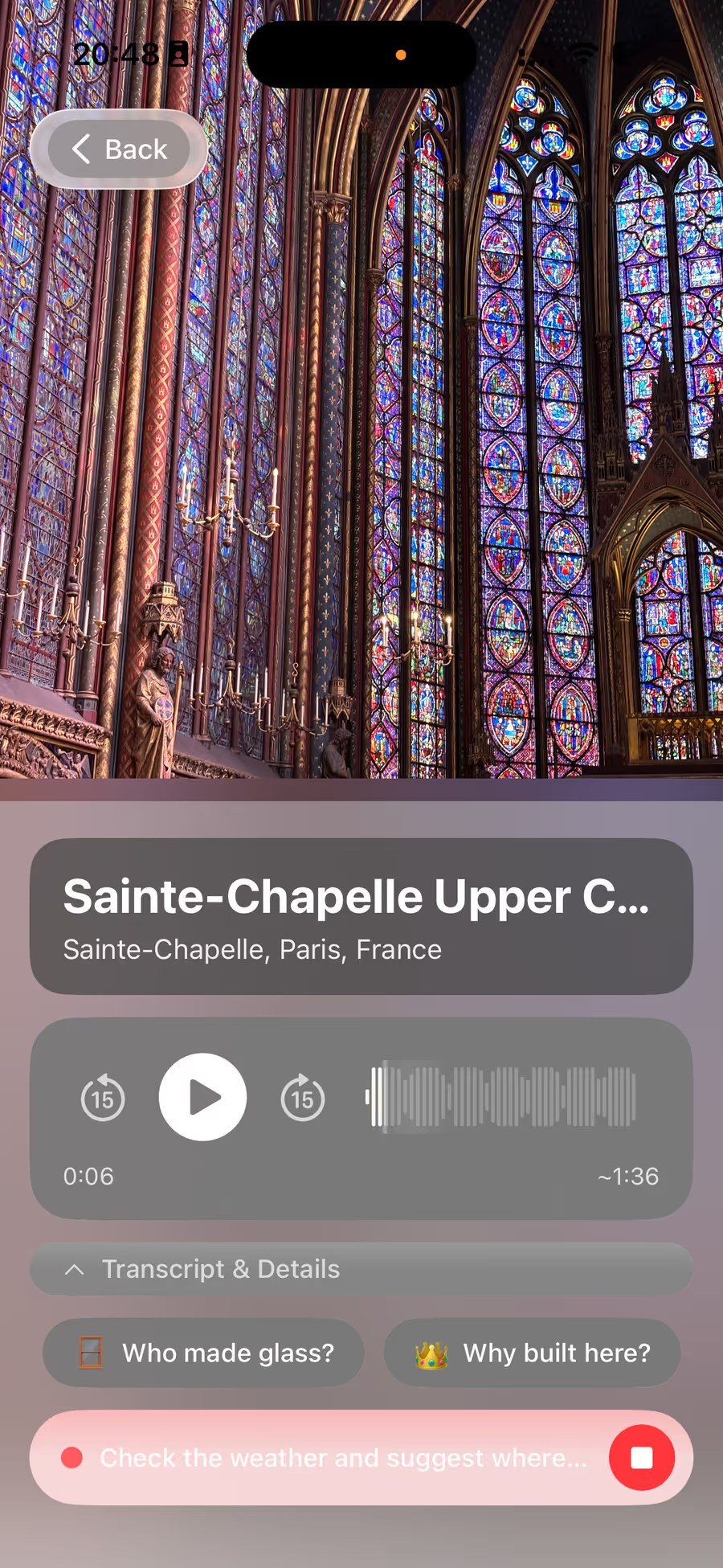
In your language. Chiaro speaks 18 languages, in a woman’s or a man’s voice, and shows place names in your language and the local one, side by side.
It connects the dots. The Map shows Chiaro’s picks around you, so you can find the next church worth the walk. Every evening, Chiaro turns what you saw into a Filo, a short story of your day, linking the cathedral in the morning to the chapel you passed in the afternoon.
See how recognition works
The landmark pages on the Chiaro website are a demo of what the app does once it recognizes a place: five stops at each, the kind of guide Chiaro builds from your photo, playing in your browser with no account. Cathedrals among them include Notre-Dame, Cologne Cathedral, Westminster Abbey, Seville Cathedral and St Stephen’s in Vienna. In the app, any cathedral you walk into gets the same treatment. If you’re not sure what kind of church you’re standing in front of in the first place, start with what is this church I’m looking at.
FAQ
What are the main features of a Gothic cathedral?
Pointed arches, rib vaults and flying buttresses. Together they let the walls be thinner and the windows much bigger, which is why Gothic interiors are so tall and full of light.
What is the difference between a nave, a transept and a choir?
The nave is the long main hall from the entrance. The transept crosses it to make the cross shape. The choir is beyond the crossing, where the clergy sang the services, and the apse is the rounded end beyond it.
How do you read a stained-glass window?
Usually from the bottom up. The scenes are stacked in small frames up the height of the window. Pick one window and follow a few scenes, and look at the bottom for the panel showing who paid for it.
What is the labyrinth on a cathedral floor?
A path set into the paving that winds to the centre without dead ends. Chartres and Amiens still have theirs. At Amiens, the centre recorded when the building began and who built it.
What’s the difference between a gargoyle and a grotesque?
A gargoyle is a carved waterspout that throws rainwater away from the walls. A grotesque is a carved figure that doesn’t carry water.
Look up, then look down
A Gothic cathedral rewards both directions. Up for the vault and the glass, down for the labyrinth and the carvings under the seats, and outside for the buttresses that make all of it stand. Give it an hour instead of ten minutes, and the building starts to explain itself.
Chiaro means “clear” in Italian. Get it on the App Store, point it at the next window you can’t read, and listen.
Snap. Listen. Explore.