
Photo by Pascal Bernardon on Unsplash
You climb a narrow spiral staircase out of a low, dark, painted room, and at the top the walls are gone. In their place are fifteen windows of coloured glass, each about fifteen metres tall, so close together that the stone between them looks like a frame holding up the light. On a sunny day the whole room turns blue and red. People stop at the top of the stairs and just stand there.
That’s the upper chapel of the Sainte-Chapelle in Paris, and it is not really a building with windows. It’s a reliquary, a jewelled box for a single object, built at the scale of a church. To understand the glass, you have to start with the object.
A crown bought for a fortune

Photo by Mike Swigunski on Unsplash
In 1238, Baldwin II, the Latin emperor of Constantinople, was broke. His empire was a shrinking remnant left over from the Fourth Crusade, and he had already pawned its most precious relic, the Crown of Thorns that Christ was said to have worn at the Crucifixion, to Venetian bankers.
Louis IX of France paid off the debt and took the crown. The sum usually given for the crown and the relics that followed it is 135,000 livres, a staggering amount for the time and, by the common estimate, about three times what the chapel built to hold them would cost. The crown arrived in France in 1239, and the chroniclers describe the king walking out to meet it barefoot, in a plain tunic, and carrying it into Paris himself. More relics of the Passion followed over the next few years, including a fragment of the True Cross.
Louis needed somewhere to put them, and he wanted it next to him. The Sainte-Chapelle was built inside the royal palace on the Île de la Cité, the Palais de la Cité, the main residence of the kings of France until the 14th century. It went up fast: begun in the early 1240s, it was consecrated on 26 April 1248.
Two chapels, one on top of the other

Photo by Mitya Ivanov on Unsplash
The building is really two chapels. The lower one, at ground level, was for the people who worked in the palace. It’s low and dark, with a painted vault of blue and gold fleurs-de-lis. Its original glass is gone: a flood in 1690 destroyed it, and the windows you see there now are 19th-century replacements.
The upper chapel was the king’s. It opened directly off the royal apartments, and it held the relics. Everything about it is designed to make the stone disappear. The walls are reduced to thin piers, and between them is glass: about 670 square metres of it, not counting the rose window.
Reading the windows

Photo by Svetlana Gumerova on Unsplash
The upper chapel has fifteen great windows in the nave and apse, dating from the mid-13th century, with something like 1,113 individual scenes between them. That figure is repeated by most guides; the important thing is that it’s far too many to take in at once, and nobody was ever expected to.
The windows tell one long story, and it has a beginning and an end.
Start on the left as you face the altar. The cycle begins at the western end of the north wall with the Book of Genesis: the Creation, Adam and Eve, the Flood. Then it works its way along the north wall through the Old Testament: Exodus, the Book of Numbers, Joshua, Judges, the prophets.
The Passion is behind the altar. The windows of the apse, the rounded east end, turn to the New Testament, and the central one, directly behind where the relics were displayed, shows the Passion of Christ. That’s the point of the whole building. The crown of thorns in the window hung above the crown of thorns in the shrine.
Then back down the south side, and into the present. The south wall returns to the Old Testament, with books like Judith, Esther and Kings, and the last window, the one nearest the entrance on the south side, does something remarkable. It leaves the Bible behind and tells the story of the relics themselves: their discovery, their journey from Constantinople, and their arrival in France, with Louis IX shown carrying the Crown of Thorns in procession.
The king put himself, and the purchase he had just made, at the end of sacred history. The glass says that the story that began with the Creation of the world ends here, in this room, with this king.
Inside each window, the scenes are set in medallions, small framed shapes of circles, quatrefoils and lozenges stacked up the height of the glass. They’re generally read from the bottom up. Don’t try to read them all. Pick one window, stand close, and follow it up a few rows. You’ll start to see tiny figures, crowns, horses, boats and walls, painted in brown-black lines on coloured glass, with the lead holding each piece in place.
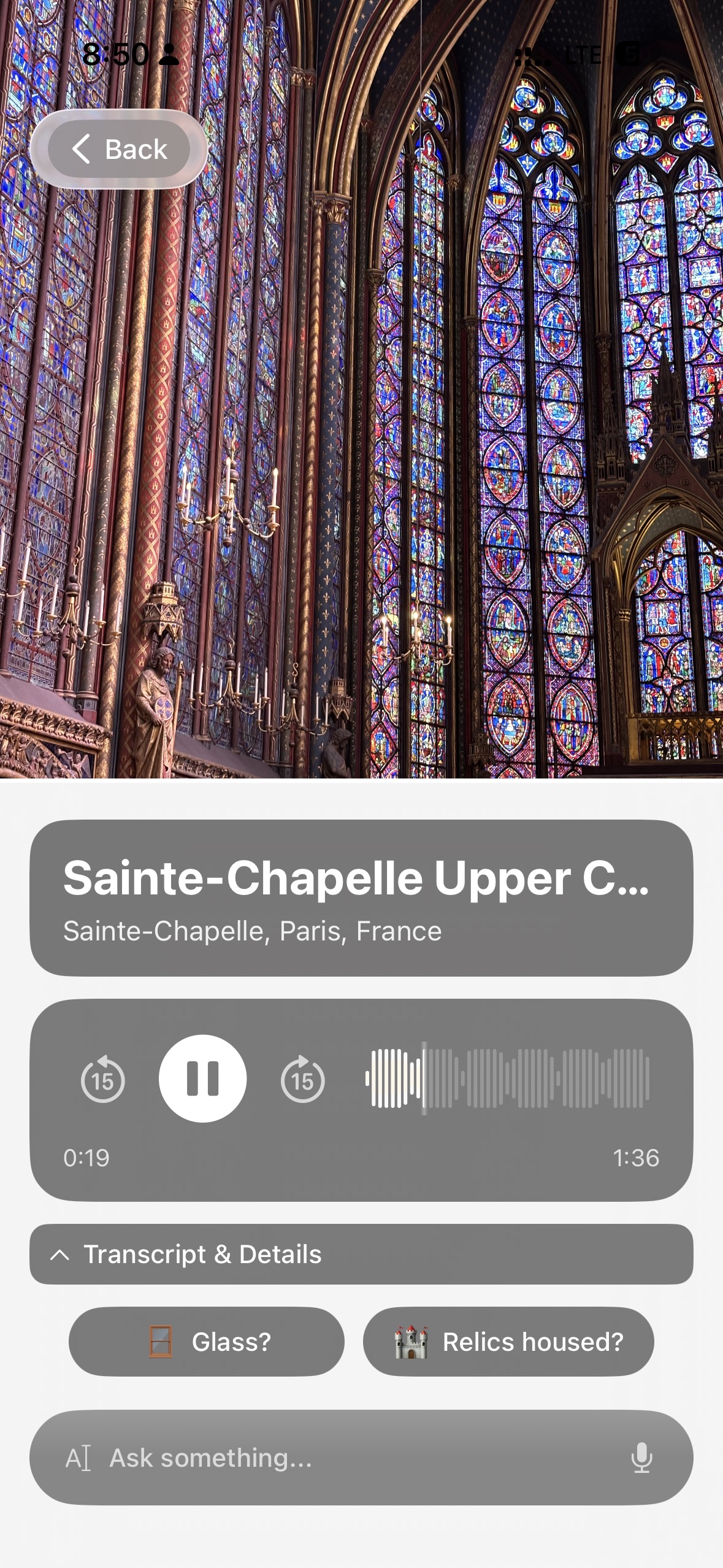
This is the room where it’s most useful to have someone tell you where to look. Point Chiaro at the windows and it tells you what you’re seeing, then lets you ask out loud which window is the relics window, or what the scene in front of you shows, without fumbling with a printed plan.
The rose window: two hundred years later

Photo by Sung Jin Cho on Unsplash
Turn around and look back toward the entrance. The great rose window above the door is not from Louis IX’s time at all. It was rebuilt in the late 15th century, during the reign of Charles VIII, in the Flamboyant Gothic style, with its tracery curling like flames. It’s about nine metres across and made of 89 separate panels showing the Apocalypse, the vision of the end of the world from the Book of Revelation.
So the chapel is a complete story in glass: the beginning of the world on the north wall, the Passion at the east, the relics on the south, and the end of the world in the west. The light changes through the day, falling on each part in turn.
The Revolution, and what was lost
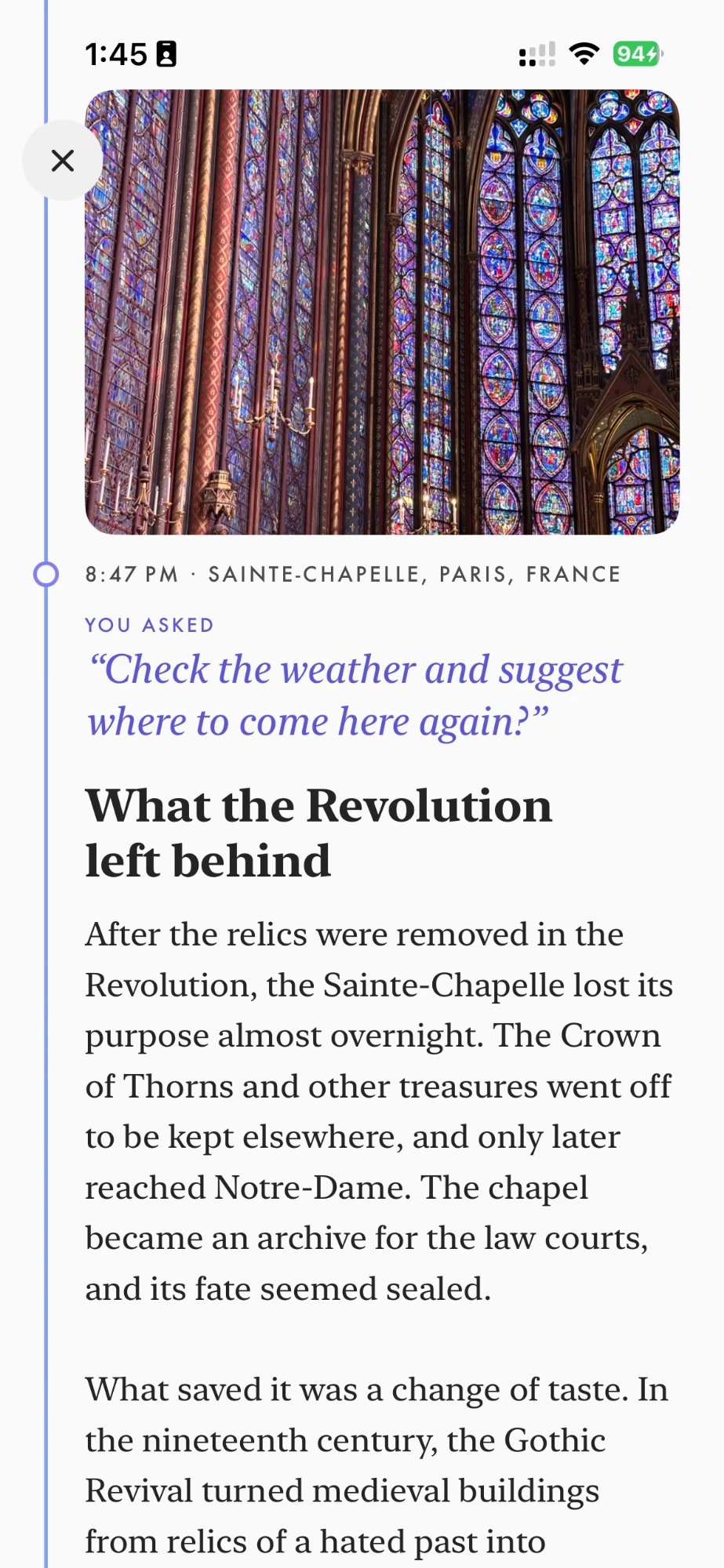
The French Revolution was hard on the Sainte-Chapelle. It was a royal building full of royal symbols, and it was treated that way. The chapel was turned into a storehouse, its sculpture and royal emblems were smashed, and its spire came down. Some of the glass was broken or dispersed. The relics were removed; the Crown of Thorns ended up at Notre-Dame de Paris, where it survived the 2019 fire. We told the story of that night in our Notre-Dame post.
Remarkably, nearly two-thirds of the original 13th-century glass survived. Some of what left the building is now in museums. Original panels are in the Musée de Cluny, the national museum of the Middle Ages, a short walk away across the river, and other early glass from the chapel is in the Victoria and Albert Museum in London. You can stand in front of them at eye level, which is the one thing you can’t do in the chapel itself.
Two restorations
By the 19th century, the Gothic was fashionable again, and the Sainte-Chapelle became one of the great restoration projects of its age. Work began in the 1830s under the architect Félix Duban, with Jean-Baptiste Lassus, and later Émile Boeswillwald and the young Eugène Viollet-le-Duc, who would go on to restore Notre-Dame. The glass itself was restored between 1846 and 1855 by the workshops of Antoine Lusson, Maréchal de Metz and Louis Steinheil. About a third of the glass, pieces added in later centuries, was taken out and replaced with medieval glass or with new glass in the 13th-century style.
The second restoration is recent. Between 2008 and 2015, a seven-year programme costing around €10 million cleaned and repaired the windows, and added a new layer of protective glass on the outside to shield the medieval panels from weather and pollution. If you saw the chapel before that and remember it as darker, you weren’t imagining it.
How to see it
Go on a bright day. Stained glass needs the sun behind it. On a grey afternoon the chapel is still beautiful, but on a sunny morning it glows.
Book ahead. The Sainte-Chapelle sits inside the Palais de Justice, Paris’s law courts, so there is a security check before you get in, and the queue can be long. A timed ticket saves most of the wait.
Do the lower chapel first, slowly. It’s the dark before the light, and it was meant to be. The effect of the upper chapel is stronger if you arrive at the top of the stairs having spent a few minutes downstairs.
Then pick one window. Sit on the bench along the wall, choose a window, and follow it up from the bottom. The relics window at the end of the south wall is a good one to start with: it’s the one that tells you why the building exists.
See the cathedral the same day. Notre-Dame is a few minutes’ walk away, and the two buildings were made for the same relic. If you want to know what to look for when you get there, our guide to what to look for inside a Gothic cathedral is a good companion to this one.
Hear the story while you look up
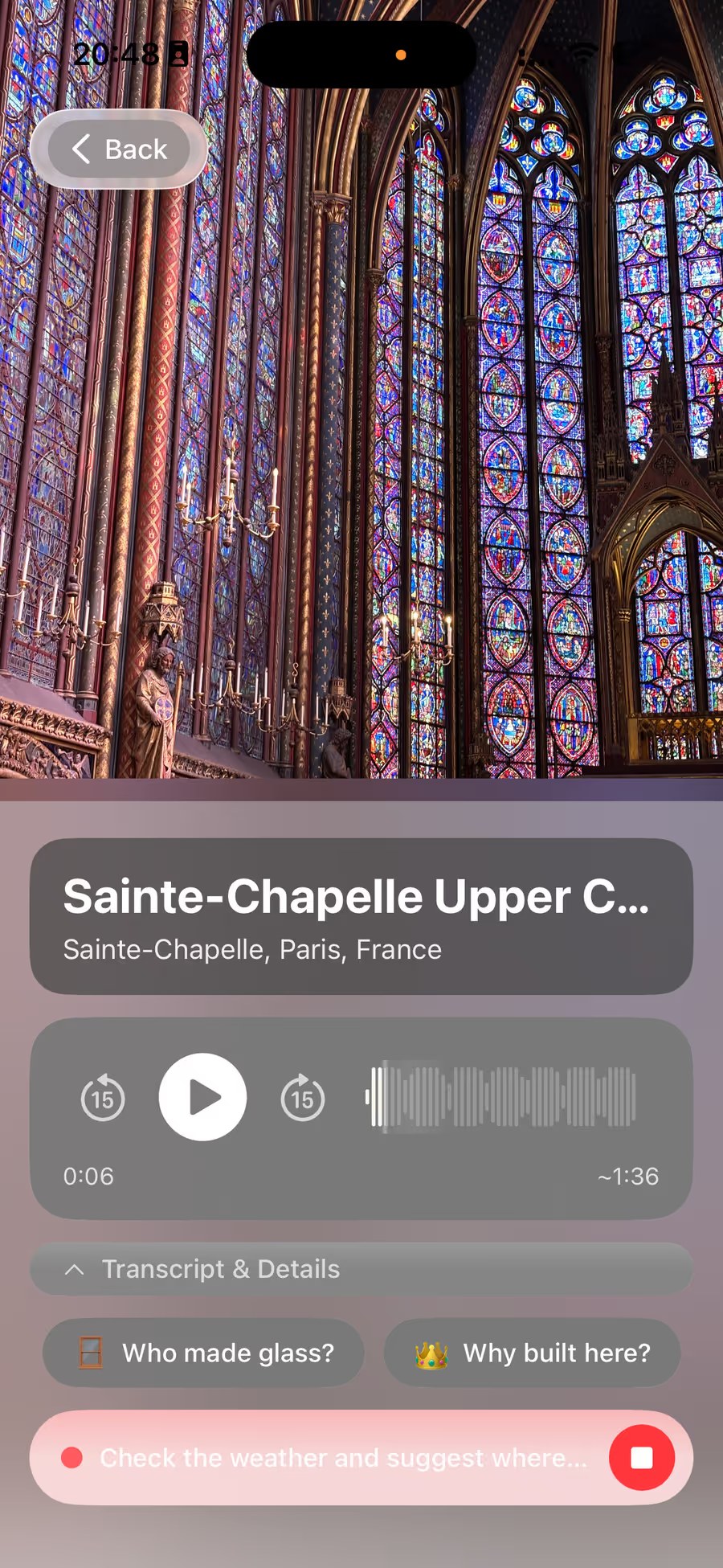
The Sainte-Chapelle page on the Chiaro website is a demo of what the app does once it recognizes a place: five stops through the chapel, the kind of guide Chiaro builds from a single photo, playing in your browser with no account. In the app itself you’re not limited to the demo: point it at any window, any building, any painting, and ask whatever you want to know, out loud, in 18 languages.
FAQ
How many stained glass windows does Sainte-Chapelle have?
The upper chapel has fifteen great windows from the 13th century, each about fifteen metres tall, plus the great rose window over the entrance, which was rebuilt in the late 15th century.
How many scenes are in the Sainte-Chapelle windows?
The usual figure is 1,113 scenes across the fifteen windows, telling the Bible story from Genesis onward and ending with the arrival of the relics in Paris.
Is the Sainte-Chapelle glass original?
Mostly. Nearly two-thirds of the glass is 13th-century. The rest was replaced or restored, much of it in the 19th-century restoration, and the windows were cleaned and protected again between 2008 and 2015.
Where is the Crown of Thorns now?
It left the Sainte-Chapelle during the Revolution and has been kept at Notre-Dame de Paris since the 19th century. It was rescued from the cathedral during the 2019 fire.
When is the best time to visit?
A sunny morning or midday, when the light comes through the glass. Book a timed ticket to cut the queue at the security check.
The box that held the crown
Louis IX built the Sainte-Chapelle to hold one object, and the object is gone. What’s left is the box, and the box turned out to be the treasure. Eight centuries later, people still climb those stairs for the light.
Chiaro means “clear” in Italian. Get it on the App Store, point it at the glass, and listen.
Snap. Listen. Explore.