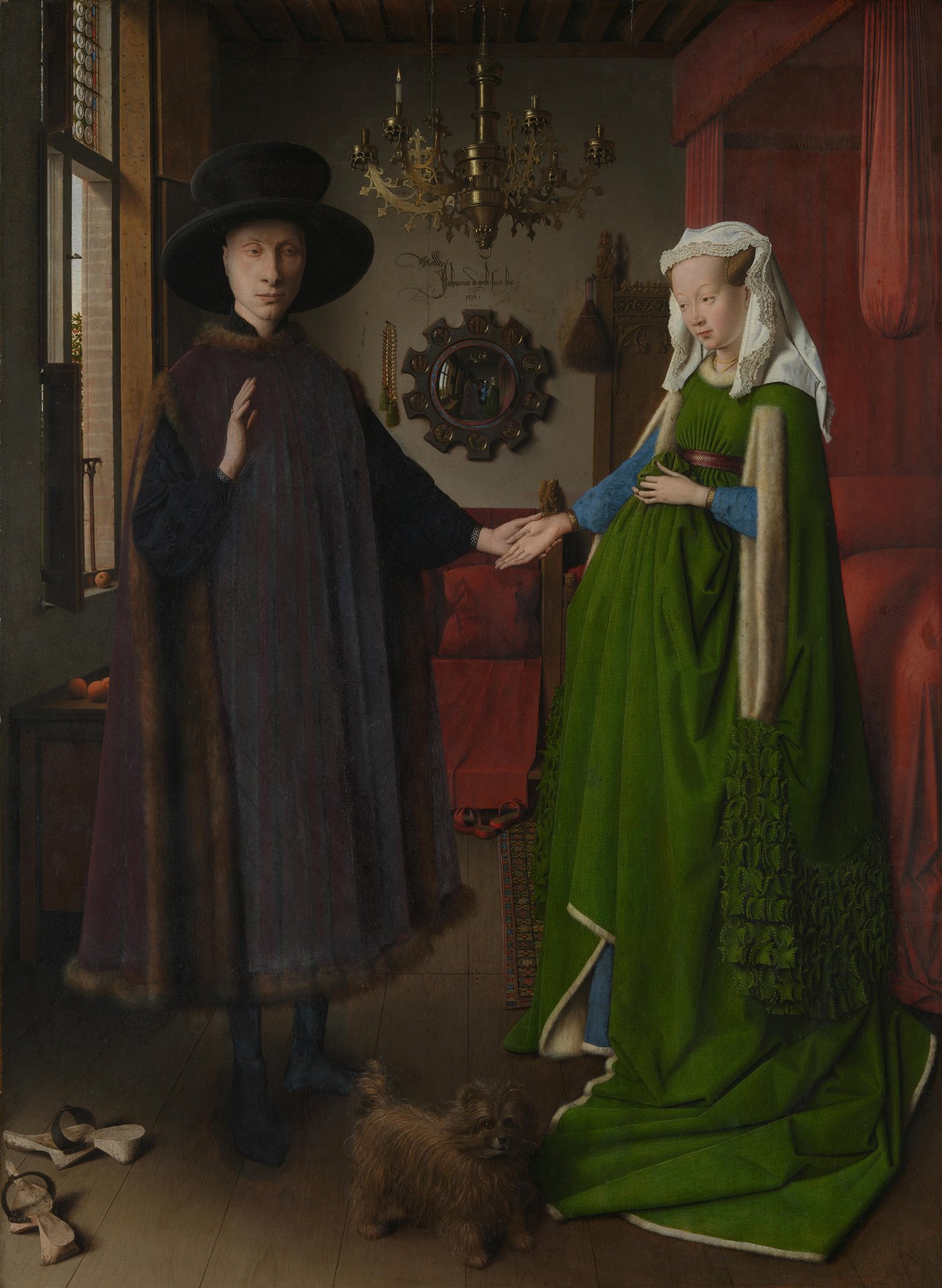
In 1516, an inventory clerk at the court of Mechelen wrote down the first item in the painting collection of Margaret of Austria, regent of the Netherlands. It was “a large picture which is called Hernoul le Fin with his wife in a chamber,” given to her by a Spanish courtier named Don Diego de Guevara, “done by the painter Johannes.” In the margin, someone added a note. The picture needed a lock, so it could be shut. Madame had ordered it done.
That painting is the Arnolfini Portrait, and for five hundred years people have wanted to lock it up, open it again, and argue about what is inside. It is small. It measures about 32 inches by 24, roughly the size of a kitchen cabinet door. And it is so dense with things — a mirror, a candle, a dog, two pairs of shoes, a few oranges, a carved saint, a brush, a string of beads, a sentence written on the wall — that it reads less like a portrait than a crime scene. Every object looks like evidence. The question is evidence of what.
Why a room this small causes so much trouble
Jan van Eyck finished it in 1434, in Bruges, the richest trading city in northern Europe. He was court painter to Philip the Good, Duke of Burgundy, and he was doing something with oil paint that nobody had done before. He laid down thin, translucent glazes, one over another, so that light seemed to sit inside the color instead of on top of it. Ernst Gombrich, the art historian, said that with this picture “a simple corner of the real world had suddenly been fixed on to a panel as if by magic.”
That is the trap. Because everything looks real, everything looks deliberate. And because the painting never tells you what it is for, every generation has filled the silence. In 1934, Erwin Panofsky called it a painted marriage certificate. Later scholars called it a betrothal, a power of attorney, a gift for relatives back in Italy, a memorial to a dead wife, even a ghost story. The National Gallery in London, which has owned it since 1842, now says plainly that the marriage reading is no longer accepted. It still hangs there, in the National Gallery’s Room 52, and the crowd in front of it is still trying to solve it.
So let’s do it properly, object by object.
The Arnolfini Portrait details at a glance
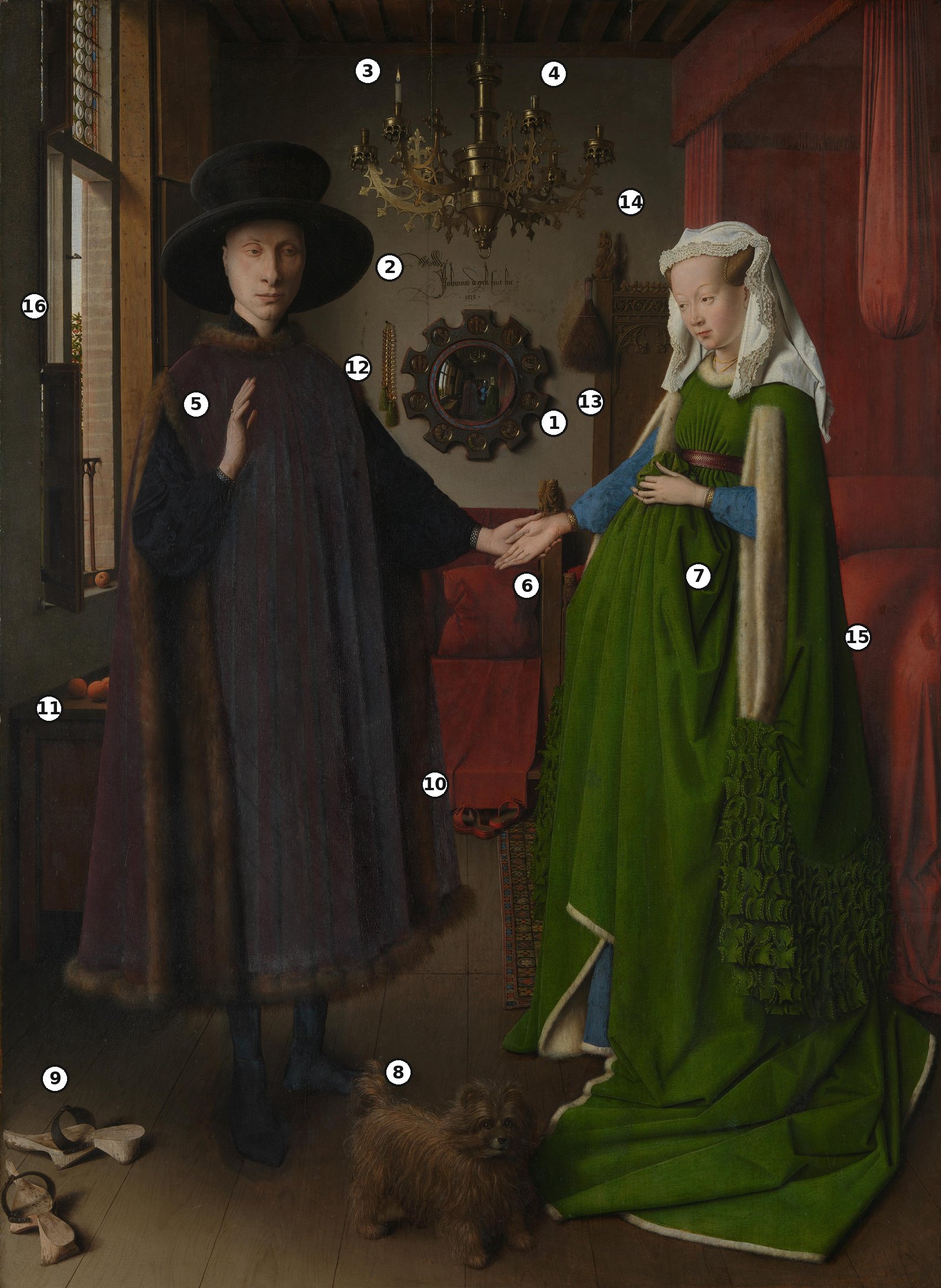
The numbers on the image match this key.
| # | Detail | Where to find it | What it may mean |
|---|---|---|---|
| 1 | Convex mirror | Center of the back wall | Two visitors reflected in the doorway; ten Passion scenes in the frame |
| 2 | Signature | On the wall above the mirror | ”Johannes de eyck fuit hic 1434” — Jan van Eyck was here |
| 3 | The one lit candle | Front left of the chandelier, the man’s side | A wedding custom, the eye of God, or the living husband |
| 4 | Burned-out stub | Chandelier, the woman’s side | In one theory, a wife who is already dead |
| 5 | Raised right hand | The man, chest height | A greeting, or an oath |
| 6 | Joined hands | Center | Long read as a marriage vow; now disputed |
| 7 | The green gown | The woman | Not a pregnancy, a fashion |
| 8 | The dog | Between their feet | Fidelity, wealth, and the only one looking at you |
| 9 | Wooden pattens | Bottom left | Outdoor overshoes, kicked off |
| 10 | Red slippers | By the bench at the back | Her indoor shoes |
| 11 | Oranges | Windowsill and chest | Expensive imports, maybe Eden |
| 12 | Prayer beads | Left of the mirror | Piety, and a classic engagement gift |
| 13 | Brush | Right of the mirror | Housekeeping, or chastity |
| 14 | Carved saint | Top of the chair back | Probably Saint Margaret, patron of childbirth |
| 15 | The bed | Right side | A reception room, not a bedroom |
| 16 | Cherry tree | Outside the window | It is summer, and they are wearing fur |
The rest of this post walks through the room in roughly that order, starting where your eye goes anyway: the mirror.
The Arnolfini Portrait mirror and the two men in the doorway
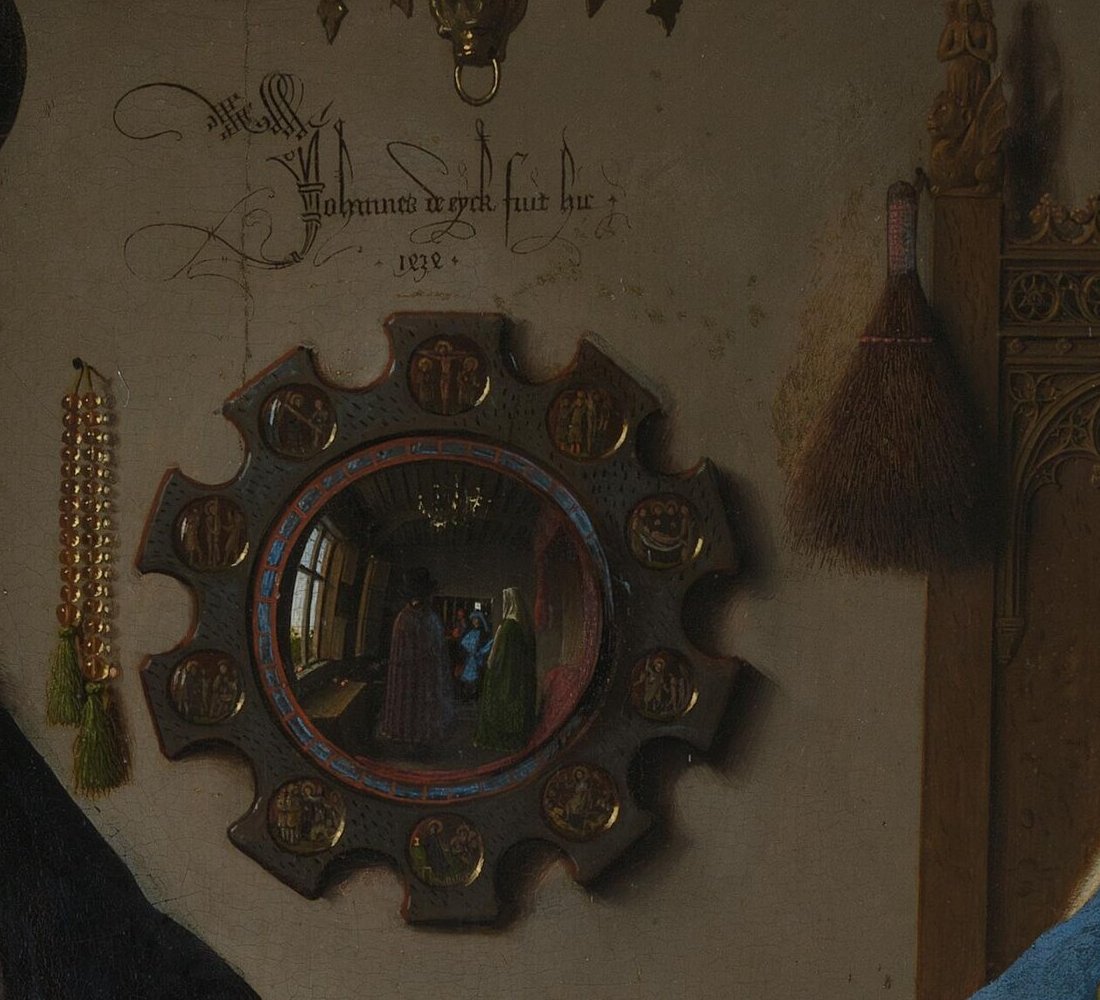
The mirror is the size of a coin on the panel. Inside it is the whole room again, bent around a curve. You see the couple from behind. You see the window, the ceiling beams, the chandelier, the bed. And between the two backs, framed in a doorway, are two small figures who are not in the main picture at all. One wears blue. One wears red. One of them seems to raise an arm.
They are standing where you are standing.
That is the move that made this panel famous. Van Eyck extended the room past its own frame, into the viewer’s space, and then put people there. Who are they? The usual answer is that the man in red is Van Eyck himself, because figures in red headgear turn up in other works by him that are often read as self-portraits. The National Gallery asks the question rather than answering it: are these the painter and his servant, arriving on a visit? Nobody knows. Panofsky thought they were the two witnesses a medieval wedding required. That idea has faded along with his marriage-certificate theory, but the two men are still there, still on the threshold.
Two more things about the mirror are worth a long look. First, it is too big. Convex mirrors of this quality could not be made at this size in 1434, so Van Eyck quietly inflated it. Second, look at the frame. It has ten spokes, and each spoke holds a tiny roundel painted with a scene from the Passion of Christ, with the crucifixion at the top. Some scholars have noticed that the scenes on the woman’s side are the ones after Christ’s death, and the scenes on the man’s side are from his life. Hold that thought. It matters later.
”Jan van Eyck was here”
Directly above the mirror, in a big looping Gothic hand, is a line written straight onto the plaster: “Johannes de eyck fuit hic 1434.” Jan van Eyck was here. 1434.
Think about how strange that is. Painters signed the frame, or the bottom edge, or a little painted label. Van Eyck himself usually painted his signature on the frame so it looked carved into the wood. Here he wrote it on the wall of somebody else’s house, in the middle of the picture, in the elaborate script of a legal document, and the wording is not “made this” but “was here.” It is half notary’s flourish and half graffiti.
Panofsky read it as a witness’s signature on a contract. Lorne Campbell, who wrote the National Gallery’s catalogue, pointed out that inscriptions painted on walls were ordinary decoration in that period and saw little reason to think the picture records any event. Campbell’s own summary is the most useful sentence ever written about this painting: only the unnecessary lighted candle and the strange signature provoke speculation. Everything else, he thought, can be explained as a rich couple in a rich room. We will get to the candle in a moment. But notice that even the most skeptical expert in the field admits the signature is strange.
If you want another painter who put his own presence into his work as an argument, Albrecht Dürer did it with a whole face, in his 1498 self-portrait. Van Eyck did it with five words and a date.
One candle burning at noon
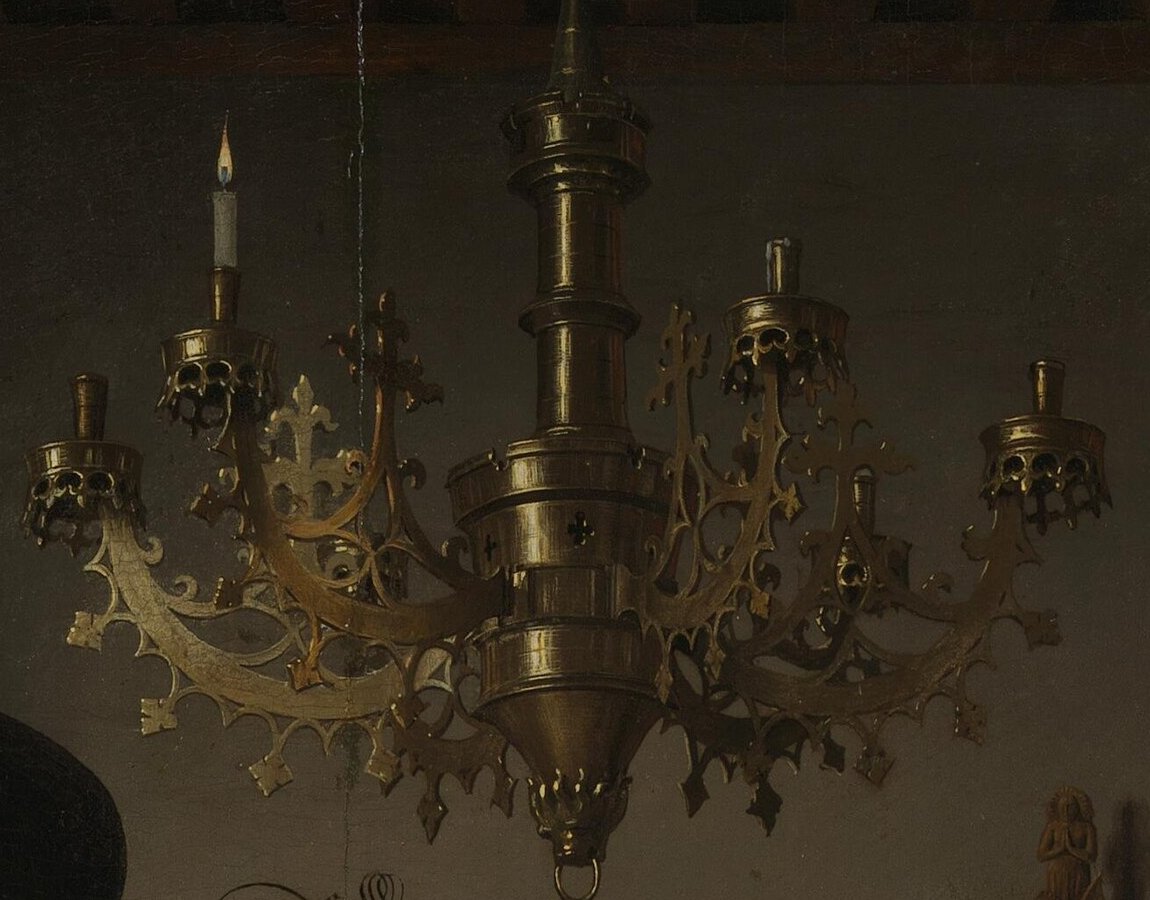
The room is full of daylight. It pours through the window on the left and lands on every surface. And yet, in the brass chandelier above the couple’s heads, one candle is burning. Just one, in the front holder on the man’s side.
The chandelier itself is a boast. It is enormous for a private house, and it would have cost a fortune. But the single flame is the detail that has launched a thousand essays. Panofsky connected it to a Flemish custom of lighting a candle at a wedding, and to the idea of God’s presence in the room, like the lamp that burns in a church sanctuary. That reading still turns up on placards everywhere.
Now look across the chandelier to the woman’s side. In one of the holders there is a short white stump. A candle that has burned all the way down.
Which Arnolfini, and was his wife already dead?
This is where the painting changes under your feet. For more than a century, everybody knew who these people were, and the picture went by the name the Arnolfini Wedding. In 1857, the art historians Crowe and Cavalcaselle connected the picture to “Hernoul le Fin” in Margaret of Austria’s inventory, which is a Flemish ear’s version of Arnolfini, a family of silk and cloth merchants from Lucca who had settled in Bruges. A few years later, the scholar James Weale named the couple as Giovanni di Arrigo Arnolfini and his wife Giovanna Cenami. That pairing went into every textbook.
Then, in 1997, a document turned up showing that Giovanni di Arrigo and Giovanna Cenami married in 1447. That is thirteen years after the date on the wall, and six years after Van Eyck died. Whoever this woman is, she is not Giovanna Cenami.
Attention moved to a cousin, Giovanni di Nicolao Arnolfini, another Lucchese merchant in Bruges. He is the man the National Gallery now names, with a careful question mark in its official title. Read aloud, the label is Portrait of Giovanni Arnolfini and his Wife, with the question mark hanging over the first name. He would have been in his late thirties in 1434. And here is the wrinkle. Giovanni di Nicolao had married a woman named Costanza Trenta in 1426. In February 1433, Costanza’s mother wrote a letter that included the line: Costanza and Lionardo are dead.
In 2003, the art historian Margaret Koster published an argument in Apollo magazine that follows that letter to its end. If the woman is Costanza, the painting is a memorial. A living husband and a wife who has been dead for about a year. The lit candle burns on his side; the spent stub sits on hers. The Passion scenes after Christ’s death are on her side of the mirror; the scenes from his life are on his. His clothes are dark. In 2016, a French physician named Jean-Philippe Postel went further in a book called L’Affaire Arnolfini, suggesting she appears to him as a ghost asking for prayers.
Is it true? The National Gallery is not persuaded. Its current view is that the woman is probably Giovanni’s second wife, whose identity is unknown. There is no surviving record of that second marriage either, which is exactly why the memorial theory refuses to die. So be honest about where things stand: nobody has proved who she is. But once you have seen the candle stub, you cannot unsee it.
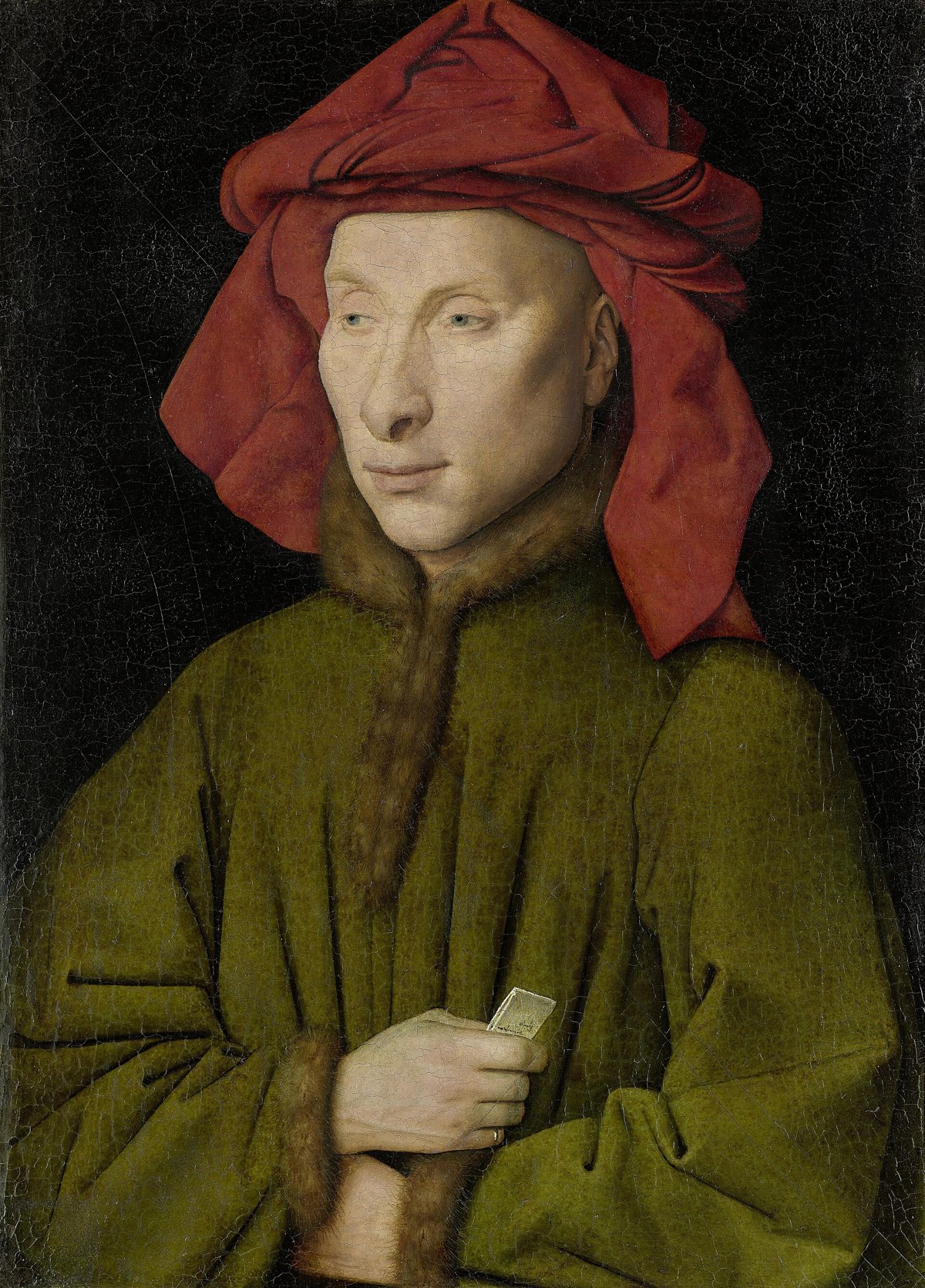
The man, at least, we have met again. Van Eyck painted the same long face, heavy-lidded eyes and thin mouth a few years later, in a small portrait now in the Gemäldegalerie in Berlin. The museum labels him, cautiously, as a man from the Arnolfini family. That a court painter portrayed the same merchant twice suggests the two men were more than client and painter. They may have been friends.
The hands, the oath, and a gown that isn’t pregnant
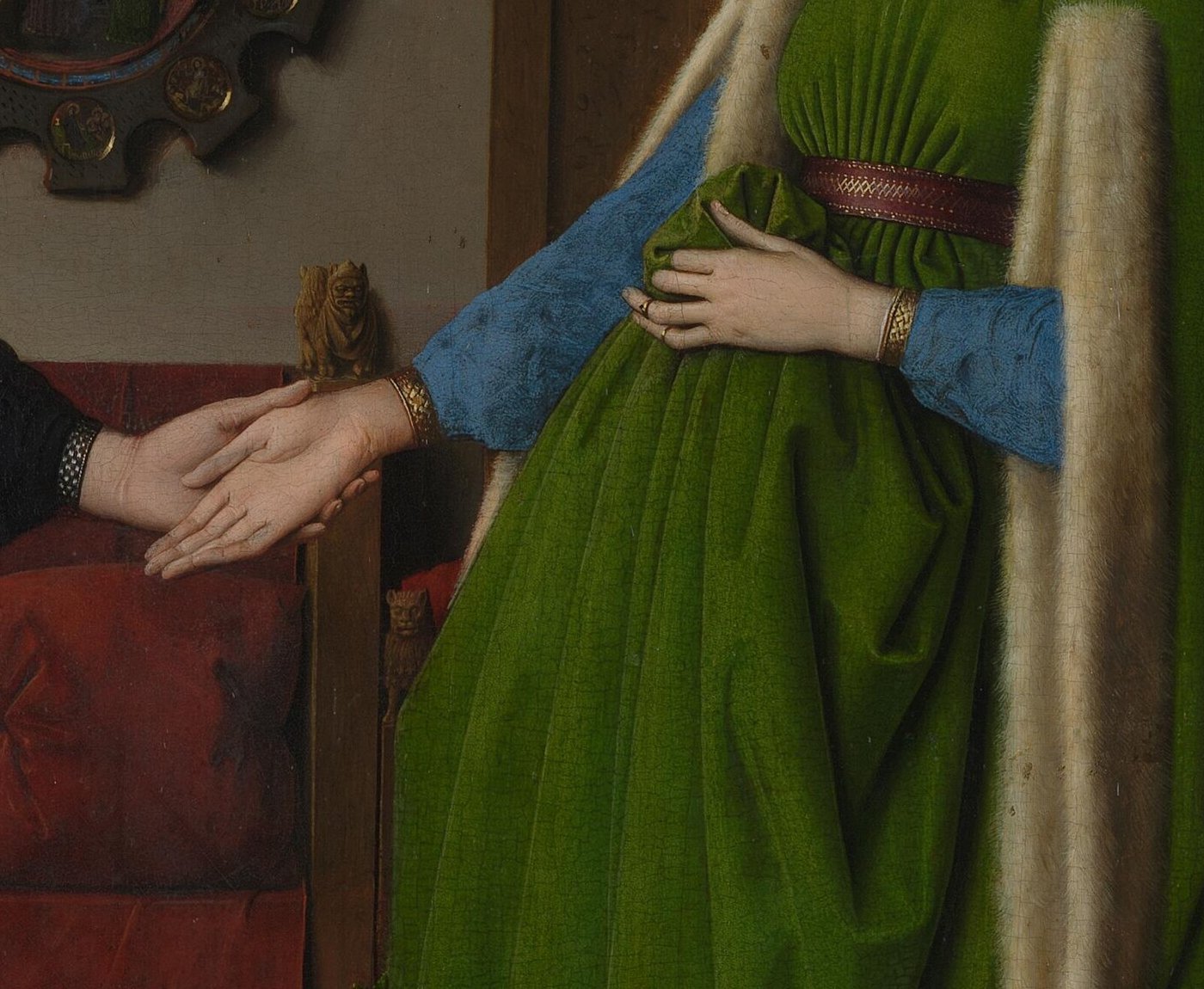
Look at his hands. The right one is raised, palm out, at chest height. The left one holds her right hand, which rests in his palm. Panofsky saw an oath being sworn. The historian Margaret Carroll proposed a cleverer version: that this is an already married couple, and the husband is formally handing his wife legal authority to do business in his name, a kind of power of attorney in paint. Others see nothing more than a greeting to the two men coming through the door. The raised hand works for all three. That’s the genius and the problem.
Now, the question everyone asks in front of this painting: is she pregnant?
No. Of all the symbolism questions in this room, this is the one with a clear answer, and the National Gallery says so outright. She is holding up a huge, heavy gown, and the gathered fabric bunches in front of her. Fifteenth-century paintings of virgin saints show the same high waist and the same rounded silhouette, and nobody thinks Saint Catherine is expecting. Yards of cloth meant money, and the Arnolfini were in the cloth business. The gown is a bill of lading for how much fabric this household could afford. It is lined with fur, with dagged sleeves cut into leaf shapes, and the green itself was a difficult, expensive dye.
The dog, the clogs, and the shoes nobody notices
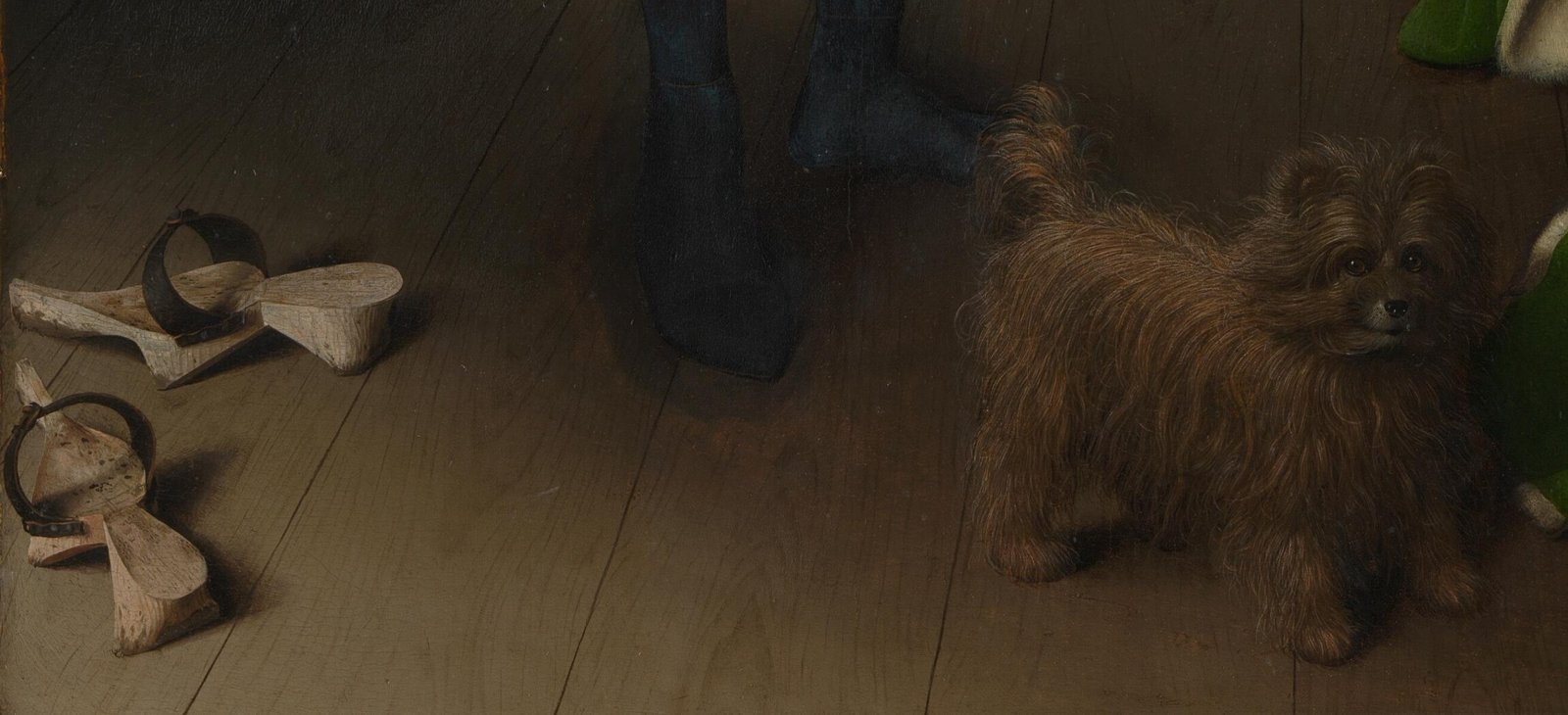
At their feet stands a small, shaggy brown dog, an early ancestor of the breed we now call the Affenpinscher, or something close to a griffon terrier. Every hair seems to be painted separately. Dogs in marriage portraits stood for fidelity, and an expensive lapdog was also a status object, the way a designer handbag is now.
But the real point of the dog is its eyes. The man looks out at you, a little absently. The woman looks down at him. The dog is the only creature in the room looking straight at the viewer, alert, as if it has just heard the two visitors at the door. Van Eyck left one more trace down here. The National Gallery points out that you can see the painter’s own thumbprint in the shadow by the dog’s leg.
Bottom left, near the window, lie a pair of pattens. These are wooden overshoes with leather straps, worn outdoors to keep fine shoes out of the mud of a Bruges street. They have been kicked off, toes in different directions. A man who has taken off his outdoor shoes is home. Panofsky saw holy ground, like Moses removing his sandals before the burning bush. Others read it as a sign he would not stray. The memorial theorists read it as a man who would not remarry.
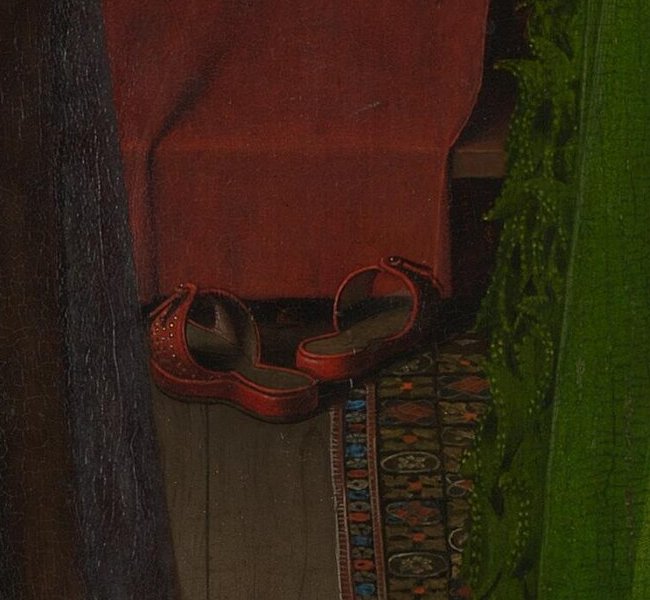
Most visitors never find the second pair. Look at the back of the room, under the bench, beside the little oriental carpet. There is a pair of red slippers, presumably hers.
Oranges, beads, a brush and a saint
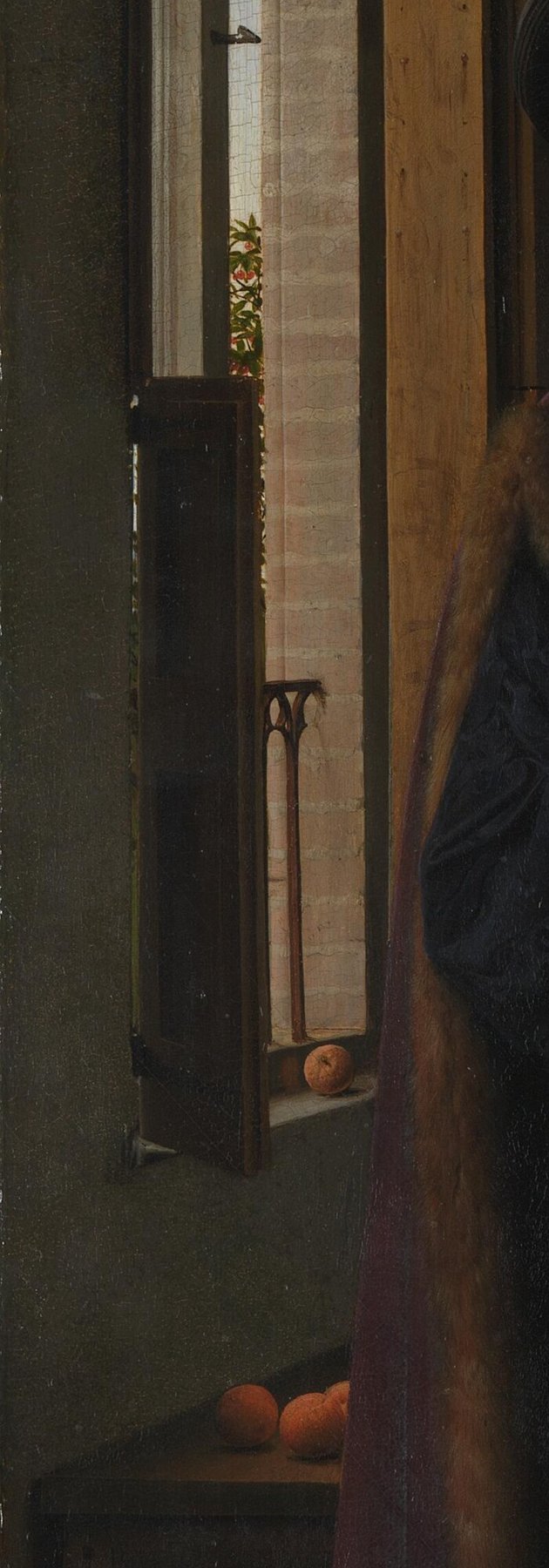
On the windowsill sits one orange. Three more lie on the chest below. In Burgundian Bruges, oranges were imported luxuries, and it is possible the Arnolfini traded in them. Some readers see the fruit of Eden before the Fall. In Italy, where the couple came from, oranges could also stand for fertility in marriage. The simplest reading is also the strongest. Van Eyck is showing you a household that leaves expensive fruit lying around.
Outside the window there is a tree with red fruit on it. Those are cherries, which means it is early summer. And both of them are wearing fur. His tabard is trimmed with what may be sable. Her gown is lined with ermine or squirrel. Maximiliaan Martens, a historian of Netherlandish art, suggested the picture was meant for family in Italy, a display of prosperity, which would explain why the couple are dressed for a different season than the tree.
On the back wall, left of the mirror, hangs a string of amber-colored beads with green tassels. Prayer beads were a favorite present from a man to his bride-to-be. To the right of the mirror, a small brush hangs from the chair. Some scholars pair them: pray on one side, work on the other.
At the top of the chair back, just above the brush, is a tiny carved figure standing on a monster. She is most likely Saint Margaret, who burst out of a dragon in her legend and became the patron saint of women in childbirth. Some read her as Saint Martha, the patron of housewives. Either way, a saint for wives is watching over the woman in green.
Chiaro is useful at exactly this distance. The carved saint is barely the height of a fingernail on the panel, and when you are leaning toward it, the story of Margaret and her dragon plays while your eyes are on the chair, not on a placard three feet away.
The bed, finally, is not what it looks like. Wealthy households in France and Burgundy kept beds in their reception rooms and used them as seating. The red curtains are a sign of status, not an invitation into a bedroom.
The symbolism argument nobody can win
Count up the theories and they cancel each other out. The candle is God, or a wedding custom, or a dead wife. The dog is fidelity, or lust, or a pet. The oranges are Eden, or fertility, or groceries. The art historian Jan Baptist Bedaux pointed out the catch decades ago: if the symbols are disguised so well that they look like ordinary objects, there is no way to prove the painter meant them as symbols at all. Craig Harbison took the middle road, and it is the one we’d take too. Objects in a fifteenth-century home could carry several meanings at once, and Van Eyck was clever enough to know it.
It also traveled. Margaret’s niece Mary of Hungary inherited it, and it passed to Philip II of Spain. By 1599 it hung in the Alcázar in Madrid with lines from Ovid painted on its frame, a cynical couplet about how promises cost nothing. A royal painter in Madrid copied the couple’s pose for a portrait of Philip’s daughters. And a later court painter in the same palace, Diego Velázquez, almost certainly knew it. His Las Meninas, with a king and queen reflected in a small mirror on the back wall, is the most famous answer one painting has ever given another.
How it reached London
It was last recorded in the Spanish royal collection in the 1790s. By 1816 it was in London, in the hands of a Scottish officer, Colonel James Hay. He said he had fallen in love with it in Brussels while recovering from wounds after Waterloo. The likelier story involves the Battle of Vitoria in 1813, when British troops looted the baggage train of Joseph Bonaparte as he fled Spain with portable works of art.
Hay offered it to the Prince Regent, the future George IV, who kept it on approval for two years and then sent it back. In 1842 the young National Gallery bought it for six hundred pounds and gave it inventory number 186. It is still NG186.
By then the shutters, the original frame and Ovid’s couplet were gone. The Pre-Raphaelites, a generation later, borrowed its convex mirror for their own pictures.
Where to see the Arnolfini Portrait at the National Gallery
The painting hangs in Room 52 at the National Gallery on Trafalgar Square, among the early Netherlandish paintings in the Sainsbury Wing, which reopened in 2025 after a long renovation and is now the main entrance. Admission to the collection is free. The gallery is open daily from 10 a.m. to 6 p.m., with late opening on Fridays until 9 p.m. Booking a free timed ticket is optional; it gets you through security faster. Rooms do get rehung, so check the gallery’s map on the day.
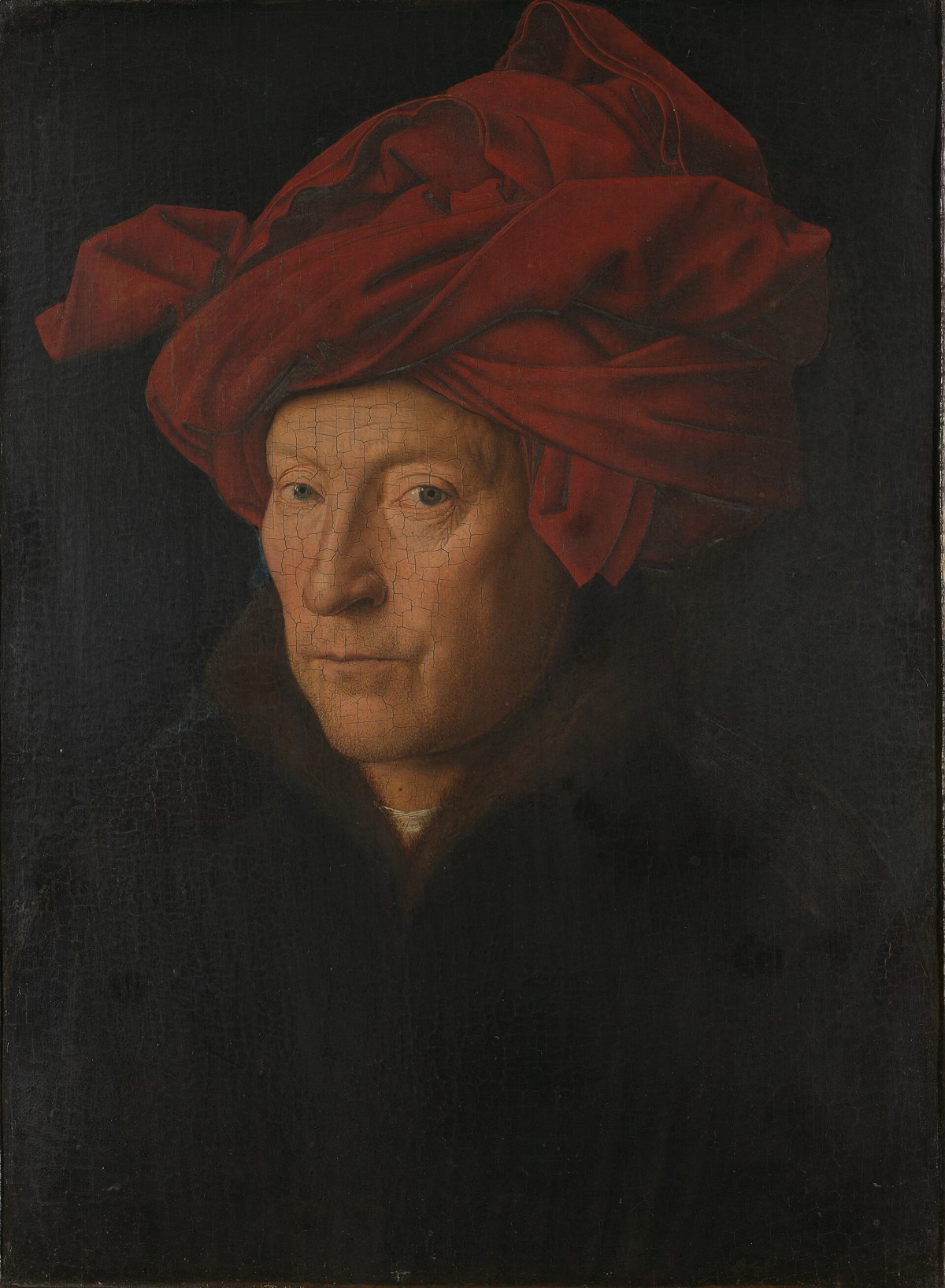
While you are in the gallery, look for Van Eyck’s Portrait of a Man in a red turban, dated October 21, 1433, a year before the Arnolfini panel. Many scholars think it is a self-portrait. Its frame carries his motto, “Als ich can” — as I can. If they are right, you are looking at the man in red in the mirror, full size.
It is worth coming early. The panel is small, it is under glass, and the details that matter are measured in millimeters. A crowd of three people is enough to block the dog. It is also the first stop on our National Gallery audio guide, for a reason. If you have never stood in front of something this small and felt it fill the room, our museum tips for people who think they don’t get art are a good place to start.
For a much bigger room full of borrowed faces, Raphael’s School of Athens gets the same numbered treatment, and the whole series is collected in Famous Paintings, Every Figure Identified.
What to look for in front of it
Stand back first. Let it be a portrait of two people in a room. Then step in close, as close as the guard allows, and work your way through the room in this order. The mirror and its two visitors. The words on the wall. The one candle burning and the one burned out. His raised hand. Her gathered gown. The dog’s eyes. The clogs, and then the red slippers at the back. The orange on the sill, the cherries outside, the saint on the chair.
Then step back again and notice what has happened. You came in looking at a couple. You are leaving as one of the two people in the doorway, the ones in the mirror, the ones the dog heard coming. Jan van Eyck was here, the wall says. Now so were you.