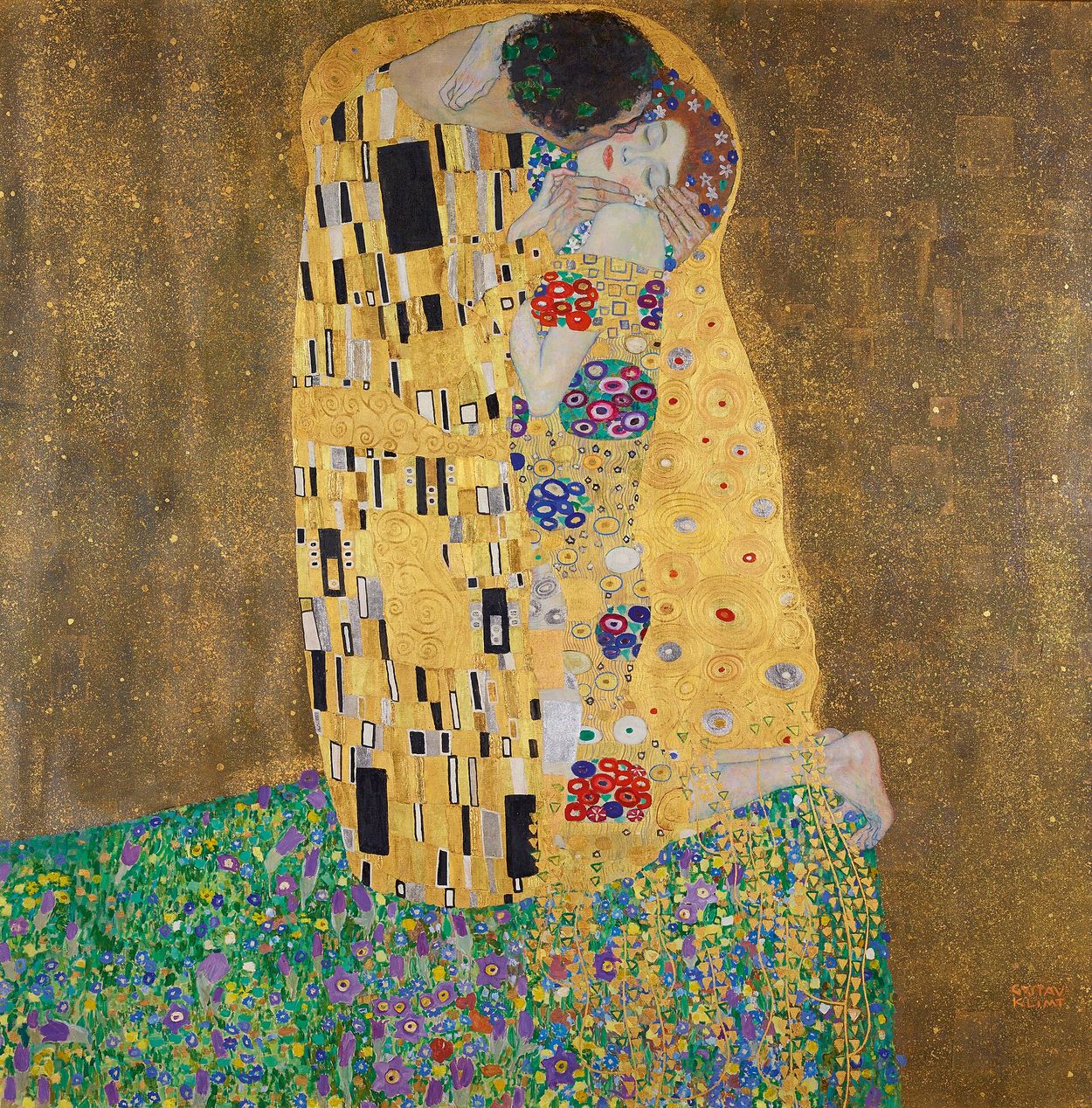
In the summer of 1908, the Austrian Ministry of Culture and Education bought a painting off the wall of a temporary exhibition hall in Vienna, and the painting was not quite finished. The show was called the Kunstschau. It opened on June 1, 1908. The painting was the work of a forty-five-year-old artist the same ministry had been fighting with for most of a decade. The catalogue called it Liebespaar, “the lovers.” The price was 25,000 crowns. The world now calls it The Kiss. Klimt’s lovers, bought by the state before the paint had settled, have not left Vienna since.
Here is the strange part. Eight years earlier, the same ministry had commissioned Gustav Klimt to paint the ceiling of the University of Vienna’s Great Hall. When he delivered the first canvas, dozens of professors signed a protest against it, and critics attacked it in the press as obscene. By 1905 Klimt had handed back his fee and taken his paintings home. Then, in 1908, the state turned around and paid a small fortune for a picture of two people about to kiss. Something in this canvas made the city forgive him. The answer is in the pattern, and you can read it like a sentence once you know the grammar.
The Kiss at a glance
It is a square, 180 by 180 centimetres, just under six feet on each side. It is oil paint and gold leaf on canvas, with silver and, according to several technical accounts, a little platinum. Most reference books date it 1907 to 1908. The Belvedere dates it 1908 to 1909, and its own documentation has Klimt starting it in the first half of 1908 and finishing it in 1909. In other words, he seems to have kept working on it after it had already been sold.
There is no story to it. No myth is named, no saint, no client. A man in a long robe, at the edge of a flowered ledge, bends his head down at a hard angle to kiss the cheek of a woman who kneels against him. Her eyes are closed. His face is almost entirely hidden. Around them, a single golden shape closes them off from the world like a bell. Behind them, there is nothing but a field of speckled gold.
That is the whole painting. Everything interesting is in how it is made.
The Kiss by Klimt, read point by point
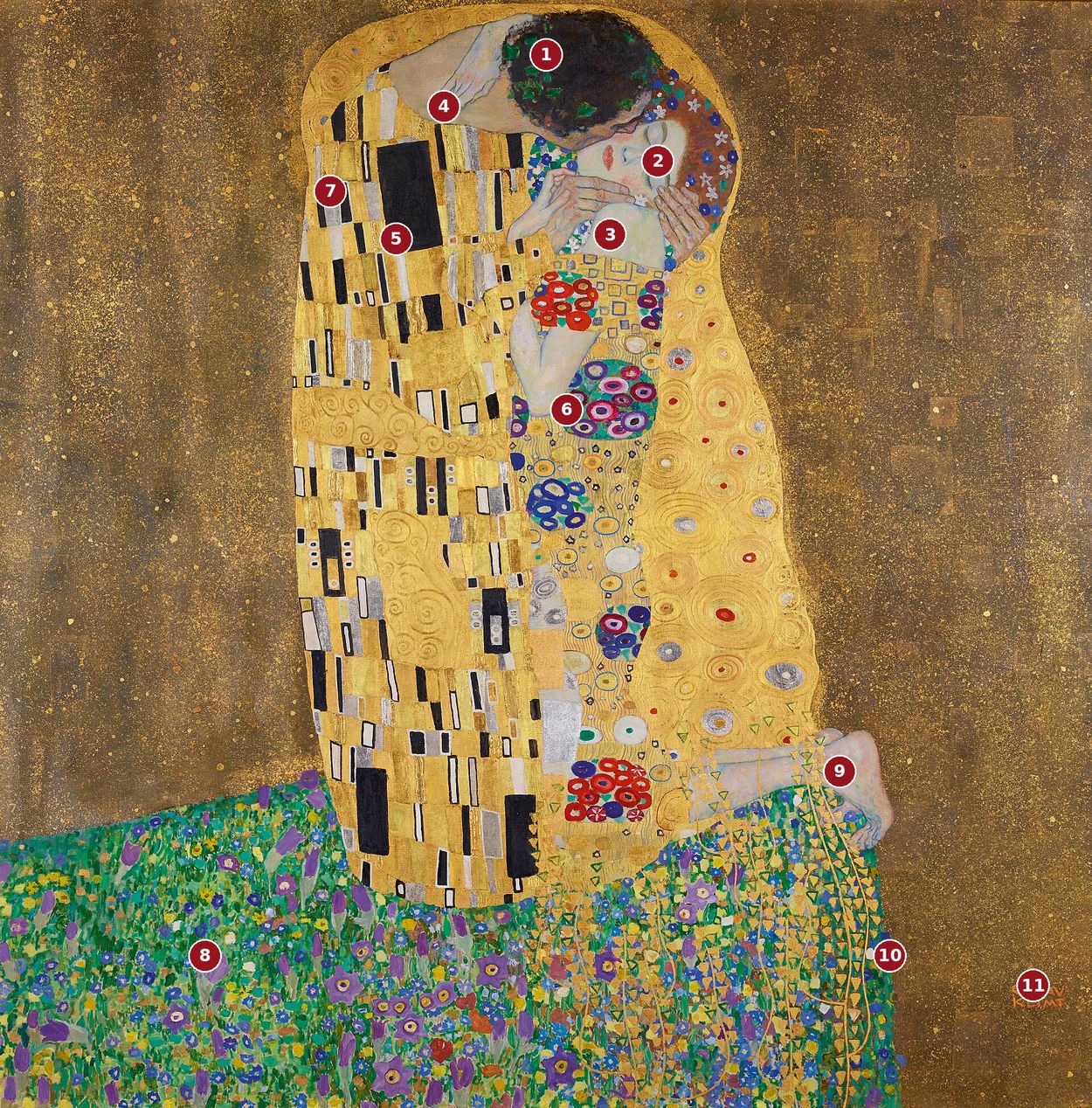
The numbers on the image match this key. Read it top to bottom, the way your eye actually travels.
| # | What it is | What to notice |
|---|---|---|
| 1 | The man’s head | Crowned with a wreath of ivy, bent almost at a right angle, the back of his neck thick and dark. His face is turned away from us. |
| 2 | The woman’s face | Eyes closed, flowers in her hair, her cheek tilted up to receive the kiss. Hers is the only face we really see. |
| 3 | The hands at her face | His long hand cups her cheek. Her own hand, fingers curled, is raised to his at her chin. |
| 4 | Her arm around his neck | Her other hand rests on the back of his neck. Whether she is pulling him in or holding him back is the oldest argument about this painting. |
| 5 | His robe | Black, white and silver rectangles, stacked like bricks or tiles on a ground of gold spirals. |
| 6 | Her dress | Circles, ovals and bright flowers in red, blue and violet, falling in a long column to her feet. |
| 7 | The golden bell | One continuous outline wraps both bodies. There are two people inside and one shape outside. |
| 8 | The meadow | A carpet of small flowers under the couple, painted almost like a mosaic. |
| 9 | Her feet | Bare, the toes curled tight, right at the edge where the meadow stops. |
| 10 | The falling strands | Thin golden tendrils trailing from her ankles down the right-hand edge of the meadow. |
| 11 | The signature | ”GUSTAV KLIMT” in small orange capitals, floating in the gold to the lower right. |
Once you have the key in your head, the painting stops being a pretty gold picture and starts being an argument.
Rectangles for him, circles for her
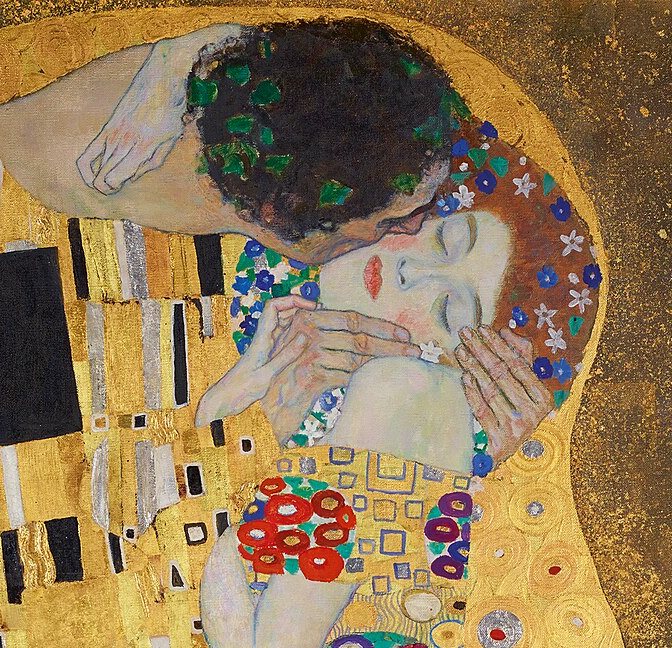
Look at the robe first. The man is built out of rectangles: solid black blocks, white blocks, grey blocks, set upright like a wall. The only curves on his side are the gold spirals in the background of the robe, and the blocks sit on top of them. Now look at her. She is built out of circles. Little rings, loops, spirals, and then flowers, which are circles that have bloomed. Even the colour obeys the rule. His side is mostly black, white and gold. Hers is full of colour.
The usual reading is the simple one, and it is right as far as it goes. The rectangle is the masculine sign, the circle the feminine one, and the two systems meet at the point where their bodies press together. Klimt did not invent this code for this picture. He had been using it for years in his portraits and friezes. What is new here is how cleanly it works. You could cover both faces and still tell, from the pattern alone, which body is which.
There is a more surprising version of this idea. The neuroscientist Eric Kandel, who won a Nobel Prize for his work on memory, wrote a long book on Vienna around 1900 called The Age of Insight. He pointed out that Klimt was a regular at the salon of Berta Zuckerkandl, whose husband Emil was one of the city’s leading anatomists, and that Klimt’s little rectangles and ovals look a great deal like the sperm cells and egg cells in the biology textbooks of the day. Kandel makes the case most directly for other Klimt paintings, so treat it as a strong hint rather than a rule. But once you have heard it, it is hard to unsee. The gold bell starts to look less like a halo and more like a cell.
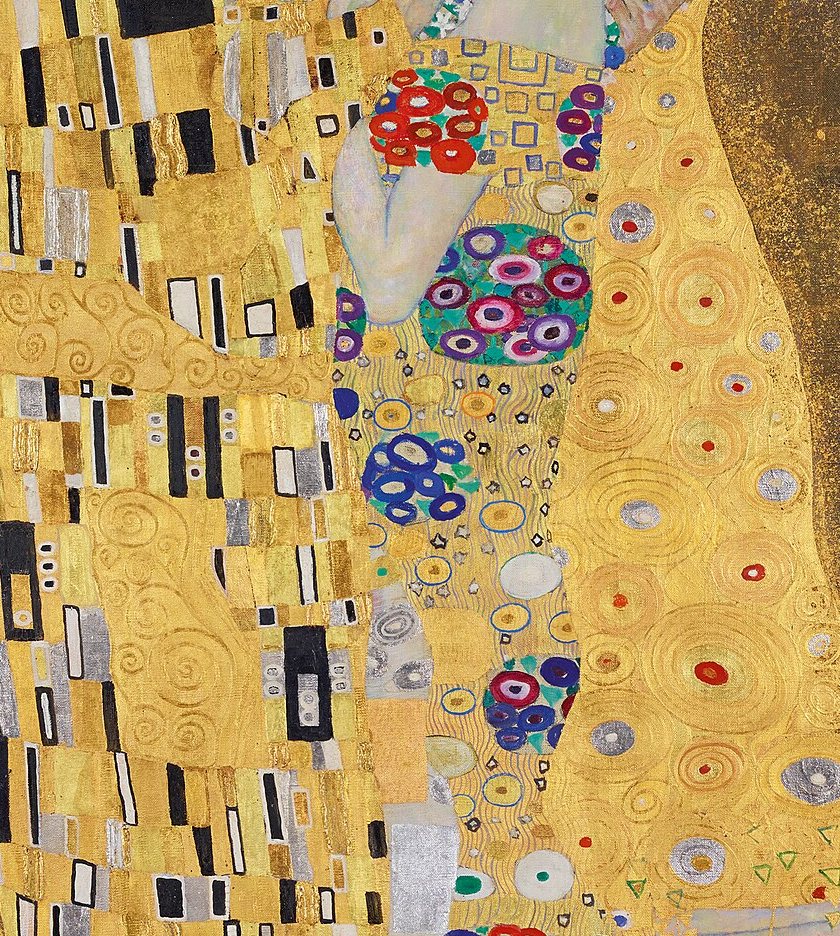
Then look at the place where the two patterns touch. Down the middle of the canvas, his rectangles stop and her flower-circles begin, with almost no gap between them. And just below her shoulder, a small patch of gold squares has crossed over onto her dress. The two systems are not sealed off. They overlap at exactly one place. That place is the embrace.
The edge of a cliff
Now drop your eyes to the bottom of the canvas. The flower meadow does not run out to the frame. It stops. On the right side it ends in a sharp line, and below that line there is nothing but more of the gold-flecked void. The woman is kneeling right at that edge. Her bare feet are on the last few inches of ground, and her toes are clenched, the way your toes clench when you are standing too close to a drop.
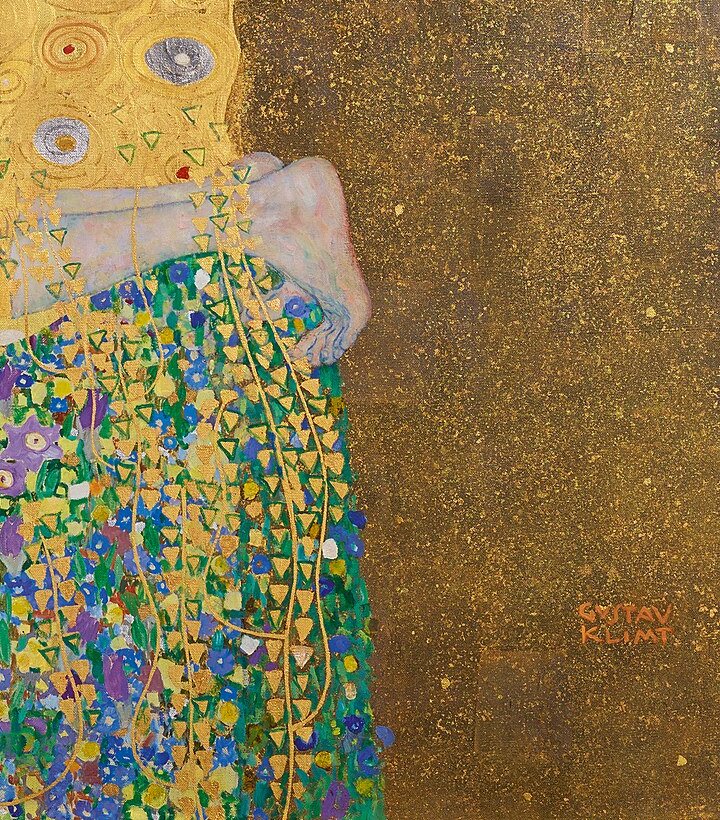
This is the detail most people walk past, and it is the one that changes the painting. Without it, The Kiss is a picture of bliss. With it, it is a picture of bliss on a ledge. The couple is safe only inside the gold shape. One step outside and there is no ground at all. The thin golden strands that trail from her ankles down the edge of the meadow, like vines or hair, make the drop feel real.
Is she surrendering, or bracing? You can make the case either way. Her eyes are closed and her head is tipped back, which reads as giving in. But her face is turned away from his mouth, so he kisses her cheek rather than her lips, and her neck is bent at an angle no one could hold for long. The hand at the back of his neck could be pulling him closer or keeping him at a fixed distance. Art historians have been arguing about her posture for a century, and Klimt never wrote a word about it. We think the ambiguity is the point. A kiss is the moment just before you know.
Gold leaf, a father’s trade, and the churches of Ravenna
The gold is not decoration laid on top. It is the ground the whole painting is built on, and it came to Klimt from two places.
The first was his family. His father, Ernst Klimt, was a gold engraver who had come to Vienna from Bohemia. Gustav grew up watching gold being worked by hand, and he trained at the Vienna School of Arts and Crafts rather than at the Academy, so he learned craft techniques that most painters never touched. Applying gold leaf, pressing patterns into it, mixing metal with paint: for him these were workshop skills, not exotic effects.
The second was Ravenna. In 1903 Klimt travelled to Italy twice, and on those trips he stood inside the Basilica of San Vitale in Ravenna. In a letter home to Emilie Flöge he dismissed much of the town as poor, but called the mosaics a thing of unheard-of splendour. Translations of the exact phrase differ. The meaning does not.
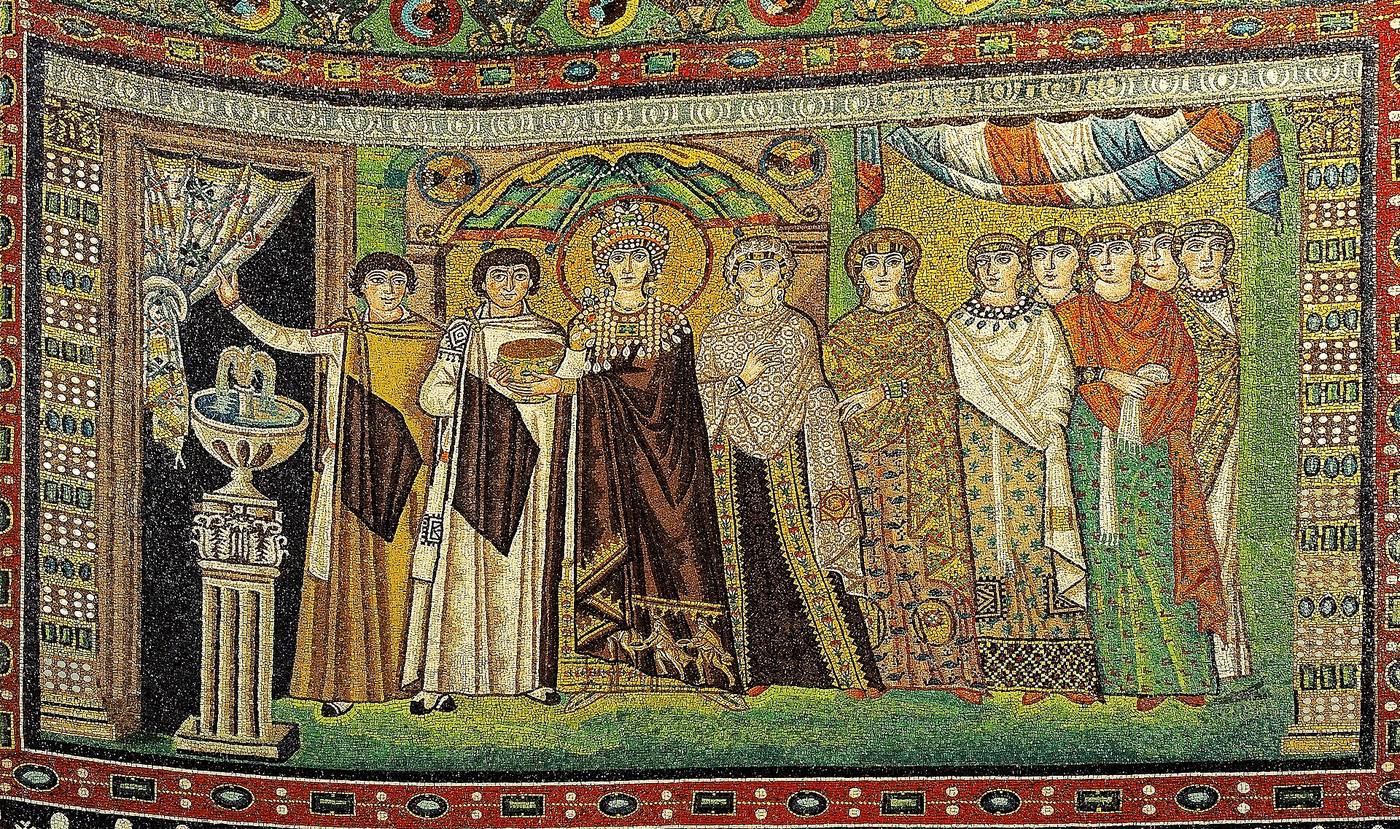
Go and look at the Empress Theodora in her apse mosaic from around 547, and you will see where Klimt’s golden period comes from. The figures are flat. The robes are not cloth so much as fields of pattern, jewels and little geometric tiles. The faces and hands are the only parts treated as flesh. And everything floats on gold, with no floor, no horizon, no real space. That is exactly the recipe of The Kiss. Two modelled faces, a few hands, a pair of feet, and then a flat universe of ornament around them.
The years that followed are what people mean by Klimt’s Golden Period. It produced the portrait of Adele Bloch-Bauer, now in New York, and the frieze for the Palais Stoclet in Brussels. The Kiss is its peak and, in a sense, its ending. Within a few years, Klimt had largely stopped using gold.
The rehearsal on the Secession wall
The Kiss was not Klimt’s first painted kiss. Six years earlier, in 1902, he made a long mural cycle for an exhibition about Beethoven at the Vienna Secession, the exhibition hall he had helped found. Its final panel shows a naked couple locked in an embrace inside a kind of golden enclosure, under a line from Schiller’s Ode to Joy, the poem Beethoven set in his Ninth Symphony: “Diesen Kuss der ganzen Welt,” this kiss to the whole world.
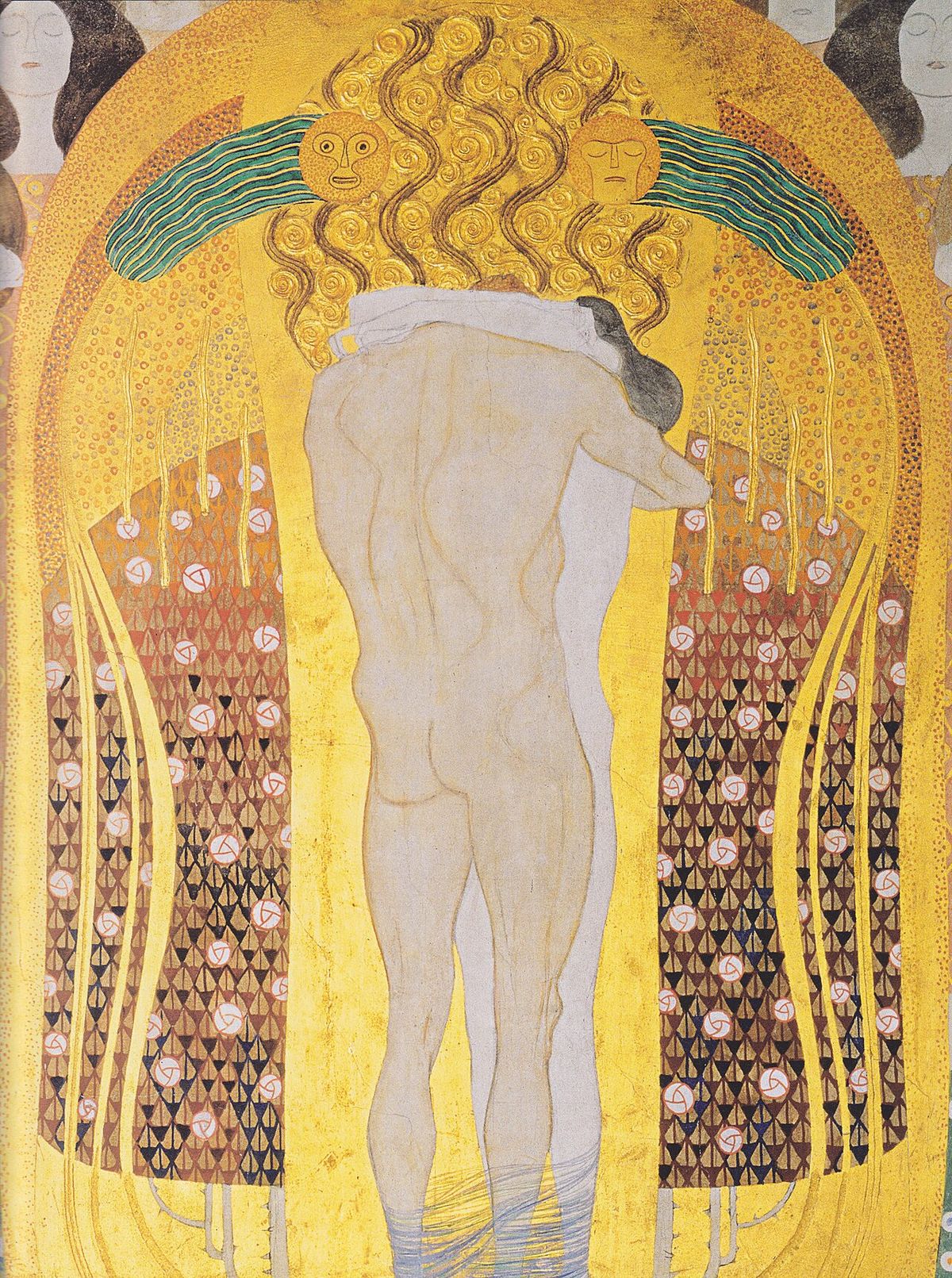
Look at the two side by side and the family resemblance is obvious. The man with his back to us, his body hiding hers. Her arms around his neck. The gold shape closing them off. In 1902 the couple is naked, with a choir of angels singing beside them. By 1908, Klimt has dressed them, removed the choir, and put them on a ledge over nothing. The utopian version became the human one.
The Beethoven Frieze still survives. It is in the basement of the Secession building, a few minutes’ walk from the Opera, and if you are in Vienna to see The Kiss, it is the best companion piece in the city.
Who is who: Klimt, Emilie Flöge, or someone else?
The question everyone asks is who the lovers were. The honest answer is that nobody knows. Klimt left no notes on the models. He kept no diary. What we have are three or four strong guesses.
The man is usually said to be Klimt himself. The thick neck, the dark hair, the long robe all fit. Klimt worked in a long, loose painter’s smock most of his life, and photographs show him in one. But he was famously uninterested in painting himself. He once wrote, in a short note, that there was no self-portrait of him, because he was not interested in himself as the subject of a painting. If this is Klimt, he made sure we could not see his face.
The woman is most often said to be Emilie Flöge. She was a fashion designer who ran a successful couture salon in Vienna with her sisters. Her sister Helene had married Klimt’s brother Ernst. She and Klimt were close companions from the early 1890s until his death in 1918. They spent their summers together at the Attersee, the lake where he painted most of his landscapes, a story we told in our post on Klimt’s forest paintings. When Klimt collapsed with a stroke in January 1918, the story goes that his first words were to send for Emilie. Whether they were lovers in the usual sense is still debated. The Belvedere’s own recent research points to Klimt’s feelings for her as one of the threads in the painting.
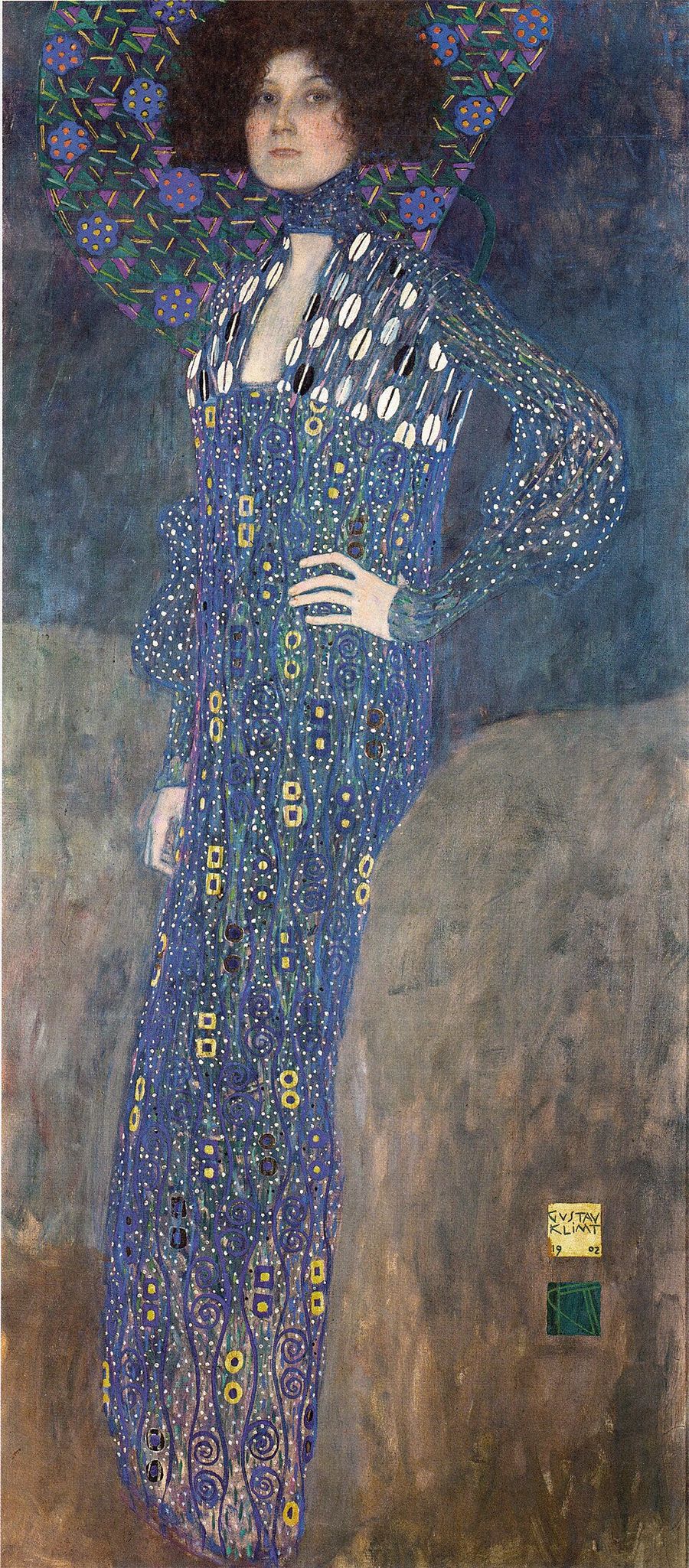
The other candidate is a model known only as “Red Hilda.” She was a red-haired woman who sat for Klimt around the same years, and many writers see her face in other paintings from the period, among them Danaë and Goldfish. The woman in The Kiss has red-gold hair. That is not proof, but it is not nothing.
There is one name you will see that does not hold up. Some websites claim the woman is Alma Mahler, the composer’s wife, who had a flirtation with Klimt years earlier. There is no evidence for it at all.
The most useful answer may be that the question is slightly wrong. Klimt was not painting a portrait of a couple. He was painting the idea of two people becoming one shape. That is why the man’s face is hidden. A portrait needs a face. A symbol does not.
The Kiss meaning: myth, Rodin, and the moment before
Because the painting has no title beyond “the lovers,” people have tried to give it a story. Two myths come up again and again.
The first is Apollo and Daphne from Ovid’s Metamorphoses. In that story, the god catches the nymph at the exact moment she turns into a laurel tree. Read that way, the woman’s stiff body, closed eyes, and the vines trailing from her feet are the transformation beginning. Bernini carved the same instant in marble three centuries earlier, and we wrote about his Apollo and Daphne at the Galleria Borghese. The other myth is Orpheus and Eurydice, the moment Orpheus turns to embrace his wife and loses her forever to the underworld. That reading explains the cliff edge beautifully. She is about to fall.
Neither myth is necessary. The Belvedere’s own recent research adds a different source, Auguste Rodin, the French sculptor whose own marble Kiss was the most famous embrace in European art at the time. Rodin visited Vienna in 1902 and saw Klimt’s Beethoven Frieze. The two men admired each other. A painted answer to the sculptor’s kiss, done in gold instead of marble, fits.
So what does The Kiss mean? Here is our reading. It is a painting about a boundary. The gold bell is a boundary between the couple and the world. The cliff is a boundary between ground and nothing. The seam where his rectangles meet her circles is a boundary between two people. Klimt has stopped time at the instant when all three boundaries are about to give way, and not one second later. That is why it does not look like a picture of sex, even though it plainly is about desire. It looks like a picture of the moment you hold your breath.
Why Vienna forgave him
Go back to the ministry and its 25,000 crowns. Franz Smola, a curator at the Belvedere, has pointed out that a schoolteacher in Vienna at the time earned around 1,200 crowns a year. The state paid roughly twenty years of a teacher’s salary for a single painting, by an artist whose university ceilings it had found too indecent to hang.
Part of the answer is that The Kiss is chaste where the ceiling paintings were not. The bodies are covered. The only bare skin is faces, hands, and feet. The desire is all in the pattern. A ministry official could buy it without a scandal.
The other part is that the Kunstschau was a celebration of Austrian design, timed to the sixtieth anniversary of Emperor Franz Joseph’s reign. The Kiss looked like Vienna’s answer to Paris: modern, decorative, rooted in craft, and unmistakably local. The state was not just buying a painting. It was buying a national style. It worked. Those University paintings, the ones that caused the scandal, were destroyed in a fire at Schloss Immendorf in Lower Austria in May 1945. The Kiss is the Klimt that survived to define him.
Where is The Kiss? The Upper Belvedere in Vienna
The Kiss hangs in the Upper Belvedere, the larger of the two baroque palaces that Prince Eugene of Savoy built in the early eighteenth century on a hillside just southeast of Vienna’s old centre. It is the hilltop palace, at Prinz-Eugen-Strasse 27, and the easiest way to reach it is tram D to the Schloss Belvedere stop. It has been in the collection since 1908 and has not travelled since.
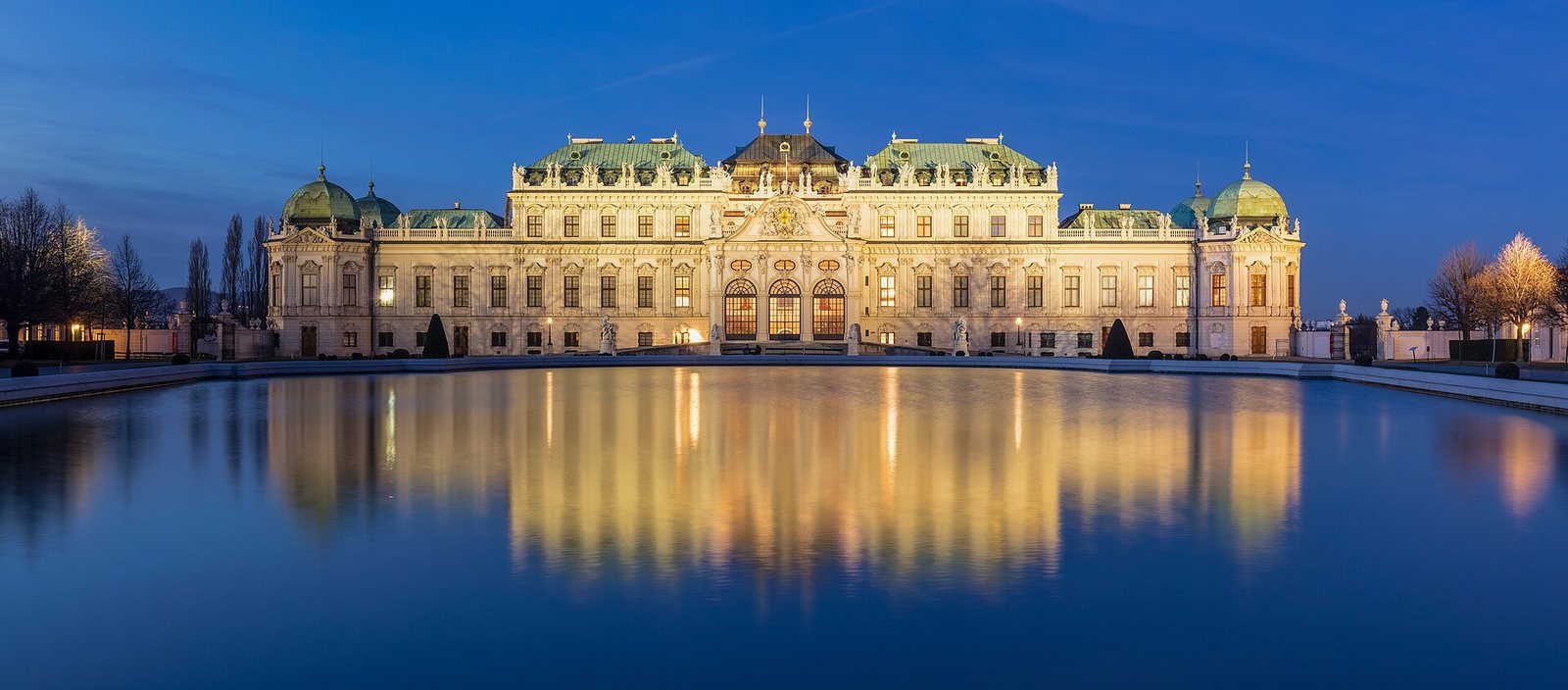
The painting is on the first floor, which Americans would call the second floor, in the galleries devoted to Vienna around 1900, alongside the Belvedere’s other Klimts, including his Judith of 1901. The museum is open every day from 9 a.m. to 6 p.m. A standard ticket to the Upper Belvedere costs 23 euros as of late 2026, and visitors under nineteen get in free. You book a time slot, so the morning crush is controlled, but this is still the busiest room in the building. The first slot of the day and the last hour before closing are the calmest.
Most people see it from the doorway, take a photo, and leave. Do the opposite. Walk up close and start at the bottom. In the room, with Chiaro running, the story of the cliff edge and the curled toes arrives just as you are looking down at those last few inches of meadow, which is the part of the painting the crowd at shoulder height never sees. Then let your eye climb. The meadow, the column of her dress, the seam where his rectangles meet her circles, her hand on his neck, and finally the bent head at the very top of the square, so close to the frame that he seems to be ducking under it.
What to look for when you are standing in front of it
Stand about two metres back first. From there the gold is one surface, and the couple reads as a single tall shape, like a tower or a flame.
Now step close. The gold breaks apart. The background is not a flat sheet of leaf but a mottled, speckled field, as if gold dust had been blown across a dark ground. The robe turns out to be as much spiral as rectangle. The circles on her side of the bell are rings within rings, some of them silver. The light changes as you move, because the metal reflects and the paint does not. That is the Ravenna effect, borrowed straight from mosaics that were designed to glitter by candlelight.
Then find the faces. The faces, the hands and the feet are the only parts painted like ordinary oil painting, with soft shadows and real skin. Everything else is ornament. Klimt is telling you where to look. The pattern is the world. The faces are the people. And the people are almost lost in it.
Look last at her feet. If you want to know whether this is a happy painting, those toes are the answer, and they are clenched.
For a slower way through the rest of the collection, our guide to looking at art when you do not “get” it works especially well in a building like the Belvedere, where one painting draws all the crowds and the rooms next to it sit almost empty.
The Kiss is a square of gold almost six feet across, and the most important thing in it is a few inches of grass running out under a woman’s toes.