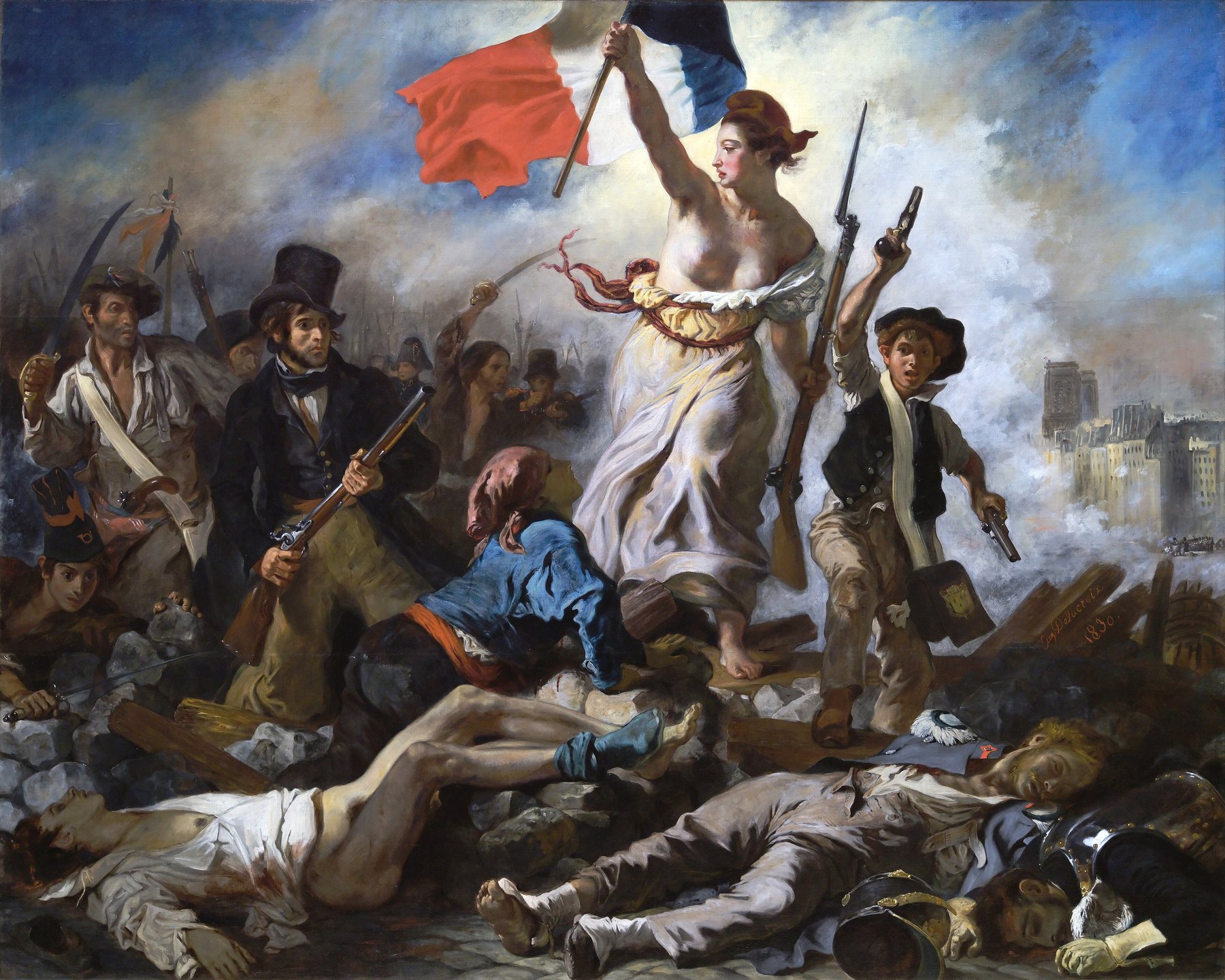
On July 28, 1830, someone climbed one of the towers of Notre-Dame de Paris and hung a tricolour flag from the top. You can still see that flag, the size of a fingernail, in the corner of Liberty Leading the People. For fifteen years that flag had been illegal. The white flag of the Bourbon kings flew over France, and the red, white and blue of the Revolution and of Napoleon was something you kept in a drawer. Within three days the king who had banned it, Charles X, was finished.
A thirty-two-year-old painter named Eugène Delacroix was in Paris for those three days. That autumn he started a canvas about them. He called it “The 28th of July,” and he put that little flag on Notre-Dame, far away in the smoke, on the right. The painting hangs in the Louvre, and most people who walk past it get two things wrong. They think it shows the French Revolution of 1789. And they think the man in the top hat is Delacroix.
Neither is right. The painting is about a different revolution, forty-one years later, and the man in the top hat is almost certainly somebody else. It is also a painting the French state bought, hung, panicked about, and hid.
The three days that weren’t 1789
In late July 1830, Charles X signed a set of decrees that suspended the freedom of the press, dissolved the newly elected Chamber of Deputies and rewrote the voting rules in favor of the old landed aristocracy. They were published on Monday, July 26. On Tuesday the printers walked out, because a muzzled press meant no work. By Wednesday Paris was full of barricades.
The French still call July 27, 28 and 29 the Three Glorious Days. Students, workers, shopkeepers and boys off the street pulled up the paving stones and fired on the king’s troops from windows. Several hundred people died. On the 29th the Louvre itself was taken. Charles X abdicated a few days later and went into exile, and his cousin Louis-Philippe, the Duke of Orléans, became King of the French. Not King of France. The change of words was the whole point.
So this is not the storming of the Bastille. There is no guillotine anywhere near this barricade. It is a picture of a constitutional monarchy being born, painted by a man who would soon be decorating that monarchy’s public buildings.
Liberty Leading the People, figure by figure
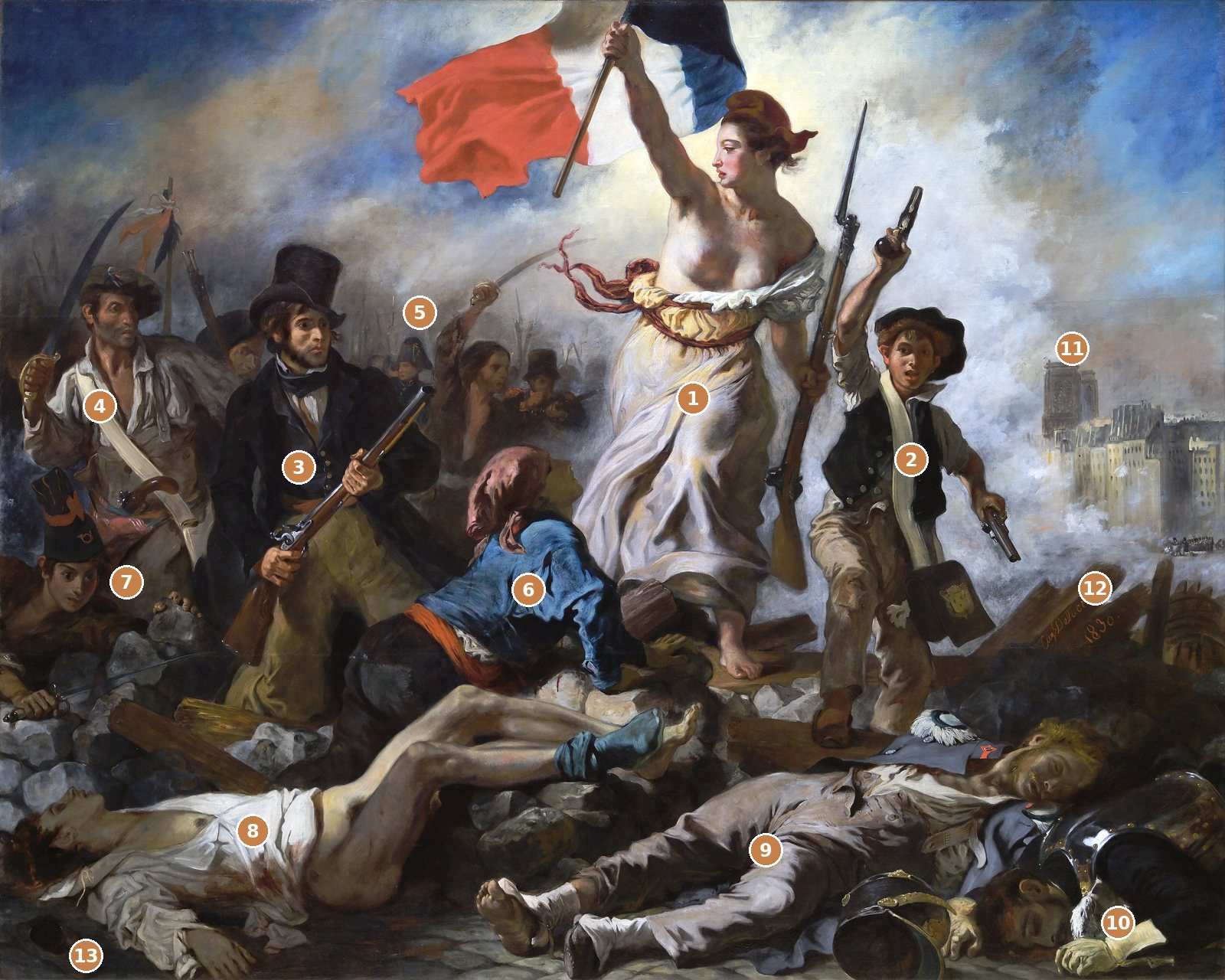
The numbers on the image match this key. Where an identification is traditional rather than certain, the table says so.
| # | Figure | Where to find him | Who it is |
|---|---|---|---|
| 1 | Liberty | Center, barefoot, flag in her right hand, musket in her left | An allegory, not a portrait. Later called Marianne |
| 2 | The boy with two pistols | Right of Liberty, mouth open, a cartridge pouch at his hip | A Paris street kid. Nicknamed Gavroche, after a character Victor Hugo invented thirty years later |
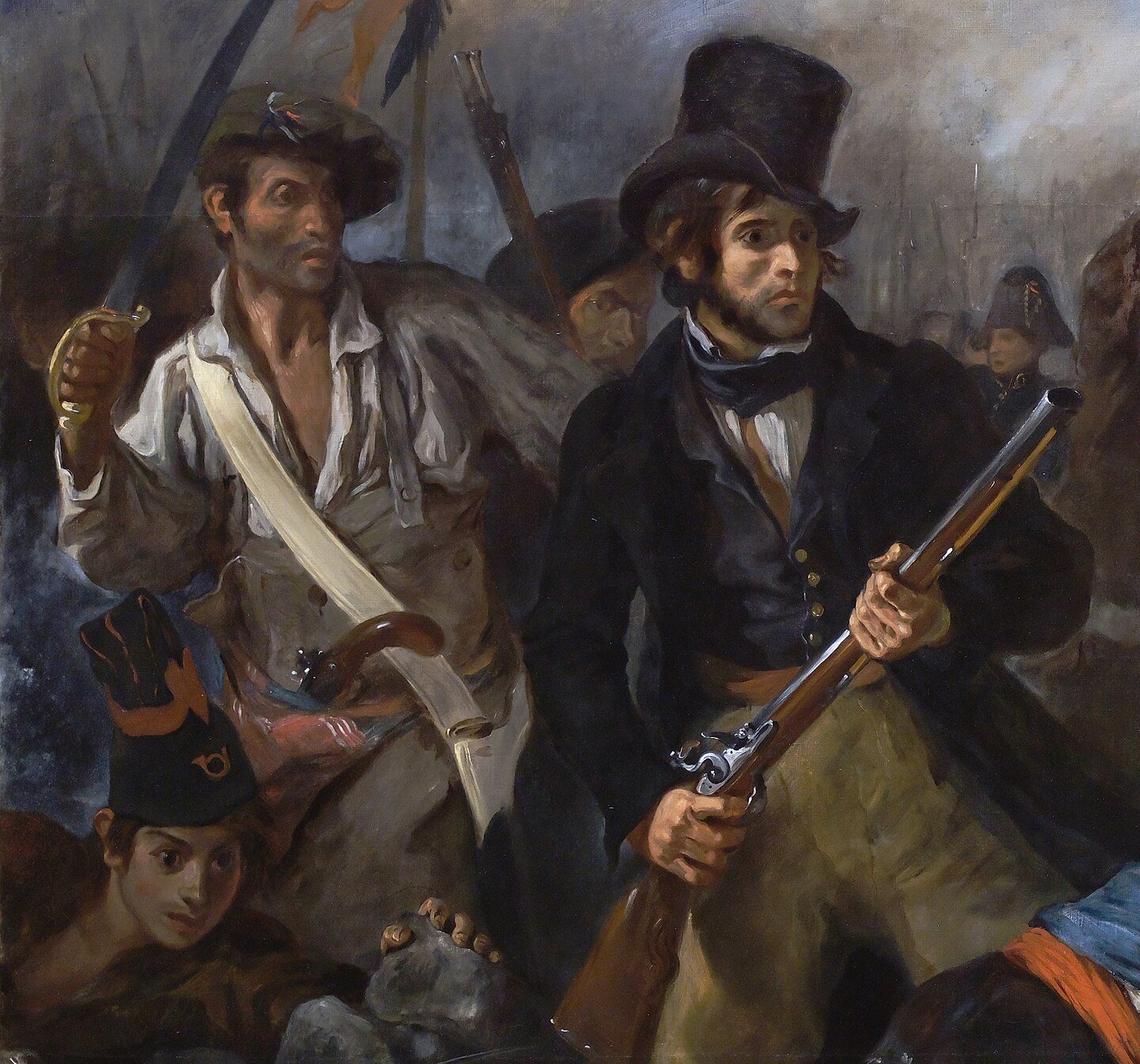
| 3 | The man in the top hat | Left, kneeling on the barricade with a double-barreled gun | Long said to be Delacroix. Modern historians disagree |
| 4 | The worker with a sabre | Far left, white shirt, a pistol in his sash | A factory hand or laborer |
| 5 | The polytechnicien | Background, behind the top hat, in a bicorne | A student of the École polytechnique |
| 6 | The wounded man in blue | Kneeling at Liberty’s feet, looking up | A workman, dressed in blue, white and red |
| 7 | The boy in the National Guard cap | Far left, half hidden behind paving stones | A second street kid, in a captured cap |
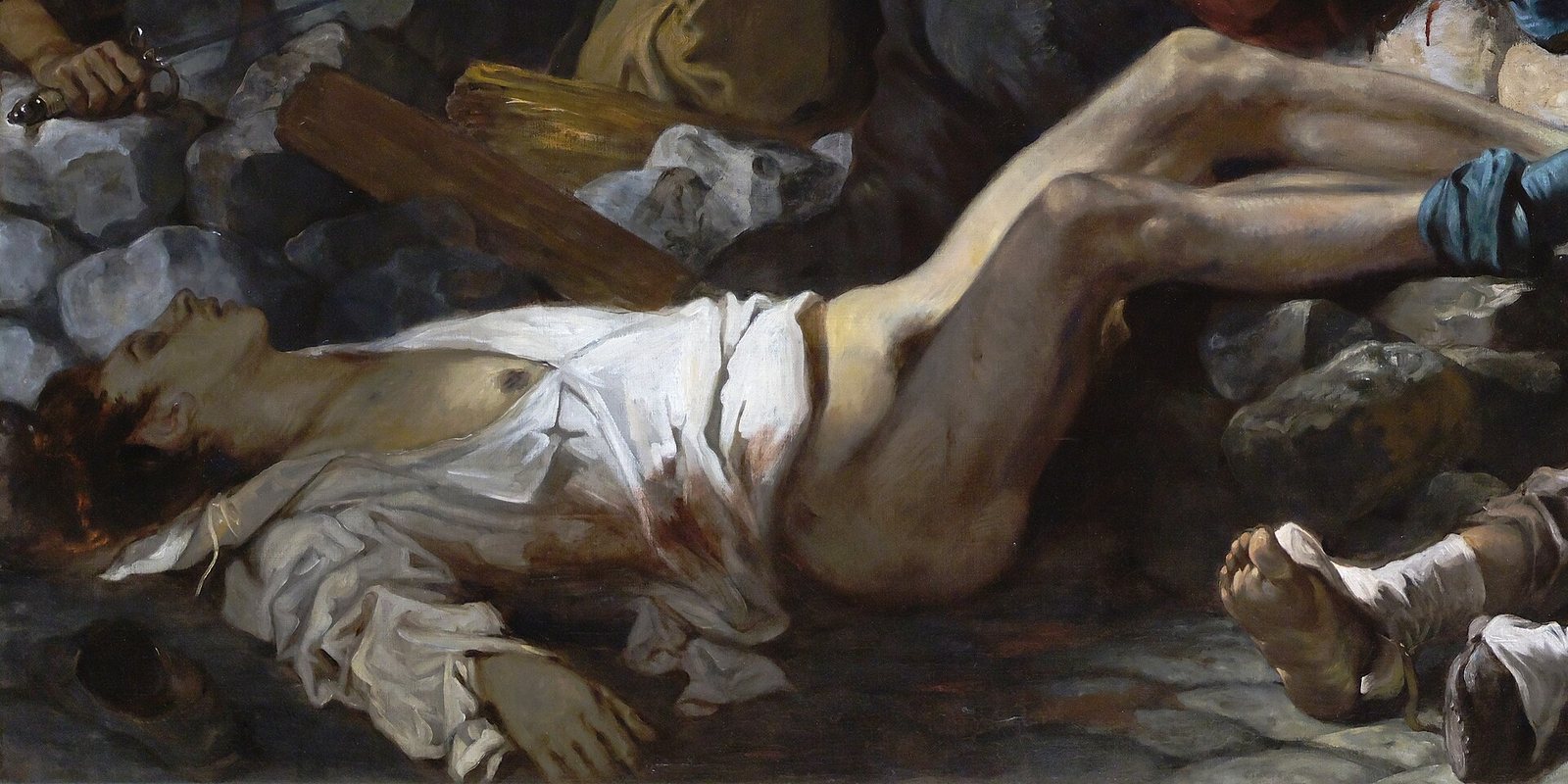
| 8 | The half-stripped dead man | Lower left, one blue sock | An insurgent, already looted |
| 9 | The dead Royal Guard | Lower right, on his back, his shako rolled away | One of the king’s soldiers |
| 10 | The dead cuirassier | Lower right corner, face down, in a breastplate | Royal cavalry |
| 11 | Notre-Dame | Far right, in the smoke, a tiny tricolour on the tower | The flag that dates the scene to July 28 |
| 12 | The signature | Right, mid-height, in red: “Eug. Delacroix 1830” | Painted like graffiti on the barricade |
| 13 | The lost shoe | Bottom left corner, next to the dead man’s hand | Hidden under varnish until 2024 |
Who is the woman? Liberty, not a portrait
Start where your eye goes anyway. She is not a goddess on a cloud. She is a big, strong, sunburned woman of the street, barefoot, with her dress slipping off her shoulders, climbing over the dead. Her head is in profile, turned back toward the crowd, as if she is shouting “come on.” In her right hand is the tricolour. In her left is an infantry musket with a bayonet, the kind of weapon you took from a soldier.
The red cap on her head is the Phrygian cap, the bonnet of freed slaves in ancient Rome and the badge of the 1789 revolutionaries. That is the one direct quotation of the earlier revolution in the whole picture, and it sits on the head of an allegory, not a real person. Delacroix was careful about that.
Critics went after her in 1831. Classical allegories were supposed to be smooth, white and idealized. This one had dirt on her skin and hair under her raised arm. One reviewer in the Journal des artistes wrote that Delacroix had painted “our beautiful revolution with mud.” That was meant as an insult. It is also a pretty good description of what Delacroix was trying to do.
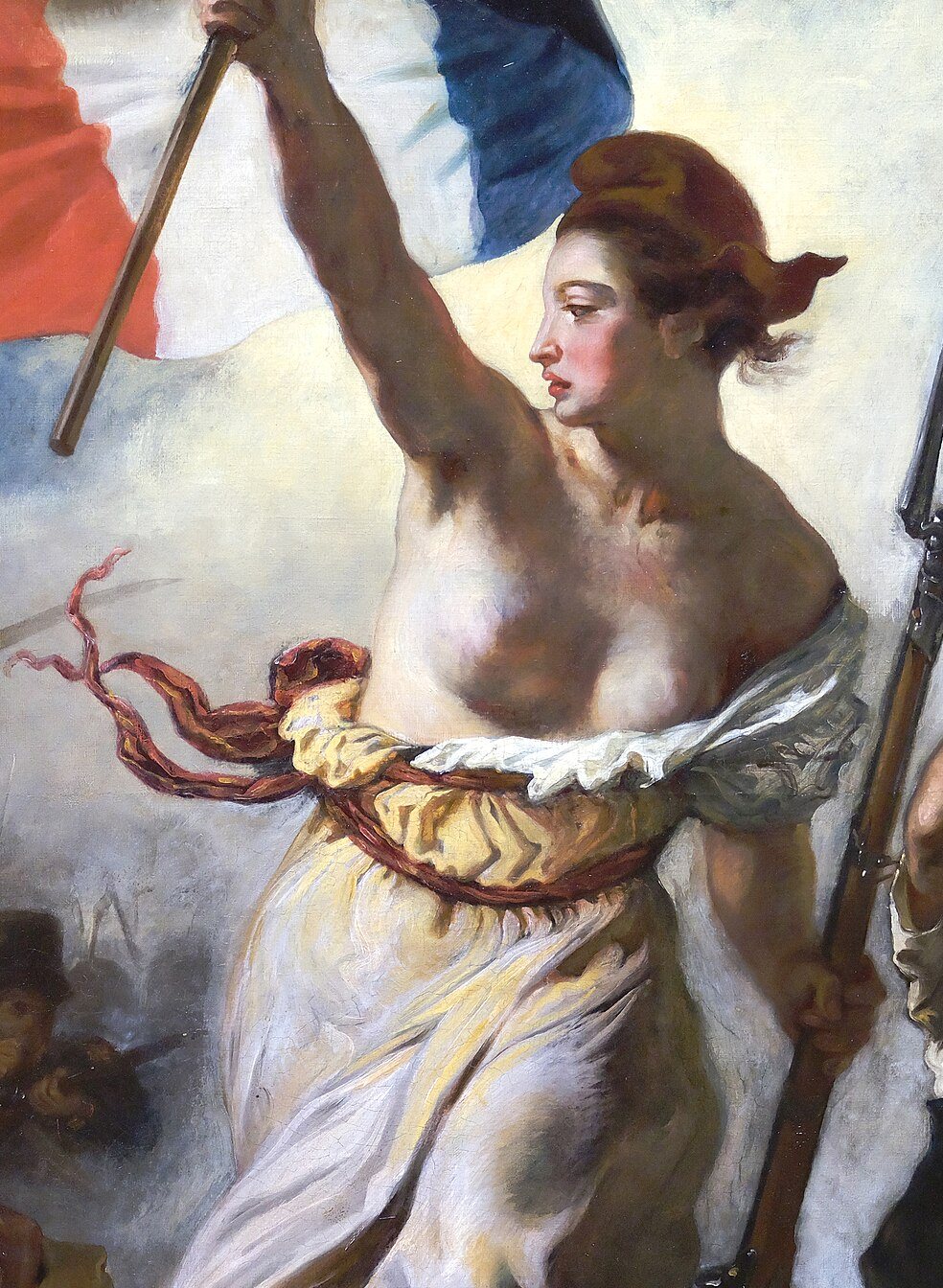
Over the next century she became Marianne, the national personification of the French Republic, and the image slid into the national bloodstream. From 1978 to 1995 she was on the hundred-franc banknote, next to a portrait of Delacroix.
The boy with two pistols, who isn’t Gavroche
To Liberty’s right runs a boy of maybe twelve or thirteen. He wears a black velvet beret and a waistcoat, has a pistol in each hand, one raised and one down, and is yelling. Across his chest is a white strap holding a cartridge pouch big enough for a grown soldier. It looks borrowed from someone who no longer needed it.
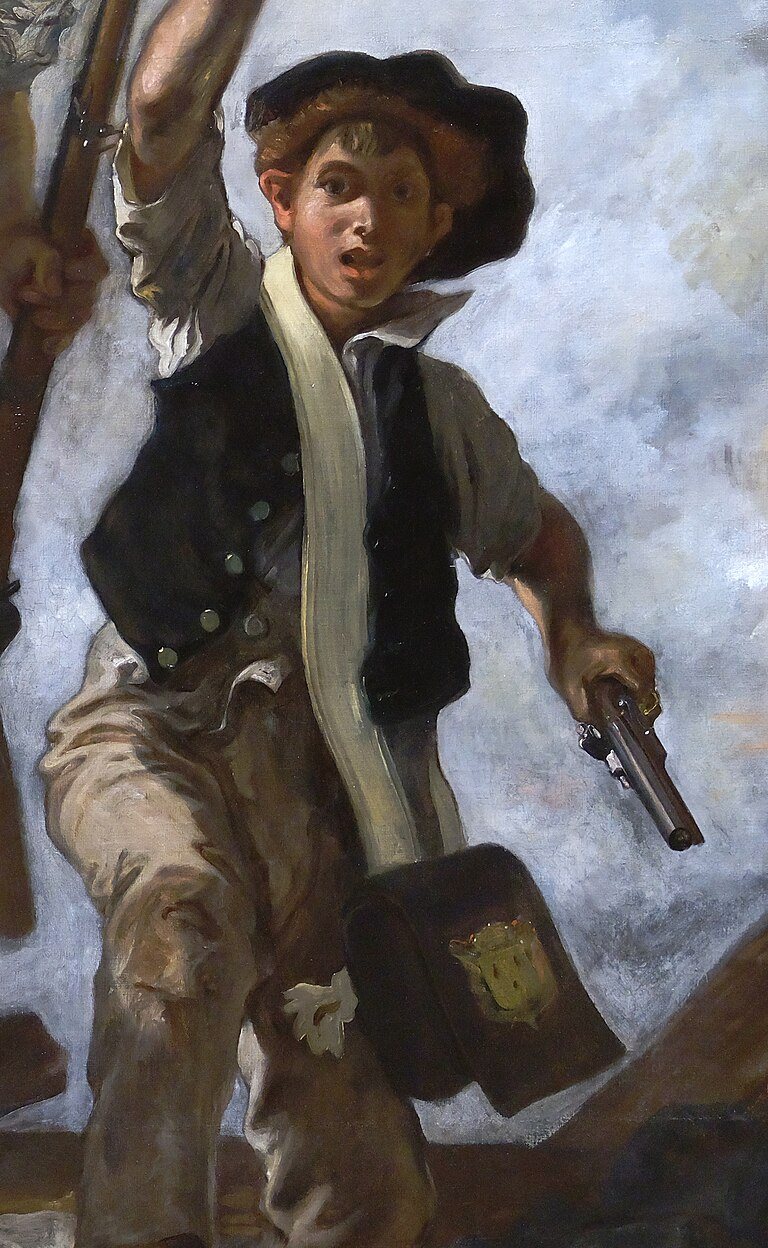
Everyone calls him Gavroche. Gavroche is the street urchin in Victor Hugo’s Les Misérables, who dies singing on a barricade while collecting cartridges from dead soldiers. The resemblance is so strong that it is widely believed Hugo had this boy in mind. But look at the dates. Les Misérables was published in 1862. Hugo’s barricade is set during a different uprising, in June 1832. Delacroix painted his boy in 1830. If anyone borrowed, it was Hugo. Côme Fabre, the Louvre’s curator of nineteenth-century French painting, makes exactly this point: the boy is nicknamed Gavroche, even though Hugo’s character came much later.
The 2024 restoration also changed where he stands. Under the old varnish he seemed to walk beside Liberty. With the varnish thinned, it became clear that he runs slightly ahead of her. He is not following Liberty. He is leading her.
The man in the top hat: is it Delacroix?
Now the famous question. On the left, kneeling on the barricade, is a man in a tall black hat, a black frock coat and a loose cravat, gripping a double-barreled gun. He is the only figure with a face precise enough to look like a portrait. For a long time guidebooks said it was Delacroix himself, putting himself on the barricade.
It is a lovely idea. It is probably wrong. Modern art historians reject the self-portrait reading. Other names have been put forward, including the theater director Étienne Arago and Frédéric Villot, a friend of Delacroix who later became a curator at the Louvre. There is no consensus, and no document from Delacroix settles it.
What we do have is Delacroix’s own account of how he felt. In October 1830 he wrote to his brother Charles, a retired general: “I have undertaken a modern subject, a barricade, and if I have not won victories for my country, at least I will paint for her.” Read that sentence again. It is the sentence of a man offering a painting instead of a battle. Most historians read it as a quiet admission that he was not on the barricade, and a man who writes that to his brother is not likely to have painted himself there with a gun.
There is a better reading of the top hat, and it comes from the clothes. The hat, the coat and the cravat say bourgeois, a gentleman. But look lower. His trousers are a workman’s trousers, and he wears a workman’s belt. He is kneeling in the rubble. The figure is deliberately mixed, part gentleman and part laborer, and that mixing is the message. In 1830 the middle class and the working class fought on the same side for three days. The man in the top hat is that alliance, in one body.
The worker with the sabre and the student in the bicorne
To the top hat’s left is his opposite. A rough-faced man in a white shirt, a beret on his head, a sabre raised in his fist and a pistol jammed into his sash, which is tied with a red scarf. He is usually described as a factory worker. He looks like a man who has been fighting since Tuesday.
Behind them, small and easy to miss, is a young man in a bicorne hat. That is the uniform of the École polytechnique, the elite engineering school, whose students joined the insurgents in 1830 and were celebrated for it. Put the three together and you have a deliberate set: the worker, the bourgeois, the student. Delacroix lined up the social classes of Paris on the left side of his barricade like a cast list.
And below them, almost buried, is a figure most people never notice. A boy peers over the paving stones, clutching them with both hands. On his head is a tall black cap with a horn badge on the front, the cap of the voltigeurs of the National Guard. It is not a child’s cap. Whose it was, we can only guess. There are two street kids in this picture, not one, and the second is the one who looks frightened.
The wounded man in blue, white and red
At Liberty’s feet, a man drags himself up from the stones and twists to look at her. His head is wrapped in a knotted kerchief. He wears a blue jacket, a white shirt and a red sash.
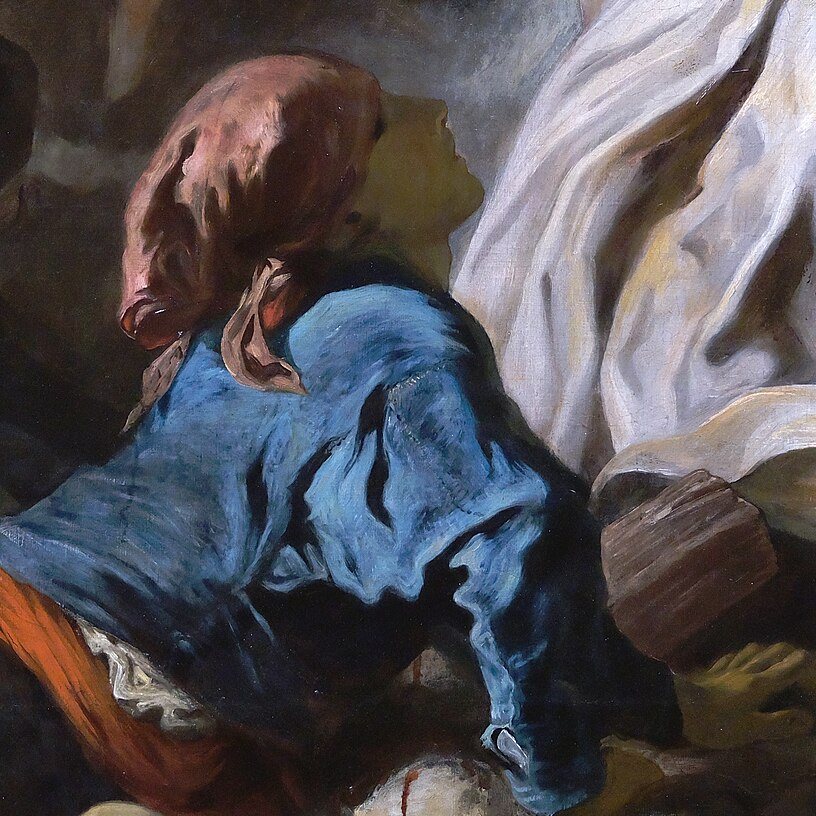
Blue, white and red. He is dressed in the flag. He is also the only figure in the painting who looks at Liberty, rather than past her or at us. A dying man looks up at the thing he has been fighting for, and he is wearing its colors.
The restorers found that Delacroix scattered tiny touches of blue, white and red across the canvas, far from the flag. Laurence Mugniot, one of the two restorers, said he “hid tiny dabs of blue, white and red all over in a subtle sprinkling to echo the flag.” The flag is not just in Liberty’s hand. It is in the clothes, the wounds and the smoke.
The dead at the bottom of the barricade
The bottom third of the painting is the part people walk past.
On the left lies a young man, stripped of his trousers, his shirt pulled up, one blue sock still on his foot. Bodies on the barricades were looted for anything wearable, and this one has been picked over. Delacroix took the pose partly from the tradition of the dead hero and partly from a painting he knew from the inside. As a young man he had posed for Théodore Géricault, for one of the figures in The Raft of the Medusa. That painting now hangs in the same room as this one.
On the right lie two of the king’s men. One, on his back with his grey coat open, is a soldier of the Royal Guard. His shako, the tall military cap, has rolled away on the ground. Beside him, face down in a steel breastplate, is a cuirassier, a heavy cavalryman, recognizable by his white epaulette.
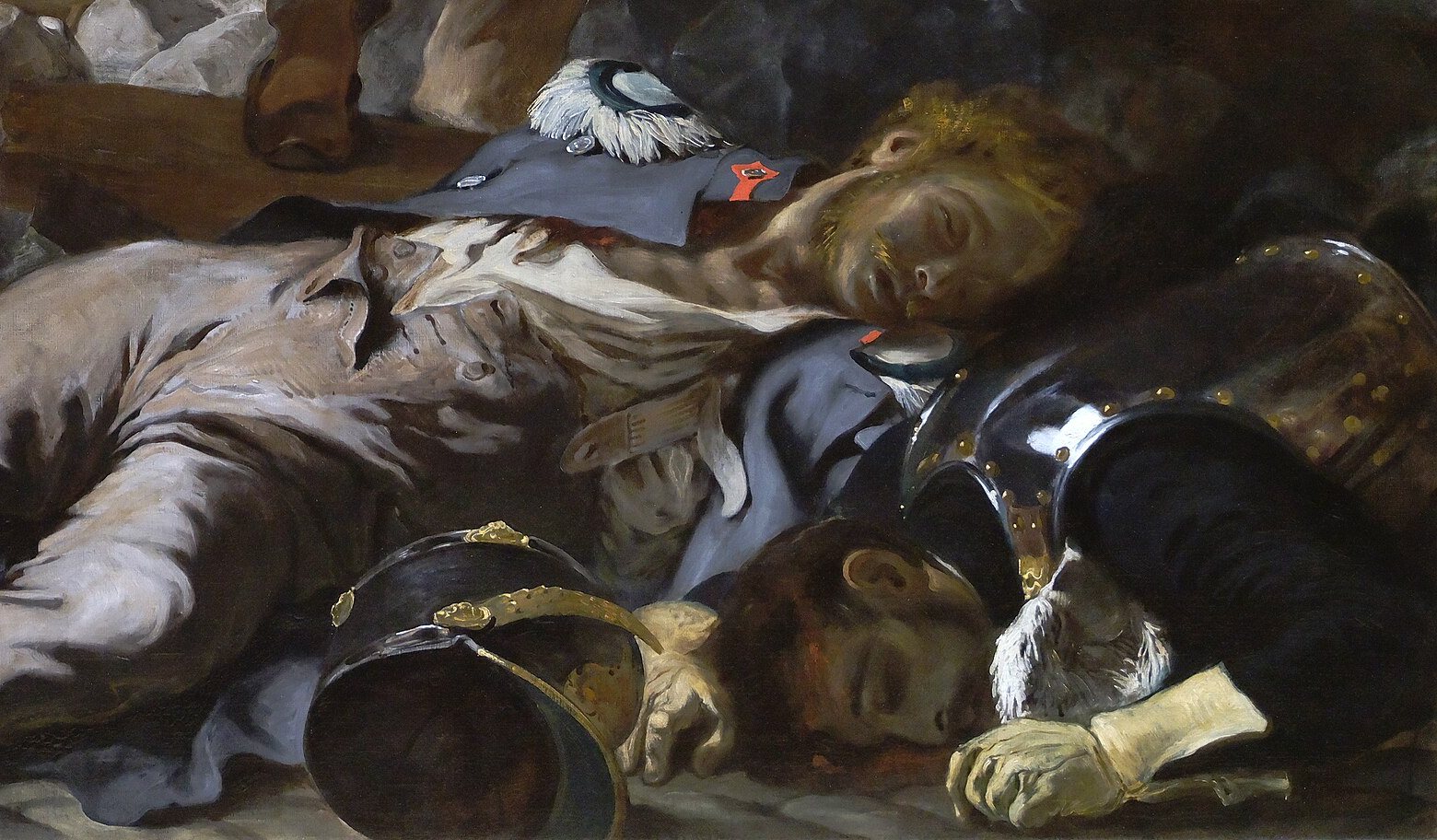
Notice that Delacroix gives the dead on both sides the same weight, the same light and the same care. Nobody in this pile is a villain. The Louvre’s own writing about the painting talks about its realism, about the hideous sight of corpses left in the streets for days. In 1830 Parisians had seen exactly that. Liberty is not walking on clouds. She is walking on people.
Notre-Dame, and a city that doesn’t quite fit
Look past the boy, over his shoulder, into the smoke. There are the two square towers of Notre-Dame, and on one of them, if you get close, a flag the size of a fingernail. Red, white and blue. That is the flag hung on the morning of July 28, and it is why Delacroix’s title was “The 28th of July” and not just “A Barricade.”
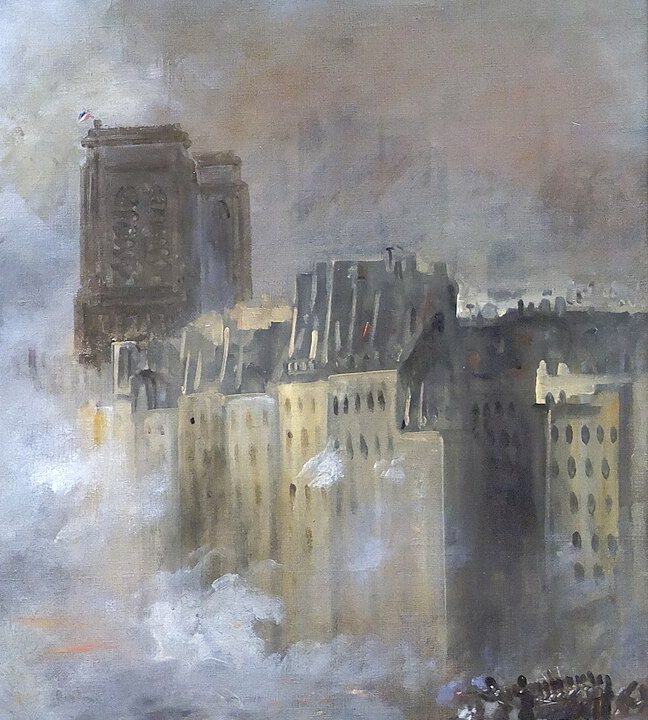
Below the towers is a row of tall houses on the river. The restoration showed that each facade is different from its neighbor, and that the gunfire coming from the windows is painted as tiny pink streaks in the smoke. The geography is loose. You cannot stand at a single spot in Paris and see this exact view, and historians still argue about where the barricade is supposed to be. Delacroix was not making a map. He wanted the cathedral in the frame, because the cathedral was Paris. If you want the building’s own story, our Notre-Dame guide picks it up from there.
Liberty Leading the People meaning: why the state hid it
The painting went to the Salon of 1831, which opened in the spring, under the title “The 28th of July. Liberty Leading the People.” It was a hit and a scandal at the same time. In August 1831 Louis-Philippe’s government bought it from Delacroix for 3,000 francs. It was meant to honor the revolution that had made the new king.
The problem was that revolutions do not stay finished. Within a year Paris had a cholera epidemic and, in June 1832, another uprising, the one Hugo would write about. A picture of a bare-breasted Liberty leading armed workers over the bodies of royal soldiers stopped looking like a celebration of the government. It started looking like instructions.
The painting came down. It was returned to Delacroix, and it disappeared from view for years. In 1848 the critic Champfleury wrote that it had been hidden in an attic for being too revolutionary. That same year a new revolution brought in the Second Republic, and the painting came out briefly. It was shown again at the great Paris world’s fair of 1855, where Delacroix had a room to himself. It went to the Musée du Luxembourg, the national museum of living artists, in 1863, the year Delacroix died. It entered the Louvre in 1874, under the Third Republic. By then a Republic could finally hang it without flinching.
Every French government after 1830 had to decide whether this painting was about them or against them. The answer kept changing.
What the 2024 restoration brought back
For most of the twentieth century, Liberty Leading the People was a brown painting. Visitors saw a yellow dress, a muddy sky and a dull flag, and they assumed that was Delacroix. It wasn’t. It was varnish.
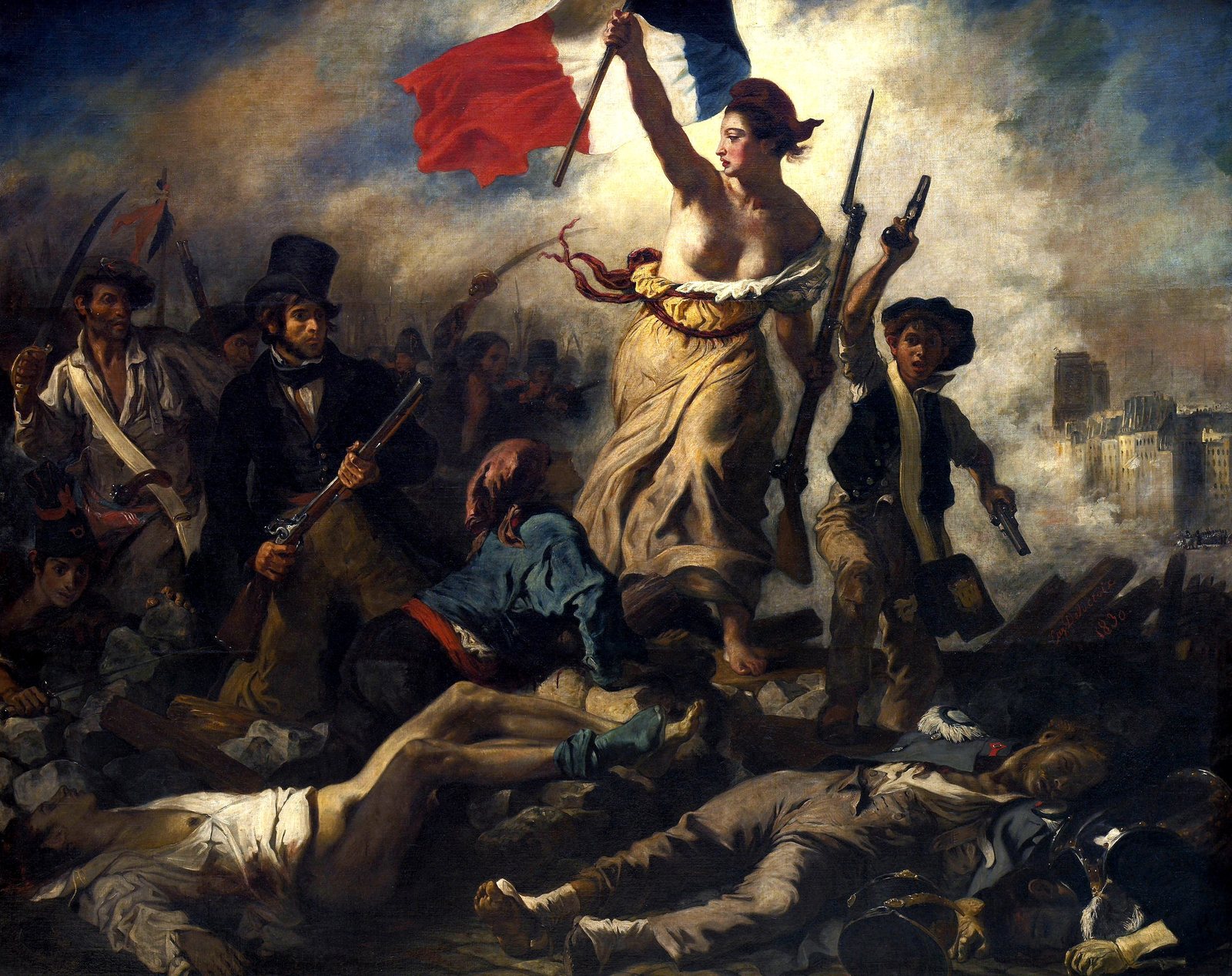
In the autumn of 2023 the Louvre’s restorers, Bénédicte Trémolières and Laurence Mugniot, started work. They worked for about six months and took off eight layers of oxidized varnish, along with the grime trapped inside them. The last full restoration, in 1949, had laid down a thick varnish and some retouching of its own. Sébastien Allard, the director of the Louvre’s paintings department, put the effect simply: the whites and the shadows had all ended up melting together under the yellowish layers.
What came back was a different painting. The sky is white cloud and white smoke, not brown haze. The flag is sharp. And Liberty’s dress, which everyone had described for decades as yellow, turned out to be light grey. Delacroix had painted the whole thing grey, then brushed yellow on top, strongest at her bust and fading down toward her legs. The solid yellow was a retouching from 1949. A shoe appeared in the bottom left corner, old, worn and leather, that had melted into the paving stones. The painting went back on the wall in the spring of 2024.
The difference is easiest to see in the corners. Stand to one side, find the lost shoe, then look up at the sky behind Liberty’s raised arm. Chiaro tells the story of the eight varnish layers while you are looking at that sky, which is the only part of the canvas where you can really see what the restorers took away.
Where to see Liberty Leading the People in the Louvre
The painting is in the Louvre’s Denon wing, on the first floor, in the Salle Mollien, which the museum numbers as Room 700. This is the long red room of big French Romantic paintings. It is about 2.6 meters high and 3.25 meters wide, so you will see it from the doorway. Géricault’s Raft of the Medusa hangs in the same room, and David’s Coronation of Napoleon is close by in the Salle Daru, a room our guide to the Coronation’s crowd walks you through figure by figure.
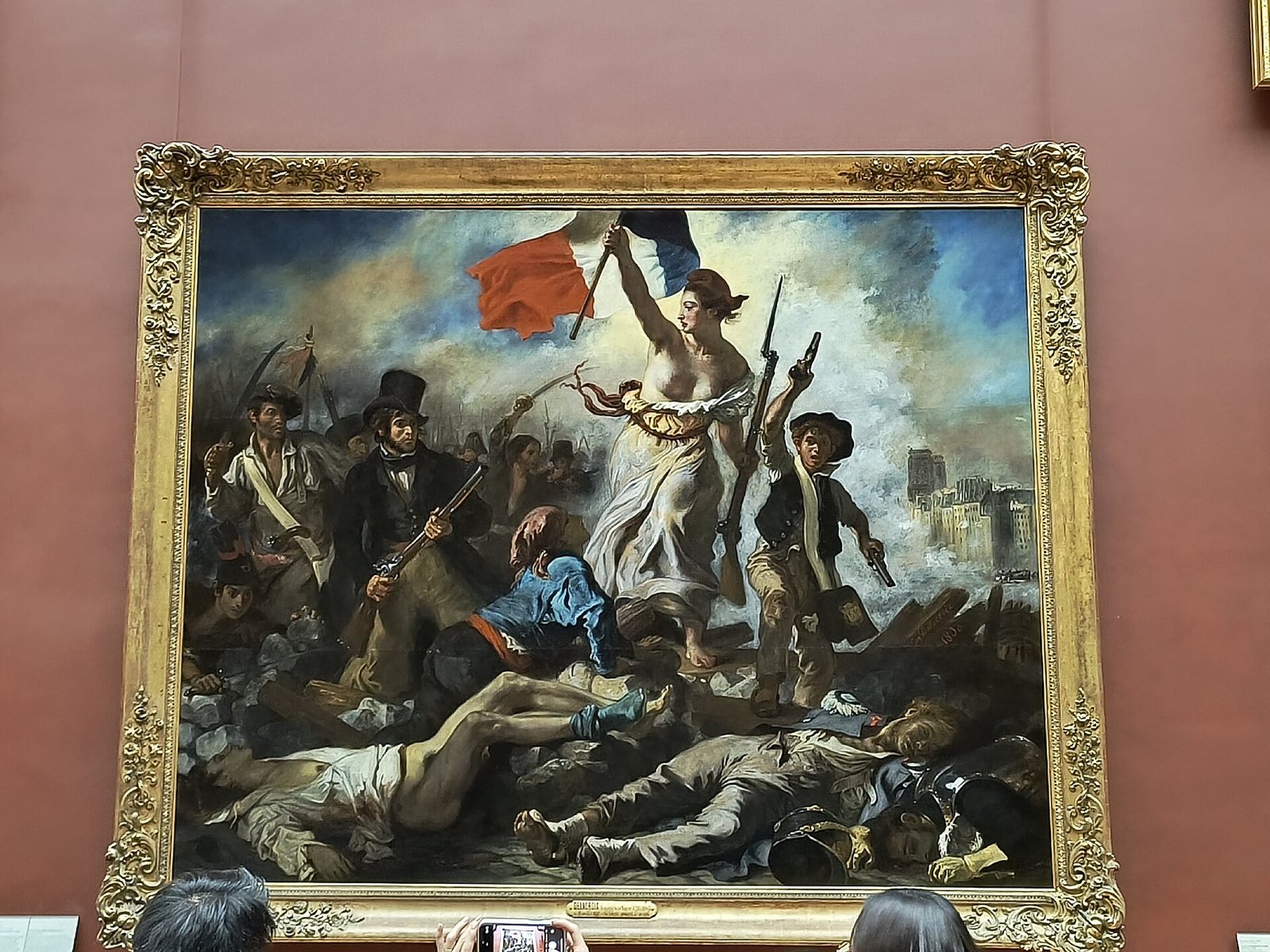
The Louvre’s official site gives its hours as 9 a.m. to 6 p.m. on Monday, Thursday, Saturday and Sunday, and 9 a.m. to 9 p.m. on Wednesday and Friday. It is closed on Tuesdays. Tickets are 22 euros for residents of the European Economic Area and 32 euros for other visitors, and the museum recommends booking a time slot in advance. The Wednesday and Friday evenings are the best time for this room. The crowds thin out once the Mona Lisa line is gone, and the Salle Mollien is a short walk from her room.
The painting has traveled more than most. In 1999 it flew to Tokyo inside an Airbus Beluga cargo plane, because it was too big for a jumbo jet. In February 2013, on loan to the new Louvre-Lens, it was defaced with a marker. A restorer cleaned it off in under two hours.
If you like reading a crowded canvas this way, Raphael’s School of Athens gets the same numbered key, and the whole series is collected in Famous Paintings, Every Figure Identified.
What to look for when you stand in front of it
Give it ten minutes.
First, get close to the right-hand edge and find the signature, “Eug. Delacroix 1830,” in red paint on the timber of the barricade, at about the height of the boy’s knee. He signed it the way someone would scrawl on a wall in the street.
Second, find the little tricolour on Notre-Dame. It is tiny. It is the date of the painting.
Third, look at the top hat, then drop your eyes to his trousers and belt. The whole argument about class is in the gap between his head and his knees.
Last, go down to the bottom left and find the shoe. For decades nobody could see it. Now it is the quietest object in the loudest painting in the Louvre. You can hear more of the painting’s story on our free Louvre audio guide, which stops at it.
Delacroix lived another thirty-three years. He became one of the most honored painters in France and painted ceilings and libraries for the same state that had hidden his barricade in an attic. But he never painted anything like it again. Somewhere in the smoke over the river, on a cathedral tower, a flag the size of a fingernail is still marking the 28th of July.