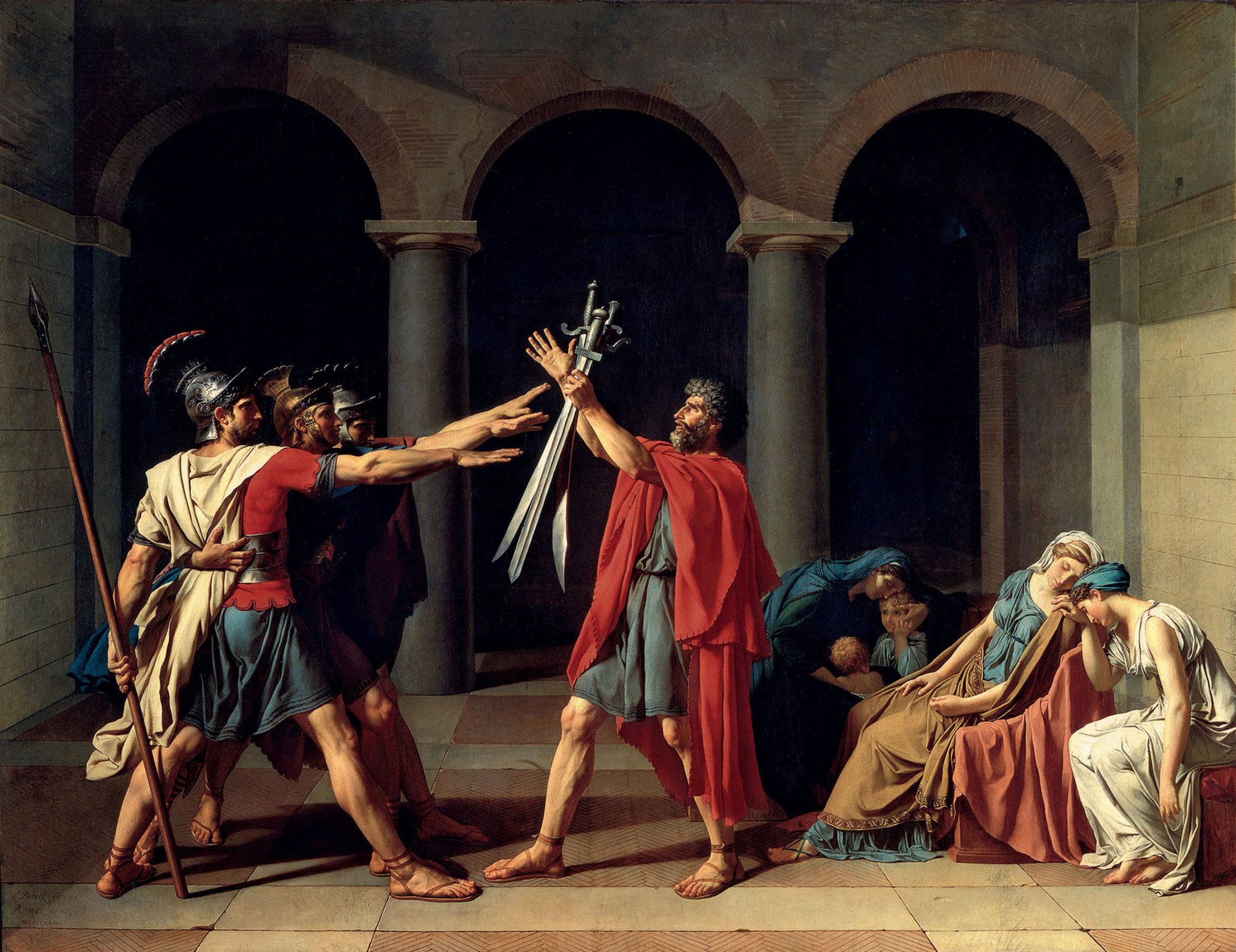
In the summer of 1785, Jacques-Louis David was in Rome, finishing a painting for the King of France. It showed three brothers swearing to die for their country. David opened his studio to visitors before shipping it to Paris, and the painting made him famous across Europe before it had left Italy. That painting is the Oath of the Horatii. Its patron was Louis XVI.
Eight years later, Louis XVI was dead, and David had voted for his execution. In July 1793 a friend of his, the radical journalist Jean-Paul Marat, was stabbed in his bathtub by a twenty-four-year-old woman from Normandy named Charlotte Corday. The day after the murder, the National Convention asked David to paint him. The result, The Death of Marat, is the most effective piece of political propaganda ever painted by a great artist. It is also, oddly, a quiet picture: one man, one box, one letter, and a wall of empty air.
The two canvases bracket the French Revolution. One was painted for a king and became a revolutionary banner. The other was painted for the revolutionaries and spent decades hidden from them. You can see one in Paris, in the same red room as David’s Coronation of Napoleon. The other is not where most people assume it is.
The commission David ignored
The Oath began as a royal commission. In the early 1780s the Bâtiments du roi, the king’s arts administration under the Comte d’Angiviller, was paying painters to make large pictures of ancient virtue, the idea being that a public raised on Roman heroism would make better subjects. David had caught d’Angiviller’s attention with his Belisarius at the Salon of 1781. He was given a subject from early Roman history.
He did not paint it the way he was told. A teaching sheet the Louvre’s education team uses notes, drily, that the painter did not respect the format he was commissioned to deliver, and the picture was approved anyway. It is 3.30 metres high and 4.25 metres wide, close to eleven by fourteen feet. He also changed the scene.
The story comes from Livy. Around the seventh century before Christ, Rome and the neighboring city of Alba Longa were at war. To save bloodshed, each side picked three champions. Rome chose three brothers, the Horatii. Alba chose three brothers, the Curiatii. The families were linked by marriage: a Curiatius sister, Sabina, was married to one of the Horatii, and a Horatius sister, Camilla, was engaged to one of the Curiatii. Whatever happened, the women would lose someone.
Livy describes the fight. He does not describe an oath. There is no scene in the ancient sources of three brothers swearing on their father’s swords. The moment David built the whole picture around is his own invention. He probably took the mood from Pierre Corneille’s tragedy Horace, which French audiences knew by heart, but the gesture itself is his.
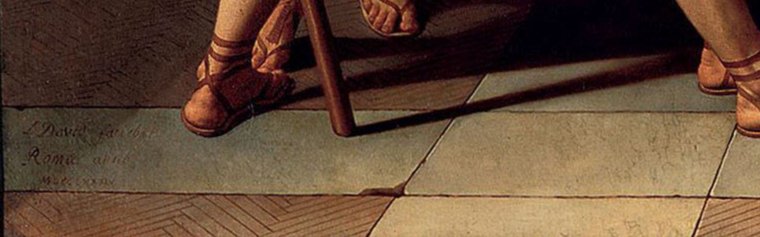
To paint it, he went back to Rome in the autumn of 1784, to be near the antiquities, and stayed about a year. His pupil Jean-Germain Drouais, who had just won the Prix de Rome, was in the city too and, according to the old accounts, helped. Down in the lower left corner, on a paving stone, David signed it in Latin: L. David faciebat Romae anno MDCCLXXXIV. “L. David made this in Rome in the year 1784.” The Louvre’s records say it was not actually finished until July 1785.
The Oath of the Horatii, figure by figure
The numbers on the image match the key below.
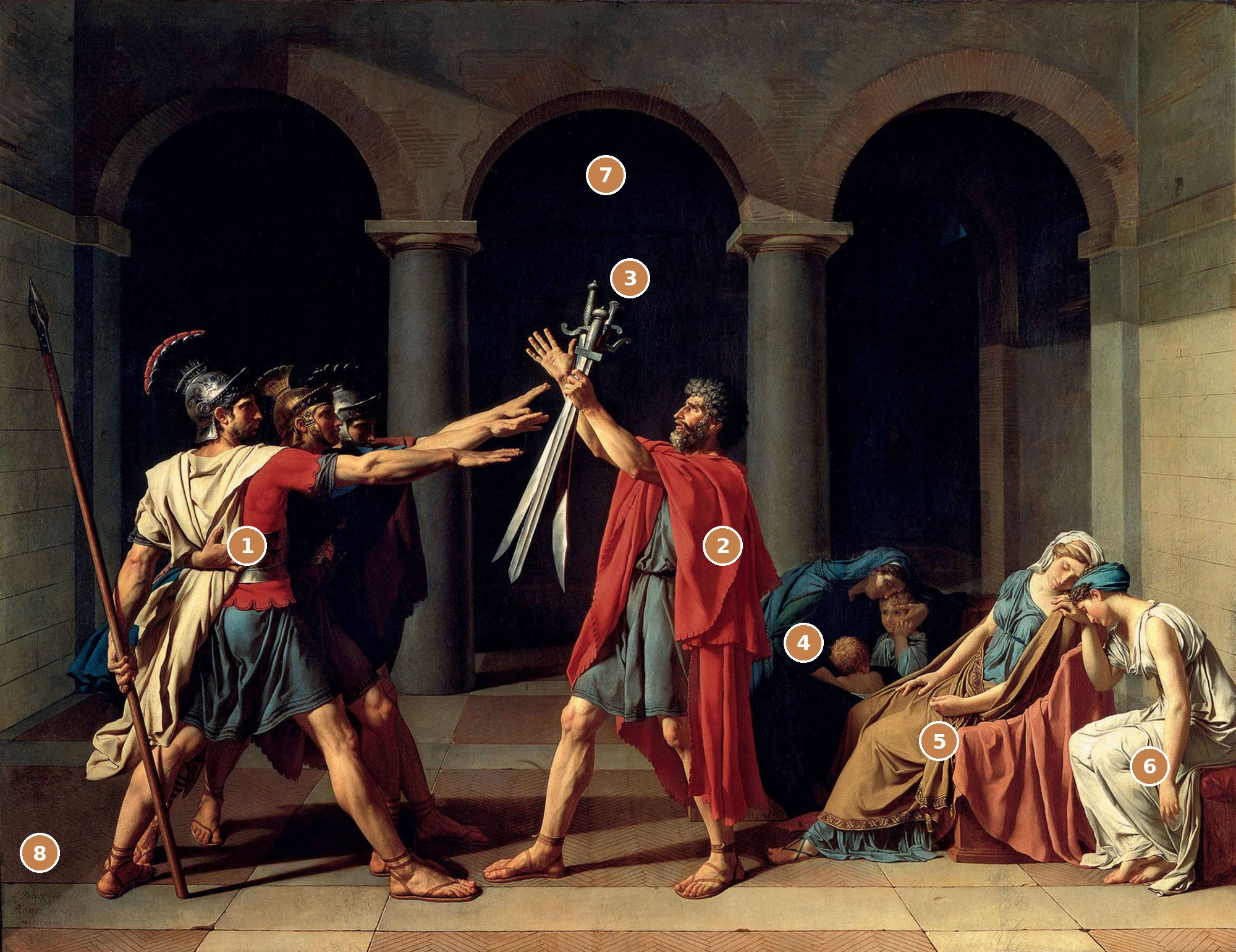
| # | Who or what | Where to find it | Why it matters |
|---|---|---|---|
| 1 | The three Horatii brothers | Left, in helmets, one arm each thrust forward | Rome’s champions, swearing to win or die |
| 2 | Their father | Center, in the red cloak | Holds up the swords and administers the oath |
| 3 | The three swords | In the father’s raised hand, at the center of the canvas | Two curved, one straight; the hands converge here |
| 4 | The mother and two children | Behind the young women, in a dark blue veil | Shields the children’s eyes from the scene |
| 5 | Sabina | Seated, in blue with an ochre mantle | A Curiatius by birth, married to one of the Horatii |
| 6 | Camilla | Far right, in white | A Horatius by birth, engaged to one of the Curiatii |
| 7 | The three arches | Across the back of the room | One arch for each group of figures |
| 8 | The signature | Lower left, on the paving stone | ”Made in Rome, 1784” |
Oath of the Horatii analysis: men in straight lines, women in curves
Start with the brothers. The front one plants his foot and holds a spear; the second wraps an arm around the first’s waist; the third, half hidden, reaches past them both. Their right arms go out together, flat and rigid, palms down. Their legs make a wedge. You could draw every one of these figures with a ruler. Drouais, the old accounts say, painted the arm of the brother at the back.
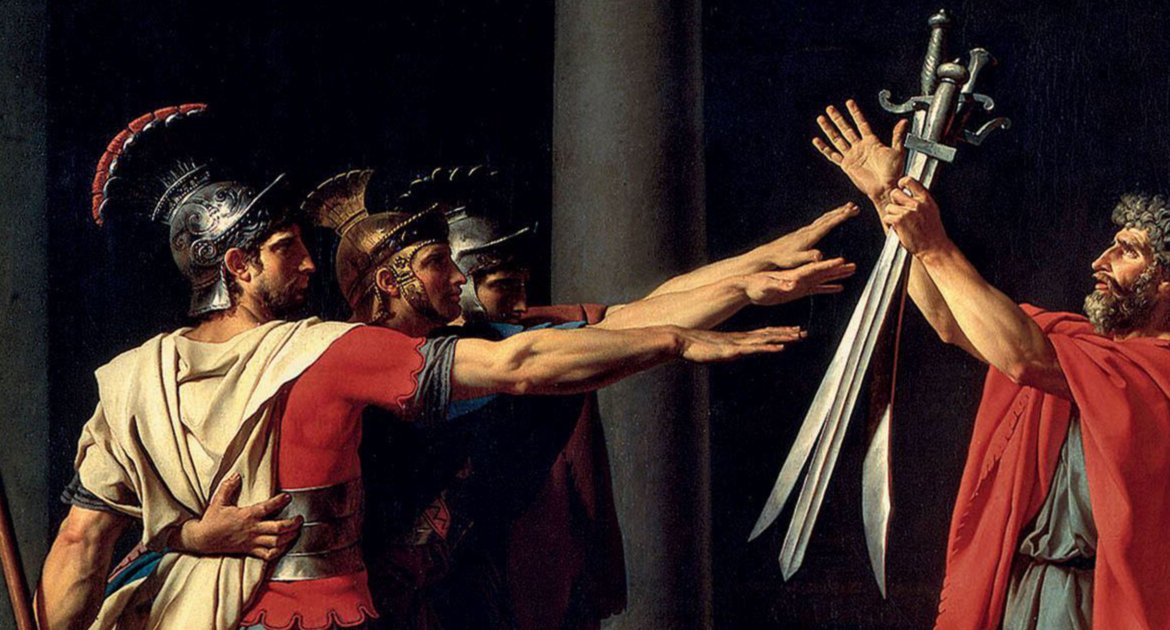
Now look at the father. He is the hinge of the picture. He stands in the middle arch with the three swords raised, and every line in the left half of the canvas points to his fist. Look at the blades: two are curved, one is straight. Some writers read that as a forecast of the fight, in which only one brother came home alive. David never explained it, so treat it as a good guess rather than a code.
Then cross to the right, and everything goes soft. Sabina sits with her head tilted onto Camilla’s, her ochre mantle falling in long loops; she is the wife of one Horatius and the sister of the men he is about to kill. Camilla, in white, covers her eyes with her hand. Behind them the boys’ mother, in a dark blue veil, folds two small children against her. One child hides; the other, a boy, peers out.
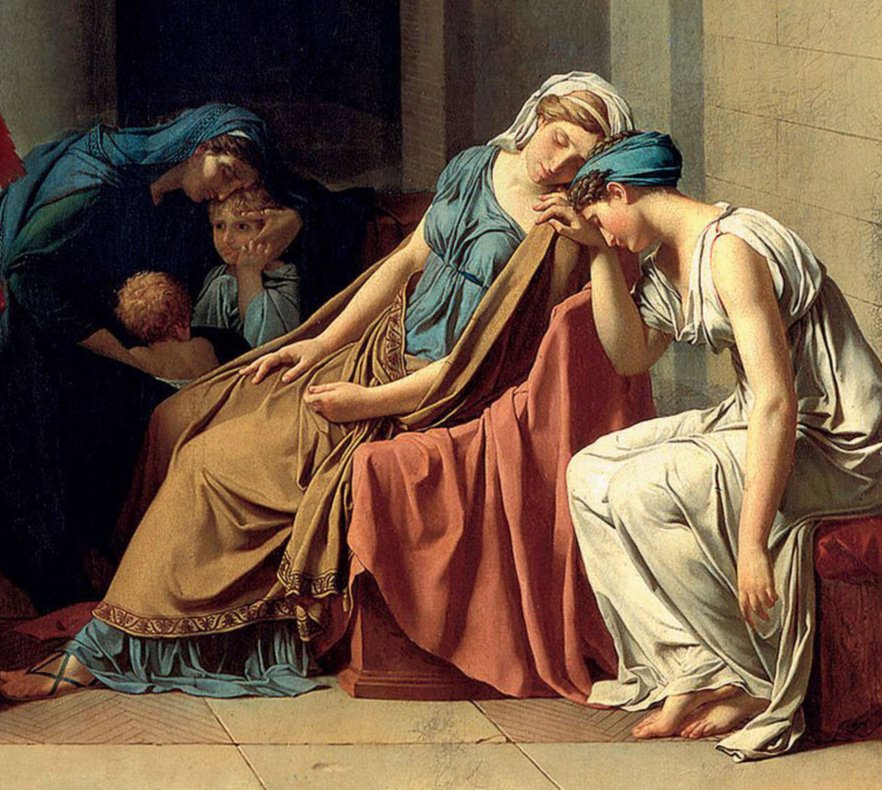
That is the whole argument of the composition. The men are built like the columns behind them, upright and hard. The women are built like the arches, curved and bowed. The three arches divide the stage into three bays, one for the sons, one for the father, one for the women, and the background is kept almost empty so nothing distracts from the bodies. The colors are dull and the brushwork is invisible. After decades of pastel Rococo boudoirs, this looked like a slap.
What David leaves offstage is the end of the story. Livy says the last surviving Horatius came home carrying the spoils of the dead Curiatii. Camilla recognized among them a cloak she had made for her fiancé, and wept. Her brother killed her on the spot for mourning an enemy of Rome. Every Parisian who saw the painting in 1785 knew the girl in white was about to be murdered by one of the young men on the left.
What the oath meant, and how the meaning changed
The Oath was the sensation of the Salon of 1785, which opened in the Louvre on August 25. It arrived late, and David’s enemies at the Academy hung it badly; complaints from visitors got it moved to a better wall. The crowds were not reading it as a call to revolution. It was a royal commission about loyalty to the state, and in 1785 the state was the king.
Then the state changed. By the time David showed it again, at the Salon of 1791, France had a constitution and the painting looked like something else: a vow of citizens to the nation, sworn over the bodies of their own families. That same year David drew The Tennis Court Oath, with a hall full of deputies throwing out their arms in the same gesture. The Oath of the Horatii’s meaning drifted with the politics around it. The painting stayed put.
The gesture kept traveling. The straight-armed “Roman salute” has no clear ancient source; many historians trace it back to this canvas and the revolutionary pictures that copied it. More than a century later it was adopted by Mussolini’s fascists. David did not invent fascism. He did invent the arm.
Eight years later, a knock at a door on the Rue des Cordeliers
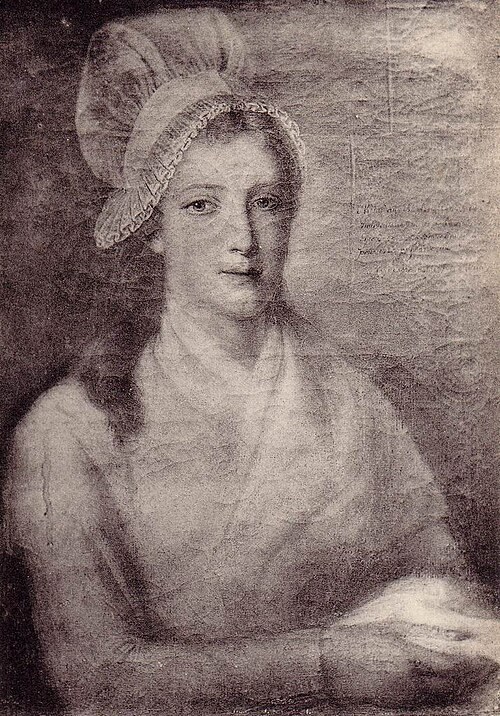
On the evening of July 13, 1793, Charlotte Corday talked her way into Marat’s apartment in Paris. She was twenty-four, from Caen, and a sympathizer of the Girondins, the moderate faction Marat had helped drive out of the Convention six weeks earlier. That morning she had bought a kitchen knife. She had already written to Marat asking to be received, promising information about traitors in Normandy.
Marat was in his bath. He suffered from a skin disease that tormented him in his last years; he worked for hours at a time in a medicinal tub, with a board across it as a desk and a cloth wrapped around his head. What the disease was, nobody has ever agreed. He let her in, took notes on the names she gave him, and she stabbed him once, under the collarbone. She did not try to run. She was tried and guillotined four days later, on July 17.
The next day the Convention asked David, who was a deputy, a member of the Committee of General Security and Marat’s friend, to commemorate him. David also staged the funeral. Four months later, on November 14, 1793, he stood in the Convention and presented the finished canvas. His speech survives in the Convention’s printed record. “The people demanded their friend,” he said; they cried out, “David, take up your brushes, avenge our friend, avenge Marat.” He offered the painting, and asked that Marat be given a place in the Panthéon.
The Death of Marat painting, object by object
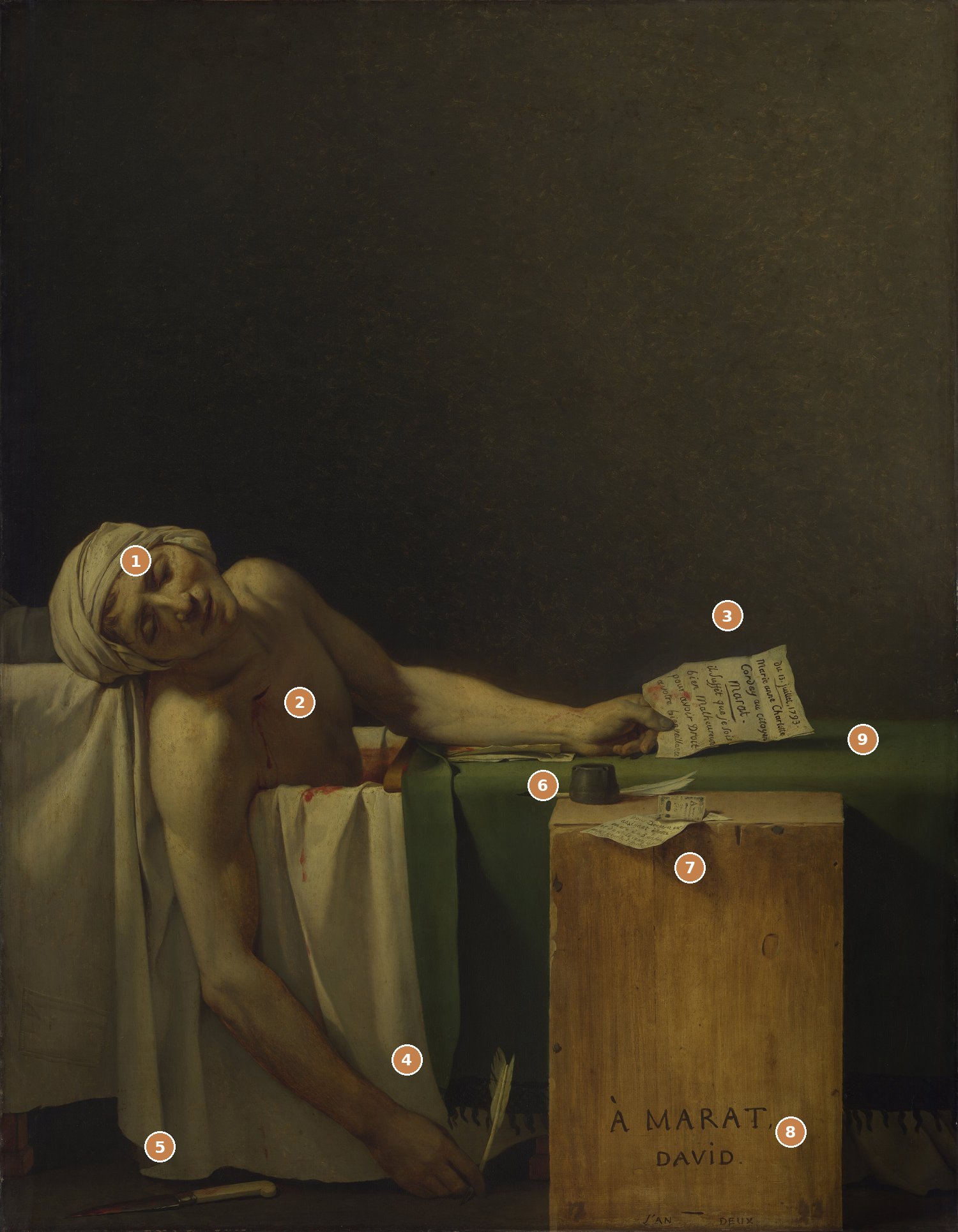
| # | Object | What it says |
|---|---|---|
| 1 | Marat’s head, wrapped in a cloth | The sick man, made serene; the face is calm, almost smiling |
| 2 | The wound | A single small cut under the collarbone |
| 3 | Corday’s letter | Her request to be received, dated July 13, 1793 |
| 4 | The quill | Still in his hand; he died working |
| 5 | The knife | The bloodied kitchen knife on the floor |
| 6 | The inkwell | Set on the box he used as a desk |
| 7 | The note and the banknote | Marat’s charity to a soldier’s widow |
| 8 | ”À Marat, David” | David’s dedication, painted like a carved epitaph |
| 9 | The green cloth | Thrown over the board laid across the tub |
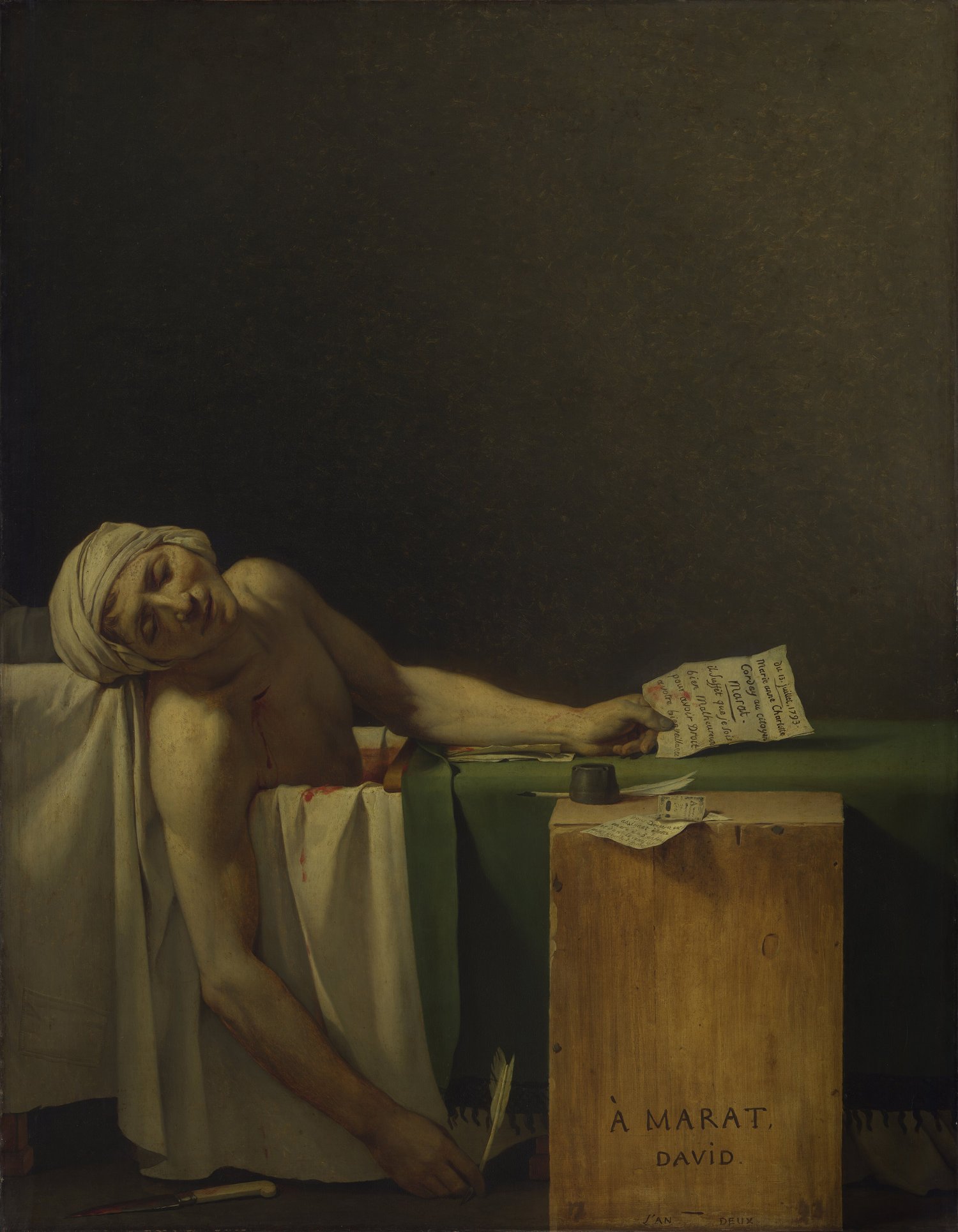
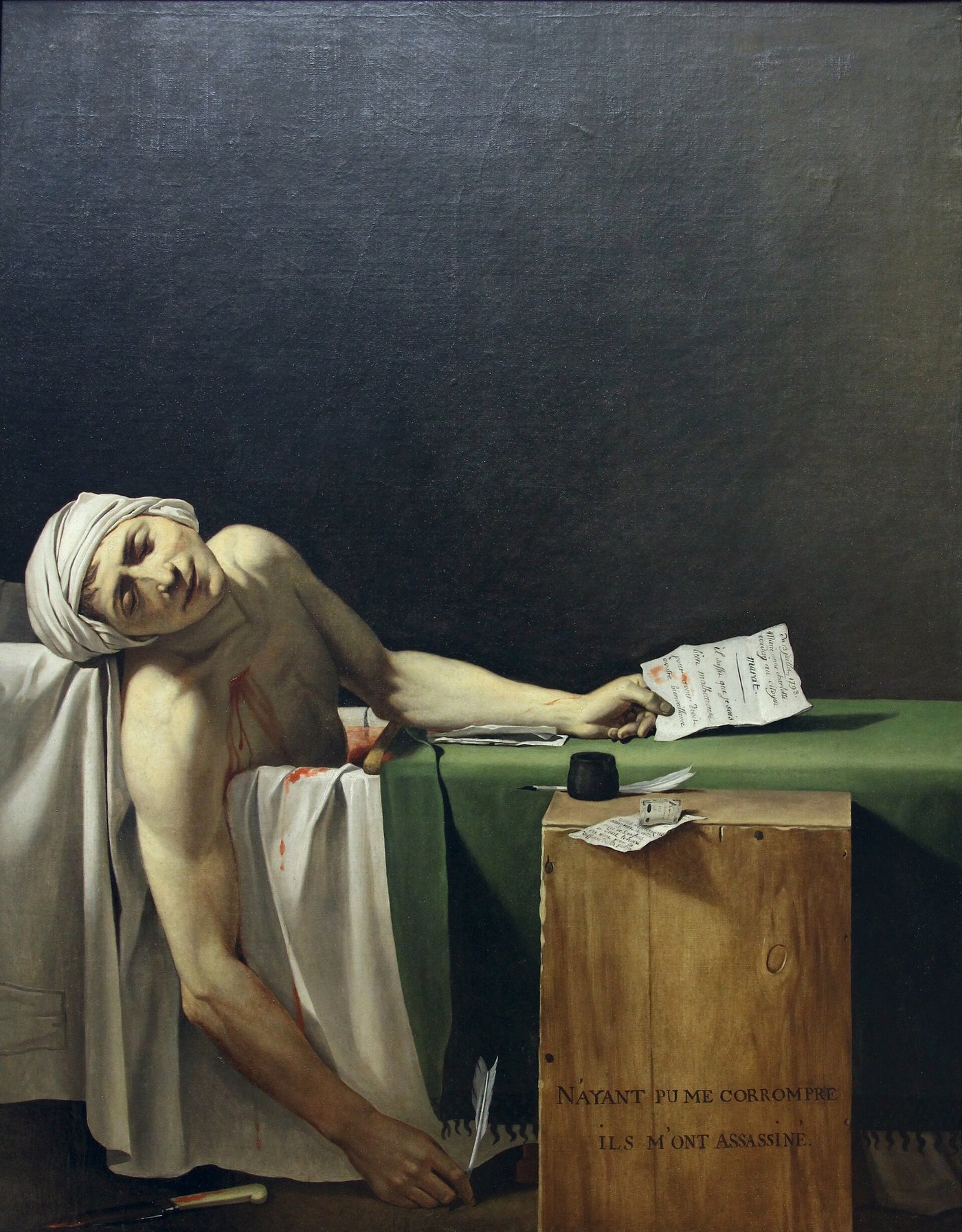
The canvas is 165 by 128 centimetres, about five and a half feet tall. Nearly the whole top half is blank wall, a grainy, flickering brown with nothing in it. Marat’s body fills the lower left. He has slumped over the edge of the tub, head lolling on a folded cloth, right arm hanging to the floor. The pose is a deliberate quotation. The Louvre’s curators note that David modeled the body on Caravaggio’s Entombment of Christ in the Vatican, and generations of viewers have seen Michelangelo’s Pietà in that dropped arm. David took the most familiar image in Catholic Europe, a dead savior being lowered, and put a revolutionary journalist in it.
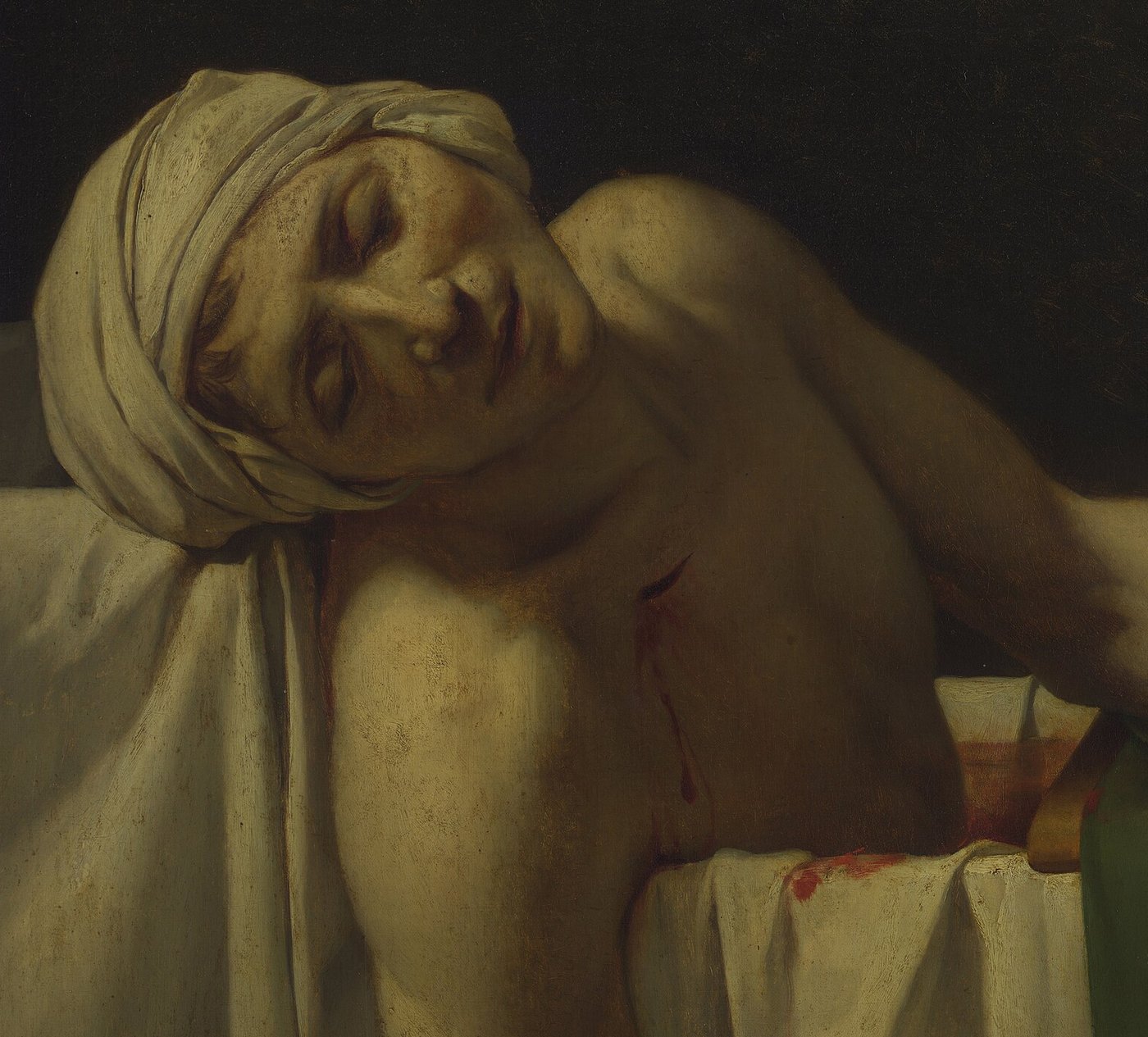
He also cleaned him up. Contemporaries described a man whose skin was ravaged. David gives him the smooth torso of a classical statue. The wound is a neat slit. There is a little blood on the sheet and a pink tint in the bathwater, and that is all.
The letter in his hand
Now read what Marat is holding. David lettered it so carefully you can read it from across the room: “Du 13 juillet 1793. Marie Anne Charlotte Corday au citoyen Marat. Il suffit que je sois bien malheureuse pour avoir droit à votre bienveillance.” In English: “July 13, 1793. Marie Anne Charlotte Corday to Citizen Marat. It is enough that I am very unhappy to have a right to your kindness.”
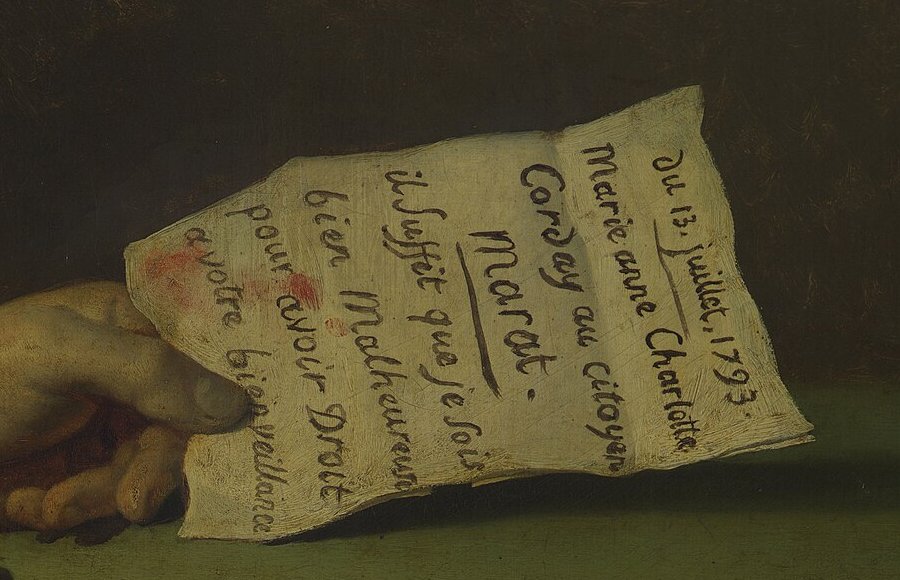
Corday never wrote that sentence. A real note from her to Marat does survive, stained with blood and bathwater, but the line in the painting is David’s invention. It does a great deal of work. It turns her into a woman who exploited his charity, and him into a man who could not refuse a stranger in distress. The murderer is not in the picture at all. She is present only as a lie in her victim’s hand.
Chiaro is useful in front of a detail like this one, which most visitors register as a smudge of handwriting and walk past: the French line is read aloud and translated while you look at the blood on the paper, which is the only way the trap David set makes sense.
The banknote on the box
Look down at the wooden box beside the tub. On it sit an inkwell, a quill and a second, smaller piece of paper, with a banknote laid on top. The note is an assignat, the revolutionary paper money. The paper under it, partly legible, begins “Vous donnerez cet assignat à cette mère de cinq enfants”: “You will give this assignat to this mother of five children,” whose husband, it goes on, died defending the nation.
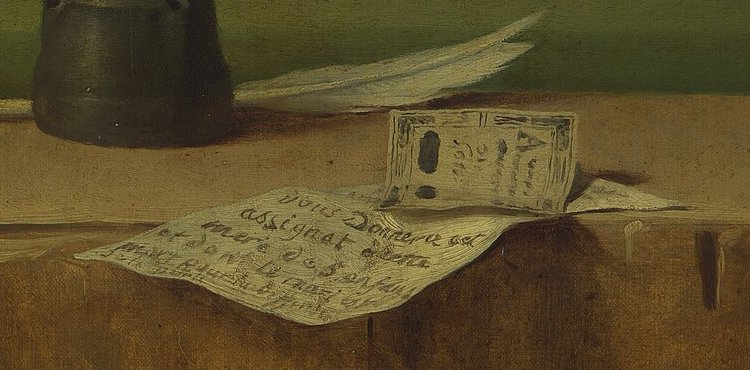
So there are two pieces of paper in the picture. One is a request for kindness that hides a knife. The other is an act of kindness, written in the last minutes of his life. David told the Convention that Marat died “giving you his last piece of bread,” and “without even enough to pay for his own burial.” The box itself was the point, too. A plain packing crate used as a desk was evidence that the People’s Friend lived poor.

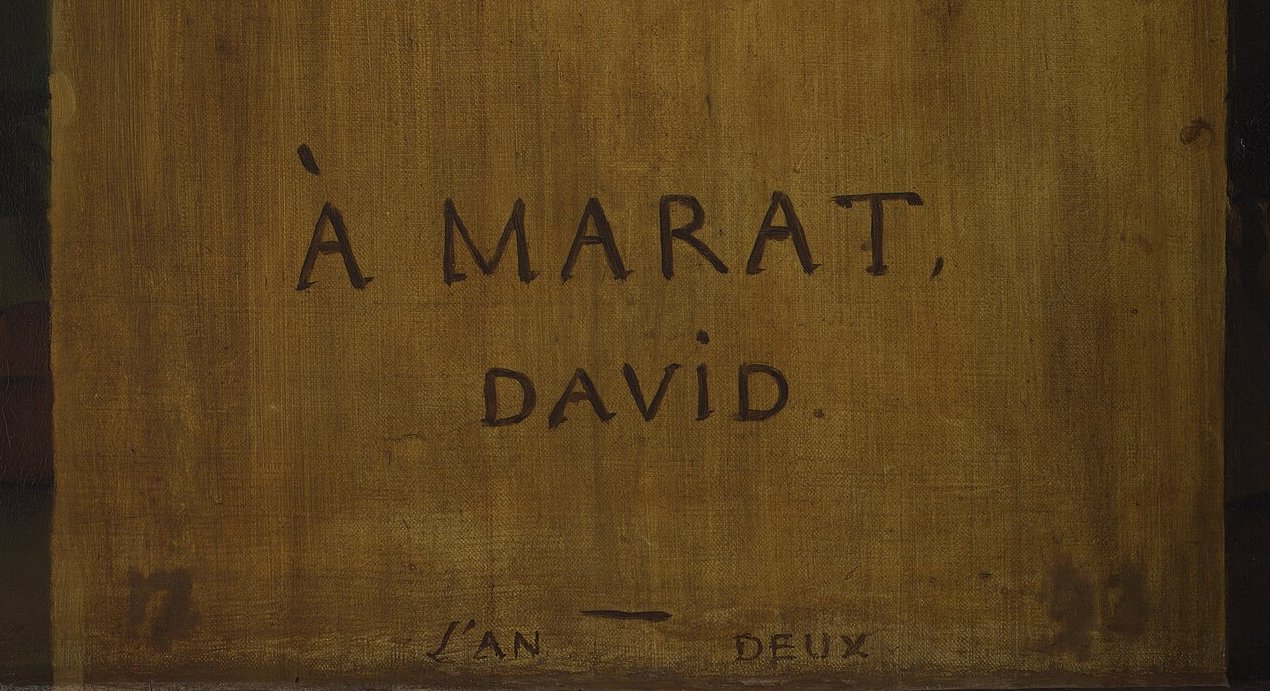
Then read the front of the box. In capitals, like letters cut into a tombstone: “À MARAT, DAVID.” To Marat, from David. Below, smaller, at the very bottom edge: “L’AN DEUX,” Year Two, in the new revolutionary calendar. The painter signed the picture as a personal gift to a dead friend, and dated it in a calendar that had abolished the birth of Christ as the start of time.
A propaganda pietà, and why it went into hiding
The Convention hung the painting in its meeting hall, paired with David’s picture of Louis-Michel Le Peletier, a deputy murdered in January 1793 for voting the king’s death. The two martyrs faced the deputies as they debated. Engravings were ordered. David’s pupils turned out copies. In September 1794 Marat’s body was carried into the Panthéon.
It did not last. Robespierre fell in July 1794, David was arrested and imprisoned, and the mood turned. In February 1795 the Convention agreed to give both paintings back to their author, and Marat’s remains were taken out of the Panthéon soon after. David kept the canvas in his studio. When the Bourbons returned and exiled the men who had voted to kill Louis XVI, David went to Brussels in 1816, and his pupil Antoine-Jean Gros hid the Marat in Paris.
It stayed in the family for decades. David’s heirs tried to sell it and failed. In the 1840s Charles Baudelaire saw it at an exhibition in Paris and wrote that the painting was “cruel like nature” and yet had “all the perfume of the ideal.” A descendant, Jules David-Chassagnol, finally bequeathed it to the museum in Brussels in 1886, and it has been on display there since 1893.
Where is The Death of Marat? Not in the Louvre
Here is the part most guides get wrong. The original Death of Marat is in Brussels, at the Royal Museums of Fine Arts of Belgium, in the Old Masters Museum on the Rue de la Régence. That is the city where David died in exile on December 29, 1825. The painting ended up a short walk from where its painter spent his last nine years.
The Louvre does have a Death of Marat. It is a studio copy, one of four early replicas that survive, and the best guess is that it was painted by David’s assistant Gioacchino Serangeli. The Louvre acquired it in 1945. It looks almost identical, with one change you can spot instantly: the box no longer says “À Marat, David.” It says “N’ayant pu me corrompre ils m’ont assassiné.” “Unable to corrupt me, they murdered me.” The line echoes David’s own speech to the Convention, which spoke of the man “they could not corrupt” and therefore had killed.
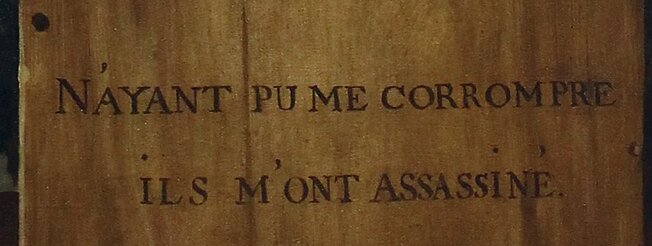
The other copies are at Versailles, in Reims and in Dijon. The Reims copy carries the same “unable to corrupt me” line; the Versailles and Dijon copies leave the box blank. For a few months the original and its copies were together in Paris: the Louvre’s David retrospective, from October 15, 2025 to January 26, 2026, borrowed the Brussels canvas and hung two period copies beside it. The Brussels museum said the painting would return to the Old Masters Museum in early February 2026.
The Old Masters Museum is open Tuesday to Friday from 10 a.m. to 5 p.m. and on weekends from 11 a.m. to 6 p.m., and closed on Mondays. Adult admission is 13 euros, and the first Wednesday of the month is free from 1 p.m. Paintings travel and rooms get rehung, so check the museum’s site before a special trip.
Where to see the Oath of the Horatii
The Oath is in the Louvre, Denon wing, level 1, in Room 702, the Salle Daru. It shares the room with the painting David made twenty years later for the man who ended the Revolution, The Coronation of Napoleon, which we take apart figure by figure in our Coronation of Napoleon guide. Standing between them is the fastest course in French history the Louvre offers: a royal commission that became a republican icon, and a republican painter who became an emperor’s.
The Louvre’s site gives its hours as 9 a.m. to 6 p.m. on Monday, Thursday, Saturday and Sunday, and until 9 p.m. on Wednesday and Friday. It is closed on Tuesdays. If you are planning a longer route through the building, our guides to what to see at the Louvre and to the Louvre’s paintings cover the rest of the floor. And if you want to see what happened to the heroic Roman gesture twenty years on, Goya’s Third of May 1808 shows the same kind of arms raised in the opposite spirit, by Spaniards facing Napoleon’s firing squad.
For a crowd of a different kind, Raphael’s School of Athens gets the same figure-by-figure treatment, and the whole series is collected in Famous Paintings, Every Figure Identified.
What to look for when you stand in front of them
In front of the Oath, stand far enough back to see the three arches as a single frame. Then follow the arms to the swords, and count the blades: two curved, one straight. Find the signature on the paving stone in the lower left. Then let your eye drift right, to Camilla in white, and remember what her brother does to her when he comes home.
In front of the Marat, wherever you see it, skip the body at first. Read the letter. Find the banknote on the box. Then look up at the top half of the canvas, the empty brown wall, which is where the real painting happens. Before you leave the Louvre, find the copy and read the box. Then remember that the original box, in Brussels, says only “To Marat, David.”
The king paid for the first painting, and David helped send him to the guillotine. The second painting David made for the revolutionaries, and they gave it back to him. He kept it until the end, in exile, in the city where it still hangs.