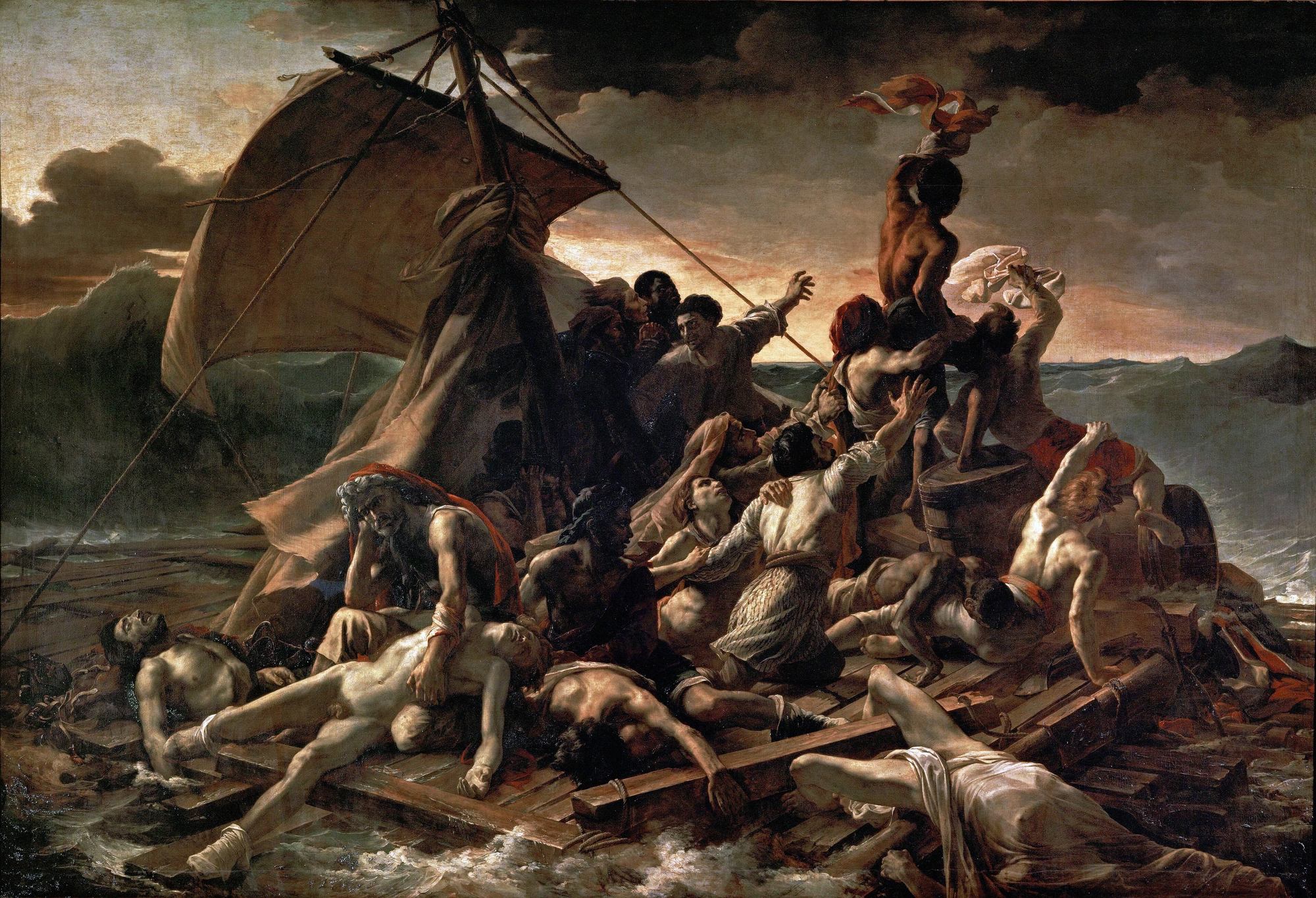
On the morning of July 17, 1816, fifteen men on a wooden raft off the coast of West Africa saw a sail. They had been adrift for thirteen days. When the raft was cut loose, at least 147 people had been standing on it. They waved. Then the ship disappeared. That moment, the ship seen and then lost, is The Raft of the Medusa.
The men who were left had fought a mutiny, eaten the dead, and, on the eighth day, thrown the weakest of their companions into the sea. They had a story nobody in authority wanted told.
Théodore Géricault told it. He was twenty-seven when he finished the painting. He spent eighteen months on it, talked to the survivors, built a model of the raft and filled his studio with body parts from a hospital morgue. He showed it at the Paris Salon of 1819 under a deliberately bland title, Scene of a Shipwreck. Nobody was fooled. Everyone in France knew which shipwreck it was, and whose fault.
The painting is almost five metres high and more than seven wide. The figures in the foreground are larger than life. It hangs today in the Louvre, in a red room a short walk from the Mona Lisa, and most people who walk past it have no idea that the men in it had names.
The Raft of the Medusa, figure by figure
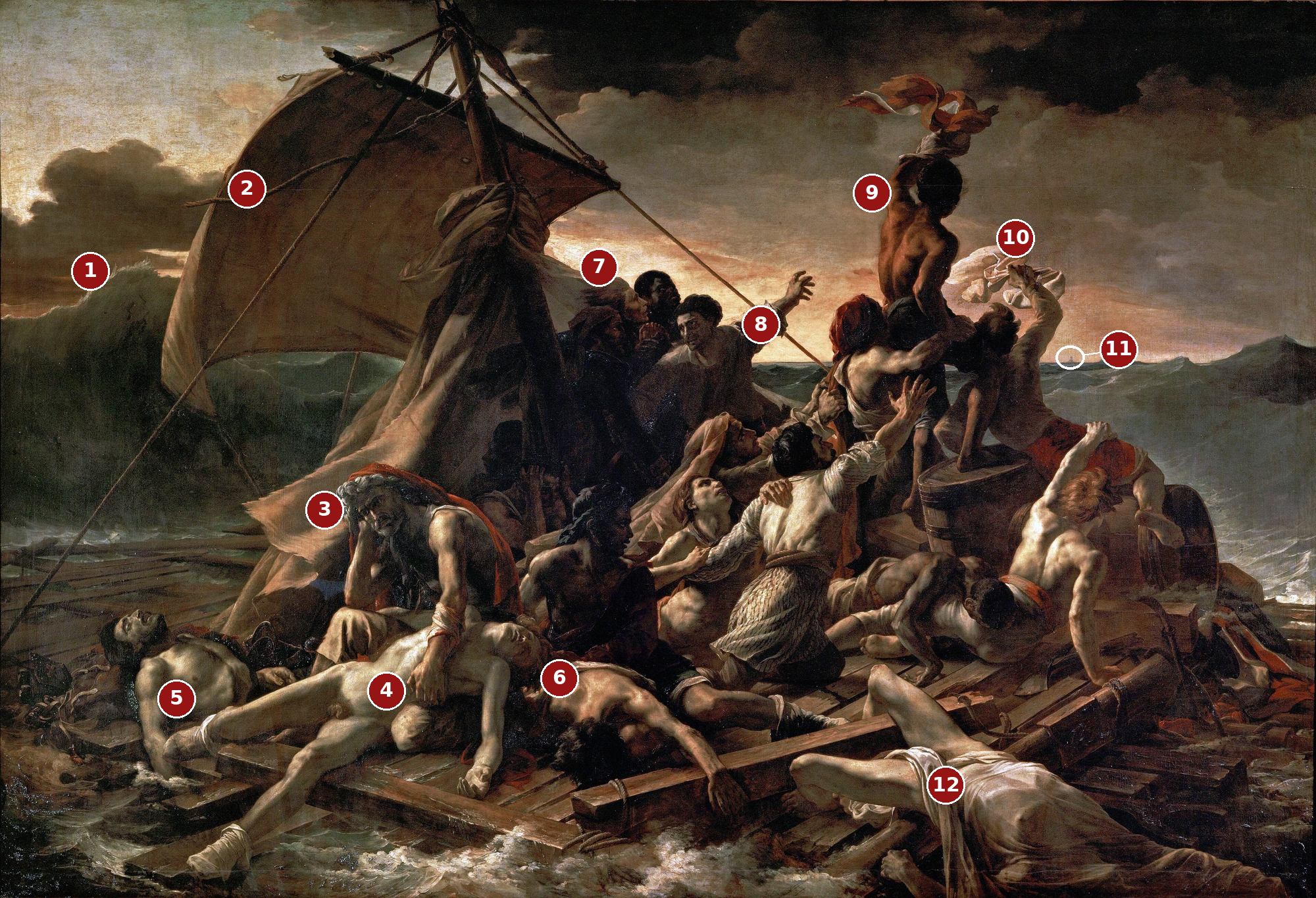
The numbers on the image match this key. Géricault never published a list of who is who, so some of these identifications rest on tradition and on what his friends said afterwards. Where that is the case, the table says so.
| # | Figure | Where to find it | Who posed, or who it is |
|---|---|---|---|
| 1 | The wave | Far left, rising behind the sail | The threat the raft is sailing away from |
| 2 | The sail and mast | Left of center | Built from the frigate’s spars; the sail drives the raft away from the rescue ship |
| 3 | The father | Lower left, in a red cloth, hand to his head | Unnamed; often read as an echo of Dante’s Count Ugolino |
| 4 | The dead son | Across the father’s knees | Unnamed |
| 5 | A corpse at the edge | Far left, head thrown back, legs in the water | One of several bodies Géricault studied from morgue specimens |
| 6 | The face-down youth | Center foreground, one arm stretched out | Eugène Delacroix is said to have posed for this figure |
| 7 | The men at the foot of the mast | Left of center, in shadow | Traditionally said to include the survivors Henri Savigny and Alexandre Corréard |
| 8 | The man pointing at the horizon | Center, arm outstretched, looking back | Often identified as Corréard; the identification is not certain |
| 9 | Jean Charles | Top of the pyramid, standing on a barrel | A Black crew member and a real survivor; the model was a Haitian man known as Joseph |
| 10 | The man waving a white cloth | Right, beside Jean Charles | Unnamed |
| 11 | The Argus | On the horizon, right of the cloth | The brig that rescued the fifteen survivors |
| 12 | A body sliding into the sea | Lower right, draped in a white sheet | Unnamed |
The Raft of the Medusa story in thirteen days
The Méduse was a French Navy frigate. In June 1816 she left Rochefort for Saint-Louis in Senegal, a colony Britain had just handed back to France after the Napoleonic Wars. On board were about four hundred people, including the colony’s new governor, Julien-Désiré Schmaltz, his family, officials, soldiers and settlers.
Her captain was Hugues Duroy de Chaumareys. He was a returned royalist émigré who had barely been to sea in twenty years. He got the command the way a great many people got things in the first years of the restored Bourbon monarchy: by having been on the right side of the Revolution. He let the Méduse run ahead of the rest of her convoy. He took advice from a passenger named Richefort, who had no business navigating anything. And on July 2, 1816, he ran her aground on the Bank of Arguin, a sandbank off the coast of what is now Mauritania, in clear weather.
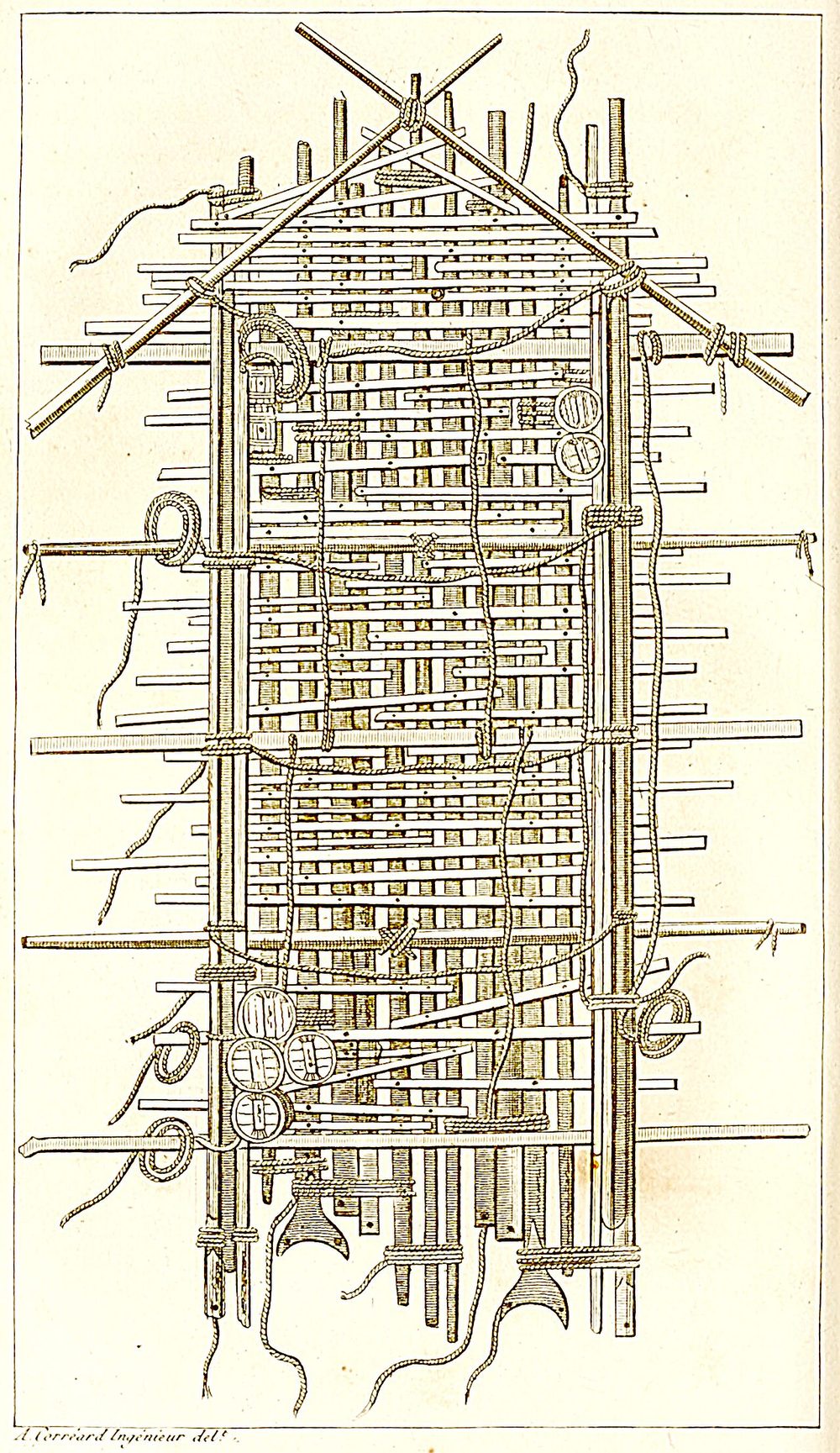
The ship’s boats could carry about 250 people. The rest went onto a raft, roughly twenty metres long and seven wide, lashed together from the frigate’s masts and planks. At least 146 men and one woman stood on it. It was so overloaded that it rode under the water, and the people in the middle stood up to their waists in the sea. The boats were supposed to tow it to shore. Within a few miles, the tow lines were let go. Accounts disagree about exactly who cast off first, but nobody disputes the result. The officers in the boats sailed away, and the raft was left in the open Atlantic with a bag of biscuit, two casks of water and six casks of wine.
The first night, about twenty men were killed or drowned themselves. Then came a mutiny. Soldiers and sailors, drunk on the wine, tried to cut the lashings and sink the raft, and the officers fought them with sabres. By the fourth day sixty-seven people were alive. By then some of them had begun to eat the dead. On the eighth day, the fittest decided that the provisions would not stretch, and threw the weak and wounded overboard. That left fifteen.
The Argus, a brig from the same convoy, found them on July 17, by chance. The survivors had seen her once and watched her vanish. Two hours later she came back. Five of the fifteen died within days of the rescue. One of them was Jean Charles, the man Géricault would put at the top of his painting.
Two survivors, one book, and a scandal
The French government would have liked the whole thing forgotten. It was not.
Henri Savigny, the ship’s surgeon, was one of the fifteen. His report reached the newspaper Journal des débats, which published it on September 13, 1816. It caused a sensation, because it put the cannibalism and the abandonment in print. Savigny then wrote a full account with another survivor, Alexandre Corréard, an engineer and geographer. Their book, Naufrage de la frégate la Méduse, went through edition after edition. Corréard drew the plan of the raft for it.
Chaumareys was court-martialled in 1817. He was acquitted of abandoning the raft, convicted of incompetence and of leaving his ship before everyone was off, and sentenced to three years in prison. Many people at the time thought he had been let off lightly. For the liberal opposition, the wreck became a parable: an incompetent aristocrat, appointed for his loyalty, steering the country onto a sandbank and saving himself.
That is the context in which a young painter with private money and no state commission decided to make the largest painting of his life about it.
A painter who shaved his head
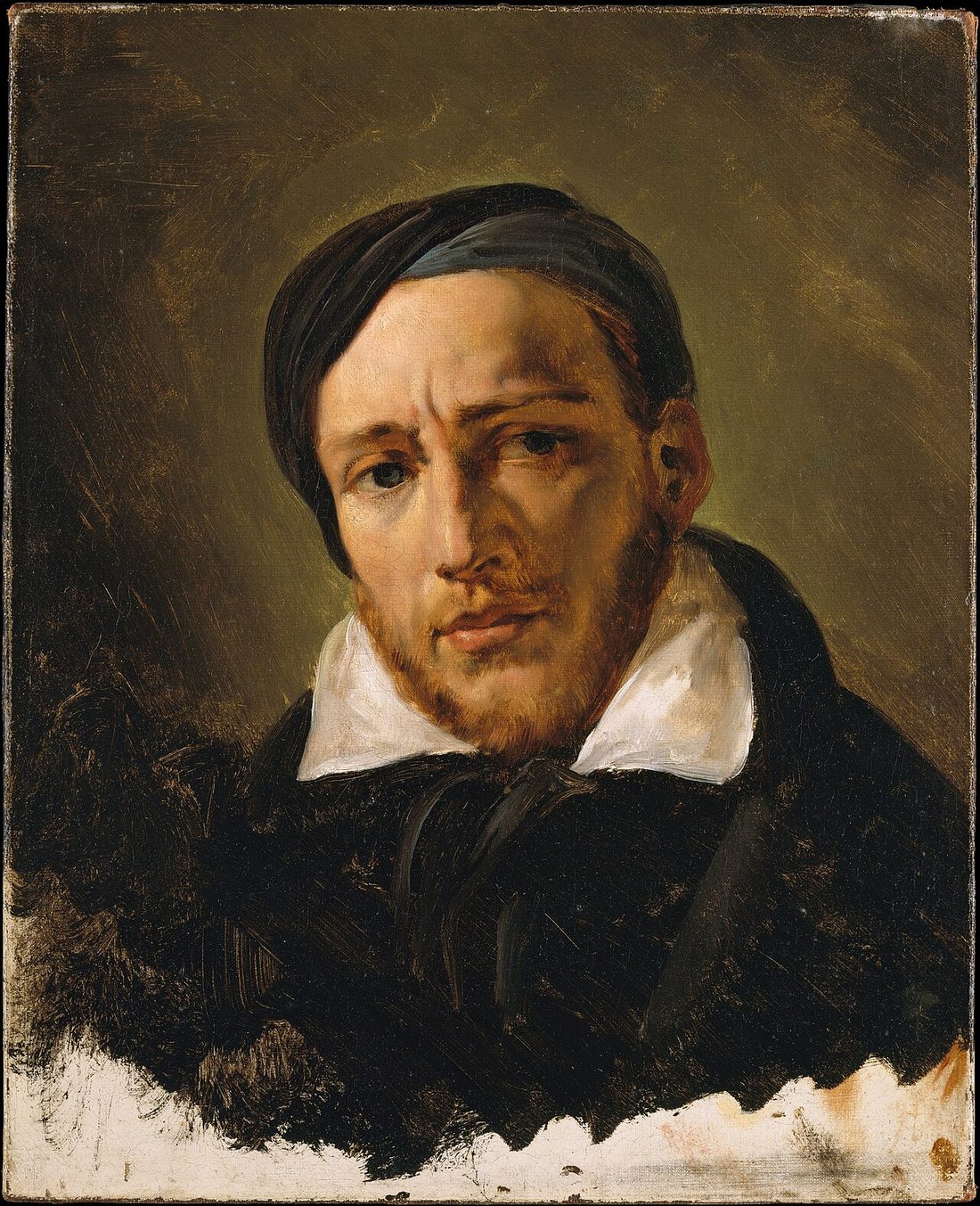
Théodore Géricault was born in Rouen in 1791. He was rich, good-looking, obsessed with horses, and had already made a name at the Salon with a cavalry officer in 1812. He had also just come back from Italy, where he had looked hard at Michelangelo, and from an affair with his uncle’s wife that had left her pregnant. He needed a subject big enough to bury himself in.
In early 1818 he met Savigny and Corréard. He interviewed them, read their book and worked with them and a third survivor, the ship’s carpenter Lavillette, on a scale model of the raft. He sketched every stage of the story he could have painted: the mutiny, the cannibalism, the rescue. He rejected each of them.
Then he went looking for death. He took a studio across from the Beaujon hospital and drew the dying patients. He brought severed limbs back to his studio and painted them as they decayed. He is said to have spent two weeks drawing a severed head borrowed from an asylum. Visitors complained about the smell.
From November 1818 to July 1819 he more or less lived in his studio in the Faubourg du Roule. He shaved his head, so that he would not be tempted to go out. He finished the painting in eight months.
He used his friends as models, and he used the survivors. Corréard, Savigny and Lavillette all posed. His assistant, an eighteen-year-old called Jamar, posed nude for several of the bodies. A Haitian model known only as Joseph posed for at least two of the Black figures, including the man on the barrel. And a young art student called Eugène Delacroix, who would go on to paint Liberty Leading the People, posed for the youth lying face down in the middle of the raft, with one arm stretched out.
Who’s who on the raft, from the bottom up
The way to read the painting is the way Géricault built it: from the dead at the bottom to the living at the top.
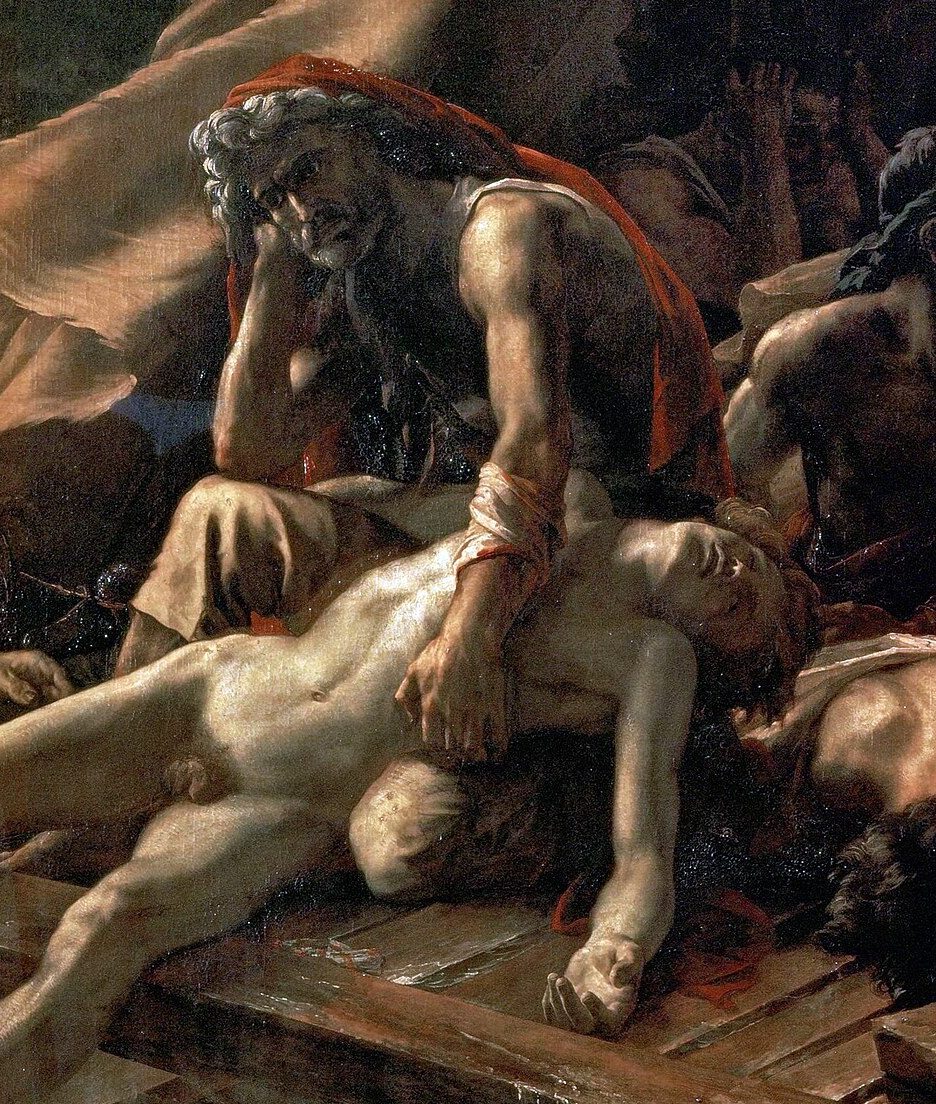
Start at the lower left. An old man in a red cloth sits with his head in his hand. Across his knees lies the naked body of a young man. The older man is not looking at the horizon. He is the only figure in the painting who has stopped hoping. Critics have connected him to Count Ugolino, the prisoner in Dante’s Inferno who watches his sons starve, and Géricault knew the story. On a raft where people ate the dead, the reference is not decorative.
Around him are the bodies. One lies at the far left with his head thrown back and his legs trailing in the sea. Another, at the lower right, is half covered by a sheet and slipping off the planks. These are the figures that came out of the morgue. Their skin is a different colour from the living, greenish and grey, and Géricault painted them with the attention most painters gave to faces.
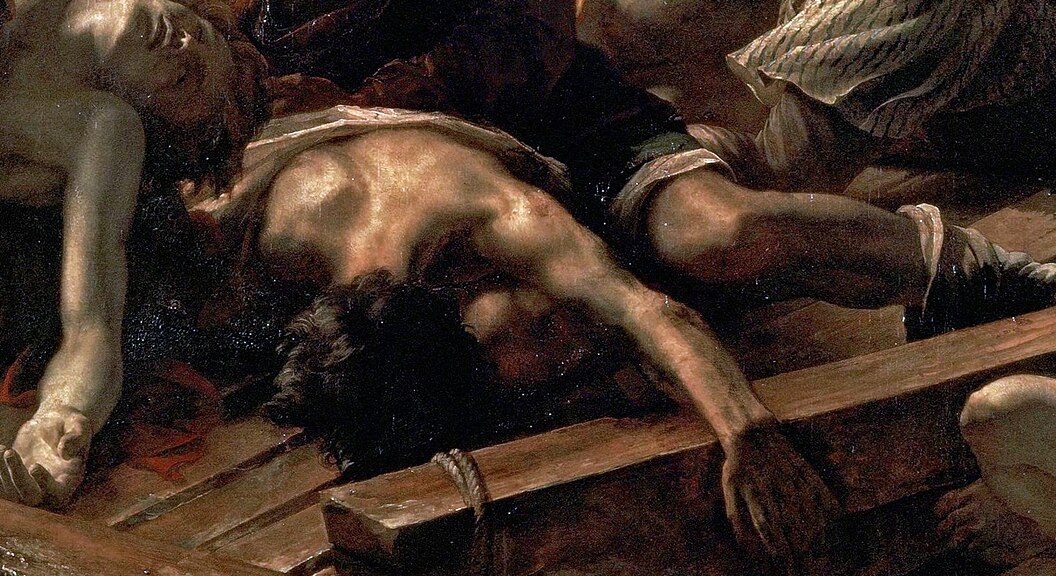
In the center of the foreground, a young man lies face down with his arm stretched out across a beam. This is the figure Delacroix is said to have posed for. He was about twenty. He later recalled being so shaken by the unfinished canvas that he ran out of the studio and all the way home. Eleven years later he painted his own big political picture, and it hangs in the same room.
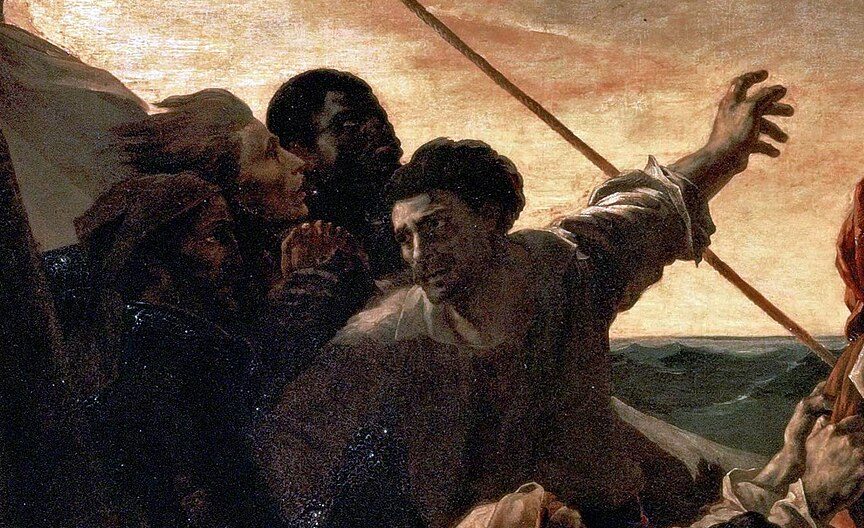
Move up and left, to the men in shadow at the foot of the mast. Tradition puts Savigny and Corréard here, the two men who wrote the book, painted from life. The figure most often named as Corréard is the man in front with his arm stretched toward the horizon, turning back to the others as if to tell them. Géricault did not label them, and the identifications in guidebooks vary. What is certain is that the two men who made the wreck public stood in front of this canvas while it was being painted, and that their faces are on it.
The man on the barrel
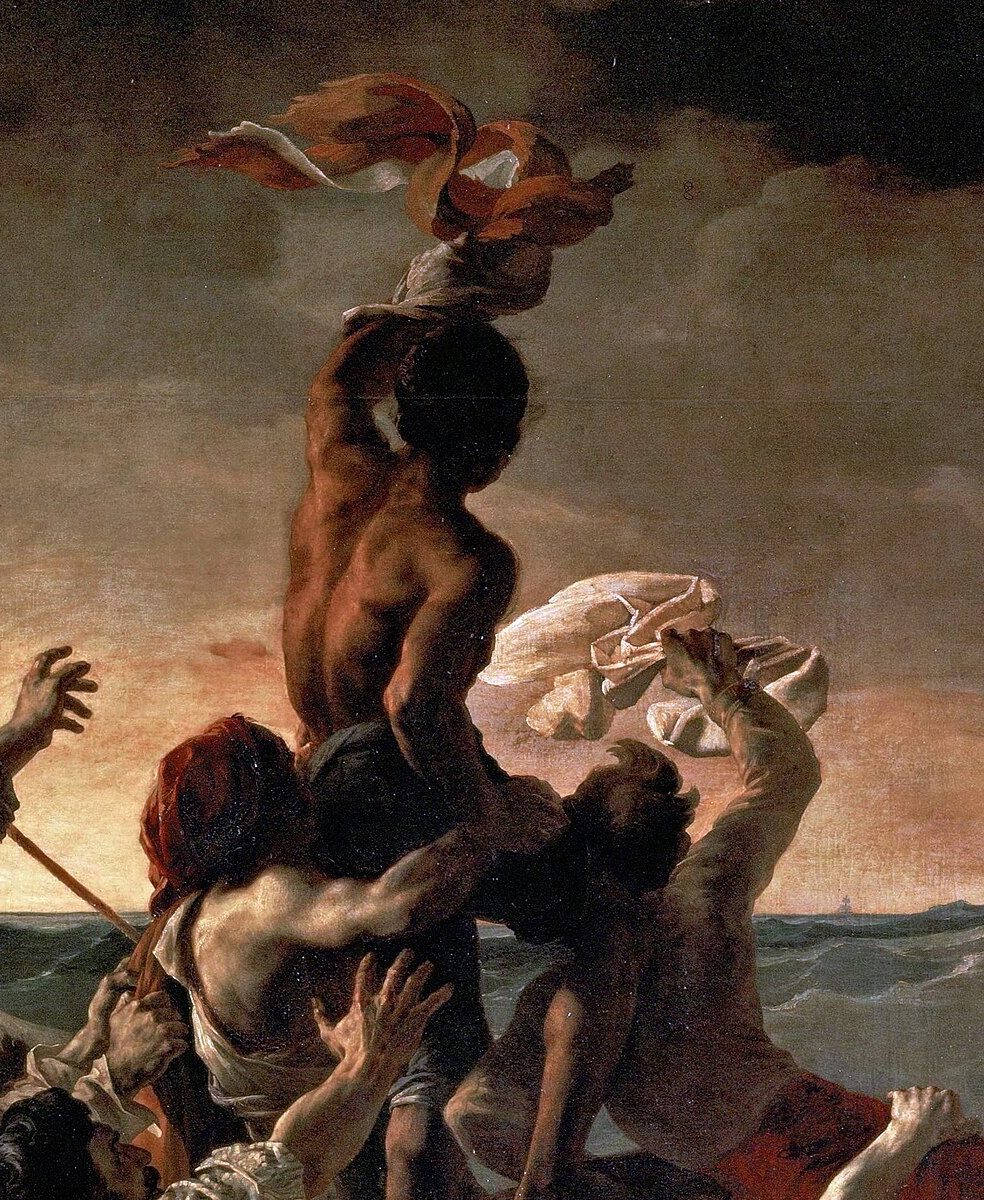
Follow the bodies up to the right and they climb, man on man, to a single figure standing on an empty barrel. He is seen from behind. He is waving a cloth over his head. He is the highest point of the painting and the last thing your eye arrives at.
He is Jean Charles, a Black crew member who survived the thirteen days and died shortly after the rescue. Géricault painted him from Joseph, the Haitian model. In 1819 the French slave trade was officially banned, but French slave ships were still sailing, and Senegal was the colony the Méduse had been sailing to. Some scholars, among them Klaus Berger and Diane Chalmers Johnson, argue that putting a Black man at the summit of the painting, as the figure who carries everyone’s hope, was a deliberate abolitionist statement, and point to Géricault’s early sketches and portrait studies of Joseph as proof that it was planned. Others are more cautious about reading a political program into it. Either way, it is hard to think of another big Salon painting of the period where the man at the top, the one everyone is reaching toward, is Black.
Beside him, another man waves a white cloth. Below them, a crowd of arms reaches up. The direction of the whole painting runs from the father at the lower left, who has given up, to the man on the barrel at the top right, who has not.
Analysis: two pyramids and a ship you can barely see
Any analysis of the composition starts with two triangles. The first is the mast with its ropes, leaning back to the left. The second is the human pile, rising from the dead at the bottom to Jean Charles at the top. The two lean against each other. The mast and sail pull the raft one way, toward the wave on the left. The bodies strain the other way, toward the right edge, toward the horizon.
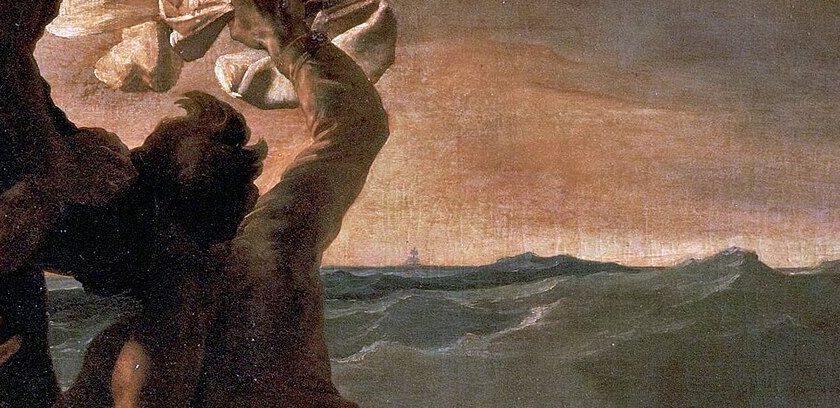
Now find the ship. Look to the right of the white cloth, on the skyline. There is a tiny grey shape, a few centimetres high on a canvas more than seven metres wide. That is the Argus. Many visitors never see it.
That is the point. Géricault could have painted the rescue, with a brig close by and sailors reaching down. He chose instead the moment when the survivors first saw the ship and did not know if it had seen them. In the real story, it went away. The painting freezes the survivors at the instant when hope and despair are the same thing. The symbolism is not hidden. A raft full of people abandoned by their officers, waving at a ship that may not stop, in a country run by the men who left them there.
The historian Jules Michelet put it in one line that is still quoted: our whole society is aboard the raft of the Medusa.
The sketch that shows what he changed
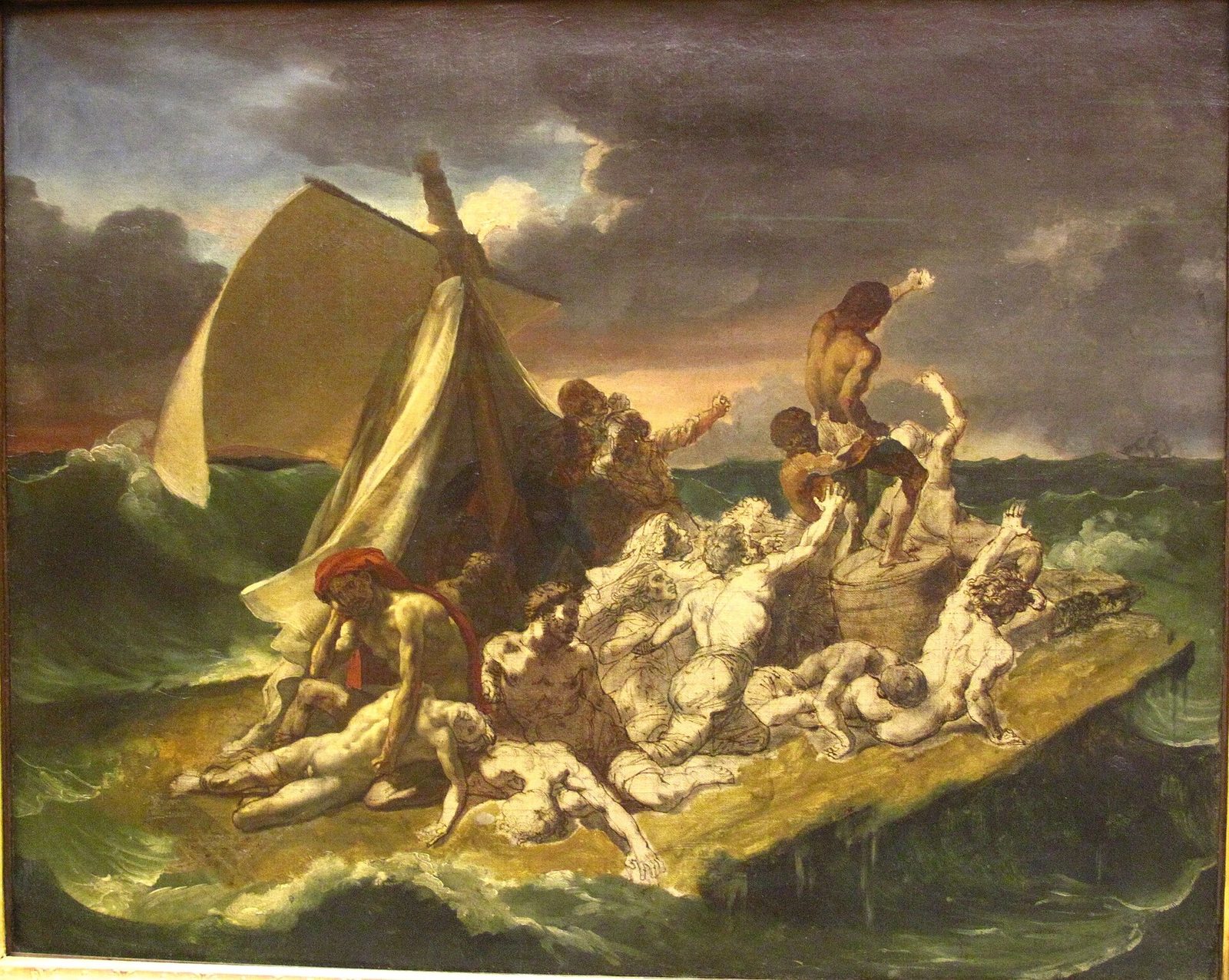
The Louvre also owns one of Géricault’s oil sketches for the Raft. Put it next to the final version and you can see the decisions. In the sketch the raft is seen more from the side, the waves are greener and wilder, and the bodies are fewer and lighter. In the final painting, Géricault pulled you in. The raft tilts toward you, the planks run out of the bottom edge of the frame, and the dead in the foreground are close enough to step onto. You are not watching the raft from a safe distance. You are on it.
He also turned the light down. The final picture is brown, black and sickly flesh, lit from one side like a Caravaggio. Part of that was intended. Part of it is time.
Why the Raft of the Medusa painting keeps getting darker
Géricault used a lot of bitumen, a tar-like brown pigment that painters of his generation loved because it went on velvety and rich. It does not stay that way. Over time bitumen darkens, shrinks and cracks, and never fully dries. Large areas of the Raft are now much darker than they were in 1819, and some of the details in the shadows can hardly be made out today.
The Louvre was worried enough about the condition of the canvas by 1859 that it commissioned two painters, Pierre-Désiré Guillemet and Étienne-Antoine-Eugène Ronjat, to make a full-size copy, in case the original was lost. The original was also torn in 1848 and repaired. It has survived two world wars by being rolled up and moved to safety in the countryside.
When you stand in front of it, much of the shadow you see was not shadow when Géricault finished. The men at the foot of the mast were easier to see. The dark is partly his and partly the bitumen’s.
Six thousand francs and a bad hanging
The Salon of 1819 opened in August. The painting was hung high, which made the foreground figures loom over the crowd and hid the details. Géricault saw it in place and knew it was a mistake. The Journal de Paris reported that it struck and attracted all eyes. Classicist critics hated the pile of corpses. King Louis XVIII came to see it and is reported to have told Géricault, with a pun on the word naufrage, that his shipwreck was certainly no disaster for him. The jury gave it a gold medal. The state did not buy it.
So Géricault rolled it up and took it to London. In 1820 it went on show at William Bullock’s Egyptian Hall in Piccadilly, where about forty thousand people paid to see it and Géricault made close to twenty thousand francs. That was far more than a French ministry would have paid him. The painting then went on to Dublin.
He did not have long to enjoy it. After a series of riding accidents and a long illness, Géricault died in Paris in January 1824. He was thirty-two. The Raft was sold with the rest of his studio in November 1824. According to the Louvre’s own catalogue, it was bought for 6,005 francs by Géricault’s friend Pierre-Joseph Dedreux-Dorcy, acting for the comte de Forbin, the director of the royal museums, who advanced the money. It has belonged to the state ever since.
That is the quiet irony of the painting. It was an attack on a royalist government, and a royalist government bought it, five years later, after the painter was dead.
Raft of the Medusa at the Louvre: where it hangs
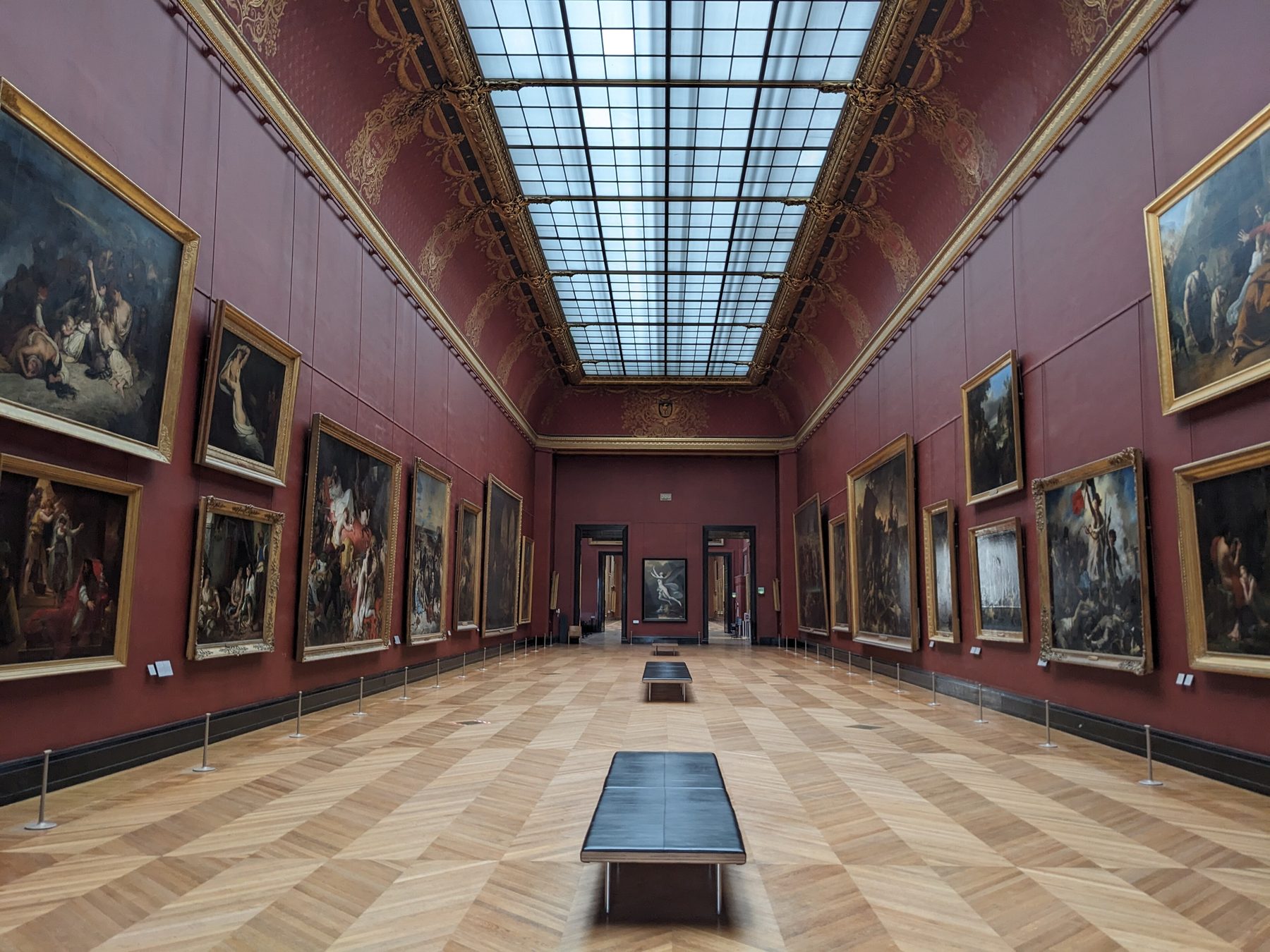
The Raft hangs in the Denon wing, on level 1, in Room 700, the Salle Mollien. This is the long red gallery of French Romantic painting. The Louvre’s catalogue lists it as inventory number 4884, oil on canvas, 4.91 by 7.16 metres. The museum warns that room assignments can change, so check its online catalogue if you are planning around one painting.
The same room is where you will usually find Delacroix’s Liberty Leading the People, so you can look from the face-down youth on the raft to the painting the same young man made in 1830. Through the next doorway is the Salle Daru, with David’s Coronation of Napoleon and The Oath of the Horatii. The Mona Lisa is a few rooms away on the same floor, which is why the Salle Mollien is often busy with people walking to and from her, and quiet with people actually looking. Our guides to the Louvre’s paintings and to what to see at the Louvre cover the rest of the wing. If the Raft leaves you thinking about how painters turned real atrocities into images, Goya’s Third of May 1808, painted five years earlier, is the obvious companion.
The Louvre’s website gives its opening hours as 9 a.m. to 6 p.m. on Monday, Thursday, Saturday and Sunday, and 9 a.m. to 9 p.m. on Wednesday and Friday. It is closed on Tuesdays. General admission is 22 euros for visitors from the European Economic Area and 32 euros for everyone else, and it is free for anyone under eighteen. Booking a time slot online in advance is strongly recommended.
If you like putting names to the faces on a canvas, Raphael’s School of Athens gets the same treatment, and the rest of the series is collected in Famous Paintings, Every Figure Identified.
What to look for when you stand in front of it
Stand in the middle of the room first, far enough back to see the whole thing. Notice that you are looking slightly down onto the raft, and that the bottom edge is almost at your feet. Géricault wanted you on board.
Then walk up and find the Argus. It takes most people a while. Once you have it, look back at the father in the lower left, who is not looking at it, and at Jean Charles on the barrel, who is. The whole painting is the distance between those two men. Chiaro is useful at exactly this point, because the Argus is the one detail on the canvas that needs a story to make sense: a few centimetres of grey paint that was, for the fifteen men still alive, the whole world.
After that, look at the bodies at the bottom, the greenish ones, and remember where Géricault got them. Look at the men at the foot of the mast, and remember that two of the real survivors stood in his studio and lent him their faces. And look at the dark patches, where the bitumen has eaten the light, and try to imagine the painting as the crowd at the Salon saw it in 1819, brighter, sharper, and more shocking.
The Raft stop on our free Louvre audio guide walks you through the same canvas, in the room, in your language.
Corréard, the engineer who drew the plan of the raft, opened a bookshop in the Palais-Royal in 1818. He called it At the Sign of the Shipwrecked Man of the Medusa, and it became a meeting place for the opposition to the restored monarchy. The government that bought the painting had spent years trying to forget the wreck. The men on the raft made sure it could not. The tiny grey ship on Géricault’s horizon is still there, still turning away, still coming back.