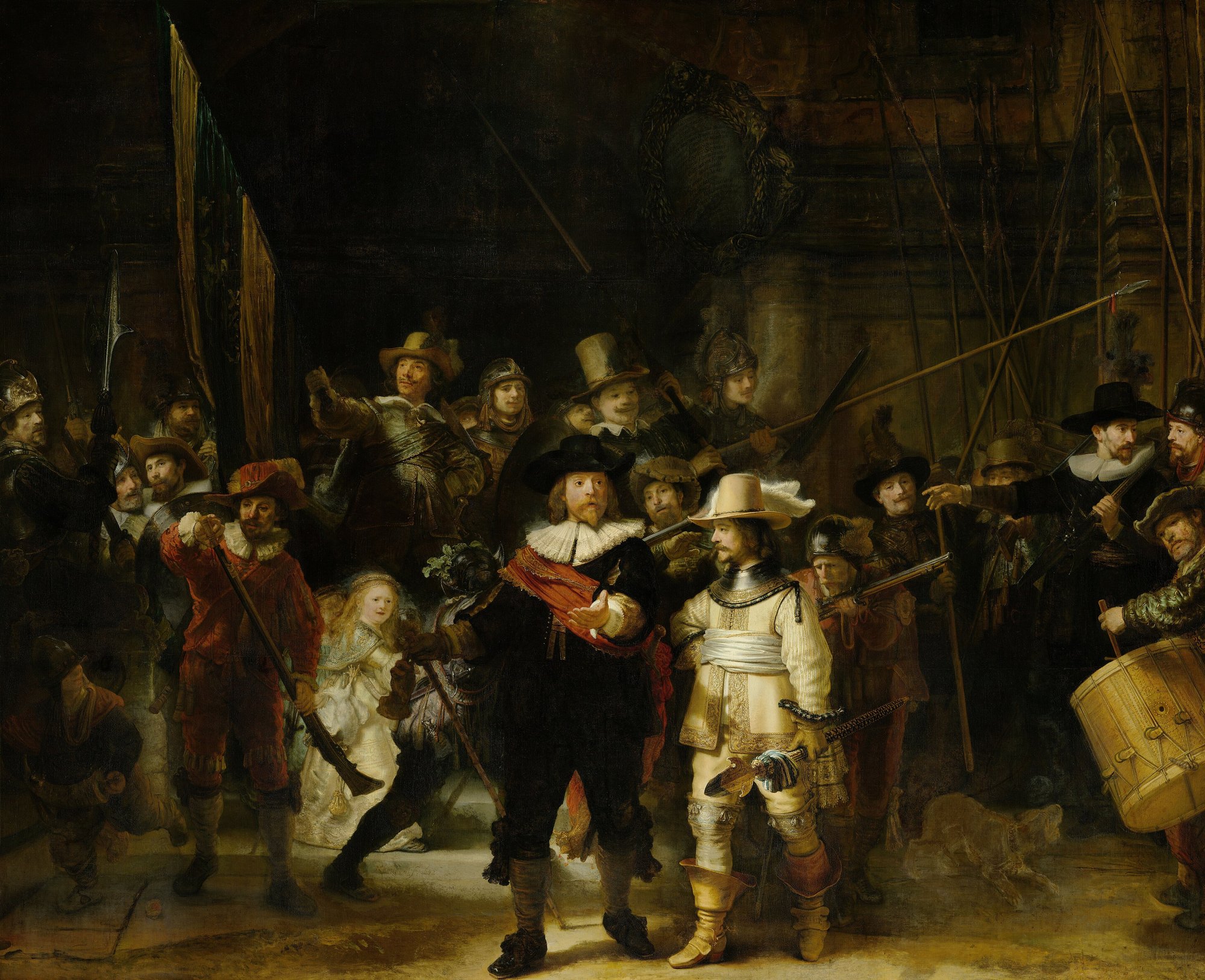
In 1659, an old cloth merchant named Jan Pietersen Bronckhorst walked into a notary’s office in Amsterdam and swore to what The Night Watch, Rembrandt van Rijn’s portrait of his militia company, had cost. Seventeen years earlier, he said, he and the other men of the company had been painted by Rembrandt, “being sixteen in number,” and each of them had paid about one hundred guilders, “one a little more, the other a little less, according to the position they had in it.” Bronckhorst was testifying for the guardian of Rembrandt’s son Titus. And Bronckhorst knew what he was talking about when he said position mattered. In the picture, he is one of the hardest men to find.
Rembrandt finished the picture in 1642, it is almost twelve feet high and more than fourteen wide, and it hangs at the end of the Gallery of Honour in the Rijksmuseum like the altarpiece of a secular church. It is also a group portrait of paying customers. When you look at it, you are looking at a bill split eighteen ways, a hired drummer, a girl nobody can name, a dog borrowed from someone else’s print, a man who was already dead, and, just possibly, one eye belonging to the painter himself.
The Night Watch, Rembrandt’s crowd at a glance
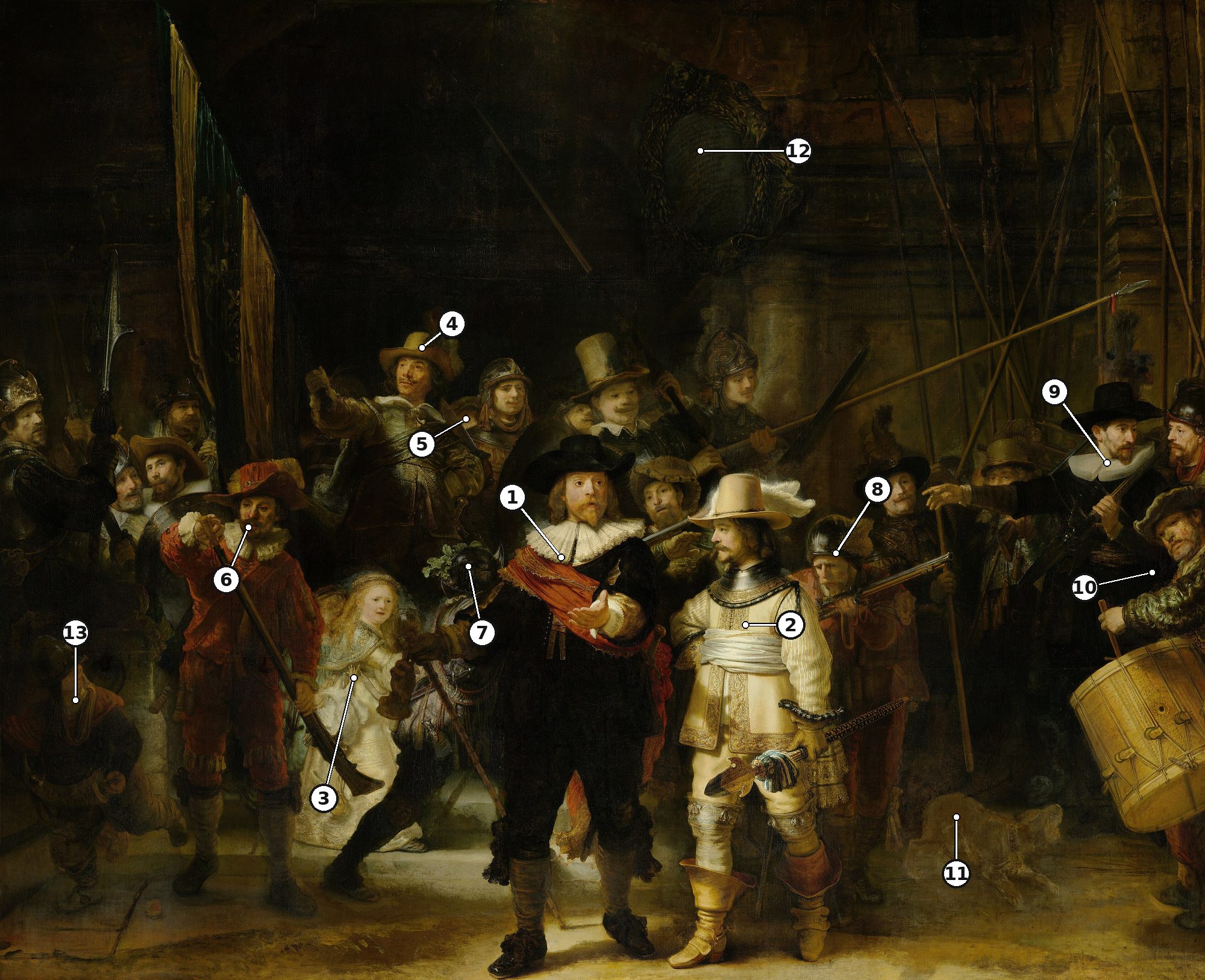
The numbers on the image match this key. Names in the second column come from the shield Rembrandt’s sitters had painted into the picture, and from the archival work of the Amsterdam historian S.A.C. Dudok van Heel, published in the Rijksmuseum Bulletin. Where an identification is a reading rather than a certainty, the table says so.
| # | Figure | Who it is | Where to find him |
|---|---|---|---|
| 1 | The captain | Frans Banninck Cocq, later a burgomaster of Amsterdam | Center, in black with a red sash, left hand held out |
| 2 | The lieutenant | Willem van Ruytenburch, lord of Vlaardingen | Beside him, in pale yellow with a white sash, holding a ceremonial partisan |
| 3 | The girl in gold | No one known; a living emblem of the company | Behind the captain on the left, a dead chicken hanging from her waist |
| 4 | The ensign | Jan Visscher Cornelisen | Upper left of center, raising the company flag |
| 5 | An eye and a beret | Possibly Rembrandt himself | Peeking between the ensign and the man in the gold helmet |
| 6 | The musketeer in red | Usually identified as Jan van der Heede | Left, loading powder into his barrel |
| 7 | The small musketeer firing | Not identified | Just behind the captain, oak leaves on his helmet |
| 8 | The musketeer blowing his pan | Jan Claesen Leijdeckers | Behind the lieutenant, in a dark helmet |
| 9 | The sergeant | Rombout Kemp | Right, in an old-fashioned millstone ruff, pointing |
| 10 | The drummer | Jacob Jorisz, hired, not on the shield | Far right, beating the drum |
| 11 | The dog | Borrowed from a print | Lower right, barking at the drum |
| 12 | The shield | Eighteen names of the men who paid | High on the archway, center |
| 13 | The powder boy | Not identified | Far left, running out of the frame |
Who is who in the Night Watch, starting with the hand
Start where Rembrandt wants you to start, with the two men walking straight at you.
Frans Banninck Cocq is the captain. He is in black, with a broad lace collar and a red sash across his chest, and he is mid-sentence. His left hand comes forward, palm open, as if he has just told his lieutenant to get the company moving. The shield above him spells his name Banning Cocq, which is how most English books spell it too. He was born in 1605, the son of a pharmacist who had come to Amsterdam from Bremen, and he married well. By the time of the painting he was lord of Purmerland and Ilpendam, two small manors north of the city, and in 1650 he became one of Amsterdam’s burgomasters. He liked this picture enough to have a watercolor copy of it made for his family album, which is now on loan to the Rijksmuseum’s print room.
Willem van Ruytenburch is the lieutenant. He is everything the captain is not: pale where Cocq is dark, in profile where Cocq faces you, listening where Cocq talks. He wears a buff coat embroidered in gold, a white sash, and a hat with a white plume, and he holds the partisan, the short ceremonial spear that was a lieutenant’s badge of rank.
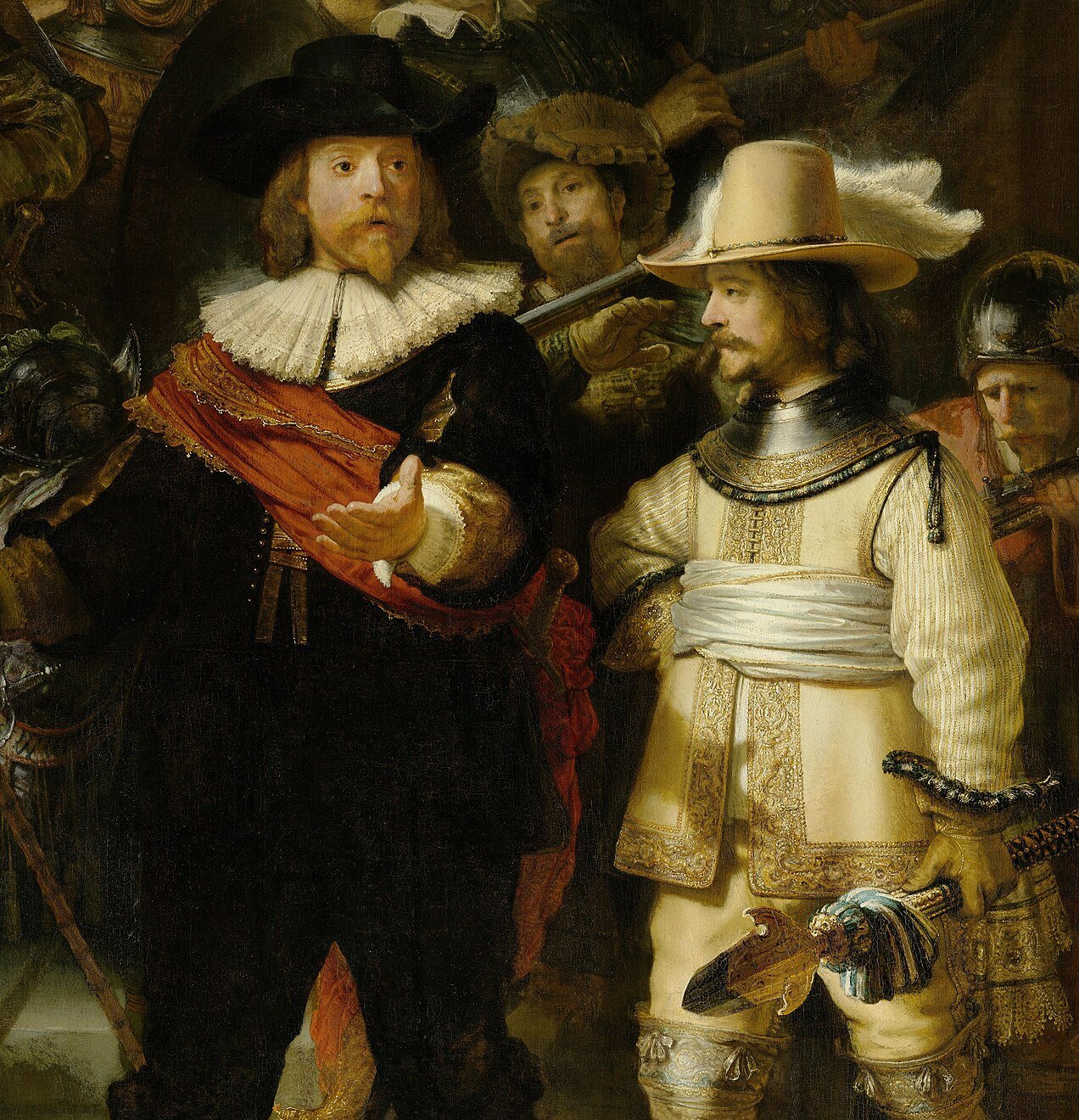
Now look at the lieutenant’s coat, just below his waist. There is a shadow on it, and it is the shape of the captain’s hand. It is the single most quoted detail in the painting, and it does two jobs at once. It tells you where the light is coming from, high and to the left. And it pushes the captain’s hand forward, out of the canvas and into your space. Stand in front of the real thing and the hand seems to hang in the air a foot in front of the picture.
Behind the two officers, Rembrandt broke the rules of the genre. Earlier militia portraits lined the men up like a team photo, so each face got its due. Rembrandt staged a moment. The company is spilling out of a dark gateway, about to march. People are loading guns, raising a flag, beating a drum, shouting, pointing, tripping over each other. It looks like chaos. It is not.
The girl with the chicken, and the man who was already dead
The most famous figure in the painting is not a member of the company. She is a girl, small and blonde, dressed in gold and pale blue, and she glows as if she has her own light source. Hanging from her waist, upside down, is a dead chicken. Its claws are prominent. That is the point.
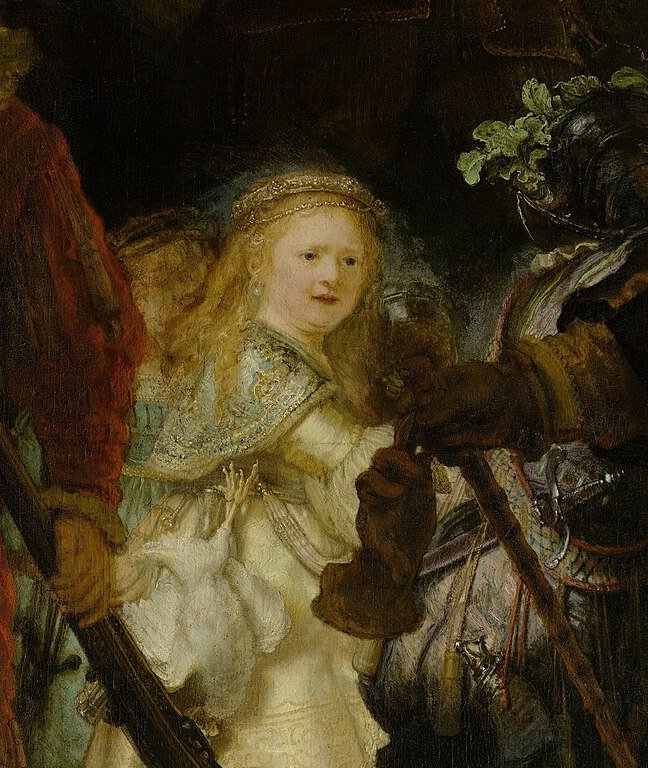
This company belonged to the Kloveniers, Amsterdam’s arquebusiers, the musket guild. Their emblem was a golden claw, a pun on their name, and the clawed chicken is that emblem made flesh. Behind the bird there is a pistol, another nod to the klover, the gun the guild was named for. The girl is a mascot, a walking coat of arms. She is not anyone’s daughter as far as the records show. Earlier writers suggested the steward of the guild hall had a daughter who modeled for her; Dudok van Heel checked, and the steward’s older daughter was thirty-five in 1642. Some people see the face of Saskia, Rembrandt’s wife, who died in June 1642, the year the picture was finished. There is no evidence for that either, and it is better to let the girl be what the painting says she is: a symbol who happens to be the brightest thing in the room.
There is a second girl just behind her, mostly hidden, in blue. Most visitors never notice her.
Now look at the musketeers, because Rembrandt hid a little drill manual in them. On the left, the man dressed head to toe in red, usually identified as Jan van der Heede, is pouring powder into the barrel of his musket. Just behind the captain, a short figure in a helmet decorated with oak leaves is firing his gun; the barrel passes right behind the lieutenant’s hat. And behind the lieutenant, in a dark helmet, another musketeer is blowing the leftover powder off his firing pan. Load, fire, clean. It is the cycle every musketeer drilled, laid across the front of the painting like a comic strip.
The man blowing his pan carries the strangest story in the picture. The museum’s own description names him as Jan Claesen Leijdeckers. According to Dudok van Heel’s research, Leijdeckers was dead by 1640, before Rembrandt could paint him from life, and the pose seems to come from a printed musket drill by Jacques de Gheyn. His name is still on the shield.
The painter of The Night Watch, peeking out
Go up a level, to the back row. The man raising the company flag is the ensign, Jan Visscher Cornelisen, and Rembrandt put him in full light, which was a compliment. The ensign carried the company’s honor. Right of him stands a young man in a gold helmet. And between the two of them, in a gap you would never look at twice, there is one eye and the edge of a soft beret.
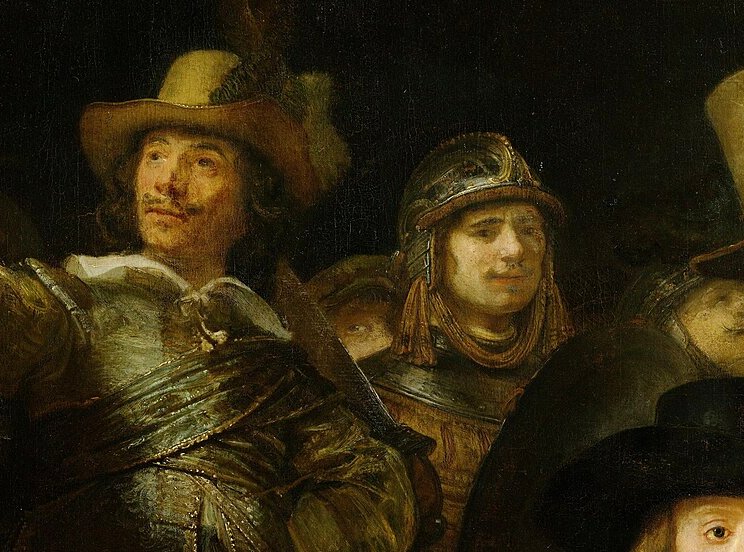
That eye is often called Rembrandt’s self-portrait. The Rijksmuseum’s own online tour says the figure “may well be” him, because the sliver of face matches his self-portraits. Dudok van Heel’s numbered key to the painting simply labels it “Self-portrait.” Nobody has proof, and no document says Rembrandt put himself in. But the beret is his, the habit was his, and the joke is his. The most famous painter in Amsterdam, in a painting where every face cost money, gave himself one eye’s worth of canvas for free.
There is a nice irony waiting for you in the same gallery. Since 2023, Rembrandt’s Standard Bearer of 1636, a full self-portrait of the young painter dressed as an ensign holding a flag, has hung in the Rijksmuseum’s Gallery of Honour, close to The Night Watch. The Dutch state bought it from the Rothschild family for 175 million euros. Six years before he painted this company’s real ensign, Rembrandt was already rehearsing for the job by playing one himself.
Who paid, and why the shield matters
Look up at the archway, above and right of the captain’s head. There is an oval shield hung on the stonework, and on it is a list of names. Eighteen of them.
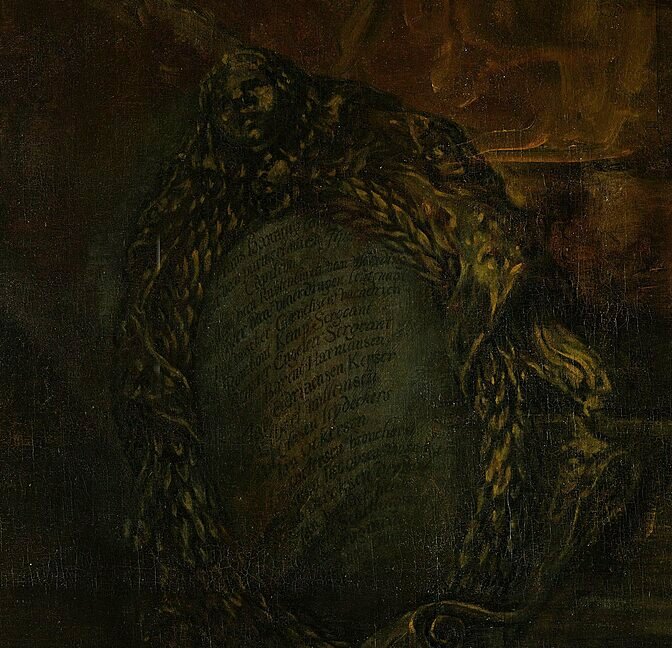
The shield was not part of Rembrandt’s original design. It was added later, by another hand, and the sources disagree on when. Dudok van Heel dates it to about 1653; other accounts, including the English Wikipedia, put it as late as 1715. Either way, it was painted on because the men wanted to be remembered by name. The irony is that the darkening varnish made the names unreadable by the eighteenth century, and they only came back after the varnish was cleaned off in 1947.
The eighteen names are the captain, the lieutenant, and the sixteen guardsmen Bronckhorst described: the ensign, two sergeants, Rombout Kemp and Reijnier Engelen, a sword bearer, pikemen, shield bearers and musketeers. Not every name can be pinned to a face, and Dudok van Heel was honest that some of his matches are educated guesses. The roster is a slice of the Amsterdam merchant class in 1642: cloth merchants, a wine broker, a grocer, all from District Two, a few streets between the Damrak and the Singel.
Bronckhorst’s sentence about the money also explains the composition. A man who paid a little more got a better place. Bronckhorst, whom Dudok van Heel identifies as the white-bearded shield bearer in the back rows, is half lost in the crowd. Rombout Kemp, the sergeant on the right in his outdated millstone ruff, got a dynamic pose and a pointing hand. The two officers, who almost certainly paid far more, got the center and the light. One hundred guilders bought you a head. The total came to about 1,600 guilders for the sixteen guardsmen, confirmed by a second witness the same year, plus whatever the captain and lieutenant paid on top.
The old story that the guardsmen hated the painting and refused to pay is a myth. The 1659 statements show they paid. The painting hung in the great hall of the Kloveniersdoelen, their guild house, as one of six group portraits commissioned for the new building. It stayed there for more than seventy years.
The drummer, the dog, and the boy running away
On the far right, a man is beating a large drum. He is Jacob Jorisz, the company’s drummer, and he is the only clearly identified figure in the painting whose name is not on the shield. He did not pay. Drummers were hired men, and Rembrandt included him for the sound. A painting in which a drum is rolling is a painting in which something is about to happen.
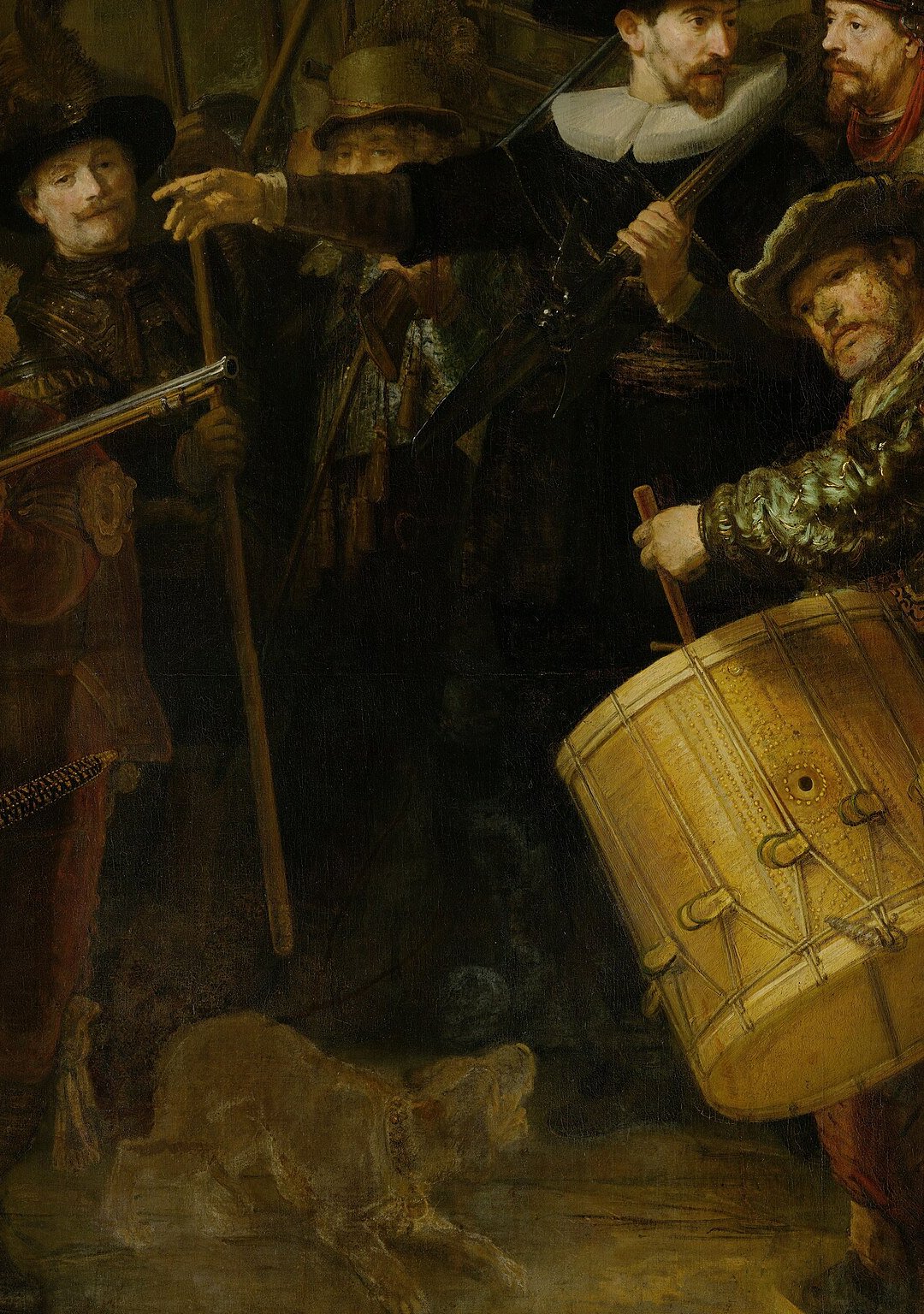
At the drummer’s feet, a scruffy dog barks at the noise. The dog is a small detail with a surprising source. Anne Lenders, a Rijksmuseum curator, has pointed out that it closely resembles a dog in an illustration by the Dutch artist Adriaen van de Venne, and X-ray images of the painting showed the resemblance went deeper than the finished surface. Rembrandt, in other words, appears to have borrowed his dog from a book.
On the far left, a boy in a helmet that is much too big for him runs out of the picture with a powder horn. He is the powder boy, and he is the counterweight to the dog. One runs left, the other barks right, and between them the whole company starts to move.
Is the Night Watch painting really set at night?
No. This is the surprise everyone should hear before they stand in front of it. The Night Watch is a daytime scene. The company is stepping out of a shaded gateway into daylight. The deep brown gloom that gave the picture its nickname came from layer after layer of varnish, which yellowed and darkened over the centuries until the whole canvas looked like it was lit by torches. Nobody in the seventeenth century called it The Night Watch. Its formal title is something like Militia Company of District II under the Command of Captain Frans Banninck Cocq, and nobody was ever going to say that out loud. By the time a shorter name caught on, the painting looked like night, so night is what it got.
The varnish was cleaned off in the 1940s, after the painting came back from the war, and the daylight reappeared. The name stayed.
The edges Amsterdam cut off in 1715
The painting you see is not the painting Rembrandt finished. In 1715, The Night Watch was moved from the guild house to Amsterdam’s Town Hall on the Dam, the building that is now the Royal Palace. It did not fit the wall it was meant for. So it was cut down on all four sides.
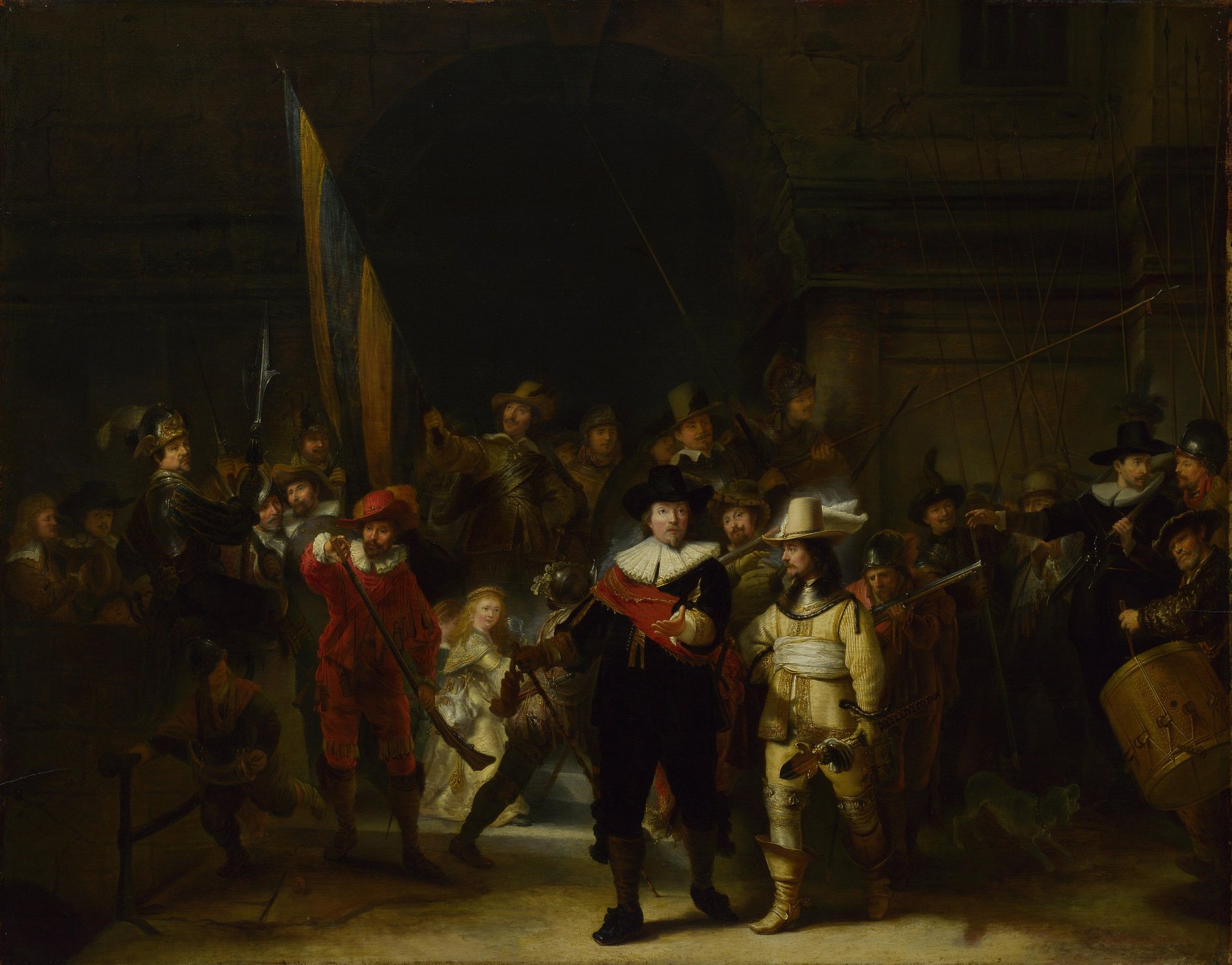
The losses were biggest on the left. According to the Rijksmuseum, a strip about 64 centimeters wide went from that side, about 23 centimeters from the top, about 11 from the bottom, and 7 from the right. Three figures at the left edge disappeared: two militiamen and a young child. So did the top of the arch, the balustrade, and the edge of the step the company is walking down. The cut-off pieces have never been found.
We know what they looked like because of a small copy, attributed to the painter Gerrit Lundens, made while the original was still whole. It belongs to the National Gallery in London. In it, the two officers are walking forward slightly off-center, toward the right, with more room behind them. The composition breathes. In the trimmed version, the captain is almost dead center, and the crowd feels tighter. Most people who know the painting know a cropped version, and most never think about it.
In June 2021, the Rijksmuseum hung printed reconstructions of the missing strips around the real canvas for a few months. The reconstructions were built from the Lundens copy with the help of artificial intelligence, trained to paint the missing areas in Rembrandt’s palette and style. The museum was clear that it would never attach them permanently. The point was to let people see, for one summer, the picture Rembrandt actually painted.
Knives, acid, and a vault in Maastricht
In 1911 an unemployed shoemaker attacked the painting with a knife; the thick old varnish saved it. On September 14, 1975, a former schoolteacher named Wilhelmus de Rijk slashed it with a bread knife, leaving zigzag cuts. The restoration that followed, in 1975 and 1976, left the varnish that is now being removed. In 1990 a man sprayed acid on it; guards doused the canvas with water, and the acid reached only the varnish.
In September 1939 the canvas was taken off its stretcher, rolled around a cylinder and moved out of Amsterdam. It spent much of the war in a vault in the caves near Maastricht, in the far south of the country.
Operation Night Watch, in public
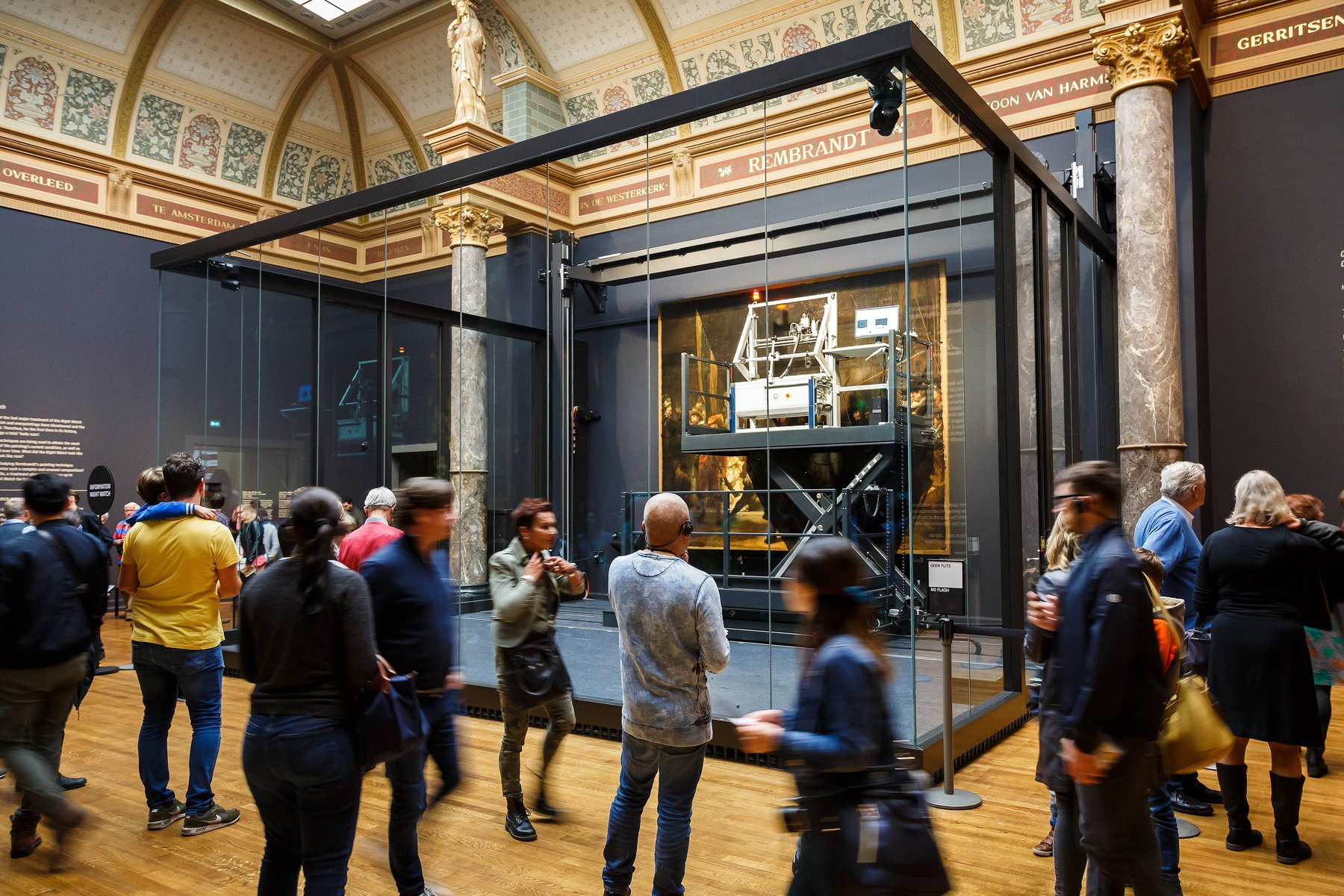
In July 2019, the Rijksmuseum started the biggest research and conservation project in the history of Rembrandt’s Night Watch, and decided to do it in front of everyone. They built a glass chamber around the canvas, right in its gallery, and the work went on while visitors watched and the cameras streamed it online. The museum called it Operation Night Watch.
The first five years were mostly looking: scans, X-ray fluorescence, photographs at enormous resolution. The research turned up surprises, including a lead compound in the paint that had never before been found in a historical oil painting, and traces of a sketch Rembrandt laid in before he began painting. In November 2024, eight conservators began removing the 1975 varnish, a little at a time, with solvent-soaked tissues pressed against the surface. The museum’s director has said the painting itself will decide how long that takes. When this article was written, the museum had not announced an end date, so whether you see the canvas behind glass, with conservators at work, depends on when you go.
What to look for, and where to see it
The Night Watch hangs at the end of the Gallery of Honour, the long central hall of the Rijksmuseum, at Museumstraat 1 on Amsterdam’s Museumplein. The museum is open every day from 9 a.m. to 5 p.m. Adult tickets cost 25 euros, visitors 18 and under go free, and everyone has to book a start time in advance, including museum card holders. Prices and hours change, so check the museum’s site before you go. The Rijksmuseum page on our site has The Night Watch as one of five audio stops, along with Vermeer’s Little Street and Asselijn’s Threatened Swan.
Go first thing or in the last hour. In the middle of the day, the crowd in front of the painting is ten deep, and the figures you want are small. Once you are there, give it three passes.
First, stand back, far enough to see the whole canvas. Watch the light. Find the hand shadow on the lieutenant’s coat, then the girl, then notice how everything else falls away into brown.
Second, walk in close on the left. Load, fire, clean: the red musketeer, the small one in the oak-leaf helmet, the man blowing his pan. Then look up at the flag and find the eye. The canvas is huge, and the eye is the size of a coin. With Chiaro running at this distance, the story of the beret, the shield and the hundred guilders plays in your ear while you are still deciding whether that eye is looking at you.
Third, go right. Kemp pointing, the drummer, the dog. Then look up at the shield and remember that every name on it was a man who paid, and that the man who painted them is up there in the back, unpaid, peeking out.
If you like this way of reading a crowded picture, the same numbered approach works on Raphael’s School of Athens, where the philosophers wear the faces of Leonardo and Michelangelo, and on David’s Coronation of Napoleon, where several people in the painting were not in the room. For another seventeenth-century painter who put himself into his own picture, see Velázquez’s Las Meninas. And if a big museum usually leaves you tired and blank, our art museum tips for people who don’t get art pass through this very gallery. The full series, every painting decoded figure by figure, is collected in Famous Paintings, Every Figure Identified.
Bronckhorst, the old cloth merchant who swore to the price in 1659, got what he paid for: a head in the crowd, half in shadow, one of eighteen. Rembrandt paid nothing and got one eye. Almost four centuries later, more people look for the eye.