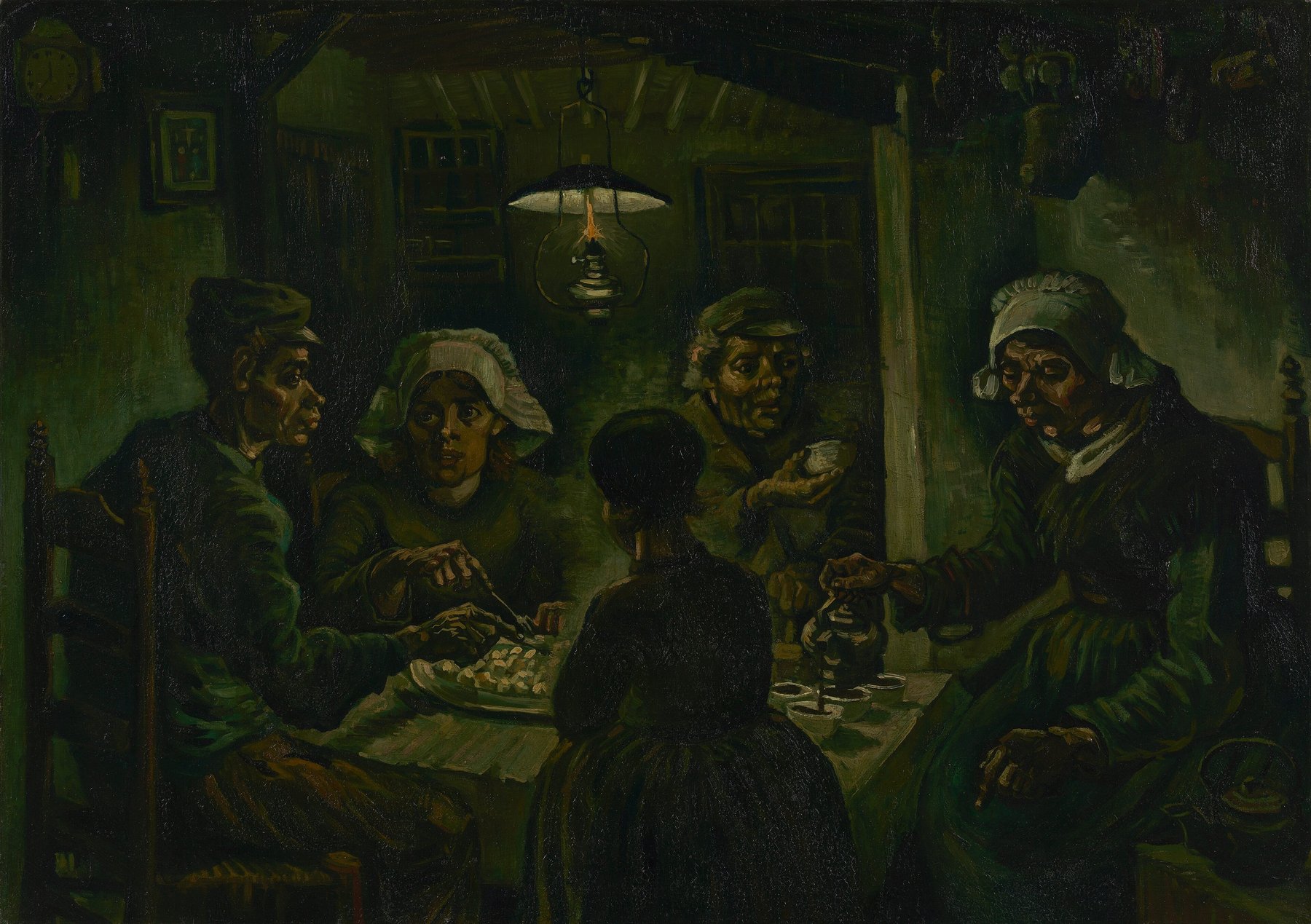
In the autumn of 1887, Vincent van Gogh was living in Paris with his brother Theo, painting sunflowers and bright little views of Montmartre, and hating, he said, the business of writing letters. He wrote one anyway, to his youngest sister, Willemien. Halfway down the page he asked about a family back in the Dutch village of Nuenen. “Did Sien de Groot marry her cousin? And did her child live?”
Then, in the very next breath, he named the best thing he had ever painted. It was The Potato Eaters. “Of my own work I think that the picture of peasants eating potatoes I did in Nuenen is après tout the best I’ve done.”
Think about where he was when he wrote that. He was surrounded by the Impressionists. He had just discovered complementary colour, Japanese prints and the broken brushstroke. And the picture he called his best was a dark brown supper in a cottage at night, five heavy faces and a single lamp. The woman whose child he was asking about was sitting at that table.
Why a brown supper matters so much
Most visitors in Amsterdam walk past it on the way to the Sunflowers. It is easy to treat it as the dull early one. That gets it backwards. This was the first picture he planned as a showpiece, the one he hoped would prove he could paint a group of figures. It was the first one he defended in writing, in a string of letters that still read like a manifesto. And it cost him a friend of five years.
It hangs today in the permanent collection of the Van Gogh Museum, and it is a stop on our Van Gogh Museum audio guide. Here is who is at the table, and why he never stopped believing in it.
The Potato Eaters, figure by figure
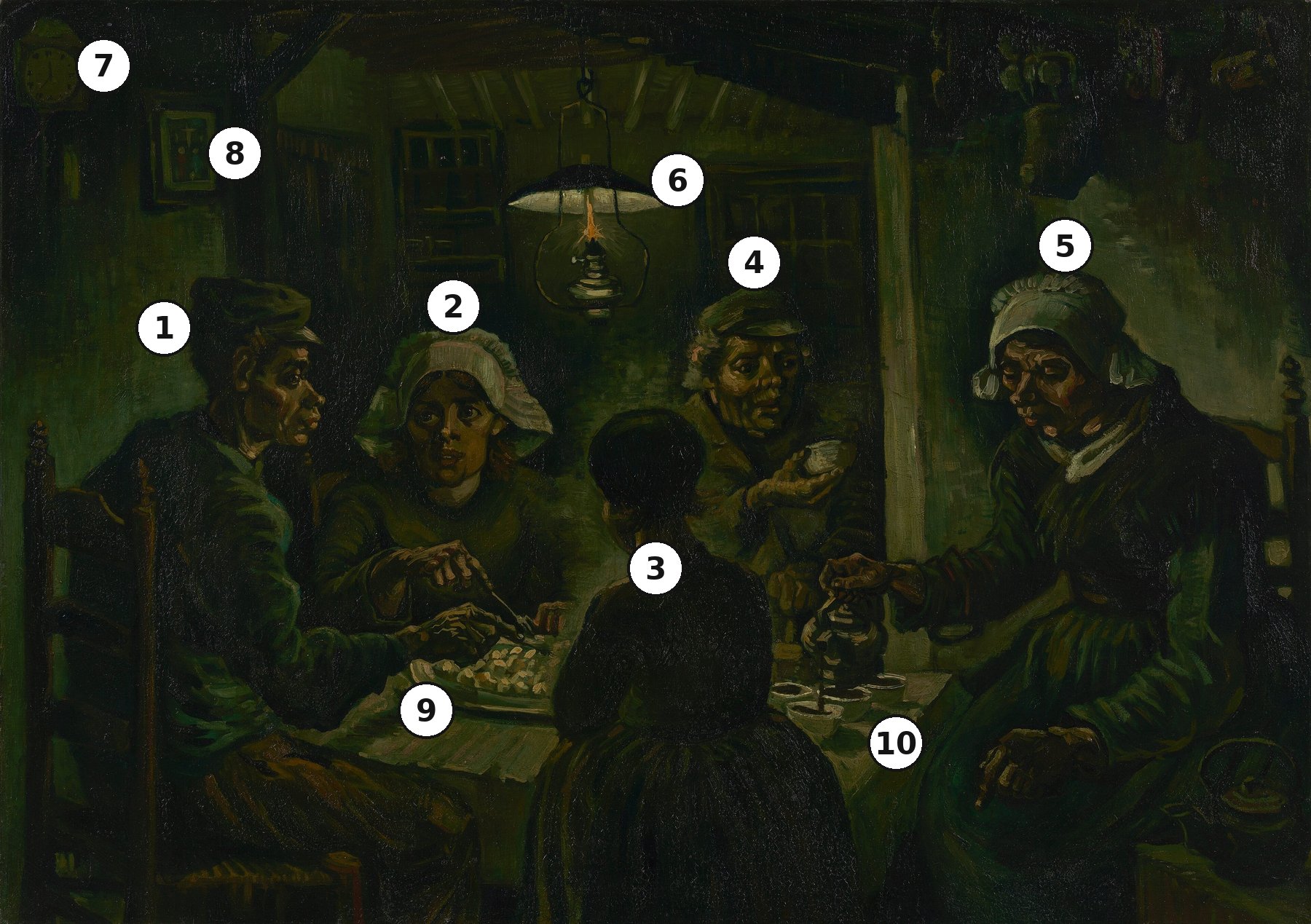
The numbers on the image match this key. Only one sitter can be named with confidence. The others are almost certainly members of the same household, but nobody wrote their names down.
| # | Who or what | Where to find it | What we know |
|---|---|---|---|
| 1 | Young man | Far left, in a cap, in profile | Probably a member of the De Groot-van Rooij household; not securely identified |
| 2 | Young woman | Left of center, in a white bonnet, fork in the dish | Gordina de Groot, the one sitter identified with confidence |
| 3 | Girl | Center foreground, back to the viewer | Unidentified; a silhouette against the lamplight |
| 4 | Older man | Right of center, holding out a cup | Unidentified; possibly a relative living in the house |
| 5 | Older woman | Far right, in a white bonnet, pouring | Unidentified; probably an older member of the household |
| 6 | Oil lamp | Hanging above the table | The only light source in the room |
| 7 | Clock | Top left corner, on the wall | Reads about seven, so this is the evening meal |
| 8 | Small framed print | Below the clock | A small devotional print, the room’s only decoration |
| 9 | Potatoes | The dish on the left | Eaten straight from the shared platter |
| 10 | Coffee | Kettle and cups at right | Coffee poured from a kettle, the evening drink |
Start at the left. The young man in the cap leans in, his hand going to the dish. Beside him, the young woman with the fork glances sideways toward him. That is Gordina de Groot, about thirty years old, unmarried, and a model Van Gogh painted again and again that winter. In the middle, the girl with her back to us is a dark cutout against the light, and she is the hinge of the whole composition. Without her the table splits into two pairs. With her it becomes a circle.
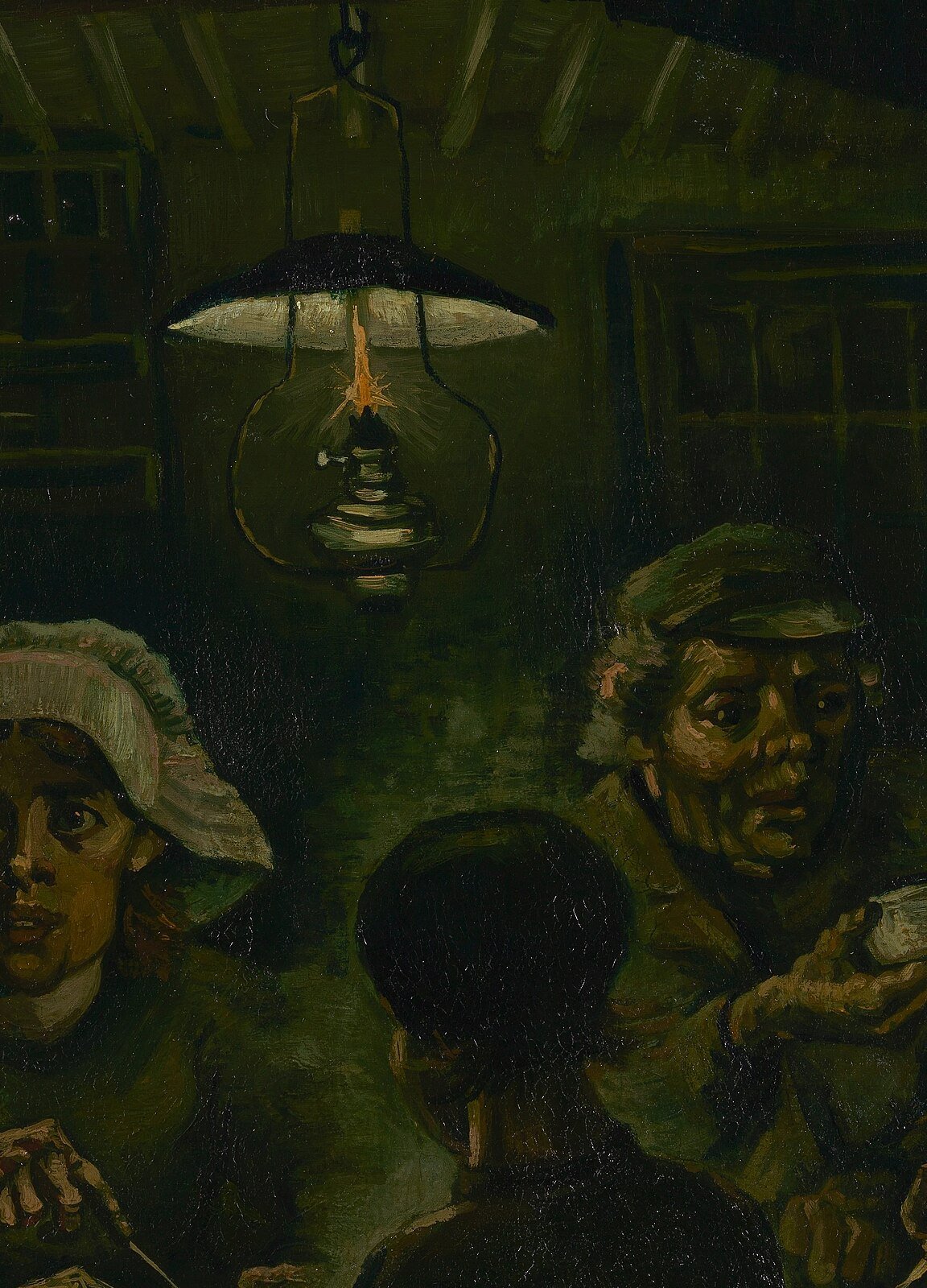
On the right, the older man holds out his cup and looks at the older woman, who keeps her eyes down on the coffee she is pouring. Nobody is talking. The clock says seven. A small devotional print hangs below it.
A winter of heads and hands
Van Gogh had moved back into his parents’ parsonage in Nuenen, in the Brabant countryside, in December 1883. Through the winter of 1884 into 1885 he walked out to the cottages of weavers and farmworkers and painted their heads, one after another. The Van Gogh Museum’s 2021 exhibition on the picture counted about forty painted head studies from that winter; the Kröller-Müller Museum puts the number of portrait studies, drawings included, at more than a hundred. He drew hands holding bowls, hands holding forks, a fist on a table.
On March 26, 1885, his father, the Reverend Theodorus van Gogh, collapsed on the doorstep of the parsonage and died. A few weeks later Vincent began the big canvas. He told Theo around April 30 that it had been done “in a comparatively short time, and largely from memory,” but that “it has taken a whole winter of painting studies of heads and hands.”
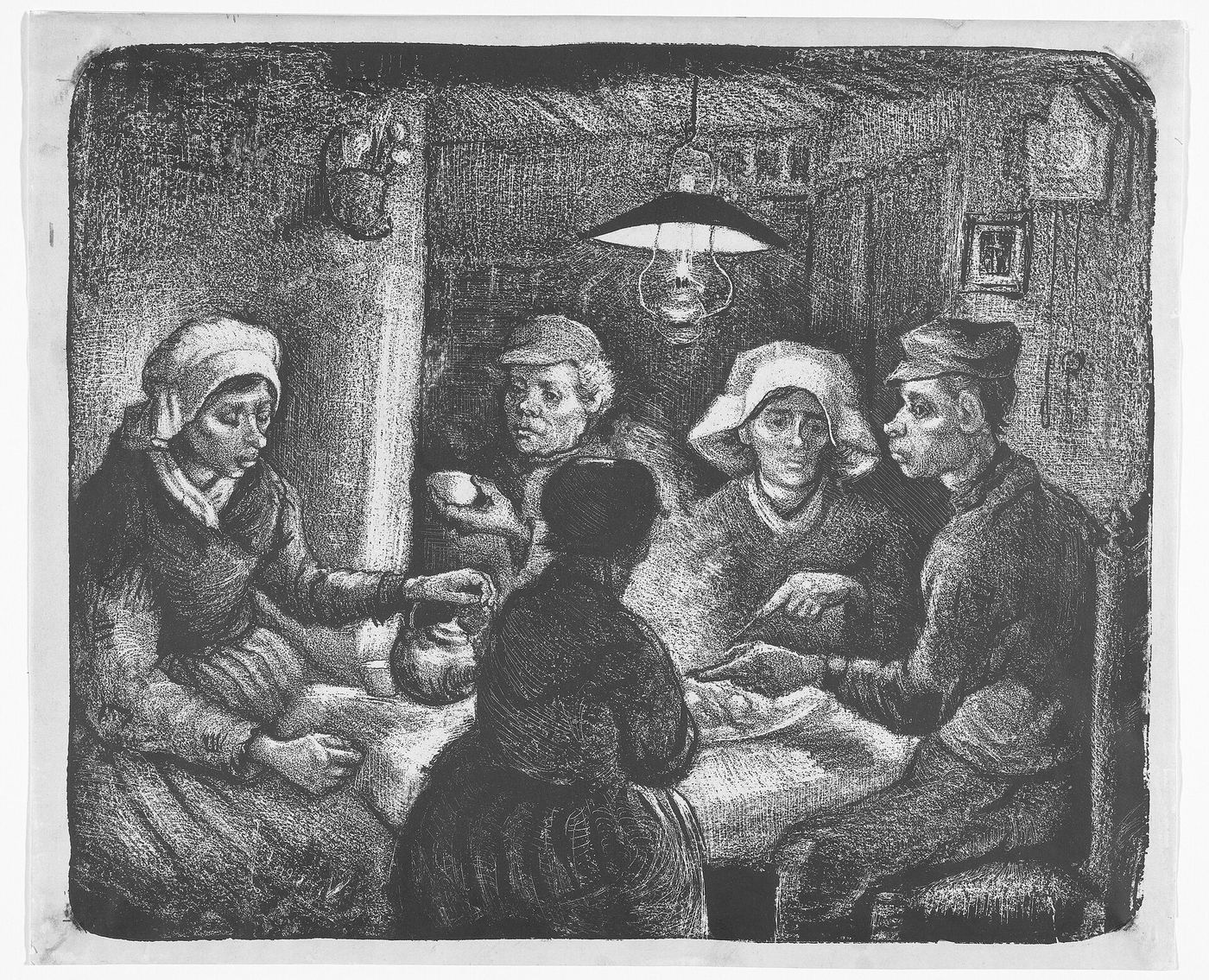
He worked toward it in stages. First a pencil sketch and a small, rough oil sketch. Then a lithograph, drawn from memory in a single day and printed in mirror image. Then a large painted study of the whole composition, now in the Kröller-Müller Museum. And finally the version in Amsterdam, finished at the very beginning of May 1885 and sent to Theo in Paris. A cat appeared in one preparatory drawing and was quietly dropped.
Gordina de Groot and the cottage on the Gerwenseweg
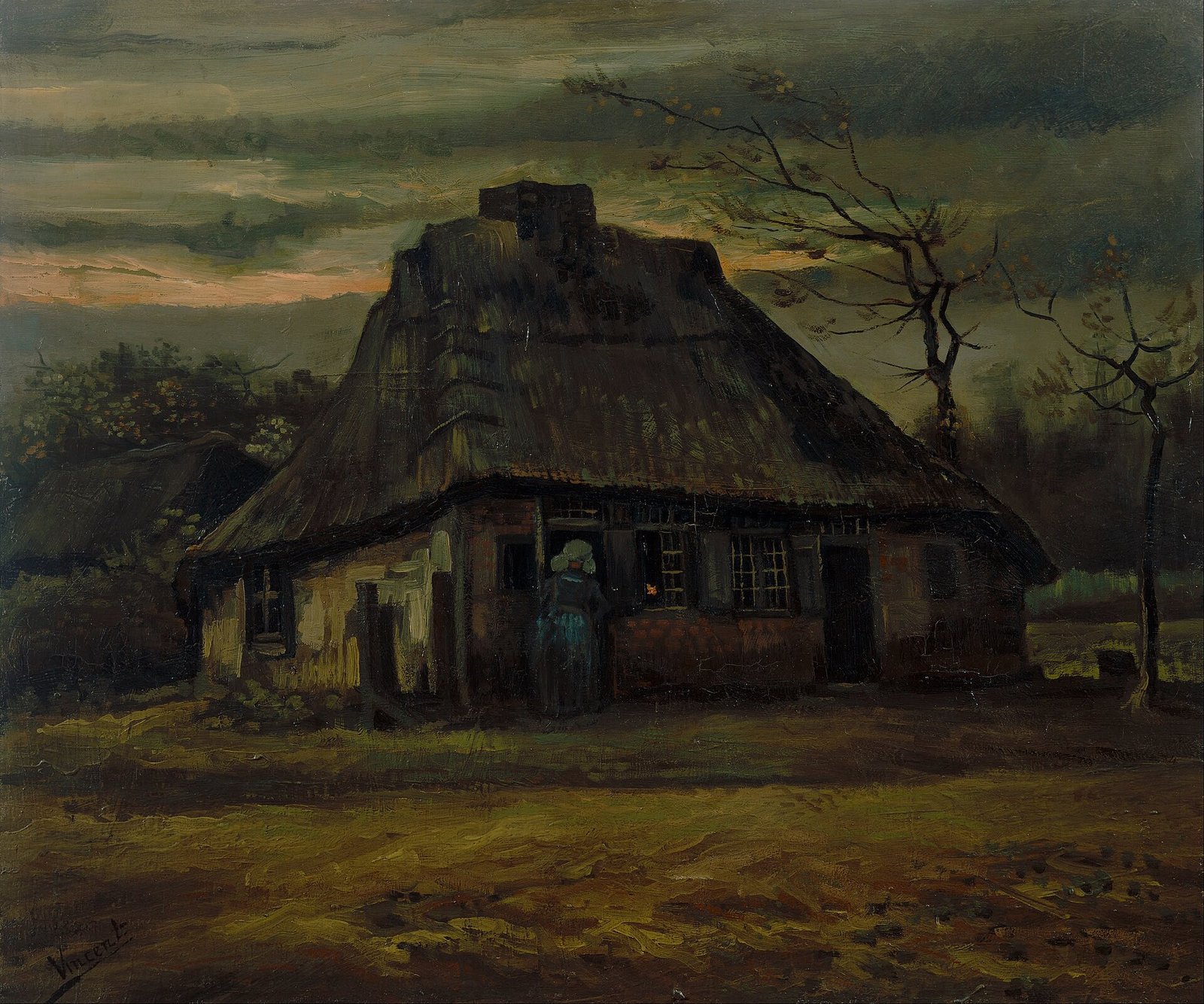
The family lived in a small cottage on the edge of Nuenen, on what is now the Gerwenseweg. The house was shared by two families, and Van Gogh was a regular guest in it. He painted the outside of it in May 1885, a low thatched hut with a dark doorway. The original cottage is gone; a replacement was built on the spot in the 1950s.
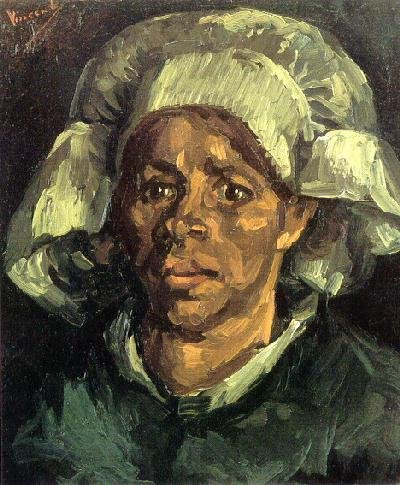
Gordina de Groot, whom Van Gogh called Sien in his letters, was the face he came back to most. She is in a series of heads from that spring, square-jawed, full-lipped, wearing the white Brabant cap, and in at least one of them she stares straight out of the canvas at the painter.
By late summer she was pregnant. The village talked, and the local Catholic clergy decided the Protestant painter who spent his evenings in her house was responsible. Van Gogh wrote to Theo in early September 1885 that the priests had warned him not to be “too familiar with people below me in station,” while threatening the villagers if they let themselves be painted. “The priest even went so far as to promise the people money if they refused to be painted,” he wrote, “but they answered quite spiritedly that they would rather earn money from me than beg some from him.”
He denied the rumour flatly. “A girl I had frequently painted was about to have a baby and they suspected me, though I had nothing to do with it.” He said Gordina herself had told him the father was a member of the priest’s own congregation, and he went straight to the burgomaster to complain. That is why, two years later in Paris, he was asking his sister whether Sien had married her cousin and whether her child had lived. The rumour had cost him his models. Two months after that letter to Theo, in November 1885, he left Nuenen for good and never painted Dutch peasants again.
”The colour of a very dusty potato, unpeeled of course”
The darkness is the first thing anyone says about this painting, and it was deliberate. Van Gogh first painted the heads in what he called flesh colour, a mix of yellow ochre, red ochre and white. It looked wrong. “All the heads were finished, and even finished with great care,” he told Theo in early May, “but I immediately repainted them, inexorably, and the colour they are painted in now is like the colour of a very dusty potato, unpeeled of course.”
Even the whites aren’t white. He explained that the light parts were mixed from vermilion, Paris blue and Naples yellow, a neutral that only looks pale because everything around it is darker. The shadows are painted with blue. He was thinking about a line from the French peasant painter Jean-François Millet, that peasants should look as if they had been painted with the very soil they were sowing.
Then he told Theo exactly how to hang it. Not against a dark wall. In a gold frame, or against wallpaper “in a deep shade of ripe corn,” because in real life the hearth and the firelight stood between the viewer and the table, outside the picture. The painting was meant to glow out of a warm surround, like a room seen from the fireside.
”These people have dug the earth with the self-same hands”
The heart of the defence comes in the letter of around April 30, 1885, written for Theo’s birthday. “I’ve tried to bring out the idea that these people eating potatoes by the light of their lamp have dug the earth with the self-same hands they are now putting into the dish, and it thus suggests manual labour and — a meal honestly earned.”
He wanted the hands to be ugly. He wanted the faces coarse. “If a peasant painting smells of bacon, smoke, potato steam, fine — that’s not unhealthy,” he wrote. “A painting of peasant life should not be perfumed.” He told Theo to show it to the dealer Paul Durand-Ruel anyway, and to be ready to hear the French for “what a daub.”
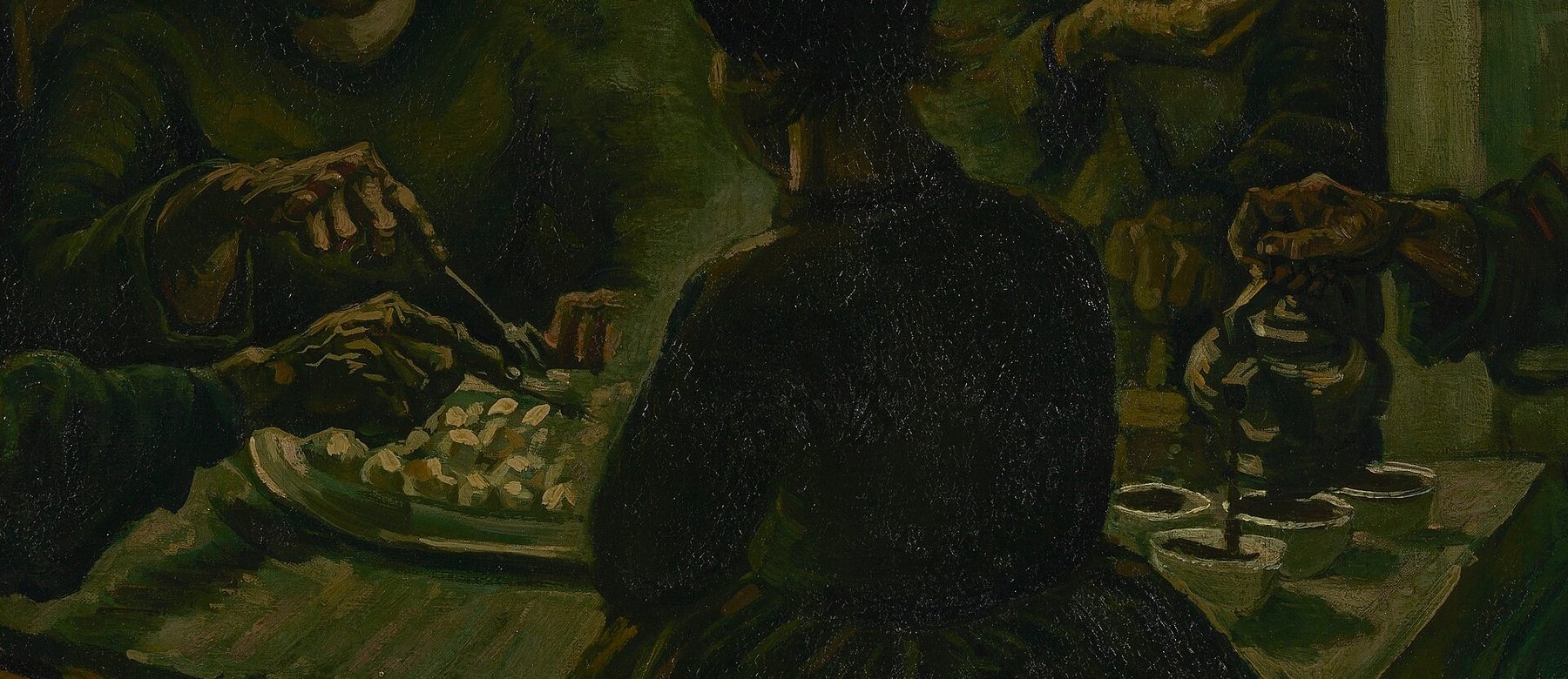
Stand in front of the canvas and look at the hands before the faces. The young man’s knuckles. Gordina’s fork. The older man’s palm cupped under his cup. The woman’s grip on the kettle. Chiaro reads the birthday letter to Theo while you follow those hands around the table, and the painting suddenly sounds like what he said it was: a meal honestly earned.
The letter that ended a friendship
Van Gogh sent an impression of the lithograph to his friend Anthon van Rappard, a painter from a well-off Utrecht family who had been his companion and sparring partner since they met in Brussels in 1880. Van Rappard’s reply, dated May 24, 1885, is one of the most brutal reviews any painter has ever received from a friend.
“You will agree with me that such work is not meant seriously,” he wrote. He mocked the “coquettish little hand” of the woman with the kettle, and asked what on earth the kettle was doing. Then he went after the anatomy. “And why isn’t that man to the right allowed to have a knee, a belly and lungs? Or are they located in his back? And why must his arm be a yard too short?” A woman’s nose, he said, looked like “some sort of little tobacco-pipe stem with a little cube at the end.” And the last blow: “while working in such a manner, you dare invoke the names of Millet and Breton? Come on! in my opinion art is too sublime a thing to be treated so nonchalantly.”
Bear in mind he was looking at the print, which is reversed and much cruder than the painting. It didn’t matter. Van Gogh’s answer came the next day, and it is two lines long. “I just received your letter — to my surprise. You are herewith getting it back.” He returned the letter unanswered.
The two men exchanged a few more angry letters that summer, in which Van Gogh told Van Rappard he had “no right to condemn my work” that way, and then the correspondence ran out. A friendship that had lasted nearly five years did not survive one supper.
Was Van Rappard wrong? On the anatomy, not entirely. The arms are short and the faces are pushed toward caricature. But Van Gogh was choosing truth of feeling over correct drawing, and he knew exactly what he was giving up. A few months later he wrote to Van Rappard that he was always doing what he couldn’t do yet, in order to learn how to do it.
Three versions of one supper
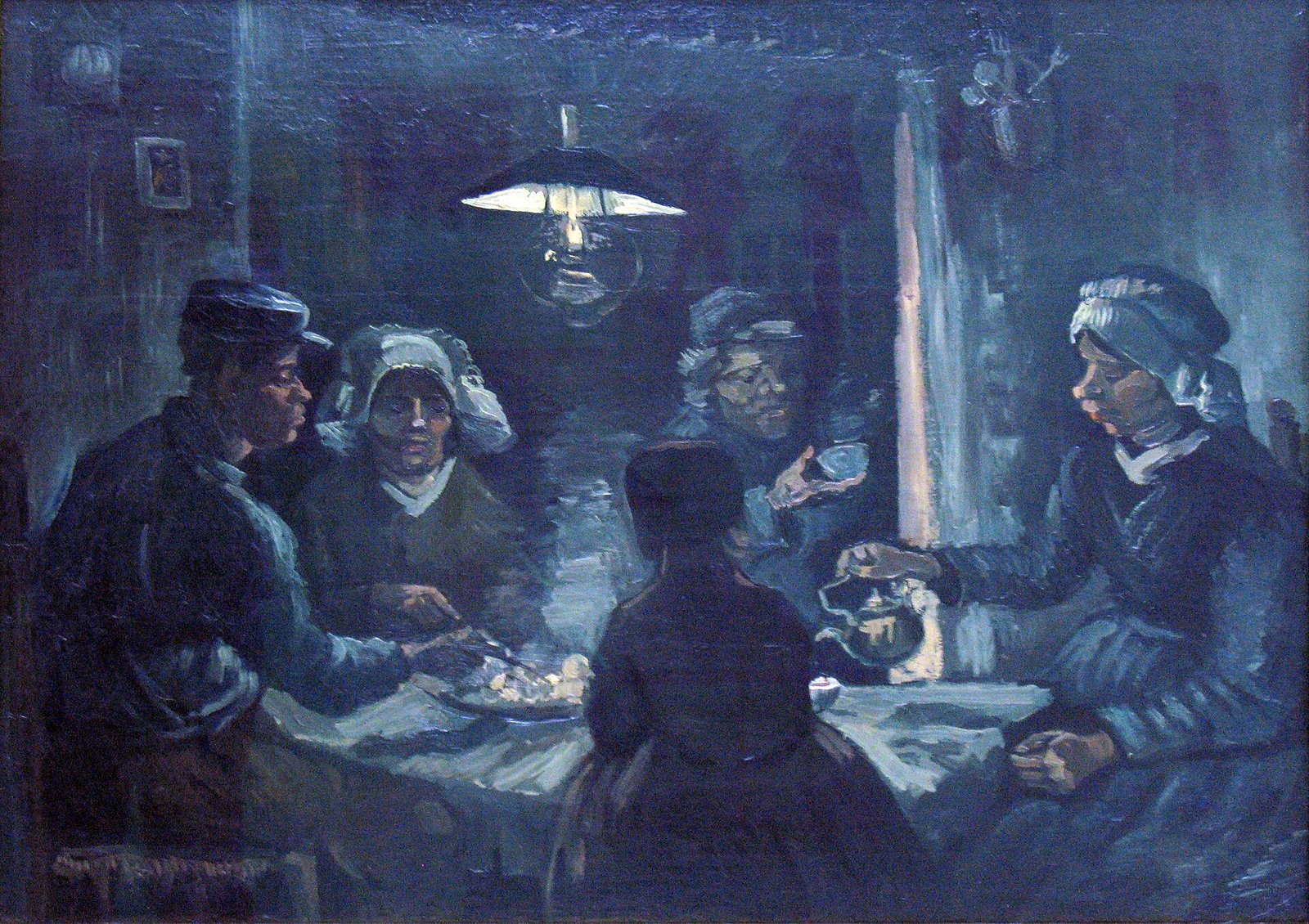
Side by side, the three versions show Van Gogh learning on the job. The lithograph is reversed, scratchy and almost all line. The Kröller-Müller study, in Otterlo, has the composition in place, with looser faces and a cooler, bluer light. The Amsterdam canvas tightens everything. The heads are harder, the lamp is brighter, the hands have knuckles.
Theo hung the finished picture above the fireplace in his Paris apartment. His widow, Jo van Gogh-Bonger, kept it, and it has been in the Van Gogh Museum since the building opened in 1973.
Both versions have had their own brush with crime. In December 1988, thieves took the Kröller-Müller study along with two other Van Goghs; it was recovered the following July. And on April 14, 1991, twenty paintings were stolen from the Van Gogh Museum, The Potato Eaters among them. The getaway car had a flat tyre. The thieves abandoned it, and the paintings were found about thirty-five minutes later.
Why he kept calling it his best
So why, in 1887, with Paris all around him, did he still rank this picture first? Partly because he had nothing else like it. He wrote to Willemien that since Nuenen he had “had no chance of getting models.” He never again built an ambitious group of figures from months of studies of live models. Almost every famous picture that came afterwards is a landscape, a still life, a portrait of one person, or a room with nobody in it.
Partly, too, because it was where his ideas came from. The insistence on painting people who work with their hands. The idea that colour should carry feeling rather than copy nature. The willingness to look clumsy if clumsy was true. The famous cypresses and starry skies are the same convictions, with brighter paint.
And he never quite let it go. In April 1890, in the asylum at Saint-Rémy, he wrote that he was thinking of painting the picture again, with the effect of lamplight. He made a few sketches of peasants at table from memory, his reminiscences of the North, but no new version followed. A month later he painted the last picture of his time in Provence, the road with a cypress and a star. The man in the swirling blue self-portrait at the Orsay, painted in the same asylum, is the same man who sat in a smoky cottage in Brabant five years earlier, counting knuckles.
The Potato Eaters FAQ
Where is The Potato Eaters?
The finished painting is in the Van Gogh Museum in Amsterdam, on long-term loan from the Vincent van Gogh Foundation, and it is currently on view in the permanent collection. The large oil study is in the Kröller-Müller Museum in Otterlo, and impressions of the lithograph are in several collections, including the Rijksmuseum.
Who are the people in The Potato Eaters?
They are members of the De Groot-van Rooij family, a peasant household in Nuenen. Only Gordina de Groot, the young woman second from the left, can be identified with confidence. The others are probably her relatives, but no document names them.
What does The Potato Eaters mean?
Van Gogh said it himself: these people have dug the earth with the same hands they are putting into the dish, so the meal is honestly earned. It is a picture of manual labour and dignity, deliberately painted without polish.
How big is The Potato Eaters?
It measures 82 by 114 centimetres, about 32 by 45 inches.
Why is The Potato Eaters so dark?
Van Gogh repainted the faces to look like “a very dusty potato” and mixed even the whites from coloured pigments. The canvas has also darkened over time, and he complained in 1885 that some of his paint was poor.
Where to see it in Amsterdam and Otterlo
The Van Gogh Museum is at Museumplein 6. Every visitor, including children who get in free, has to book a timed entry ticket online in advance, and slots for weekends and holidays sell out. Opening hours shift through the year; in November 2026 the museum is open 9 a.m. to 5 p.m., with Friday evenings until 9 p.m. The collection is hung roughly in the order of Van Gogh’s life, so The Potato Eaters sits among the dark Dutch pictures, before the light comes in. Check the museum’s floor plan on the day, since rooms are rehung.
Go early or on a Friday night, and you can often have the supper table almost to yourself for a minute. Our Van Gogh Museum audio guide has it as a stop. If you need permission to slow down in a museum, our tips for people who think they don’t get art are a good warm-up.
With a second day, the Kröller-Müller Museum in Otterlo, inside the Hoge Veluwe National Park, holds the large study and one of the biggest Van Gogh collections anywhere. Nuenen itself, about two hours south by train and bus, has a Van Gogh visitor centre and a walking route past the parsonage.
What to look for in front of it
Stand back first and find the lamp. It is the only light in the room, and everything you see is lit by it. Then step closer and find the girl with her back to you, the black shape in the middle that turns five people into a circle. Look for the clock at seven and the little picture on the wall.
Then do what Van Gogh wanted. Skip the faces for a moment and read the hands, left to right: the young man reaching, Gordina with her fork, the older man’s open palm, the woman’s grip on the kettle. Four pairs of hands that spent the day in the dirt. Then look at the faces again, and notice what Van Rappard couldn’t see in a crude print. They aren’t posing. They’re tired, and they’re eating.
Van Gogh wanted it framed in gold, against a wall the colour of ripe corn. Wherever the museum hangs it, you’ll have to imagine the fire behind you.