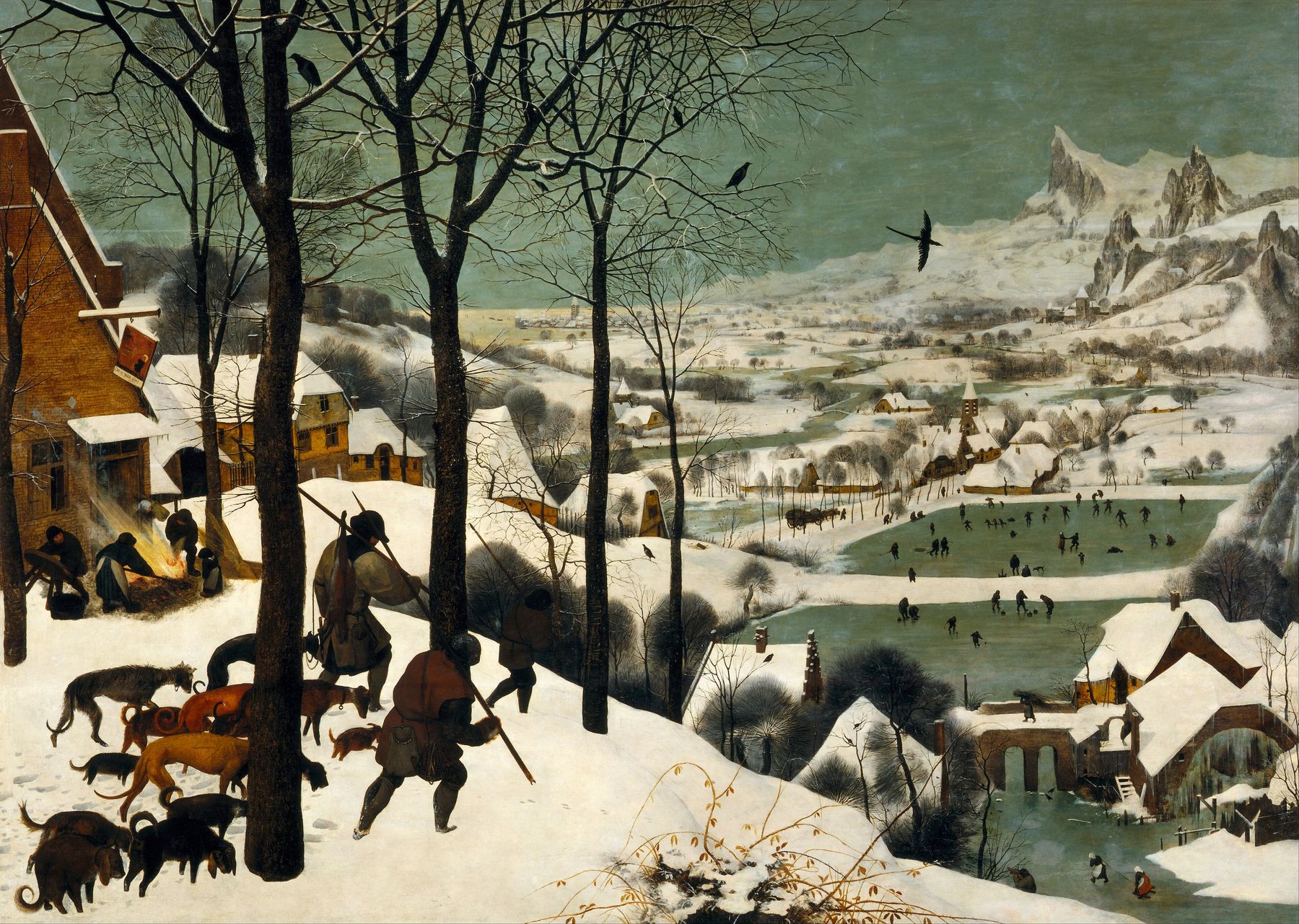
On February 15, 1566, an Antwerp merchant named Niclaes Jongelinck signed a guarantee for a friend’s debt to the city. He needed collateral, so he pledged his art. The list ran to sixteen paintings by Pieter Bruegel, and among them were “the twelve months,” the set of seasons Bruegel had painted the year before for the dining room of Jongelinck’s country house outside Antwerp. One of those panels is Hunters in the Snow. Three tired men and their dogs come over a hill at dusk, and the whole of a Flemish winter opens out below them. Today it hangs in Vienna, a few steps from the other Bruegel that everyone comes for, The Tower of Babel.
Put the two side by side and they look like opposites. One is cold, quiet and ordinary: a bad day’s hunting, a village, some kids on the ice. The other is a biblical catastrophe the size of a mountain. But they were painted two years apart by the same man, and they work the same way. Both look like a single image from across the room and turn into a hundred stories when you get close.
Why Vienna has the most Bruegels on earth
Pieter Bruegel the Elder died in Brussels in 1569. He was probably in his early forties. Only around forty of his paintings survive, and the Kunsthistorisches Museum in Vienna owns twelve of them, the largest group anywhere. They hang together in Room X of the Picture Gallery, on the first floor. No other room in the world lets you turn around and see a quarter of a painter’s surviving work.
That happened because the Habsburgs were early and obsessive fans. In the 1590s, the city of Antwerp gave the seasons series to Archduke Ernst, the governor of the Netherlands and a younger brother of Emperor Rudolf II. Rudolf collected Bruegel too, in Prague. Later, Archduke Leopold Wilhelm, who governed the Netherlands in the 1640s and 1650s and bought paintings by the wagonload, added more. When the Habsburg collections came together in Vienna, Bruegel came with them.
So in Room X you get Children’s Games, the Peasant Wedding, The Procession to Calvary, three of the five surviving seasons, and the two pictures this guide is about. Here they are, numbered.
Hunters in the Snow, every detail numbered
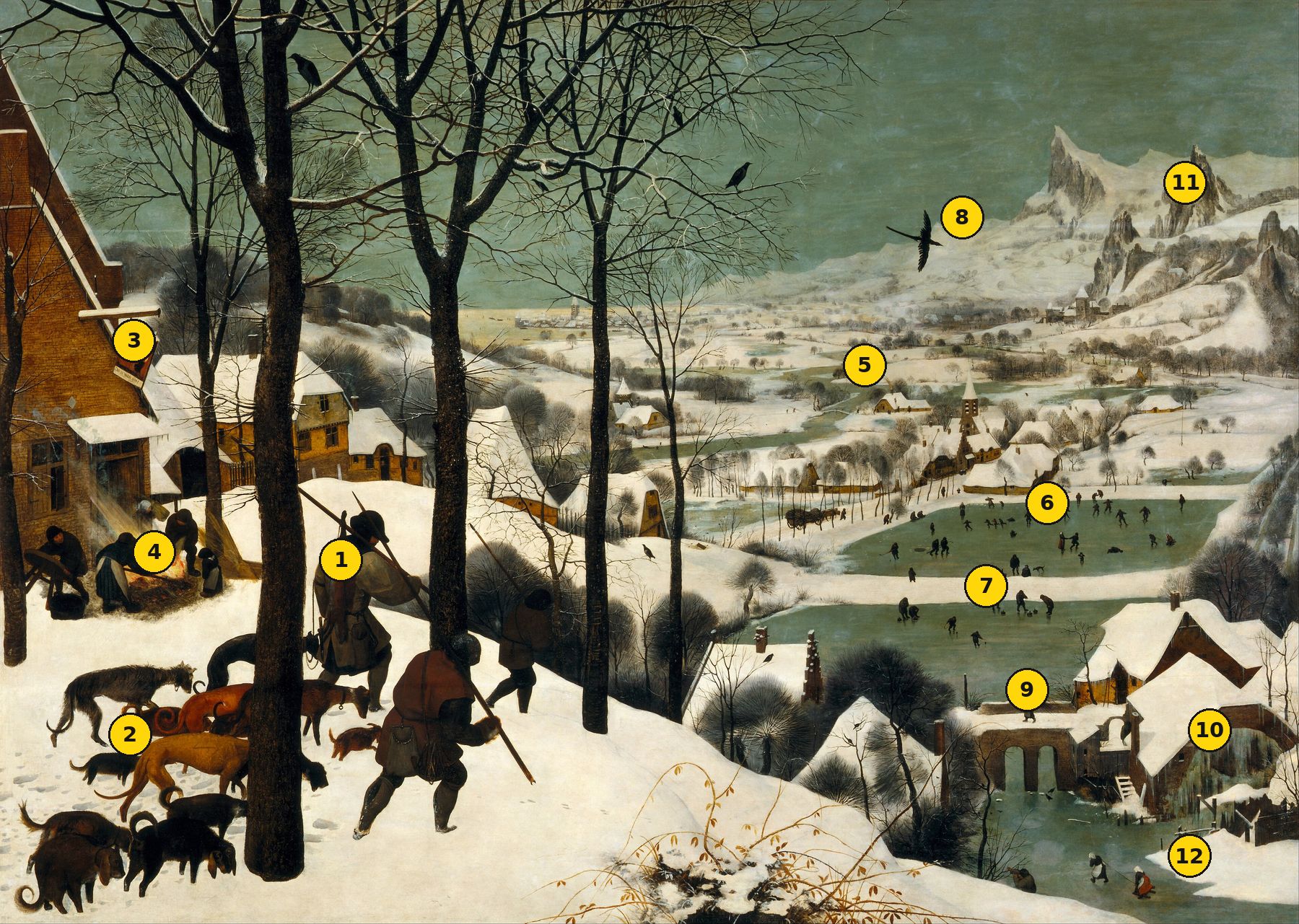
| # | Detail | What it is | Where to find it |
|---|---|---|---|
| 1 | The hunters | Three men coming home with spears and almost nothing to show for it | Center left, walking downhill |
| 2 | The dogs | A dozen or so hounds, thin and worn out | Lower left, at the hunters’ heels |
| 3 | The inn sign | The Stag, with a saint kneeling before a deer | Upper left, hanging off one hook |
| 4 | The fire | A family singeing a slaughtered pig outside the inn | Left, by the doorway |
| 5 | The chimney fire | A house on fire, neighbours running with a ladder | Far village, left of the church |
| 6 | The skaters | Villagers skating, chasing each other, falling | Upper frozen pond |
| 7 | The curling players | An early form of curling, and kolf, a stick-and-ball game | Lower frozen pond |
| 8 | The magpie | A single bird gliding over the valley | Upper center |
| 9 | The firewood carrier | A woman hauling a bundle of brush over the bridge | Right, on the bridge |
| 10 | The mill wheel | A water mill frozen solid, icicles on the wheel | Lower right |
| 11 | The mountains | Alpine peaks that do not exist in Flanders | Upper right |
| 12 | The sledge | A woman pulling another figure across the ice on a rope | Bottom right |
The hunt that went wrong
Start with the men, number 1. There are three of them, bent forward, spears on their shoulders, walking in their own footprints. Now look for what they caught. The lead hunter has a single fox slung on his back. That is the whole bag. A fox was not dinner. Three men and a pack of dogs went out on a winter day and came back with a pelt.
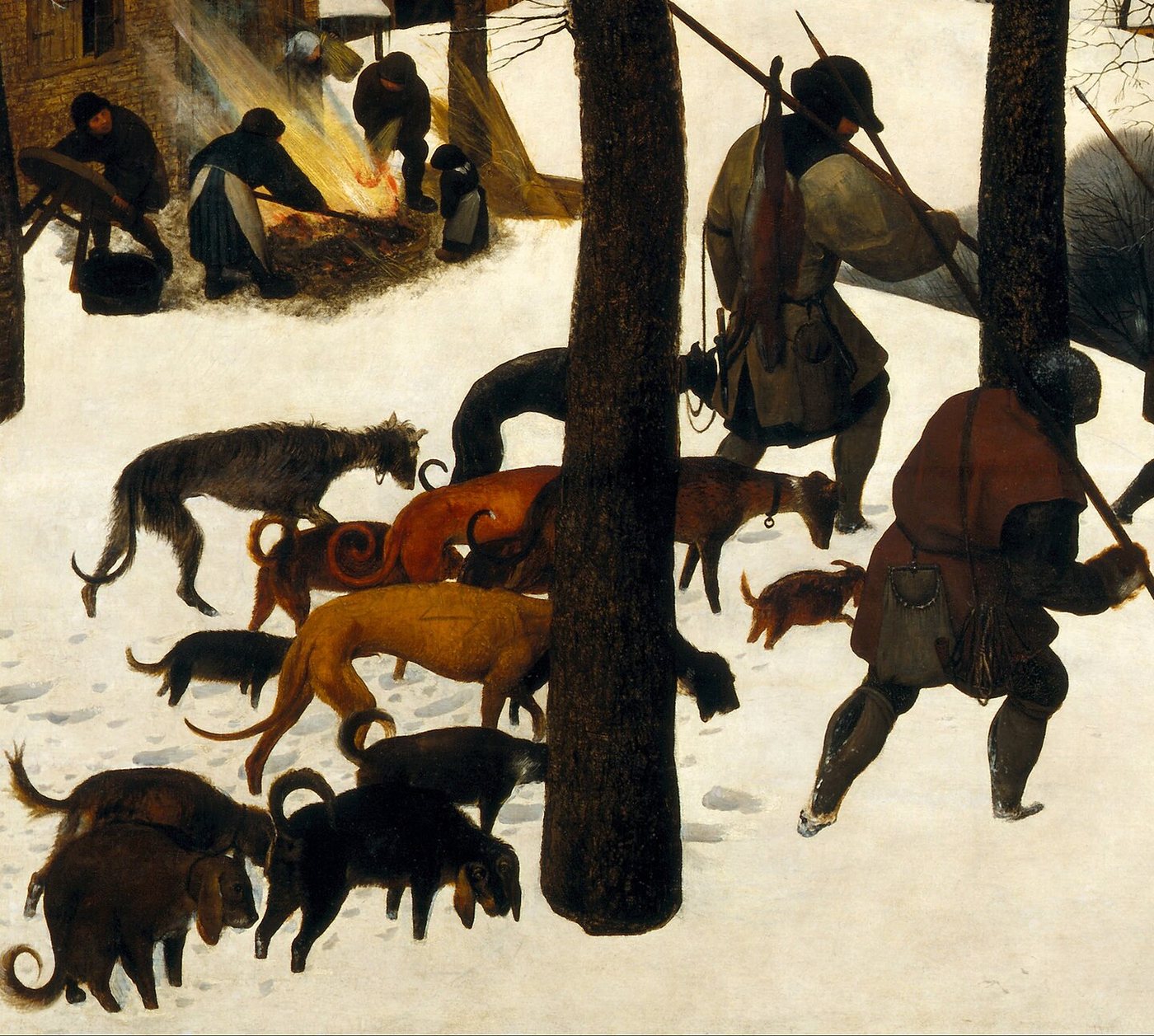
The dogs, number 2, tell the same story. Count their ribs. Bruegel never shows a face on any of these men. You see their backs, their hoods, their boots sinking into the snow. Nobody here is posing for you. You have just fallen in behind them on the path home.
The sign hanging by one hook
Number 3 is the detail that rewards a close look more than any other. The inn on the left has a painted sign, and the sign has come half loose. It hangs off a single hook, tilted, about to drop into the snow. On it, a small figure kneels in front of a deer.
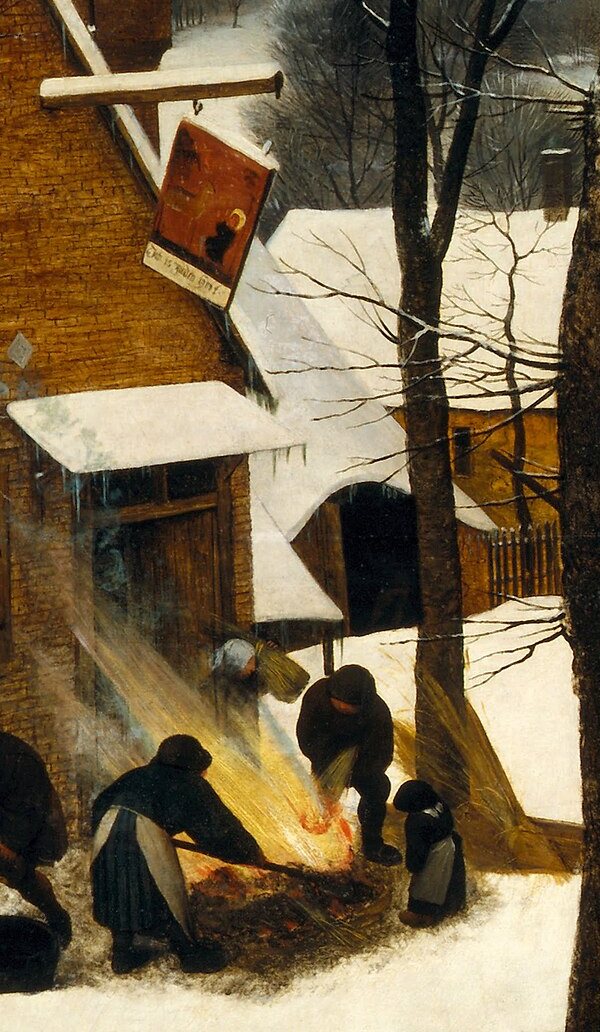
That figure is a saint, and the deer is the stag with a crucifix between its antlers. The legend is told of two saints, Hubert and Eustace, and both are patron saints of hunters. The inscription under the picture names the inn after the stag. It is hard to miss the joke. The hunters walk right past the sign of the hunters’ saint, the patron of a good hunt, and it is falling off its hinges.
Under the sign, number 4, the people of the inn have a fire going. They are singeing the bristles off a slaughtered pig, the standard job of early winter. A woman bends over the blaze, a man feeds it with straw, a small child stands by in an apron. It is the only warm color in the left half of the picture, and the hunters do not even turn their heads.
Now find the second fire, number 5. Far down in the village, left of the church tower, a chimney is on fire. Tiny figures run toward it across a little bridge, and one carries a ladder. It is no bigger than a fingernail on the panel. Bruegel put a small disaster in the middle distance and gave it no special light.
The ice, the bird and the mountains
Drop your eye to the two frozen ponds. On the upper one, number 6, people skate, chase each other and fall over. On the lower one, number 7, men lean over stones that slide across the ice. It is a game close to curling, and others are playing kolf, an old Dutch game played with a stick and ball. A woman at the bottom right, number 12, pulls a second figure across the ice on a rope.
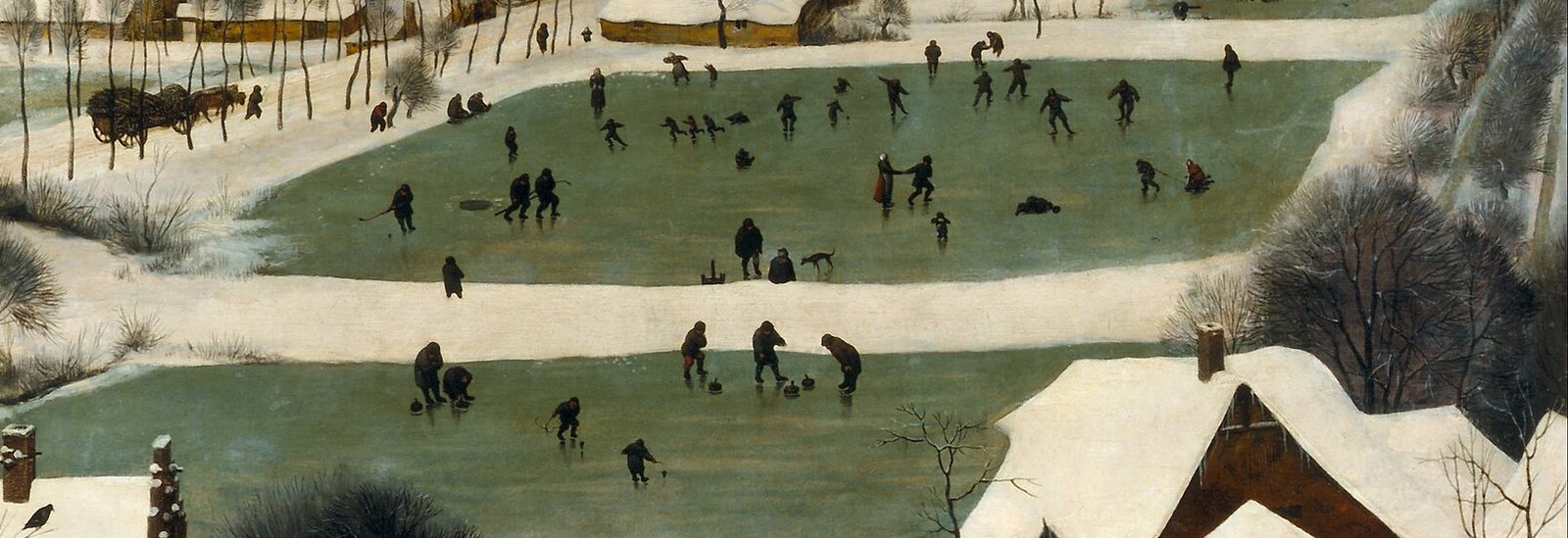
This is the contrast that holds the painting together. Up on the hill, the men are cold, hungry and quiet. Down on the ice, the village is playing. Bruegel does not tell you which is truer.
The black bird gliding over the valley, number 8, is a magpie, and in Netherlandish folklore magpies were not good news. The crows in the trees above the hunters are black and still. The mill wheel at the lower right, number 10, is frozen in place, with icicles hanging off it. And the mountains, number 11, are pure invention. There are no Alpine peaks anywhere near Antwerp. Bruegel crossed the Alps on his way to Italy in the early 1550s, and he kept painting them for the rest of his life. He set a Flemish village under Swiss mountains because the picture needed the height.
Christmas cards and Tarkovsky
This picture feels familiar even if you have never been to Vienna. The art historian Martin Kemp has called it probably the most popular secular image on Christmas cards. Andrei Tarkovsky’s camera lingers over it in his 1972 film Solaris, and Lars von Trier used it in Melancholia. William Carlos Williams wrote a poem about it. It is often linked to the hard winters of the Little Ice Age, and the winter of 1564 into 1565 is often described as a brutal one. Bruegel was painting a season everyone in Antwerp had just lived through.
Six panels for a dining room
Hunters in the Snow was one of a series. The 1566 pledge called it “the twelve months,” but most scholars now think there were six panels, each covering two months, which is how the Netherlands of the time divided the year. Hunters is December and January. Five survive, all dated 1565. Three are here in Room X: Hunters, The Gloomy Day for early spring, and The Return of the Herd for autumn. Haymaking is in the Lobkowicz Palace in Prague. The Harvesters is at the Metropolitan Museum in New York. The spring panel is lost.
They probably ran around Jongelinck’s dining room like a frieze, so that a guest could turn in a circle and walk through the whole year.
The Tower of Babel, Bruegel’s big version
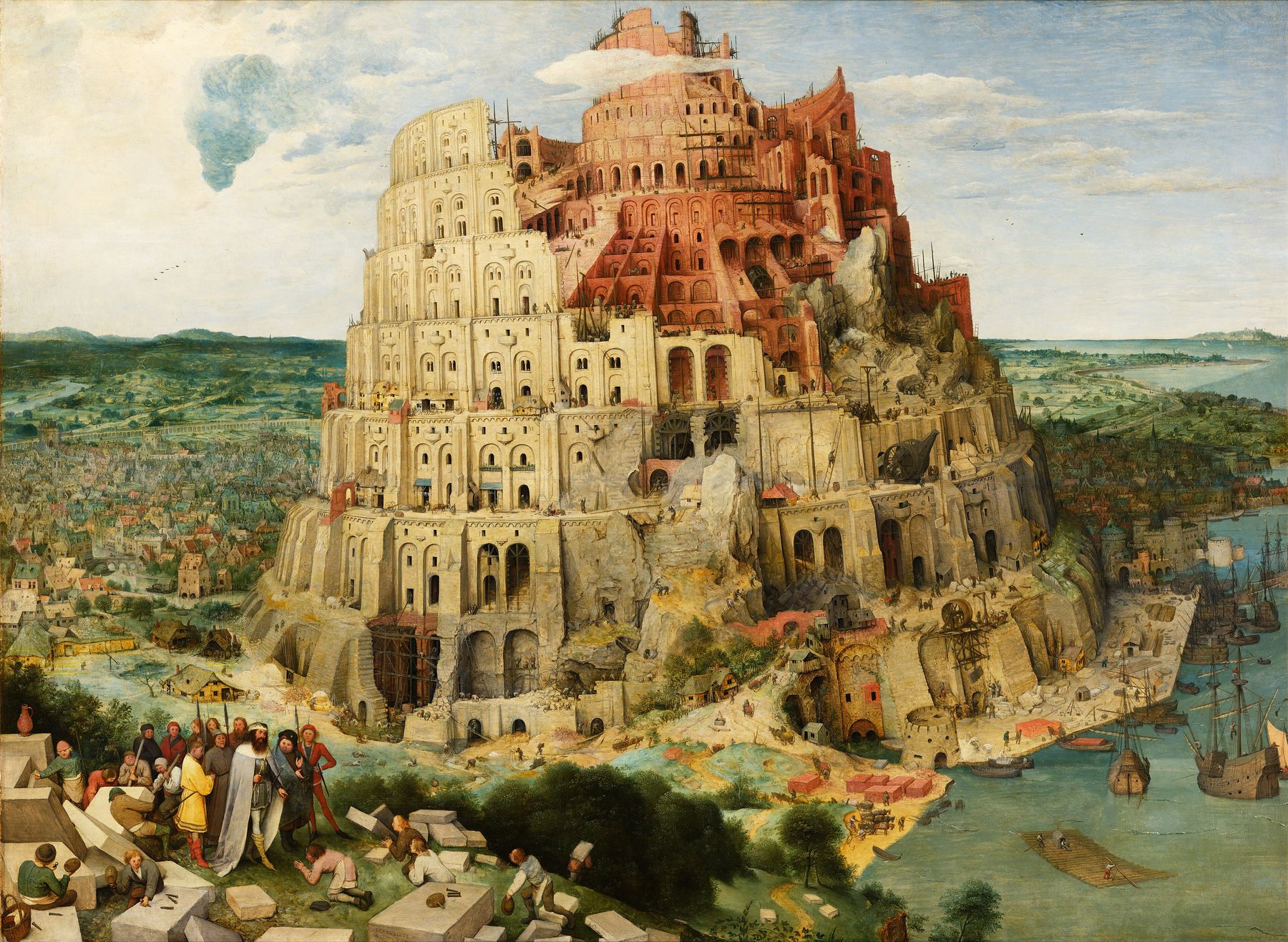
Two years earlier, in 1563, Bruegel signed a different kind of picture. It is a little smaller than Hunters, and it holds even more people. The Tower of Babel, Bruegel’s version of the story and the most copied picture of the tower ever painted, belonged to Jongelinck too; it is on the same 1566 list. Bruegel had first tried the subject years before, as a miniature on ivory painted in Rome. It is recorded in the collection of the Italian miniaturist Giulio Clovio and has since disappeared. The Vienna panel is the full statement.
The story comes from the Book of Genesis, chapter eleven. After the flood, everyone on earth speaks one language. They settle on a plain and decide to build a city with a tower whose top reaches heaven. God comes down, sees what they are doing, and confuses their language so they cannot understand one another. The building stops and they scatter. Genesis never says who was in charge. Later tradition, starting with the historian Josephus, gave the job to Nimrod, the mighty hunter and king. So in Bruegel’s version, the king shows up in person.
The Tower of Babel painting, every detail numbered
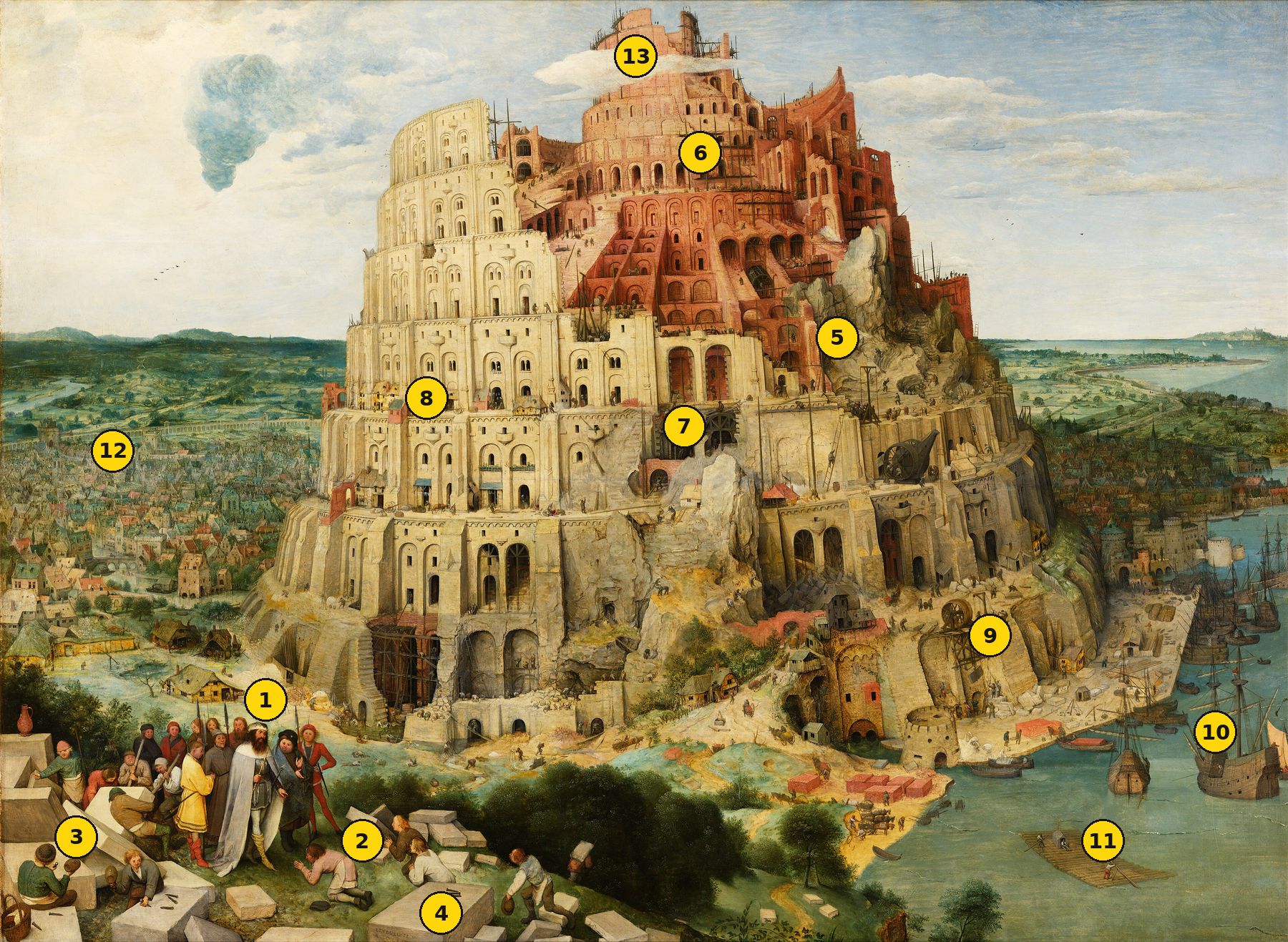
| # | Detail | What it is | Where to find it |
|---|---|---|---|
| 1 | Nimrod | The king who ordered the tower, in a white cloak and crown | Lower left, among his courtiers |
| 2 | The kneeling masons | Workers on their knees before the king | Lower left, center |
| 3 | The stonemasons | Men cutting and dressing blocks with hammers and chisels | Bottom left corner |
| 4 | The signature | ”BRVEGEL. FE. M.CCCCC.LXIII,” carved like an inscription | On a stone block, bottom center left |
| 5 | The rock | A natural crag the tower is built around | Right side, mid-height |
| 6 | The red brick | Newer brickwork, not yet faced with stone | Upper levels |
| 7 | The treadwheels | Men walking inside wheels to lift stone | Inside the arches, center |
| 8 | The houses | Huts and sheds where workers already live on the ledges | Left side, on the terraces |
| 9 | The big crane | A treadwheel crane hauling blocks up from the quay | Lower right |
| 10 | The harbor | Ships unloading building materials | Far right |
| 11 | The raft | Timber floated in on the water | Bottom right |
| 12 | The city | A crowded Flemish town spread across the plain | Left background |
| 13 | The cloud | Weather passing below the top of the tower | Summit |
A king nobody looks at
Nimrod, number 1, is the one person in the picture who is dressed for it. He wears a crown, a long white cloak and gold boots, and he holds a scepter. His courtiers crowd behind him, a man in yellow at his side. In front of him, number 2, the masons drop to their knees, hands raised.
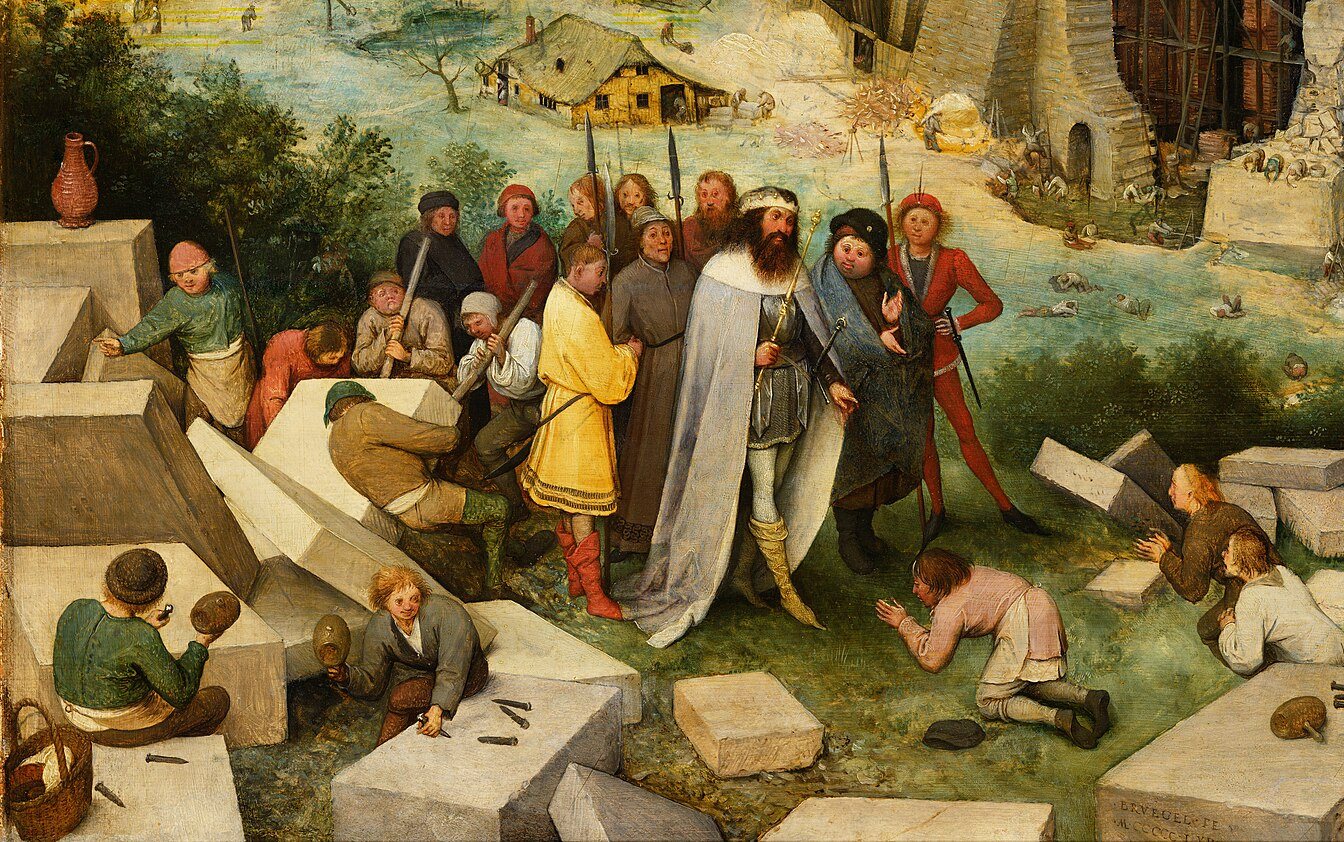
Look past them to number 3. The stonemasons in the corner are not kneeling. One sits on a block, seemingly taking a drink. Another works away with his chisel. Their tools lie scattered across the stone. Bruegel painted the king as a pompous visitor and the workers as people with a job to finish. He seems to have known more about cutting stone than about kings.
Bruegel signed the picture on one of those blocks, number 4. The letters are cut as if into the stone itself: BRVEGEL, FE for fecit, meaning “made it,” and the year in Roman numerals. The painter put his name on the building site, in the quarry, among the masons.
Why it looks like the Colosseum
Step back and look at the tower as a whole. Ring after ring of arches, rising and narrowing. If it reminds you of the Colosseum in Rome, that is not an accident. Bruegel was in Rome around 1553 and would have seen the ruin. Prints of Roman monuments, many published by his own Antwerp publisher, Hieronymus Cock, were everywhere. The arches, the vaults and the curved walls are Roman engineering.
Why would a Flemish painter dress Babylon as Rome? Nobody is certain. Christian writers had long read the “Babylon” of the Book of Revelation as Rome, and in the 1560s, with the Reformation tearing the Low Countries apart, that comparison had real bite. Others see a simpler point: the Colosseum was the most famous ruin in Europe, a building that had once seemed eternal and was now a quarry. Bruegel’s tower is being built and falling down at once.
A building site with a fatal flaw
Here is the detail engineers love. Look at the arches on the lower levels. They are not built level. Each ring of the tower is really a ramp that spirals upward, and the builders have set their arches at right angles to the slope instead of on a flat bed. Every arch leans. A real building put up like that would never stand. Bruegel shows a project that is doomed before God does anything at all.
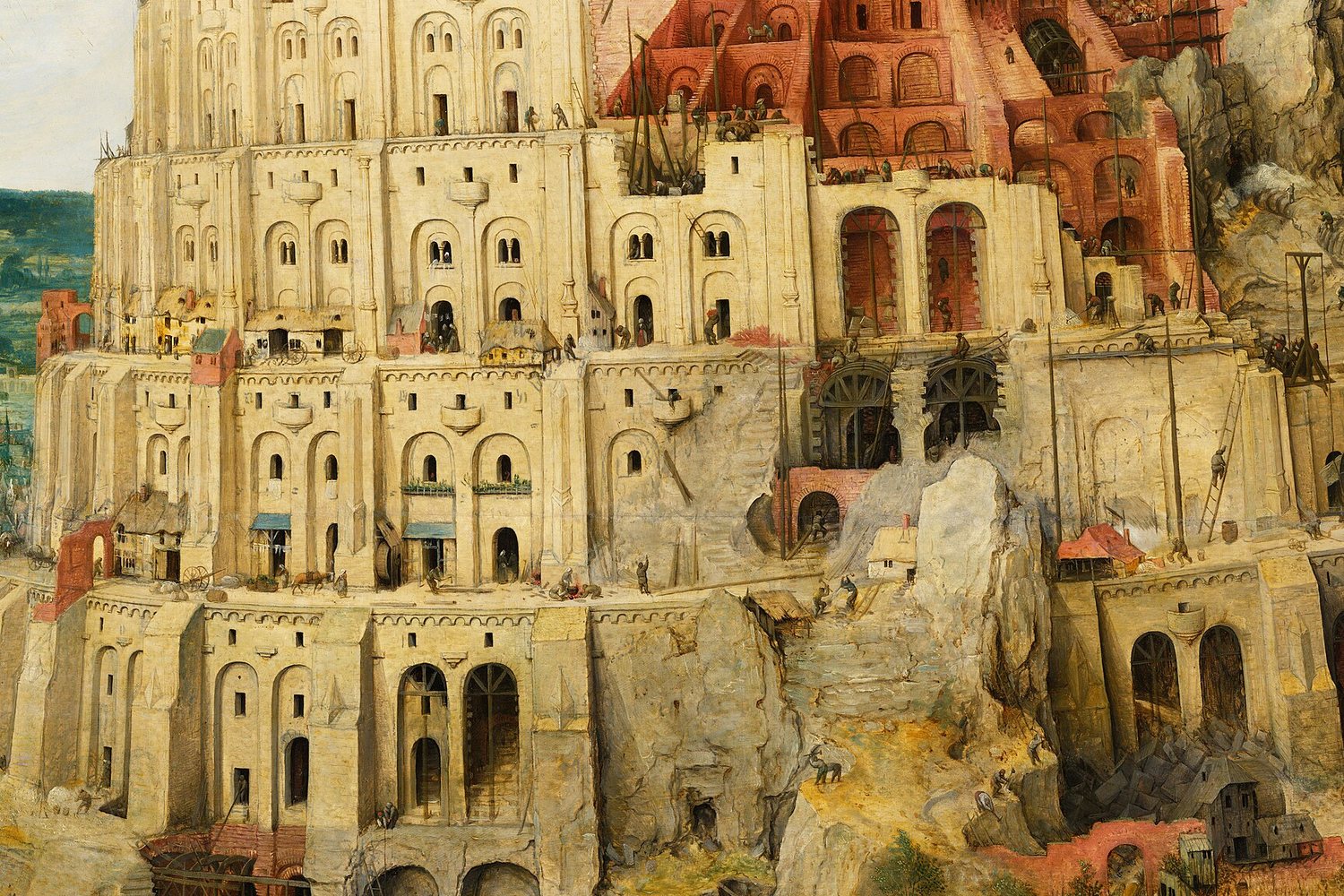
There is more. The bottom levels are not finished, even though the upper levels are going up. Raw bedrock shows through the base. The tower is built around a natural crag, number 5, and on the right side you can see where the masonry stops and the rock begins. Higher up, number 6, the stone facing gives way to raw red brick, the inner structure that has not been clad yet. Some sections near the base already look like they are crumbling.
And people live on it. On the ledges, number 8, there are huts, sheds and awnings, laundry and carts. Workers have moved in before the building is done. Inside two of the great arches, number 7, men walk inside wooden treadwheels to wind ropes that lift stone. Down by the quay, number 9, a much bigger treadwheel crane hauls blocks up from the boats. These were real machines on real building sites in sixteenth-century Antwerp, painted with an engineer’s care.
Antwerp in disguise
Look at the right edge, number 10. The harbor is crowded with ships, and a raft of timber, number 11, floats in on the water. On the left, number 12, a city spreads across the plain, with steep roofs and church spires. This is not ancient Mesopotamia. It looks like a Flemish town, and the busy port looks a lot like Antwerp, then one of the richest trading cities in Europe and a place where people from everywhere spoke every language.
A city that thinks it can build anything, full of merchants and foreign tongues, is a fine place to tell the story of Babel. Jongelinck, a rich Antwerp merchant, hung it on his wall. Whether he took it as a warning or a compliment, we will never know.
At the very top, number 13, a cloud drifts past below the summit. The tower is already taller than the weather.
The smaller tower in Rotterdam
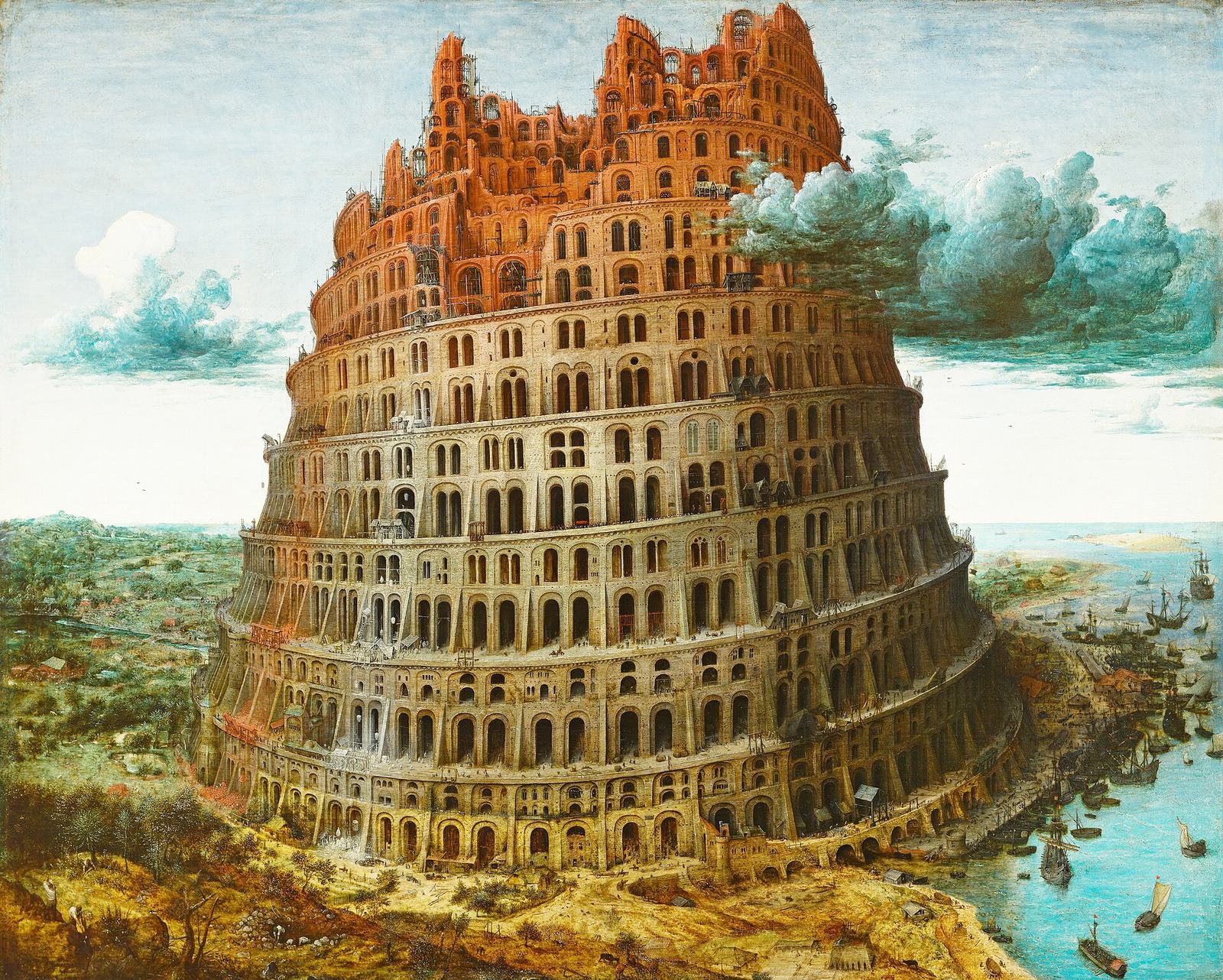
Bruegel painted the tower at least one more time. The so-called Little Tower of Babel belongs to the Museum Boijmans Van Beuningen in Rotterdam. It is roughly half the height and half the width of the Vienna panel, 60 by 74.5 centimeters, and it is undated; most scholars put it around 1563 or a little later.
It is a different mood. There is no Nimrod and no busy foreground. The tower is darker and much further along, rising into the clouds, and the people are almost too small to see. The Boijmans’s main building has been closed for a long renovation, and the painting has been shown at the museum’s Depot and lent abroad, so check before you go if you want to see the two towers in the same trip.
Hunters in the Snow and Tower of Babel FAQ
Where is Hunters in the Snow?
In the Kunsthistorisches Museum in Vienna, in Room X of the Picture Gallery on the first floor. It hangs in the same room as The Tower of Babel and ten other paintings by Bruegel.
How big is Hunters in the Snow?
About 117 by 162 centimeters, or roughly three feet ten by five feet four. It is oil on an oak panel, not canvas, dated 1565.
What is the meaning of Hunters in the Snow?
It shows December and January in a series of six paintings of the seasons. Read closely, it is about a failed hunt. Three exhausted men come home with a single fox while the village below goes on skating, cooking and fighting a chimney fire.
How many Tower of Babel paintings did Bruegel make?
Two survive: the large version in Vienna, dated 1563, and the smaller one in Rotterdam. A third, a miniature on ivory painted in Rome, is recorded in the collection of Giulio Clovio but is lost.
Why does The Tower of Babel look like the Colosseum?
Bruegel had seen the Colosseum in Rome around 1553, and Roman architecture was well known in Antwerp through prints. Using it may also carry a message, since Christian writers often called Rome “Babylon,” but scholars disagree on how pointed that was meant to be.
How many Bruegel paintings are in Vienna?
Twelve, the largest collection of his paintings in the world, and roughly a quarter of the forty or so that survive.
What to look for in Room X
The Kunsthistorisches Museum is on Maria-Theresien-Platz in Vienna, across from its twin, the Natural History Museum. When this article was written, the museum’s site listed it open every day from 10 a.m. to 6 p.m., with Thursdays until 9 p.m. Adult tickets were 22 euros online and 24 at the door, and visitors under 19 get in free. Hours and prices change, so check before you go. Our Kunsthistorisches Museum page has Hunters in the Snow and The Tower of Babel as audio stops.
Go on a Thursday evening, when the room is quieter, and plan at least forty minutes for it.
Begin with Hunters from across the room. Let the diagonal of trees pull your eye down the hill and out to the mountains. Then walk up close and do it in reverse: the fox, the dogs, the sign on its single hook, the fire, the skaters, the chimney fire in the village. Up close, a figure on the ice is the size of a grain of rice. With Chiaro running at that distance, the story of the hunters’ saint on the inn sign arrives just as you find the stag on the sign and notice it is about to fall.
Then turn to The Tower of Babel and do the same. Back up and see the whole tower against the sky. Then lean in on the lower levels and look for the tilted arches, the treadwheels, the huts on the ledges, the masons who will not kneel, and the signature on the block.
Before you leave, look at The Gloomy Day and The Return of the Herd. They are Hunters’ siblings, painted the same year for the same dining room, and seeing three of them together is the closest you can get to standing in Jongelinck’s house.
If this kind of slow, numbered looking is your thing, the same method works on Rembrandt’s crowded militia picture in The Night Watch, every figure identified, and on Bruegel’s great predecessor in Bosch’s Garden of Earthly Delights. While you are in Vienna, Klimt’s The Kiss is a short tram ride away at the Belvedere. And the whole series, painting by painting, is collected in Famous Paintings, Every Figure Identified.
The hunters on the hill do not know they are being watched. They are thinking about supper. Four and a half centuries later, crowds still stand behind them on that path, looking where they will never look: down at the ice, where everybody else is having fun.