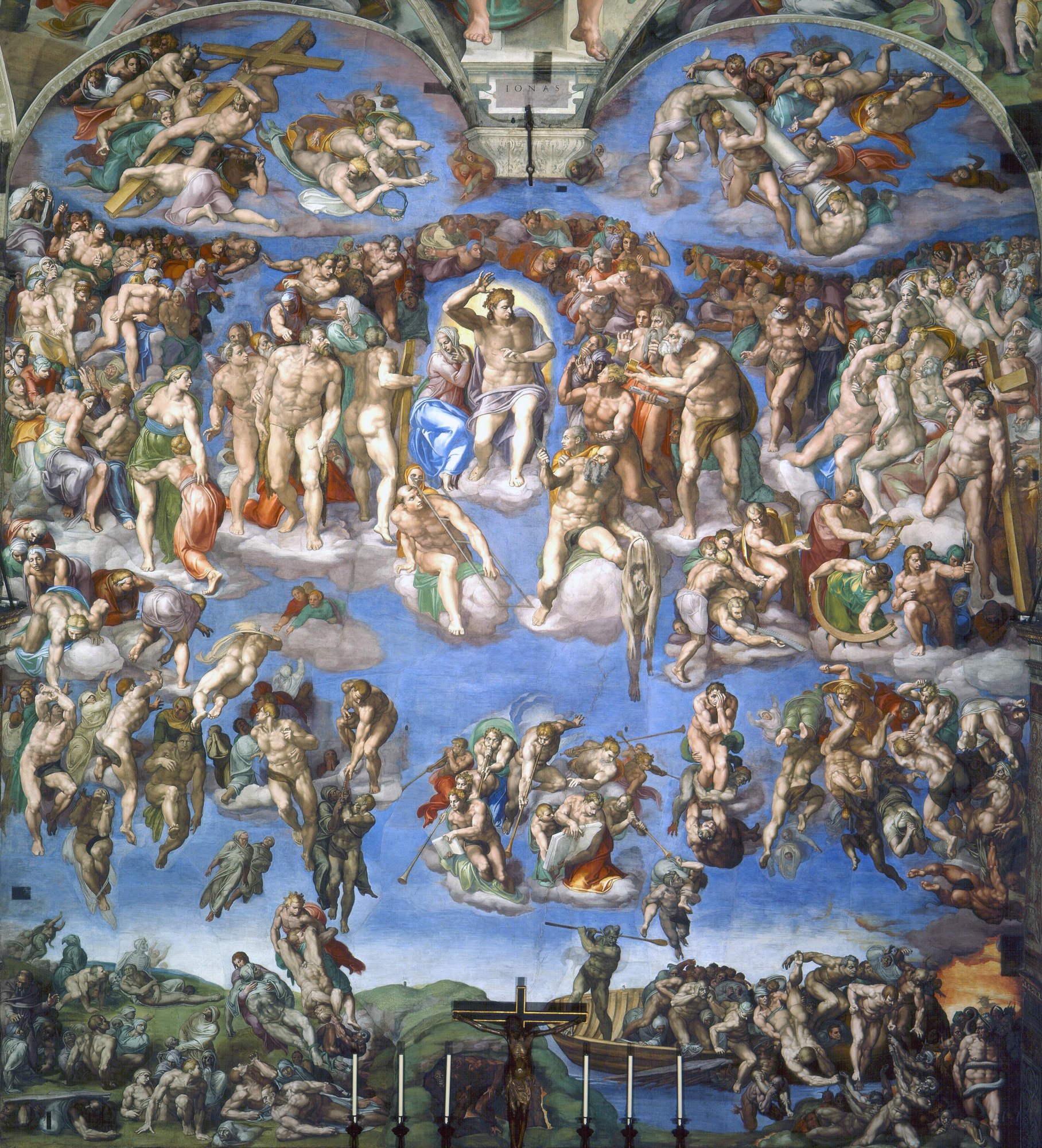
Late in 1540, before the scaffolding came down from the altar wall of the Sistine Chapel, Pope Paul III walked in to inspect his unfinished fresco. With him came Biagio da Cesena, the papal master of ceremonies. Giorgio Vasari knew Michelangelo personally, sketched their clash in the 1550 edition of his Lives, and gave Biagio’s name and the full story in 1568. Asked by the pope for his opinion, Biagio looked up at more than three hundred naked bodies twisting across the blue plaster. He called the work disgraceful in so sacred a chapel, fit instead for public bathhouses and taverns.
Michelangelo waited until the party left, climbed back up the scaffold, and painted Biagio from memory into the bottom right corner of Hell. He cast him as Minos, judge of the underworld. He gave him donkey ears and coiled a giant serpent twice around his torso, its jaws clamped onto what Biagio had wanted covered.
Vasari writes that Biagio begged both the pope and the painter in vain to scrape the face off. In Lodovico Domenichi’s 1562 anecdote collection, Paul III answered lightly: “Messer Biagio, you know that I have power from God in heaven and on earth; since my authority does not extend into Hell, you will have to be patient if I cannot free you from it.” Later Roman retellings embellished the joke with Purgatory and the Latin tag “in Hell there is no redemption.”
To clear an unbroken wall 13.7 metres high and 12 metres wide for this fresco in 1535, Paul III had ordered two narrow windows bricked shut. Michelangelo’s crew chiselled away fifteenth-century frescoes by Pietro Perugino and two lunettes from Michelangelo’s own 1508-1512 ceiling cycle, nearly twenty-five years after The Creation of Adam went up overhead. Nearly four hundred figures now turn across one frameless sheet of crushed lapis lazuli without painted borders or a single inscribed name. Even the two arches at the top belong to the storm. Wingless angels wrestle the wooden Cross and Crown of Thorns through the left lunette and cling to the stone Column of the Flagellation on the right, while between them the ceiling prophet Jonah leans backward as if blown upward by the blast below.
Why does Christ have no beard?
Medieval Last Judgments usually seat Christ on a rainbow throne, bearded, robed to the ankles, and still. Michelangelo threw out the throne, the robe, and the beard. His Christ steps half-standing out of a burst of yellow light, built like the Hellenistic Apollo Belvedere across the Vatican courtyard. His right arm swings high. His left hand points to the lance wound in his side. Everything on the wall turns around that raised arm like water around an oar.
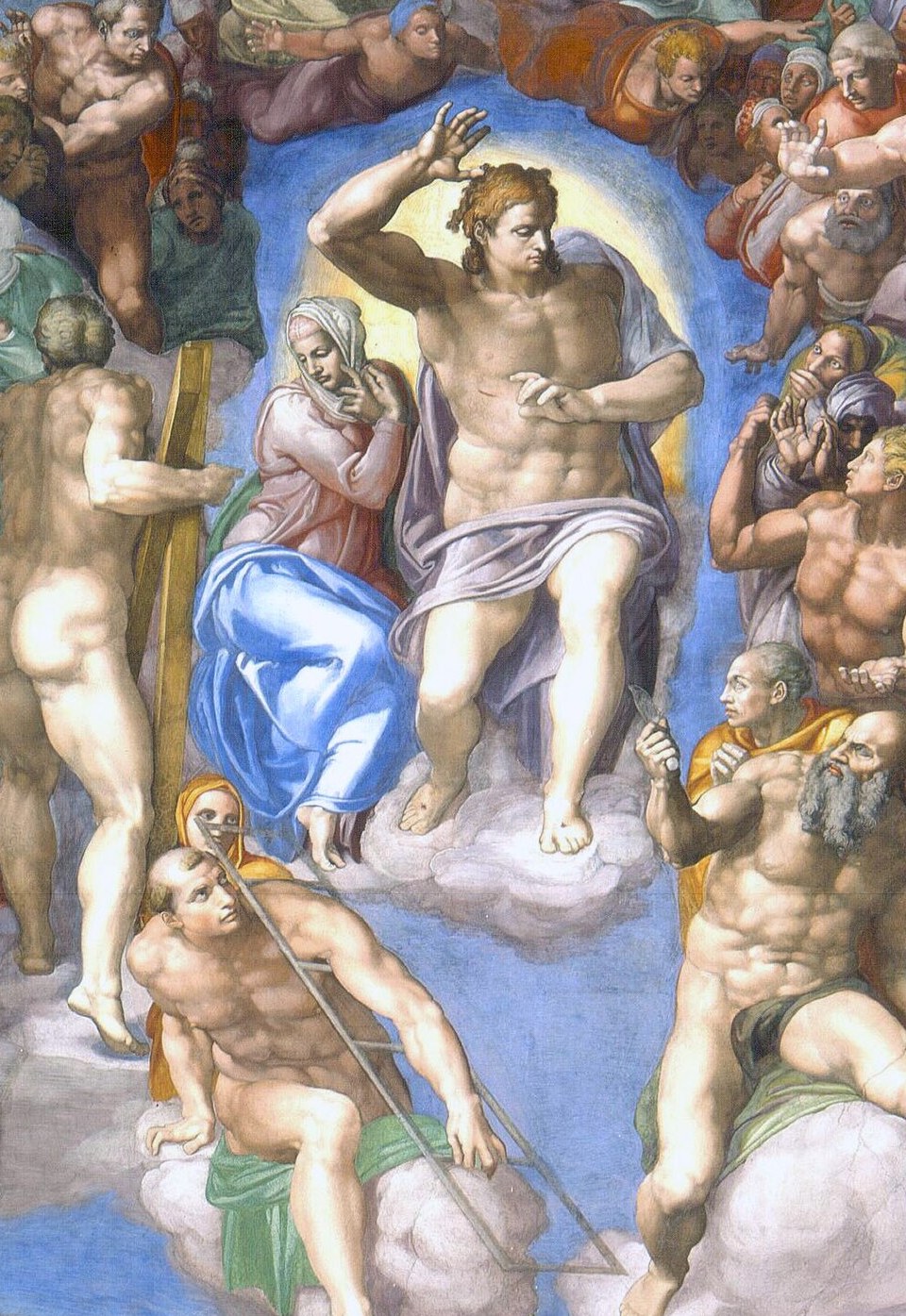
Beside him, the Virgin Mary breaks with earlier Italian frescoes, where she pleads with her son while the trial is still open. Here she folds both hands across her chest, tucks herself inside Christ’s right arm, and turns her eyes down toward the saved rising on the left. In his study of the Sistine Chapel program, the theologian and art historian Heinrich Pfeiffer points out why: the time for pleading has just run out.
Directly below Mary’s feet sits Saint Lawrence on a cloud, gripping the iron gridiron of his Roman martyrdom. Marcia Hall and Loren Partridge note why Lawrence and Saint Bartholomew hold the two prime seats beneath Christ. One was roasted and the other was flayed, so their ruined skins dramatize the Christian doctrine at the heart of this wall: the bodily resurrection of the flesh.
Whose face is on the skin in Saint Bartholomew’s hand?
Below Christ’s left foot, a bald, grey-bearded apostle sits on a cloud raising a short curved skinning knife. From his other hand hangs a complete human hide, peeled off in one piece from scalp to ankles.
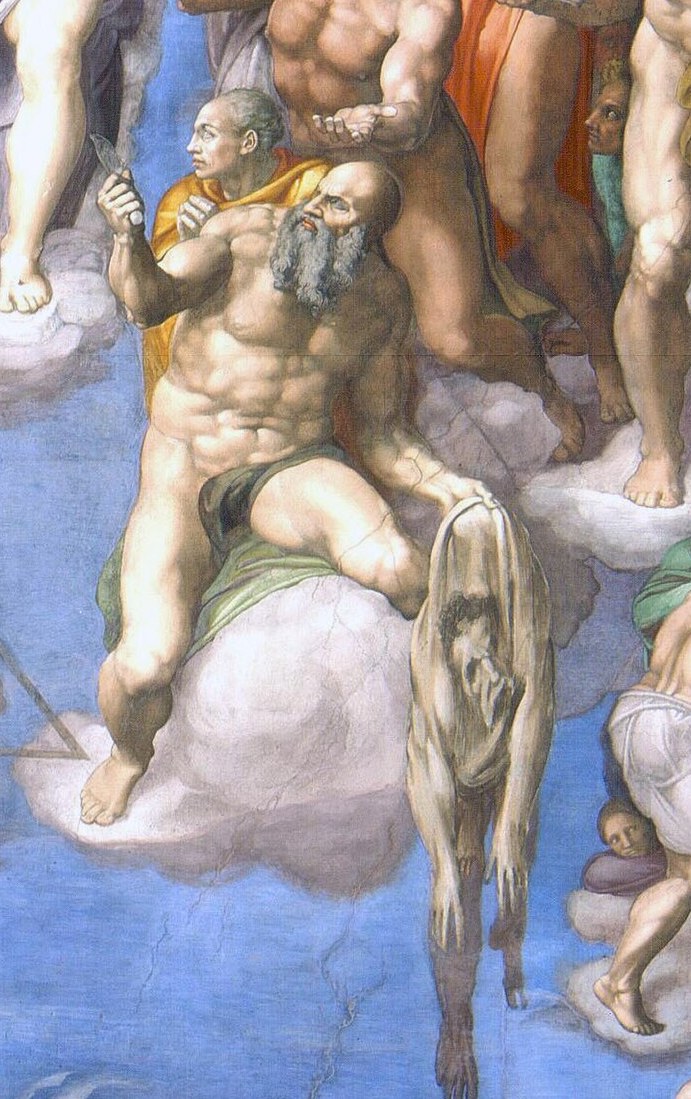
According to Christian tradition, Saint Bartholomew was flayed alive in Armenia. Yet the face drooping on the empty pelt is not Bartholomew’s. Bartholomew has a bald head and a thick grey beard. The skin has dark hair, hollow eyes, a crooked brow, and the flattened bridge of a nose broken in youth by the sculptor Pietro Torrigiano.
Neither Vasari nor Ascanio Condivi, Michelangelo’s two sixteenth-century biographers, mentioned that face. An Italian physician and art researcher named Francesco La Cava published the identification in 1925 after matching the sagging mask against Daniele da Volterra’s bronze bust and Jacopino del Conte’s painted portrait of Michelangelo. Vatican scholars since, including painting restoration director Fabrizio Mancinelli, have accepted it.
Michelangelo was sixty-one when he began the wall and sixty-six when it was unveiled on October 31, 1541. Just a few rooms and a staircase earlier on the Vatican visitor route, in the Stanza della Segnatura, Raphael had painted a brooding thirty-five-year-old Michelangelo onto the front steps of The School of Athens. Thirty years later, the five-year scaffold campaign battered the older man. Vasari records that Michelangelo fell from the planking and badly hurt his leg, went home, locked his door in fury, and refused to see any doctor. His friend Baccio Rontini, a Florentine physician, found a hidden way into the house, climbed from room to room until he reached him, and refused to leave his bedside until the leg healed.
In his poems Michelangelo wrote often of shedding his worn-out earthly husk like a snake. Forty years earlier he had carved his name across a marble sash on his young Pietà. Here he hung his empty skin over the drop between heaven and Hell.
The fifteen figures on the Sistine altar wall
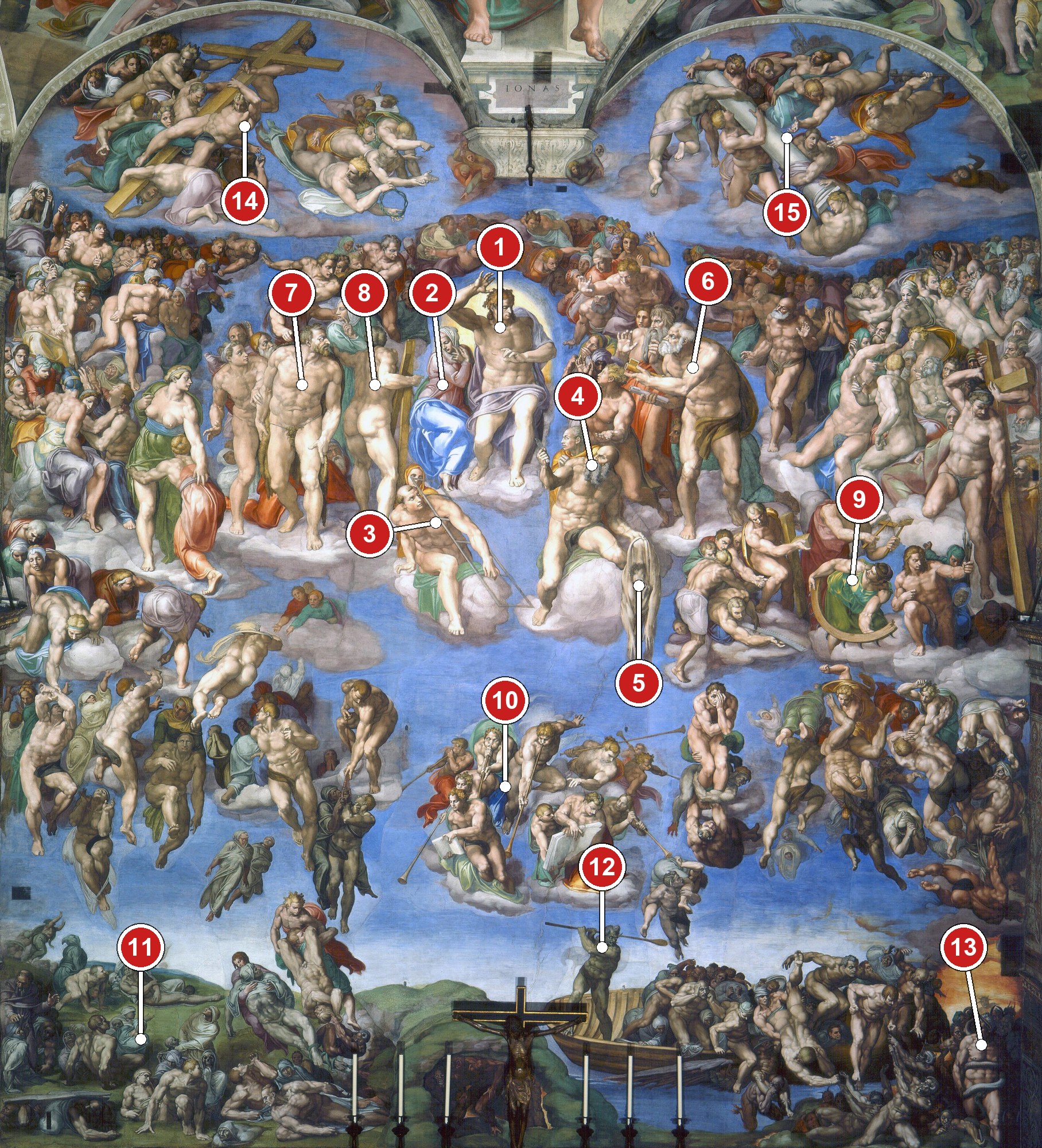
Viewer’s left is Christ’s right hand, the side of the saved. Viewer’s right is Christ’s left hand, the side of the damned. Fifteen other works get the same treatment in our Famous Paintings, Every Figure Identified guide.
| # | Figure or group | Where on the wall | How to spot them |
|---|---|---|---|
| 1 | Christ the Judge | Upper center, in a golden glow | Beardless, muscular, right arm raised over his head |
| 2 | The Virgin Mary | Tucked inside Christ’s right arm | Blue and rose robes, head turned down toward the saved |
| 3 | Saint Lawrence | Seated just below the Virgin’s feet | Holding the iron gridiron on which he was roasted |
| 4 | Saint Bartholomew | Seated on a cloud below Christ’s left foot | Bearded, flaying knife raised in his right hand |
| 5 | Michelangelo’s self-portrait | Hanging from Bartholomew’s left hand | The limp, empty human pelt with Michelangelo’s broken-nosed face |
| 6 | Saint Peter | Standing large to the right of Christ | White beard, holding out two heavy keys, one gold and one silver |
| 7 | Saint John the Baptist | Standing tall to the left of the Virgin | Muscular giant with a camel-skin wrap at his hips |
| 8 | Saint Andrew | Seen from behind between John and the Virgin | Turning his head back while bracing a wooden cross |
| 9 | Saint Catherine and Saint Blaise | Right middle band, below Peter | Catherine in green over a broken spiked wheel; Blaise behind with iron wool-combs |
| 10 | Trumpeting angels and two books | Center, below the saints’ cloud | Seven angels blow long brass trumpets while three others hold a small book for the saved and a huge one for the damned |
| 11 | The Resurrection of the Dead | Bottom left corner, on bare earth | Skeletons and newly fleshed bodies pulling themselves out of graves |
| 12 | Charon the ferryman | Bottom right-center, in a wooden boat | Demon with glowing eyes swinging a long oar to drive souls ashore |
| 13 | Minos, portrait of Biagio da Cesena | Bottom far-right corner | Donkey ears, wrapped in two coils of a biting serpent in Hell |
| 14 | Lunette with the Cross and Crown of Thorns | Top left arch | Wingless angels wrestling the cross through the air |
| 15 | Lunette with the Column of the Flagellation | Top right arch | Wingless angels clinging to the stone pillar where Christ was scourged |
What happened when Rome hired “the breeches-maker”?
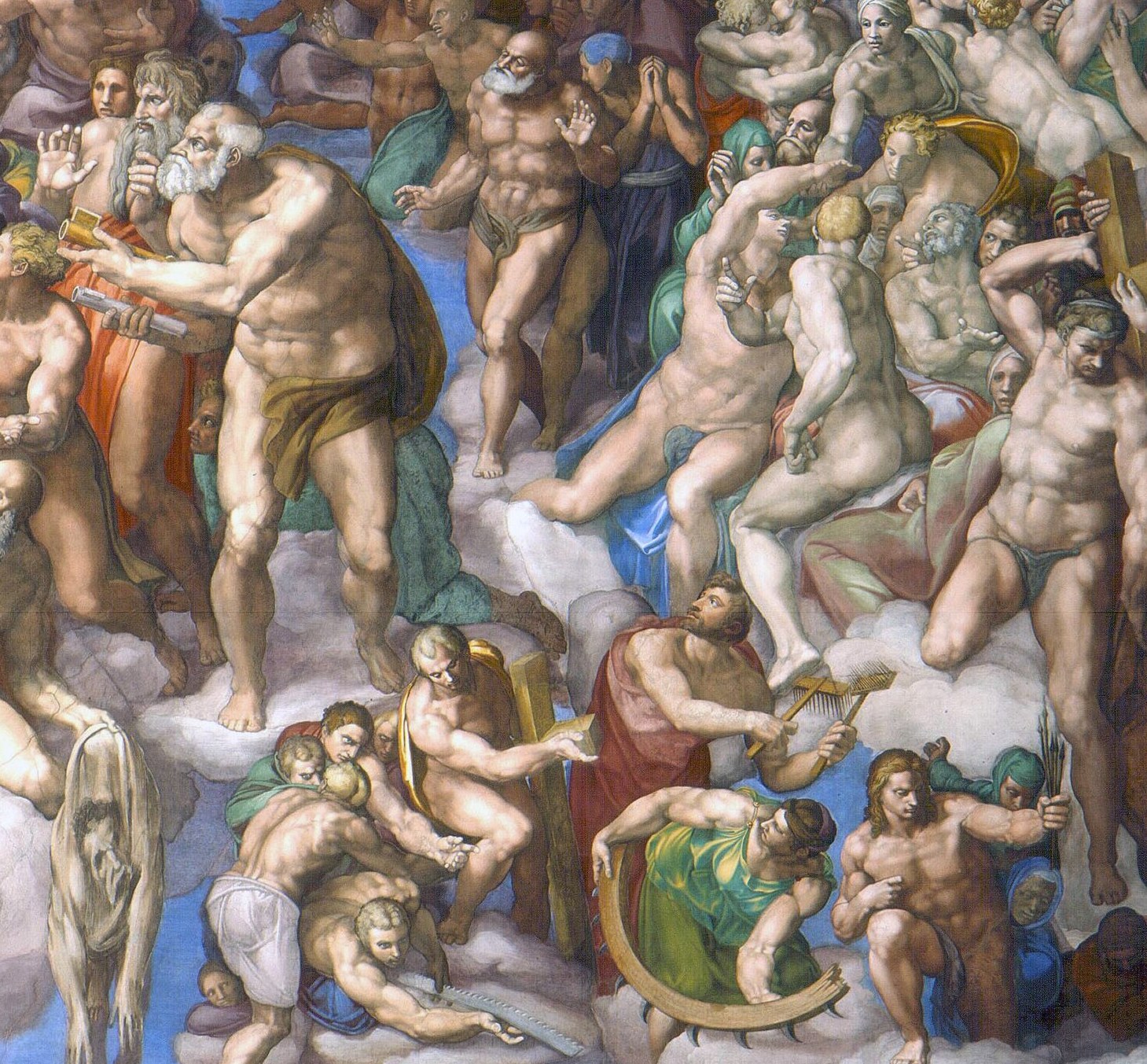
Without haloes or lettered scrolls, the saints identify themselves by holding up what killed them. To the right of Christ, Saint Peter steps forward with two oversized keys, one gold and one silver, returning his papal authority now that history is over. Just to the left of Peter, beside his outstretched keys, stands a red-cloaked bearded man whom modern Vatican scholars identify as Saint Paul. Across on the left, Saint John the Baptist wears a scrap of camel hide, while Saint Andrew turns his bare back to us between John and Mary, bracing a wooden cross.
Drop one row below Peter and the crowd becomes a wall of weapons. Saint Simon holds a long toothed carpenter’s saw. Saint Philip carries a cross, and Saint Sebastian kneels on a cloud clutching a bundle of arrows in his fist like a bowman. Next to him, Saint Catherine of Alexandria bends in a green dress over a broken spiked wheel while Saint Blaise holds two iron wool-carding combs behind her.
Those last two saints carry the deepest scar on the wall. In 1541 Catherine was completely naked, and Blaise leaned over her bare back looking down at her body rather than up at Christ. Then in December 1563 the Council of Trent condemned “lasciviousness” in sacred art. On January 21, 1564, four weeks before Michelangelo died on February 18, Pope Pius IV’s congregation ordered the fresco’s nudity painted over.
Pius IV gave the thankless job to Michelangelo’s loyal pupil Daniele da Volterra, whom Romans promptly nicknamed Il Braghettone, the breeches-maker. Over most figures Volterra brushed thin tempera cloths onto dry plaster, a technique called a secco. For Catherine and Blaise, dry paint was not enough. As Mancinelli and chief restorer Gianluigi Colalucci confirmed during the Sistine Chapel restoration between 1990 and 1994, Volterra hacked Michelangelo’s original mortar off the wall and laid fresh wet plaster to clothe Catherine in green and turn Blaise’s eyes safely toward Jesus. The 1990s team stripped away roughly half of the later seventeenth- and eighteenth-century loincloths added after Volterra’s death, but Volterra’s Catherine and Blaise had to stay; nothing of Michelangelo survived underneath them.
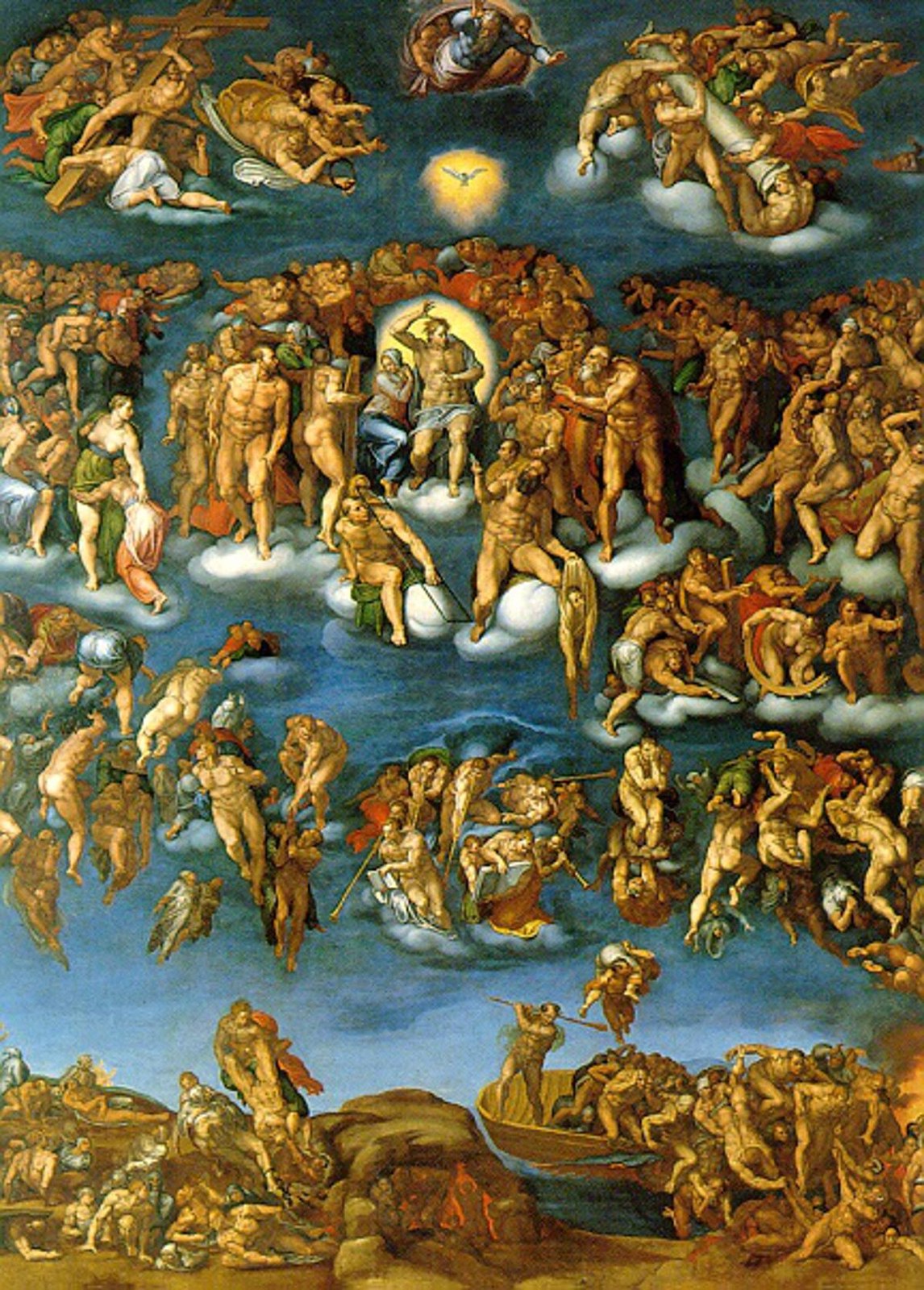
Michelangelo’s uncensored figures still survive in miniature. Cardinal Alessandro Farnese, Pope Paul III’s grandson, paid Marcello Venusti to copy the composition on wood in 1549, fifteen years before the censorship order. Venusti’s panel hangs in the Museo di Capodimonte in Naples, keeping the naked Catherine and downward-gazing Blaise that Rome chiselled off the brick.
Where Dante enters the Sistine Chapel
Down the center of the wall, wingless angels puff their cheeks into the seven brass trumpets of Revelation. Michelangelo omitted wings across the entire fresco. Below the trumpeters, three more angels hold open two books: one angel turns a small volume toward the saved floating effortlessly up on the left, while two angels strain under an enormous ledger held up to the damned falling on the right.
At the bottom left, dry skeletons push out of stony earth in Ezekiel’s valley of dry bones, putting on muscle in stages as angels pull souls upward. One angel hauls two climbers up on a string of rosary beads.
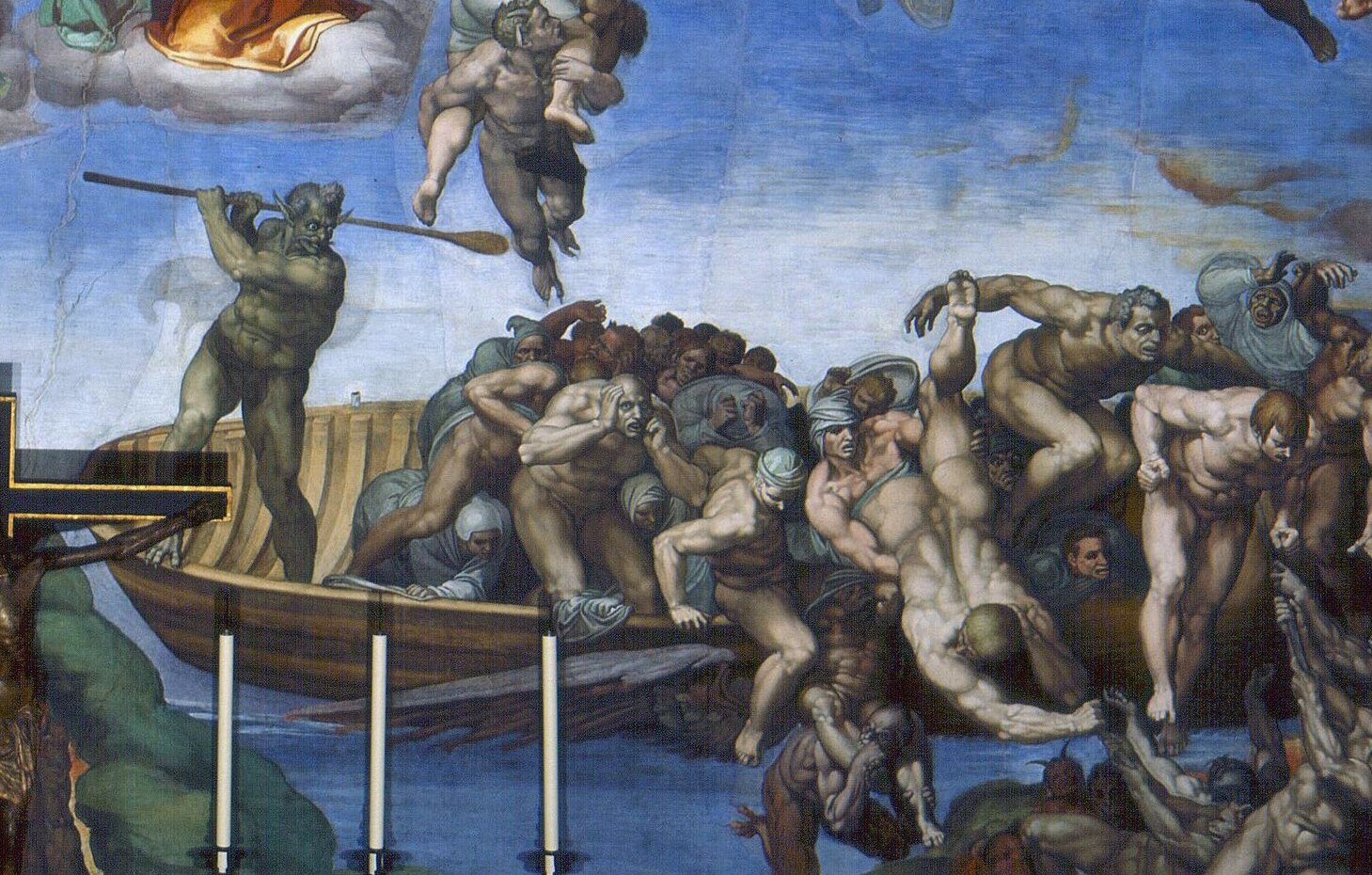
Right of the demon cave behind the altar crucifix, scripture gives way to Tuscan poetry. Vasari calls Dante Alighieri Michelangelo’s “most familiar” poet and quotes Canto III of the Inferno beside this ferryman swinging his raised oar: “Charon the demon, with eyes of glowing coal, beckoning them, collects them all; he beats with his oar whoever lingers.”
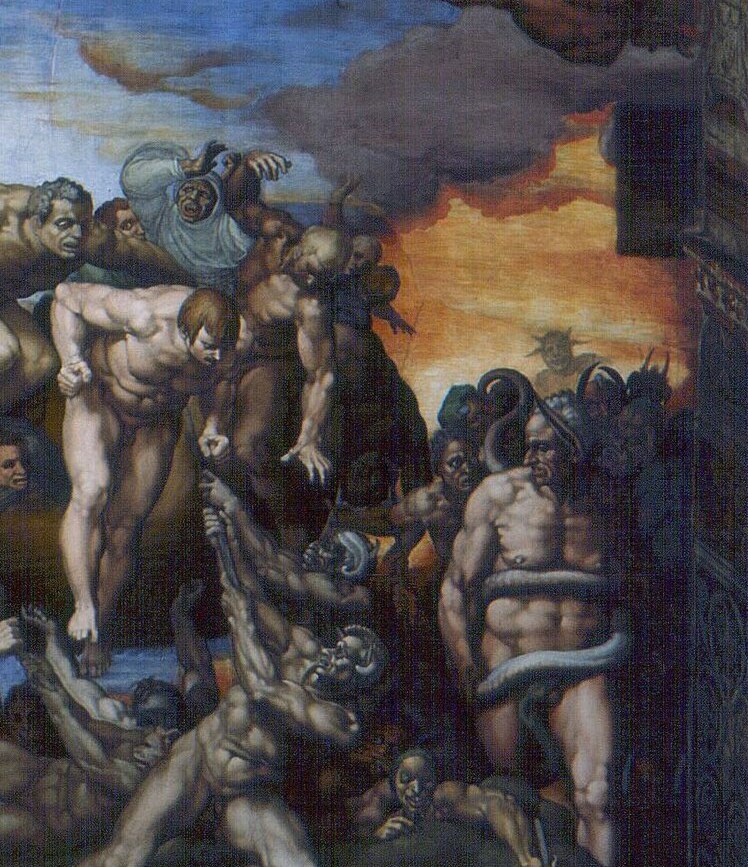
Charon’s boat empties straight onto the feet of Biagio da Cesena as Minos. In Canto V of the Inferno, Minos coils his tail around his body to assign each sinner a circle of Hell, two turns for the second circle, three for the third. Michelangelo turns the tail into a live snake and lets it bite.
Standing inside the silent chapel
The Sistine Chapel comes near the end of the one-way circuit through the Vatican Museums. Doors open Monday through Saturday from 8:00 a.m. to 8:00 p.m., with final entry at 6:00 p.m. The museums close on Sundays except the last Sunday of each month, when entry is free from 9:00 a.m. to 2:00 p.m. and last admission is at 12:30 p.m. Standard online tickets on museivaticani.va cost 20 euros plus a 5-euro booking fee.
Inside the chapel, guards enforce silence and ban photography. Nippon Television introduced the camera rule when it funded the 1980-1994 restoration in exchange for temporary image rights, and the Vatican kept it afterward to move crowds through the room. Out in the Courtyard of the Pinecone earlier on the route, large official Vatican display panels reproduce the entire altar wall, so you can listen to the walkthrough on Chiaro there before stepping through the low door into the silent chapel.
Once you are inside, walk to the wooden benches along the side walls instead of stopping in the center aisle. Find Bartholomew’s hanging skin below Christ’s left foot first, then shift your eyes just right of the brass trumpets. High above Charon’s boat, two demons drag one damned man downward. He has stopped fighting. His left hand covers half his face, and his single uncovered right eye stares straight out into the chapel.