On June 3, 1813, Caspar David Friedrich sat down at the foot of a sandstone rock above the Elbe River and drew it in pencil. Saxony was a battlefield that spring, and he had left Dresden for the village of Krippen to wait out Napoleon’s war with a friend. The drawing is nothing much. A lump of stone, carefully shaded. A few years later he put a man on top of it.
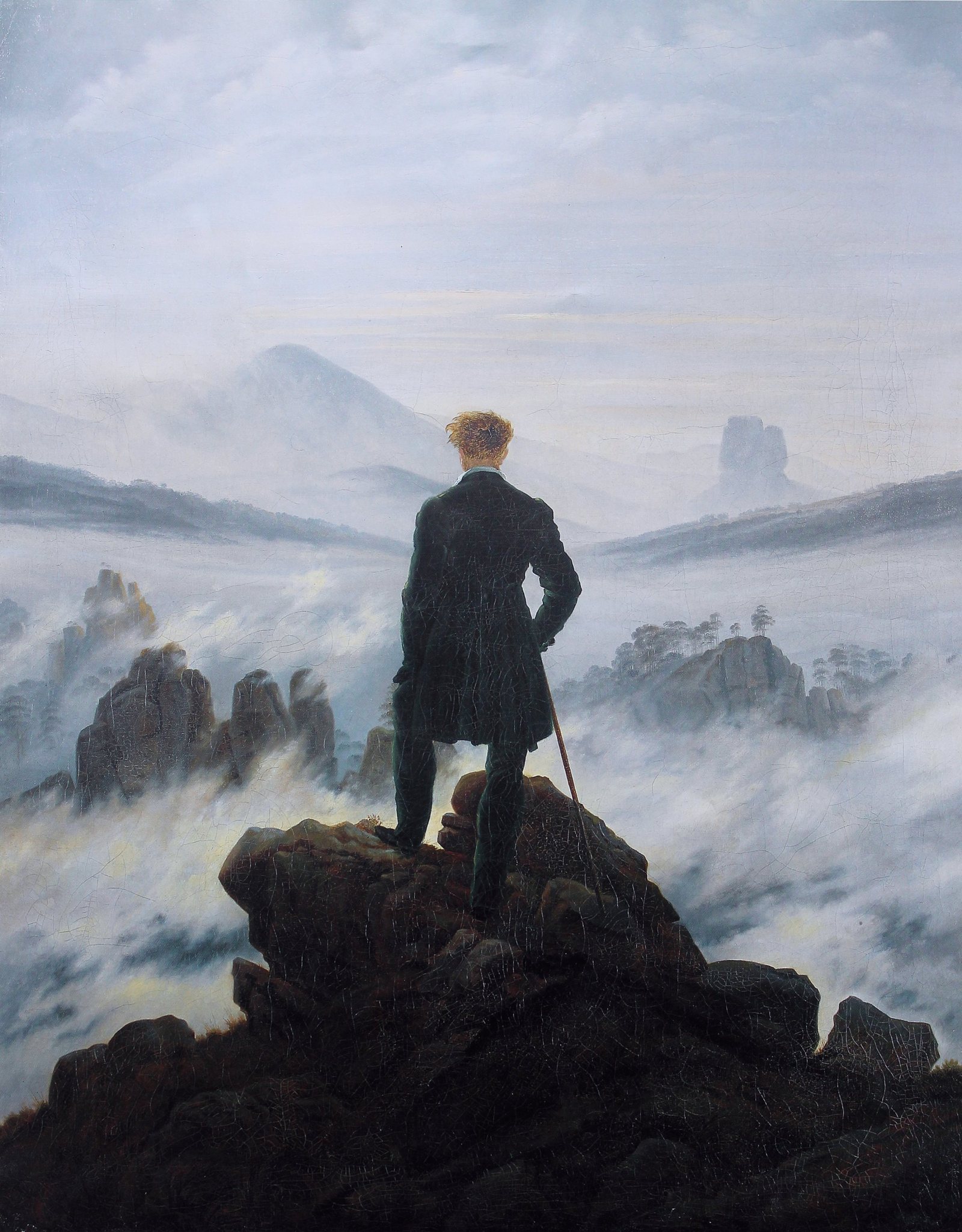
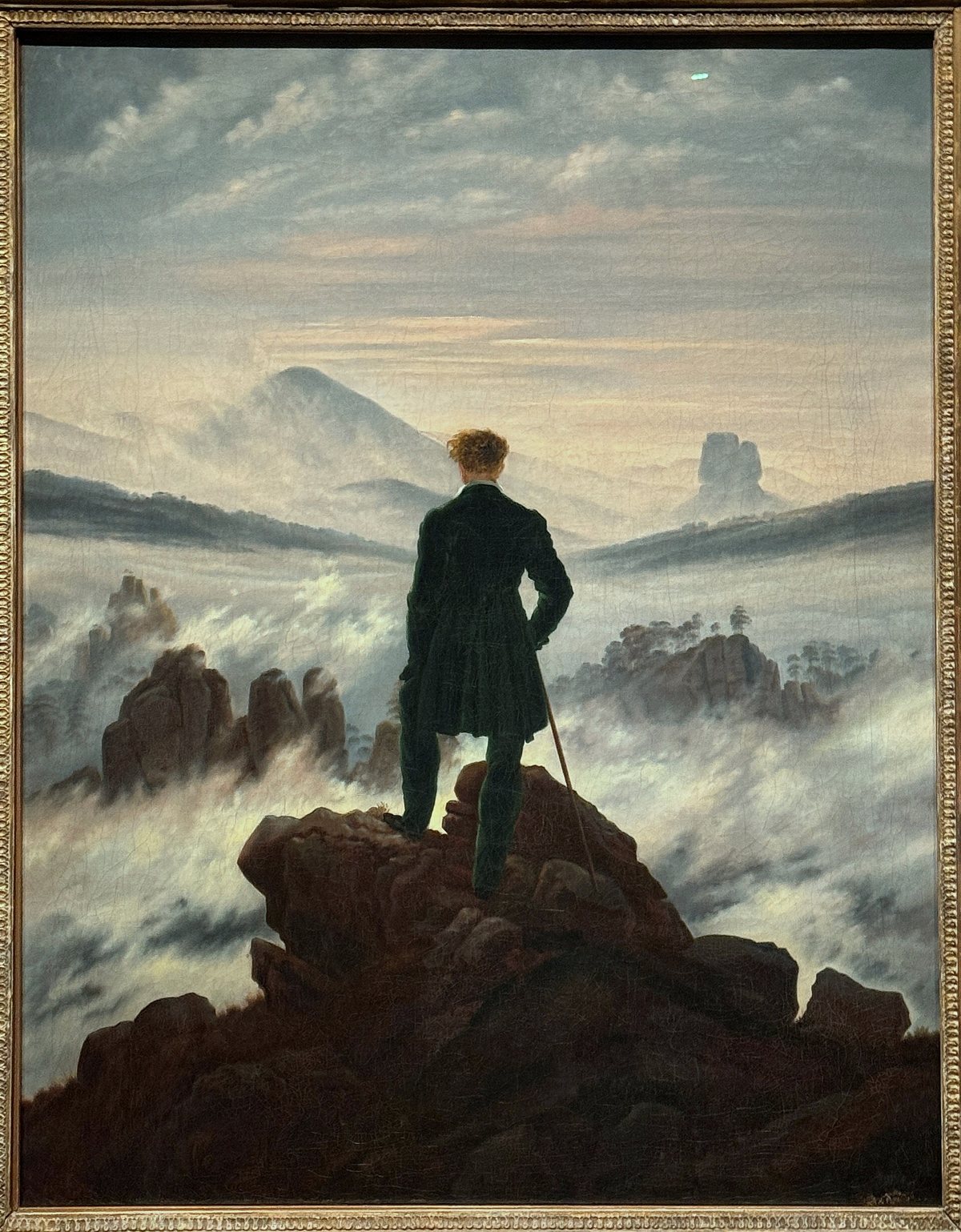
That man is the Wanderer above the Sea of Fog, and he has his back to us. We never see his face. We see his hair blown up by the wind, his green coat, his walking stick, and the view he is looking at, which is mostly cloud. It is probably the most recognized German painting in the world. It hangs in the Hamburger Kunsthalle, where visitors unconsciously copy his stance.
Here is the strange part. For more than a hundred years after Friedrich painted it, nobody wrote it down. No letter, no sale, no exhibition list from his lifetime has been tied to it. The most famous image of Romanticism walked out of the fog in a Berlin gallery around 1939, unsigned, undated and untitled.
Why a man with his back turned became everyone’s mirror
The painting is smaller than most people expect. It measures 94.8 by 74.8 centimeters, about 37 by 29 inches. The man stands dead center, on the vertical axis. The ridgelines on the left and right slope down toward him and meet behind his chest, as if the whole landscape were draining into one person. Peaks stick up from the fog like islands, and the horizon dissolves into a sky almost the same color.
Friedrich turned his figures away from us again and again. Art historians call it the Rückenfigur, the figure seen from behind. It does two things at once. It blocks us, because a back is a closed door. And it invites us, because when we cannot see a face, we stop studying a person and start borrowing his eyes. The American scholar Joseph Leo Koerner built a whole book around this, “Caspar David Friedrich and the Subject of Landscape,” arguing that Friedrich’s real subject is not the mountains but the experience of standing in front of them.
That is the plainest answer to the question of what it means. It is a painting about looking. Friedrich said it himself in one of his best-known notes: the painter should paint not only what he sees in front of him, but also what he sees inside himself. And about weather he wrote that when a landscape covers itself in mist, it appears larger and more sublime.
Wanderer above the Sea of Fog, numbered
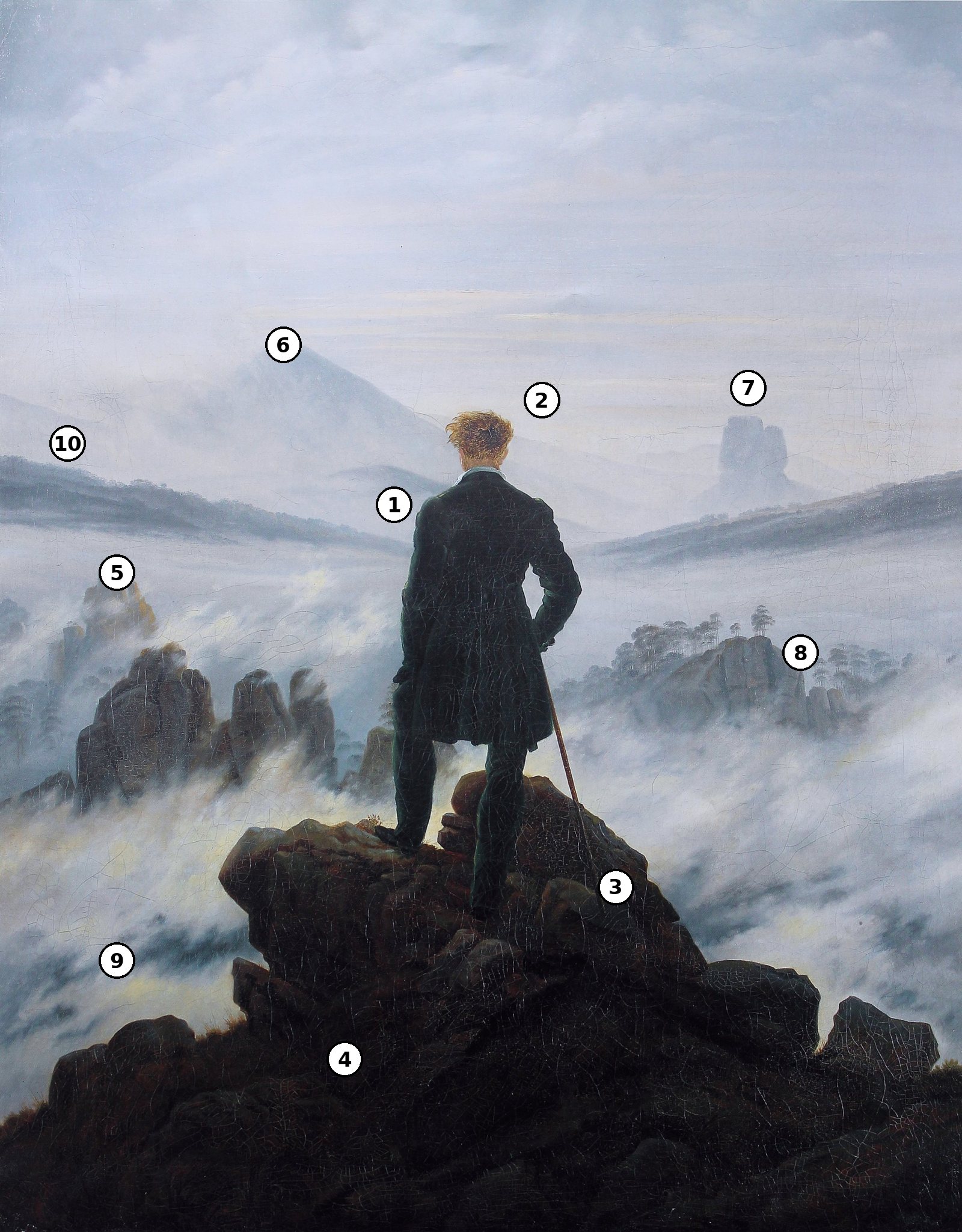
The numbers on the image match this key.
| # | Detail | Where to find it | What it is |
|---|---|---|---|
| 1 | The wanderer | Dead center | An unknown man in a dark green frock coat, seen from behind |
| 2 | His hair | Top of the figure | Reddish, wild, blown upward by the wind |
| 3 | The walking stick | His right hand | A hiker’s cane, not a sword |
| 4 | The summit rock | Foreground | Based on a rock at the foot of the Kaiserkrone, drawn in 1813 |
| 5 | Jagged rocks, left | Left middle ground | Usually identified as the Gamrig near Rathen |
| 6 | The tall mountain | Left horizon | The Rosenberg or the Kaltenberg, in Bohemia |
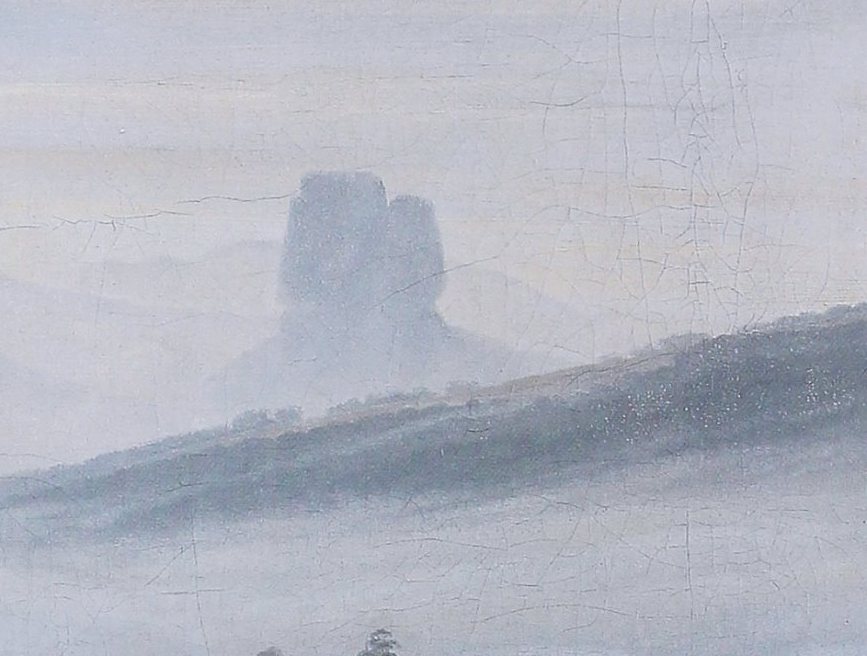
| 7 | The rock tower | Right background | The Zirkelstein, a small table mountain |
| 8 | Wooded rocks, right | Right middle ground | More sandstone, from Friedrich’s studies of the area |
| 9 | The sea of fog | Everywhere below him | The real subject, according to the title |
| 10 | Converging ridges | Both sides | Lines that lead the eye straight to his chest |
The mountains are real, the view is not
Every rock in this picture exists. You can hike to most of them in an afternoon. The region is the Elbe Sandstone Mountains, which Germans call Saxon Switzerland on their side of the border and Czechs call Bohemian Switzerland on theirs. It is a landscape of flat-topped mesas and sandstone towers, carved by the Elbe, and on autumn mornings it really does fill with fog up to the treetops.
Friedrich walked it with a sketchbook. The rock under the wanderer’s feet comes from a pencil study of a rocky knoll near the Kaiserkrone, a small crown-shaped hill above the village of Schöna, dated in his Krippen sketchbook to June 1813. The jagged formation on the left is usually matched with the Gamrig, a cluster of rocks near Rathen that he had drawn back in May 1808. The tower on the right horizon is the Zirkelstein, a little table mountain a short walk from the Kaiserkrone. The big cone on the left is across the border in Bohemia, either the Rosenberg or the Kaltenberg; scholars still argue about which.
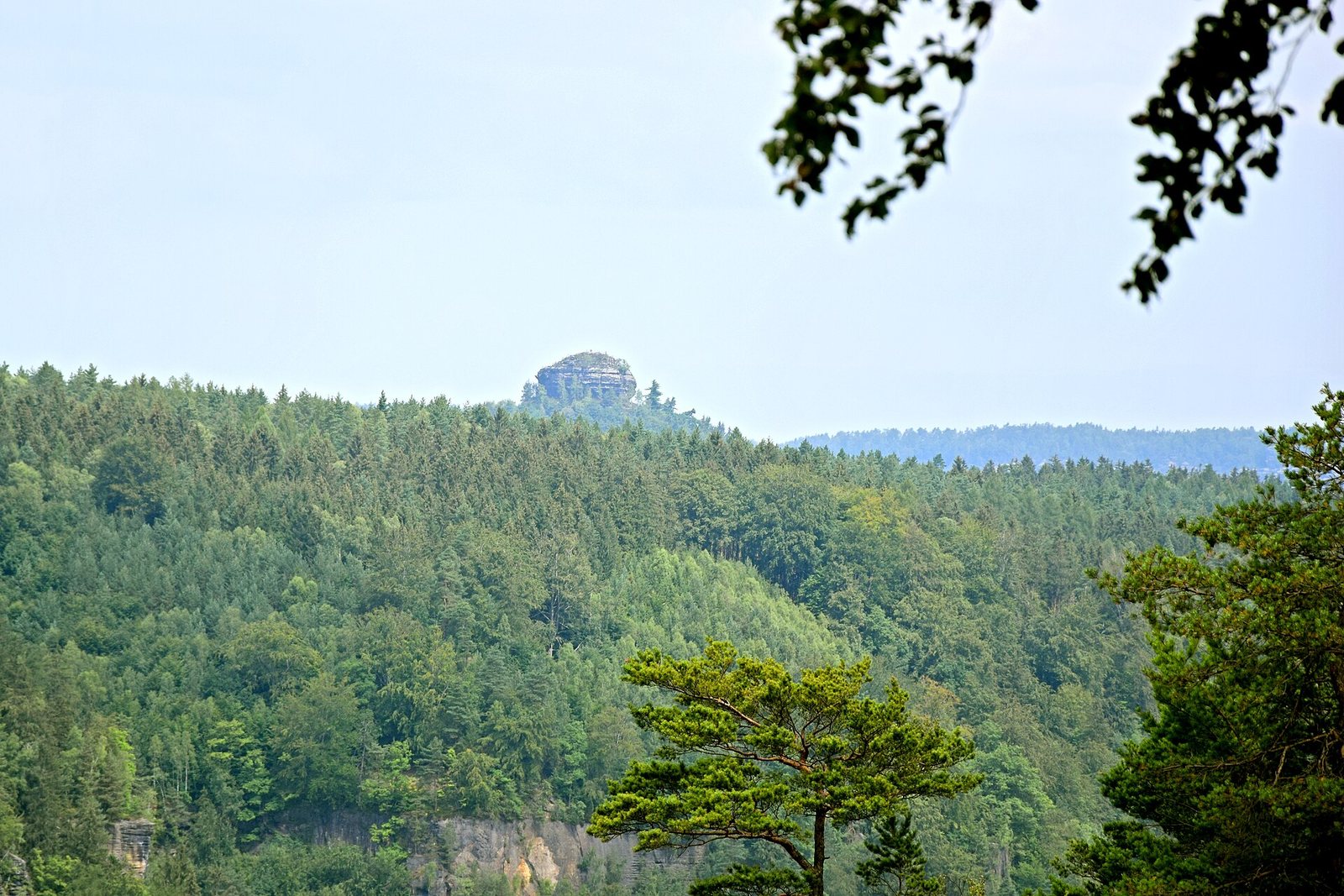
Now the catch. You cannot stand anywhere and see this. The sketches were made years apart, from different hills, facing different directions, and Friedrich rearranged them in his Dresden studio like a stage designer moving flats. From the Kaiserkrone, the Zirkelstein and the Gamrig simply do not line up that way. The view is a composite. A real place that never existed.
Friedrich did not invent nature. He collected it, piece by piece, and built a landscape that matched something in his head. Today a Caspar David Friedrich trail runs out of Krippen, with a stone stele carrying a relief of this painting, so you can stand on the real rocks and see how much he moved.
Who is the man in the green coat?
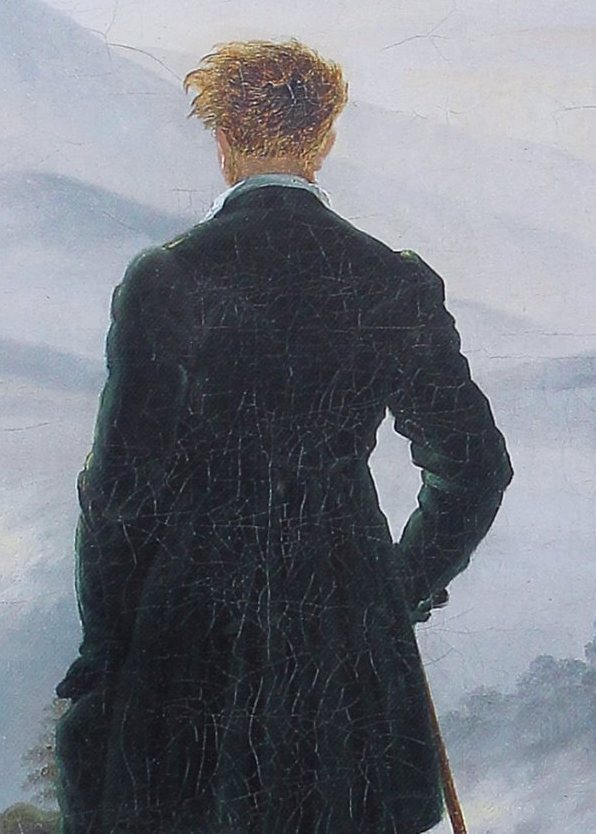
The coat is not black. Look closely and it is a very dark green, with a high collar and a cut that is close at the waist and long in the skirt. That coat has carried more theories than any other piece of clothing in German art.
The first theory came from Ludwig Grote, the art historian who first published the painting in August 1950. He read the coat as the uniform of a volunteer rifleman, one of the Jäger who joined up in 1813 to fight Napoleon in what Germans call the Wars of Liberation. If that is right, the man on the rock is a soldier who died in that war, and the painting is a memorial. The fog below him is the world he has left.
Then came a name. A handwritten note by one Karl Wilhelm Jähnig says the figure is a “Herr von Brincken,” described as a Saxon forestry official. Over the years, retellings turned that into a specific person: Colonel Friedrich Gotthard von Brincken, an officer killed fighting the French. It is a good story, and you will find it stated as fact all over the internet. The paper trail is much thinner than the story. The candidates with that name who have actually been documented either died long before 1813 or, in one case, lived until 1846, and nobody has connected any of them to Friedrich with a letter or a payment. The German art historian Helmut Börsch-Supan still thinks the painting commemorates a dead man. Others think the search for a name is pointless.
A third reading sees politics. After Napoleon’s defeat, young German nationalists wore a dark, close-cut coat they called altdeutsch, old German, as a protest against French fashion and the restored princes. In 1819 the Carlsbad Decrees cracked down on that movement. Friedrich sympathized with it. When he painted two men in that costume gazing at the moon, he reportedly said they were plotting demagogic intrigues. On this reading, the wanderer is a young man with dangerous opinions, standing above a country that has not yet become a nation.
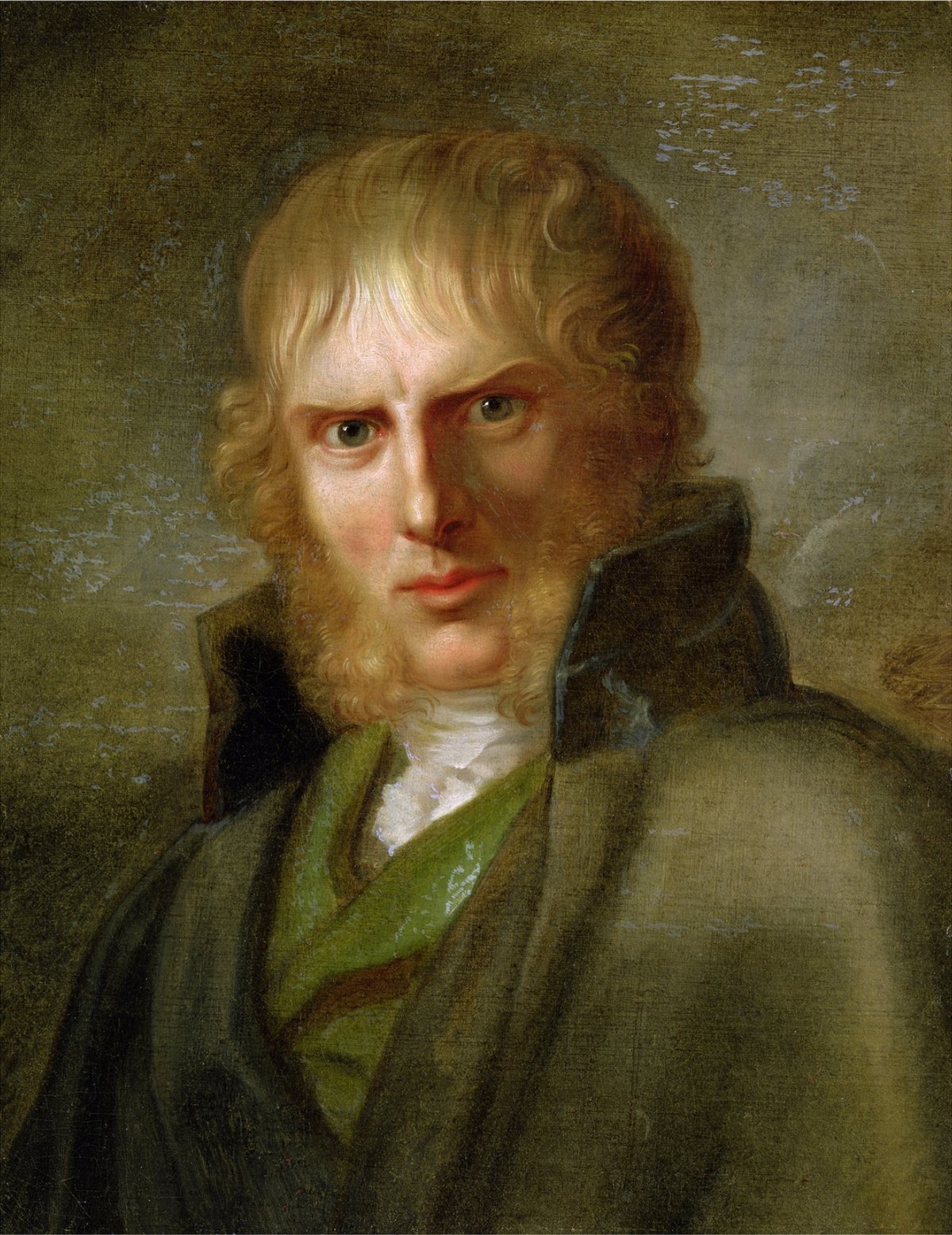
And then there is the simplest answer. Some people think it is Friedrich himself. The hair is right. In his friend Gerhard von Kügelgen’s portrait of him, which also hangs in Hamburg, Friedrich has the same reddish mop, the same high green collar, and the expression of a man who would rather be on a mountain. It may be a self-portrait, a memorial, a political statement, or all three. Friedrich left no explanation, and the turned back means he never has to.
A painting with a 120-year blank
This is where the story gets genuinely odd. Friedrich was famous in his own time, then forgotten. His dark, still landscapes went out of style even before he died in Dresden in 1840. He was rediscovered in Germany at a big Berlin exhibition in 1906, but this picture was not part of that rediscovery, because nobody knew where it was.
It surfaces in the late 1930s at the Berlin gallery of a dealer named Wilhelm August Luz, sometime before September 1939. From 1943 to 1945 it belonged to a collector in Essen, and after the war it moved through private hands in Westphalia. Grote published it in 1950. In the summer of 1959 it was lent anonymously to an exhibition at the Tate Gallery in London under a title that sounds almost comic now: “Mountaineer in a Misty Landscape.”
In December 1970 a Hamburg foundation bought it for 600,000 Deutschmarks, at the urging of the Kunsthalle’s new director, Werner Hofmann. It went on permanent loan to the museum and became the twelfth Friedrich in the collection. In 2024, two provenance researchers at the Kunsthalle, Ute Haug and Nadine Bauer, published a study of its history and could not close the gap. From Friedrich’s studio to the late 1930s, roughly 120 years, the trail is blank.
The dating has drifted for decades, from around 1815 to around 1820, because no document pins it down. The Kunsthalle says around 1817; many books say 1818, the year Friedrich married Caroline Bommer. Even the title is a modern convenience.
The sublime, explained on one rock
If you want the one word that explains why this picture works, it is the sublime. In 1757 the Irish philosopher Edmund Burke drew a line between the beautiful, which pleases us, and the sublime, which overwhelms us. Storms, cliffs, oceans, darkness, infinity. The sublime is a pleasure mixed with fear. You feel small, and somehow that feels good.
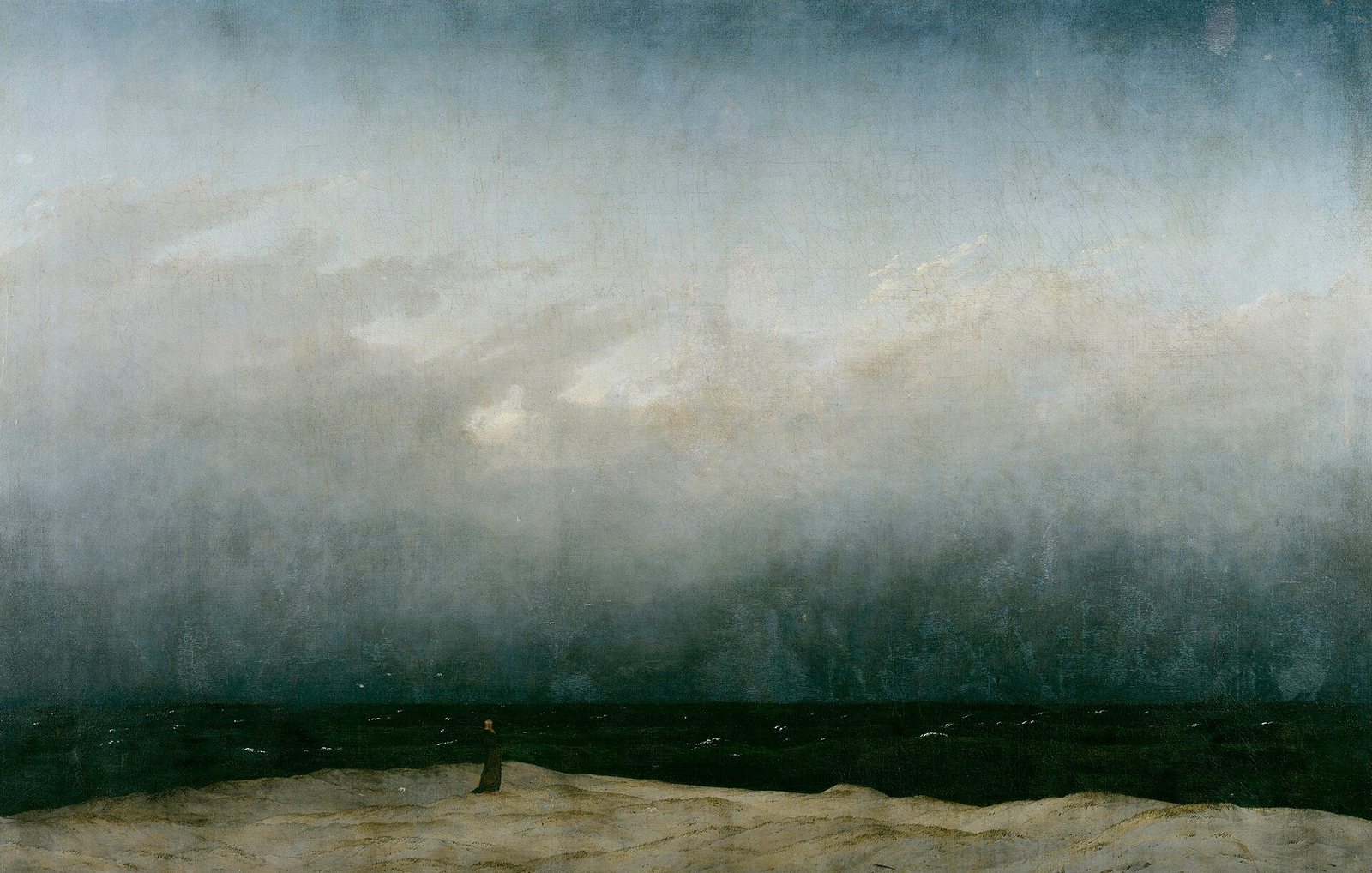
A few years before the wanderer, Friedrich painted “The Monk by the Sea,” now in Berlin’s Alte Nationalgalerie, a tiny figure on a strip of sand under an empty, oppressive sky. One critic, Heinrich von Kleist, wrote that looking at it felt as if your eyelids had been cut off.
The wanderer flips that arrangement. The monk is crushed by the infinite. The wanderer stands on top of it. He is big, central, upright, one hand on his hip. That is why the painting has two opposite readings that both feel true. It can be human mastery over nature, the self at the top of the world. Or it can be a man at the edge of an abyss, who has climbed as high as he can and still sees only cloud. The East German Friedrich scholar Hans Joachim Neidhardt put it in one line: the man on the summit is at the same time the man at the edge of the abyss in front of him.
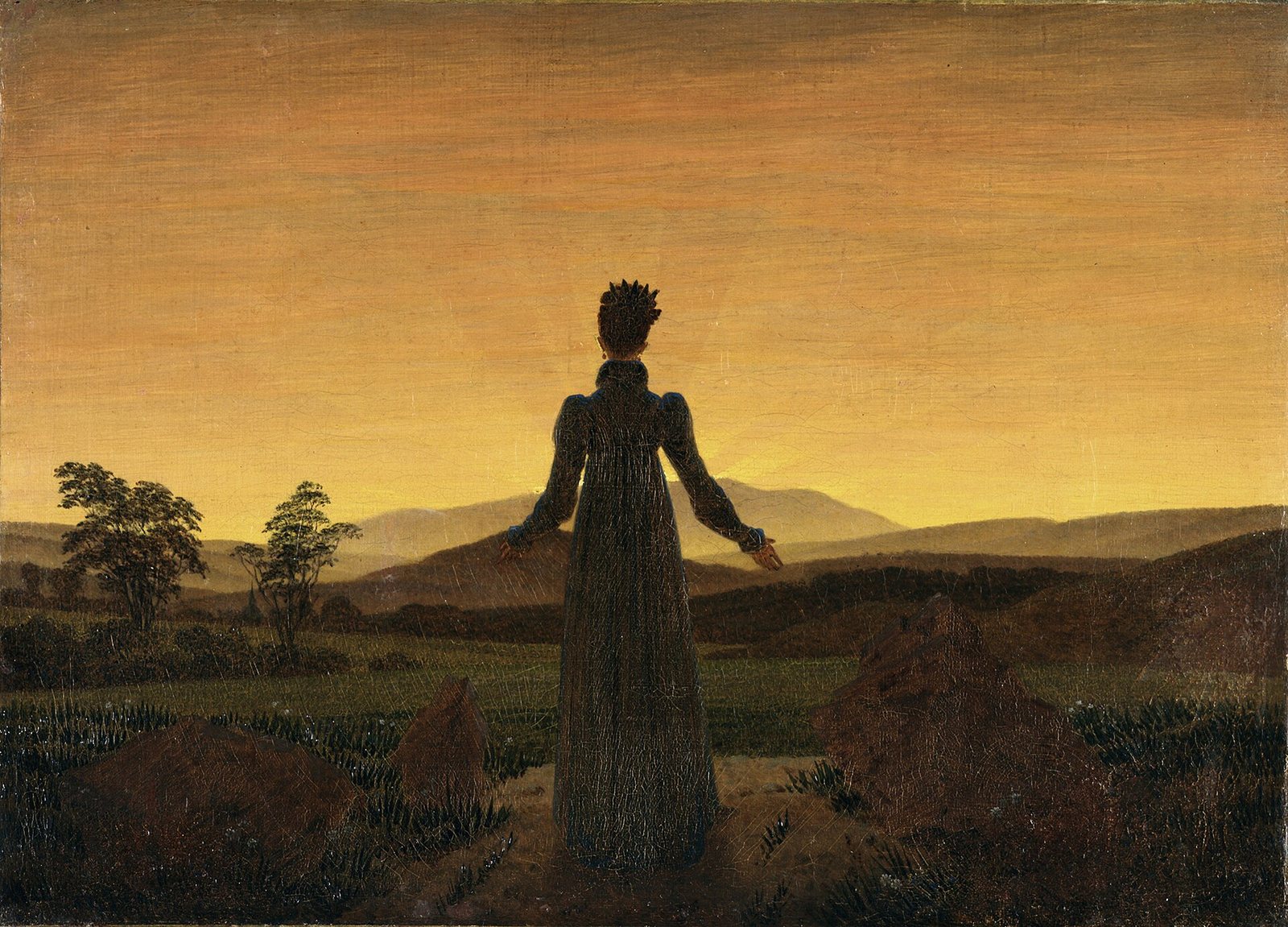
He kept using the device. Around the same years he painted a woman with her back to us, arms half open toward a blazing sun, now in the Museum Folkwang in Essen. Same pose, opposite mood: warm, open, close to prayer. For Friedrich, a devout Lutheran, a landscape could be a church without walls.
Géricault’s Raft of the Medusa was finished in Paris around the same time, and it is all bodies, shouting and spectacle. Werner Hofmann, the director who bought the wanderer for Hamburg, liked to contrast it with Delacroix’s Liberty Leading the People: the French painting tells you exactly where to go, while Friedrich’s leaves the question open. The German version of Romanticism is quieter, lonelier, and stranger.
From forgotten canvas to everyone’s book cover
The wanderer became famous late, and then all at once. After Hamburg bought it in 1970, it turned into shorthand for a whole set of ideas: Romanticism, the lone genius, the Germans and their forests, the self facing the infinite. Publishers put it on the cover of the Dover edition of Mary Shelley’s Frankenstein and on many editions of Nietzsche. The Yale historian John Lewis Gaddis built the opening of his book “The Landscape of History” around it, using the man on the rock as a picture of the historian looking back over the past. Der Spiegel and Stern have put it on their covers. It has been redone in Minecraft and parodied in Doctor Who.
The internet loves the wanderer because the back is a blank. You can put anything in front of him: a sea of fog, a sea of emails, a sea of laundry. The joke works because the pose belongs to every person who has ever reached the top of something and photographed the view.
The 250th birthday that broke Hamburg’s record
Friedrich was born on September 5, 1774, in Greifswald, on the Baltic coast of Pomerania. For the 250th anniversary, Germany threw him a two-year party. The Hamburger Kunsthalle opened first, with “Caspar David Friedrich: Art for a New Age,” which ran from December 15, 2023, to April 1, 2024, with more than sixty of his paintings. The museum counted about 335,000 visitors, the biggest exhibition in its history. Berlin and Dresden followed with their own shows during 2024.
In 2025 the wanderer crossed the Atlantic for the first time. The Metropolitan Museum of Art in New York borrowed it for “Caspar David Friedrich: The Soul of Nature,” which ran from February 8 to May 11, 2025. It has since gone home to Hamburg.
Wanderer above the Sea of Fog FAQ
Where is the Wanderer above the Sea of Fog?
It is in the Hamburger Kunsthalle in Hamburg, Germany, in the nineteenth-century galleries. It has been there since 1970, on permanent loan from the Stiftung Hamburger Kunstsammlungen, a foundation that bought it for the museum.
How big is the painting?
It measures 94.8 by 74.8 centimeters, roughly 37 by 29 inches.
Who is the man in the painting?
Nobody knows for certain. Suggestions include Friedrich himself, a soldier killed in the wars against Napoleon, and a forestry official named von Brincken. The documentation for any single name is thin.
What does Wanderer above the Sea of Fog mean?
It is usually read as a picture of the Romantic sublime: a person facing something vast and unknowable. It can be read as mastery of nature or as a man at the edge of an abyss, and Friedrich deliberately left both open.
When was it painted?
Around 1817 or 1818. The Hamburger Kunsthalle dates it to around 1817, and many books give 1818. It is unsigned and undated, and no document from Friedrich’s lifetime mentions it.
Is the landscape real?
The pieces are real. The rocks come from the Elbe Sandstone Mountains south of Dresden, including the Kaiserkrone, the Gamrig and the Zirkelstein, but Friedrich combined sketches from different places into a view you cannot see from any single spot.
Where to see it in Hamburg
The Hamburger Kunsthalle is at Glockengießerwall 5, a short walk from Hamburg’s main train station. It is open Tuesday to Sunday from 10 a.m. to 6 p.m., with a late opening on Thursdays until 9 p.m., and it is closed on Mondays. A regular ticket is 18 euros, 9 euros reduced, and visitors under eighteen get in free. There is also a cheaper short evening ticket for the last hour of the day. Check the Kunsthalle’s site before you go, since part of the complex is under renovation.
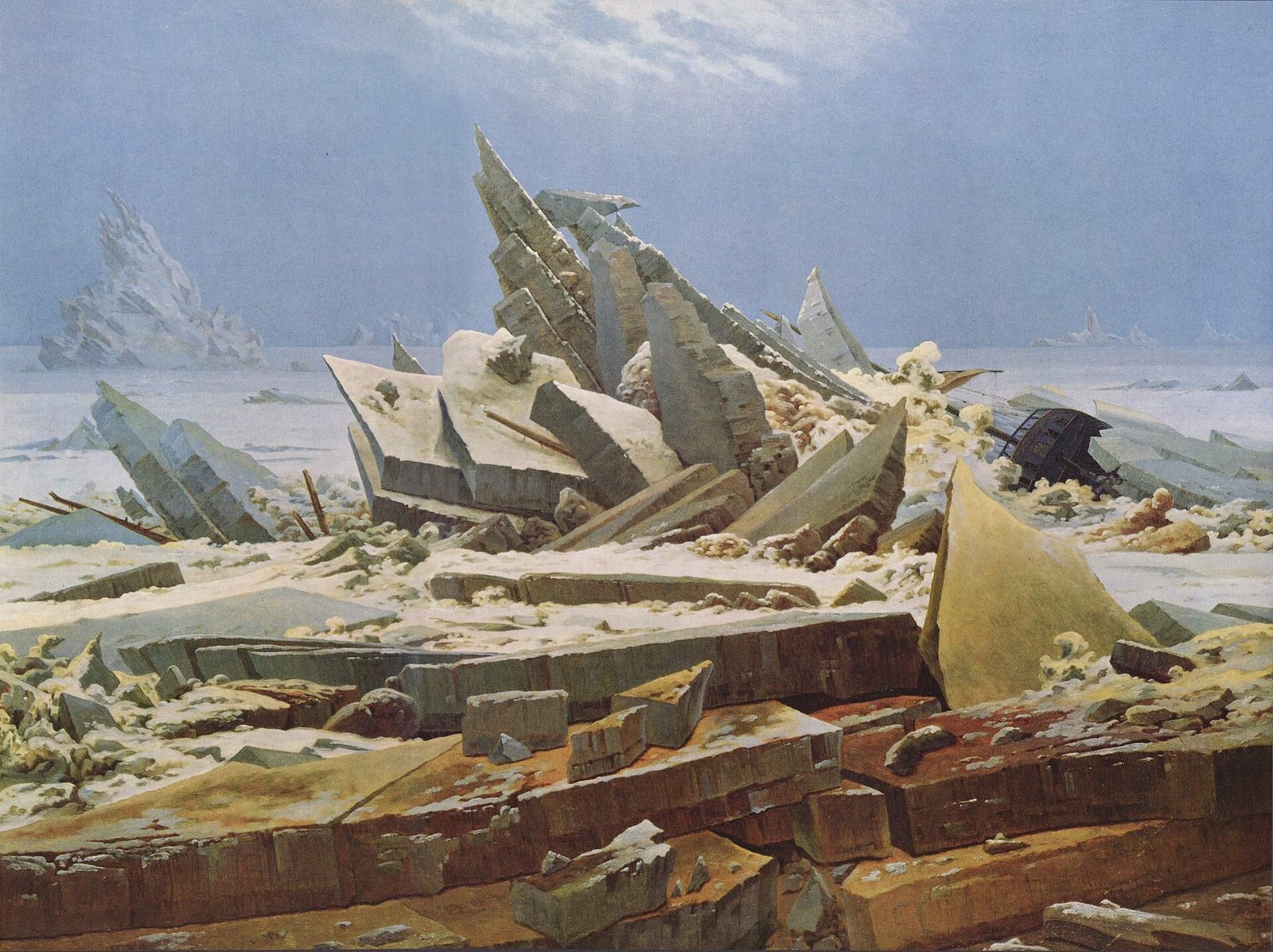
The wanderer is not alone. Hamburg has one of the best Friedrich collections anywhere, assembled largely by Alfred Lichtwark, the director who rediscovered him around 1900. While you are there, find “The Sea of Ice” from 1823 to 1824, a pile of shattered ice slabs grinding over the wreck of a ship. If the wanderer is the confident version of the sublime, this is the merciless one.
Expect a crowd, and come early on a weekday. If you have never spent real time with one painting, our guide to art museum tips for people who don’t get art makes the case for doing exactly that here.
What to look for when you stand there
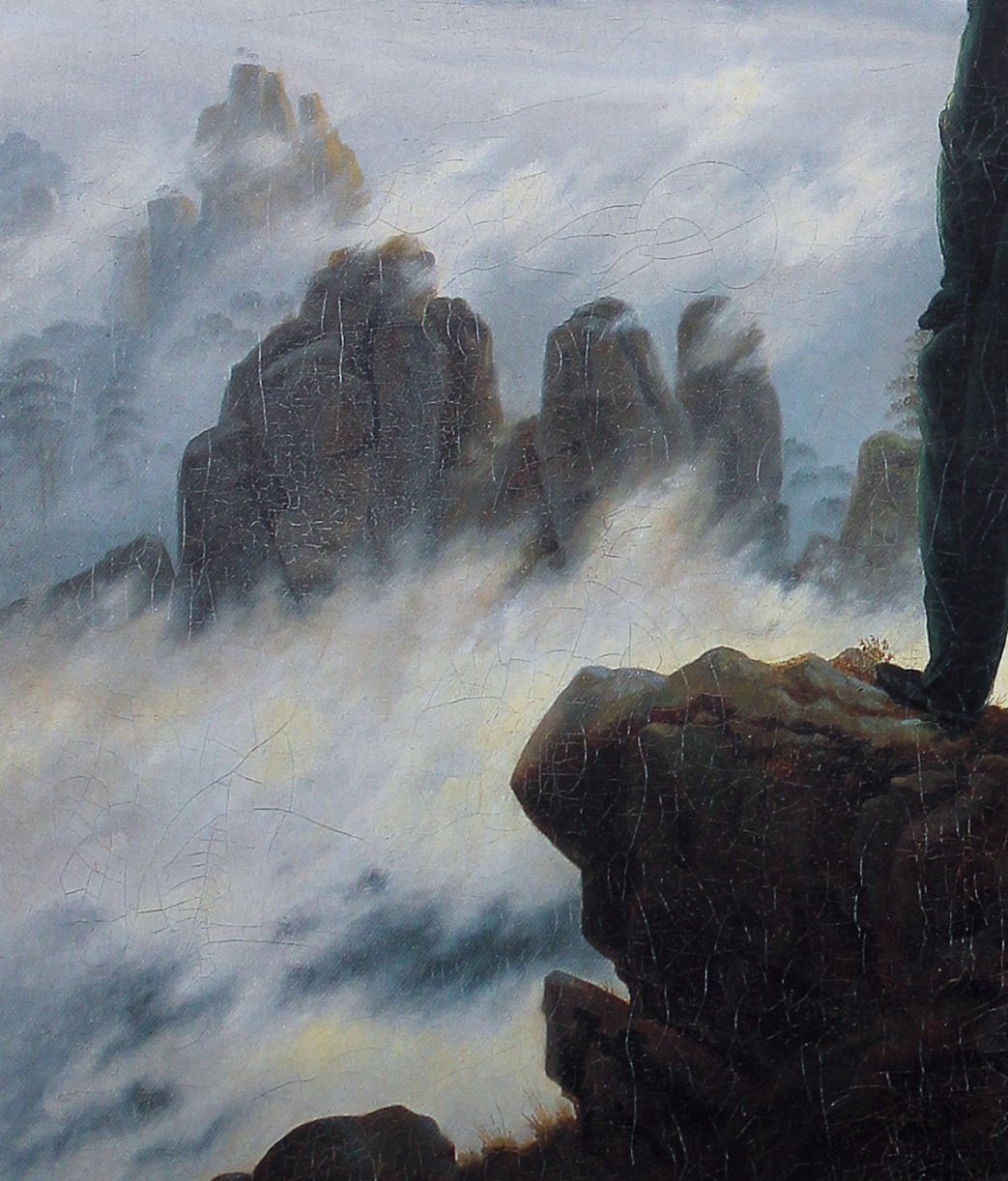
Get close first, because the reproductions lie about the color. The coat is green, not black. The fog is not white but a dozen grays and pale yellows, with a faint warm light breaking through on the left. The hair is painted strand by strand, with highlights that make it look like it is still moving. On the left, the rocks rise out of the fog in layers, each one paler than the last, which is how Friedrich builds depth without a single road or house to measure it by. Chiaro is useful in that exact spot: the story of the June 1813 sketch at the foot of the Kaiserkrone plays while your eyes are on the summit rock it became, and the gap between the drawing and the painting suddenly makes sense.
Then step back. Watch the two ridgelines slide down toward his chest. Find the Zirkelstein on the right, the cone of the Bohemian mountain on the left, and notice that they balance him like weights on a scale. Ask yourself whether he looks triumphant or lost. Then notice what you are doing. You are standing still, with your back to the room, looking past a stranger at a view you cannot reach.
That is the trick he has been pulling since around 1817. Friedrich never shows us the wanderer’s face, because the face that matters is ours. Every visitor who has stood in front of that canvas in Hamburg has been the second figure in the painting, one step behind him, on the same rock, in the same fog.
If you plan to stop in front of it, it is on our Hamburger Kunsthalle audio guide, along with the rest of the Kunsthalle’s highlights.