On May 23, 1533, a French diplomat in London wrote to his brother. Jean de Dinteville had been sent by King Francis I to keep an eye on Henry VIII, who had just married Anne Boleyn in secret and was about to tear England away from Rome. Dinteville hated it. The damp made him ill. He described himself, in the usual English rendering of the letter, as the most melancholy, weary and wearisome ambassador who ever lived.
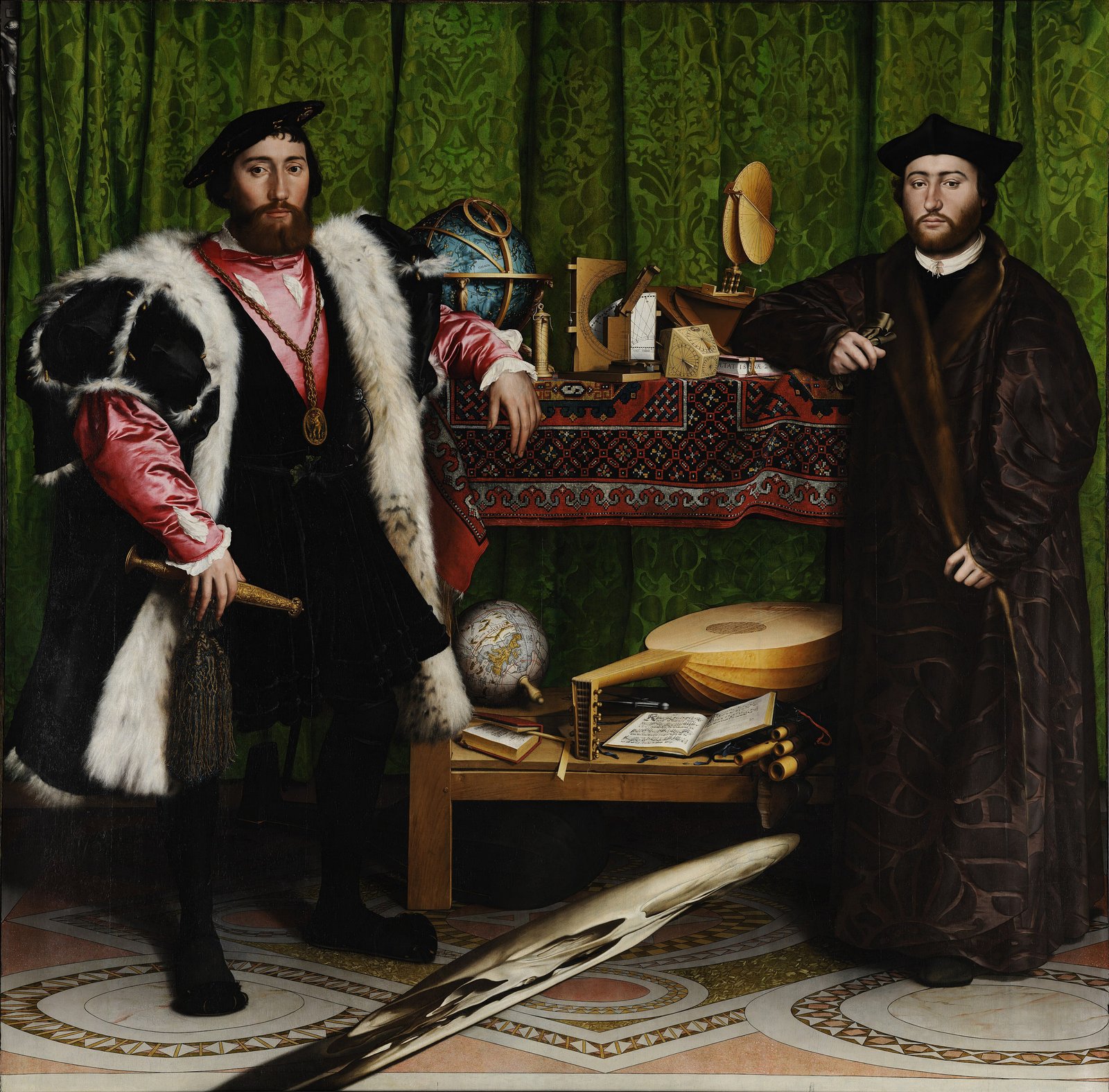
That same year he commissioned The Ambassadors, Holbein’s life-size double portrait of him and his best friend, surrounded by globes, sundials, books and a lute. The miserable diplomat made sure it carried a message. Most people walk straight past it. The message is lying on the floor, and you can only read it if you stop walking at exactly the right spot.
Why The Ambassadors by Holbein is a painting you have to walk past
Most paintings ask you to stand in front of them. This one asks you to leave. Hans Holbein the Younger painted it in London in 1533, on a panel of Baltic oak a little under seven feet square. It hangs today in the National Gallery in London. Seen head-on, it is the most confident double portrait of the Renaissance: two young men, rich and educated, leaning on a stand loaded with the best science money could buy.
Then there is the smear. A long, pale shape slants across the floor between their feet, like a cuttlefish bone. It casts its own shadow, in a different light from everything else in the room. From the front, it makes no sense at all.
The stakes of this painting are the stakes of 1533. England was splitting from the Catholic Church. Two Frenchmen, a courtier and a bishop, were caught in the middle of it. Holbein packed all of that into the objects on the shelves.
The two men: a courtier and a bishop
On the left is Jean de Dinteville, lord of Polisy in Champagne, ambassador of the King of France. He wears a pink satin doublet, a black coat lined with lynx fur, and the gold chain of the Order of Saint Michael, France’s royal order of chivalry. In his right hand is a gold dagger. Engraved on its sheath is his age: twenty-nine.
On the right is Georges de Selve, the Bishop of Lavaur, in a long, sober robe of brown damask. Under his right elbow is a closed book. Painted on its edge, in Latin, are the words “aetatis suae 25,” his age, twenty-five. Georges de Selve was only in London briefly, between about April and June of 1533, on a visit that the National Gallery says cheered his friend up. He was a scholar and a diplomat, and he had a reputation as a man who wanted the quarreling churches to reconcile.
For centuries nobody knew who they were. In 1890 the scholar Sidney Colvin proposed Dinteville, and in 1900 the historian Mary Hervey identified Georges de Selve, which settled the question.
One sitter is a man of the world. The other is a man of the church. Holbein set them on either side of a piece of furniture that holds the universe, and the painting is about what happens between those two halves.
The Ambassadors painting, every detail numbered
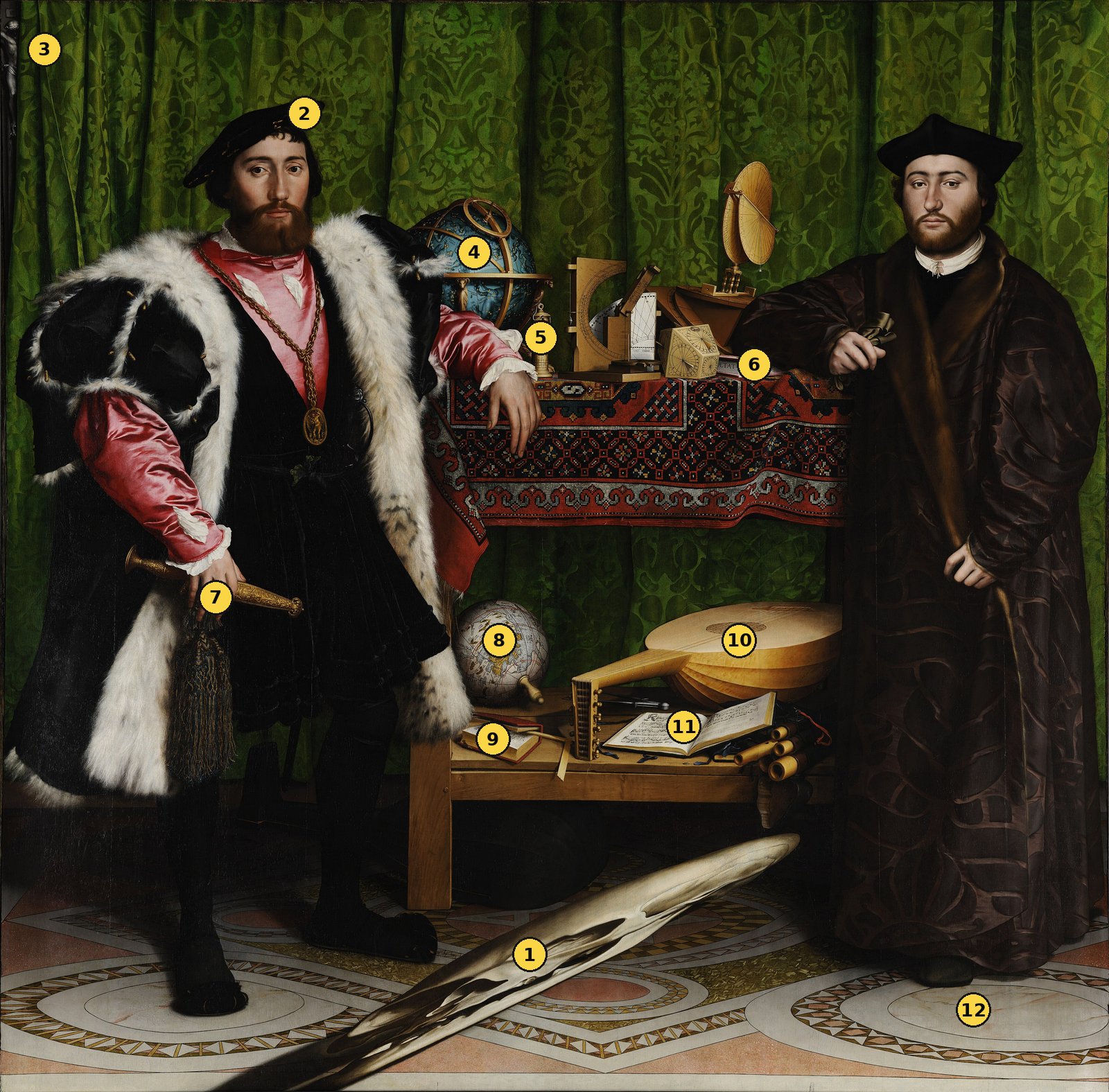
The numbers on the image match this key.
| # | Detail | Where to find it | What it may mean |
|---|---|---|---|
| 1 | The skull | Slanting across the floor | Memento mori, visible only from the side |
| 2 | Skull badge | Dinteville’s black hat | His private emblem of death |
| 3 | Crucifix | Top left corner, behind the curtain | Faith, half hidden |
| 4 | Celestial globe | Top shelf, left | The heavens, and the knowledge to read them |
| 5 | Shepherd’s dial | Top shelf, beside the globe | A date, possibly Good Friday 1533 |
| 6 | Selve’s book | Under the bishop’s elbow | ”Aetatis suae 25,” his age |
| 7 | The dagger | Dinteville’s right hand | His age, twenty-nine, on the sheath |
| 8 | Terrestrial globe | Bottom shelf, left | Dinteville’s home, Polisy, marked on it |
| 9 | Arithmetic book | Bottom shelf, left | A merchant’s manual, open at “division” |
| 10 | The lute | Bottom shelf, right | One broken string |
| 11 | The hymnbook | Bottom shelf, center | Lutheran hymns, in a Catholic bishop’s picture |
| 12 | The pavement | The floor | Copied from Westminster Abbey |
Start with the one that causes the most trouble.
The Ambassadors skull and where to stand
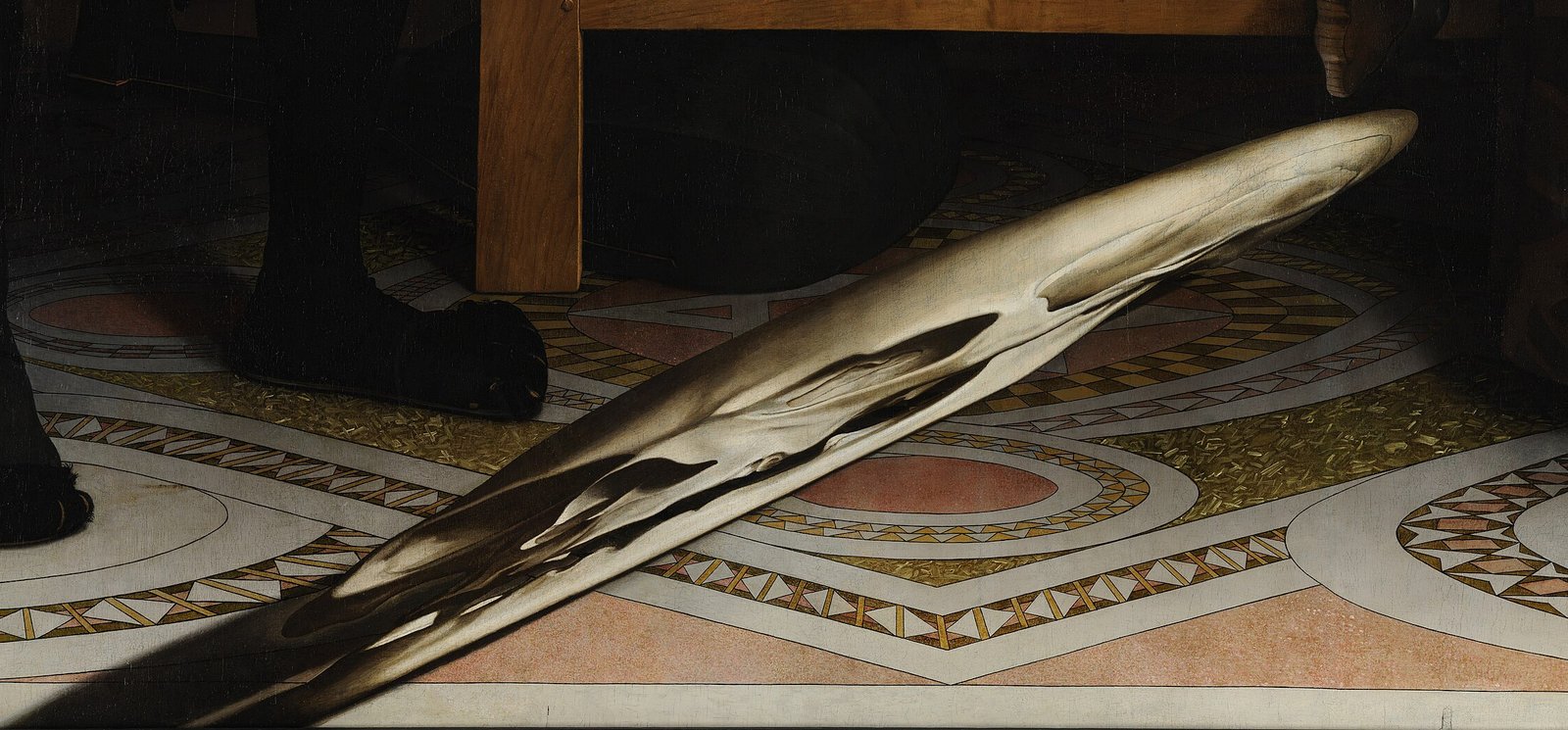
The shape on the floor is a human skull, painted in a technique called anamorphosis. Holbein stretched a normal skull along one direction, so far that it only snaps back into shape from a steep angle.
So where is the right place? The National Gallery says the effect can only be seen properly if you look up at the painting from the bottom right corner. In practice, walk to the right-hand edge of the frame, get your cheek close to the wall, and look back across the panel toward the lower left. At a certain point the smear stops being a bone and becomes a skull. Move a step, and it is gone.
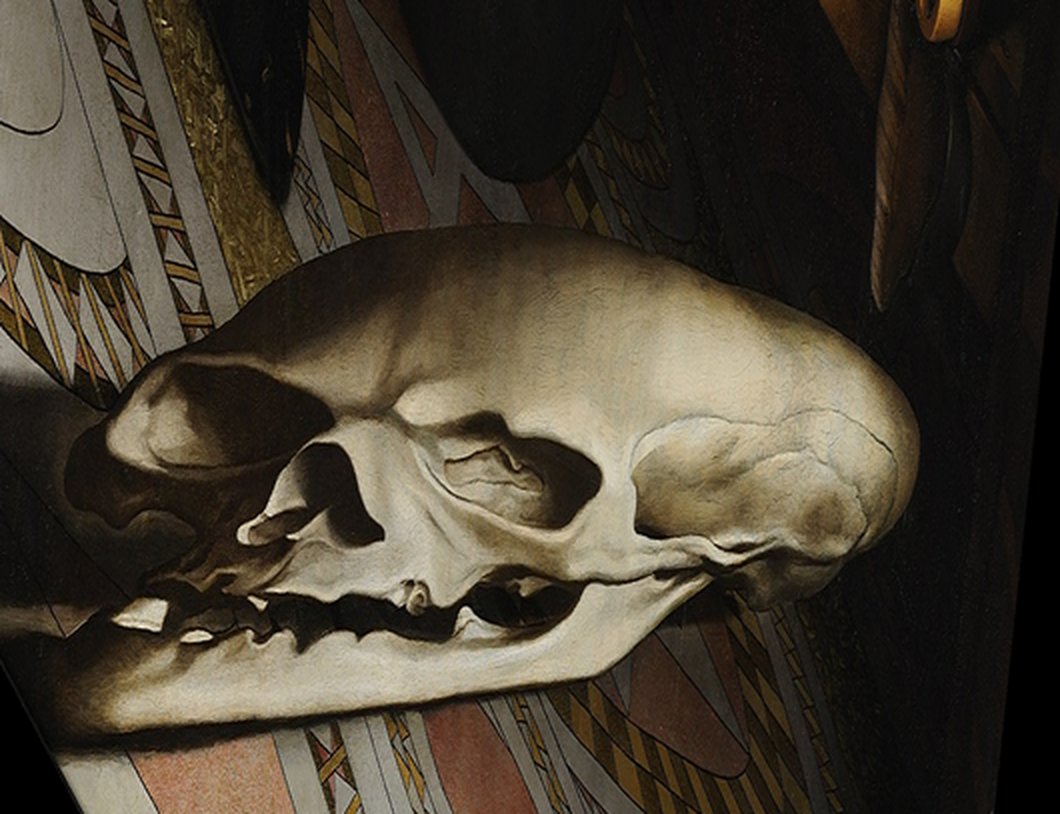
The picture seems designed to be seen while moving. One long-standing theory says it was meant to hang where people walked past it, perhaps beside a staircase or a doorway. You would come in, admire the two men in their furs, and then, as you left, glance back and see death lying at their feet. The plain box frame the National Gallery made for it in 1996 was designed to allow exactly that side view.
The plain reading is memento mori, remember that you will die. All the wealth and learning on the shelves, and the floor is waiting anyway. There is also a joke that people have been suggesting for a long time, and it is only a suggestion: in German, “hohl Bein” means a hollow bone, which sounds a little like Holbein. A skull is a hollow bone. Holbein may have signed the picture twice.
A warning about the skull you see today. When the painting was restored in the 1990s, conservators found that parts of it, including the lower jaw and the nasal cavity, had been lost to old damage. They rebuilt the missing areas, working from photographs of a real skull and using materials that can be taken off again. The shape is Holbein’s. Some of the bone is modern.
A skull on his hat and a cross behind the curtain
Once you have seen one skull, look for the second. On Dinteville’s black hat there is a small gold medallion. It is about the size of a fingernail on the panel, and it contains another skull. It is said that Dinteville’s own motto was memento mori. Whether or not that story is true, the badge tells you the big skull on the floor was his idea, or at least his taste. He was a man who wore his death on his hat.
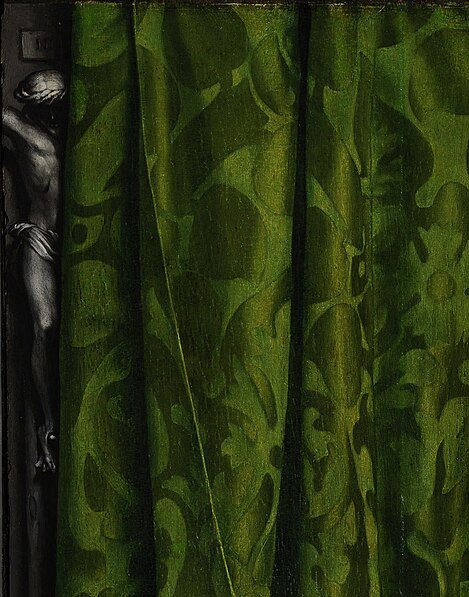
Now look at the opposite corner of the painting from the skull, at the very top left. The green damask curtain is pulled slightly back, and behind it, almost lost, hangs a silver crucifix. You can see Christ’s head and part of his body. The rest is behind the cloth. This detail was hard to make out until the 1990s cleaning removed old varnish and repaint.
Put the two together and the painting gets a structure. Death is at the bottom, enormous and impossible to see properly. Salvation is at the top, tiny and nearly hidden. One reading says the crucifix answers the skull. A gloomier one says that in 1533 even faith had been pushed into a corner.
The globes, the sundials and the date
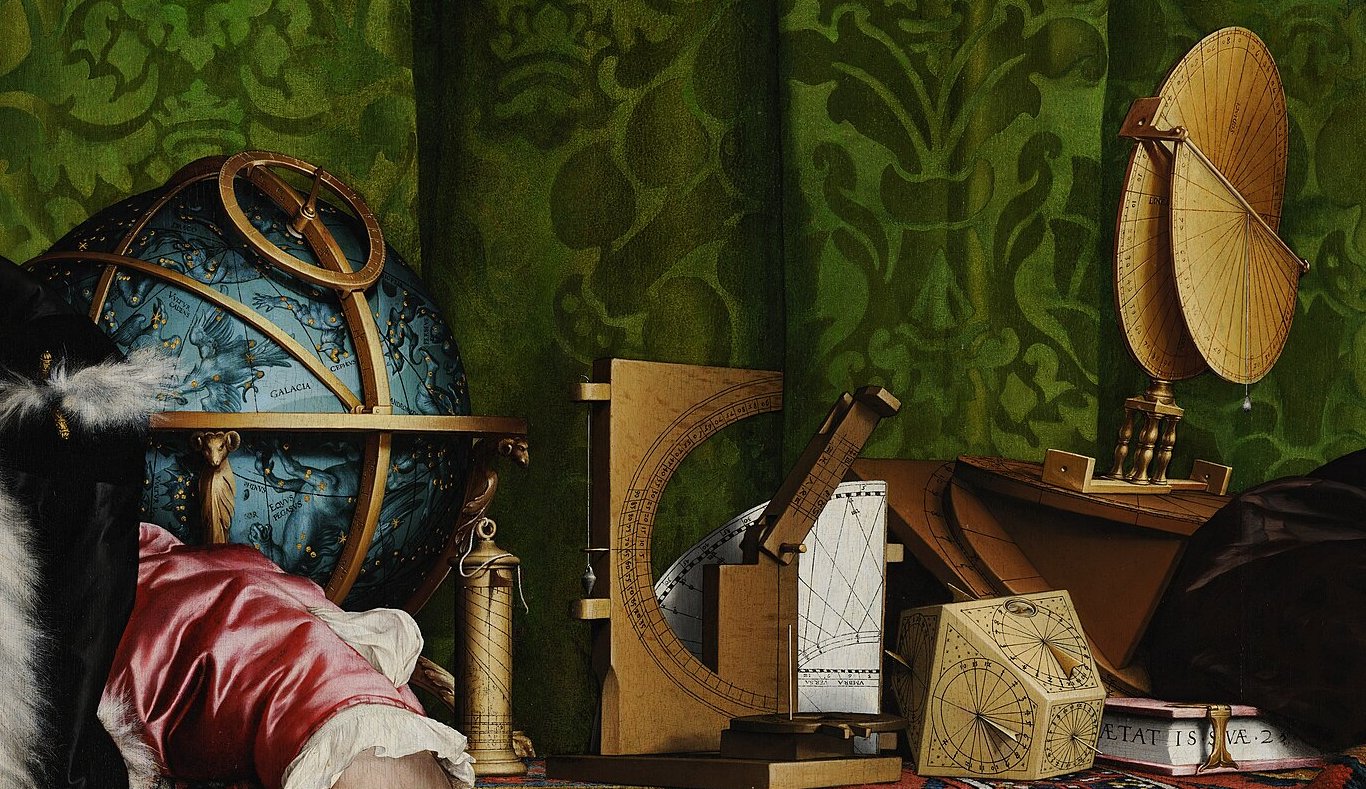
The upper shelf is the heavens. It holds the scientific kit of a man who wanted to be seen as modern. On the left is a celestial globe, the stars and constellations painted on blue. Next to it stands a small cylinder, a portable sundial known as a shepherd’s dial or pillar dial. Then a quadrant, used to measure the height of the sun. Then a many-sided brass polyhedral dial, and finally a tall torquetum, a device for working out the positions of the heavenly bodies.
These were not studio props. Nicholas Kratzer, a German astronomer at Henry VIII’s court, had sat for Holbein in 1528, and the National Gallery notes that the polyhedral dial is one Kratzer made.
Here is where it gets precise. A sundial is a calendar as well as a clock. The shepherd’s dial is set to a particular date, and historians have spent a long time working out which. Because a pillar dial gives the same reading twice a year, the setting fits either a day in mid-April or a day in mid-August. The historian of astronomy John North argued, in his 2002 book The Ambassadors’ Secret, that the instruments point to the afternoon of April 11, 1533. That was Good Friday, the day of the crucifixion. Other readers propose different dates, including the historian Eric Ives, who linked the setting to the moment in the spring of 1533 when Anne Boleyn was given royal honors at court. Nobody has proved any of them. But if North is right, the painting is set at the hour Christ died, with a crucifix in the corner and a skull on the floor.
The Ambassadors and Holbein’s broken lute string
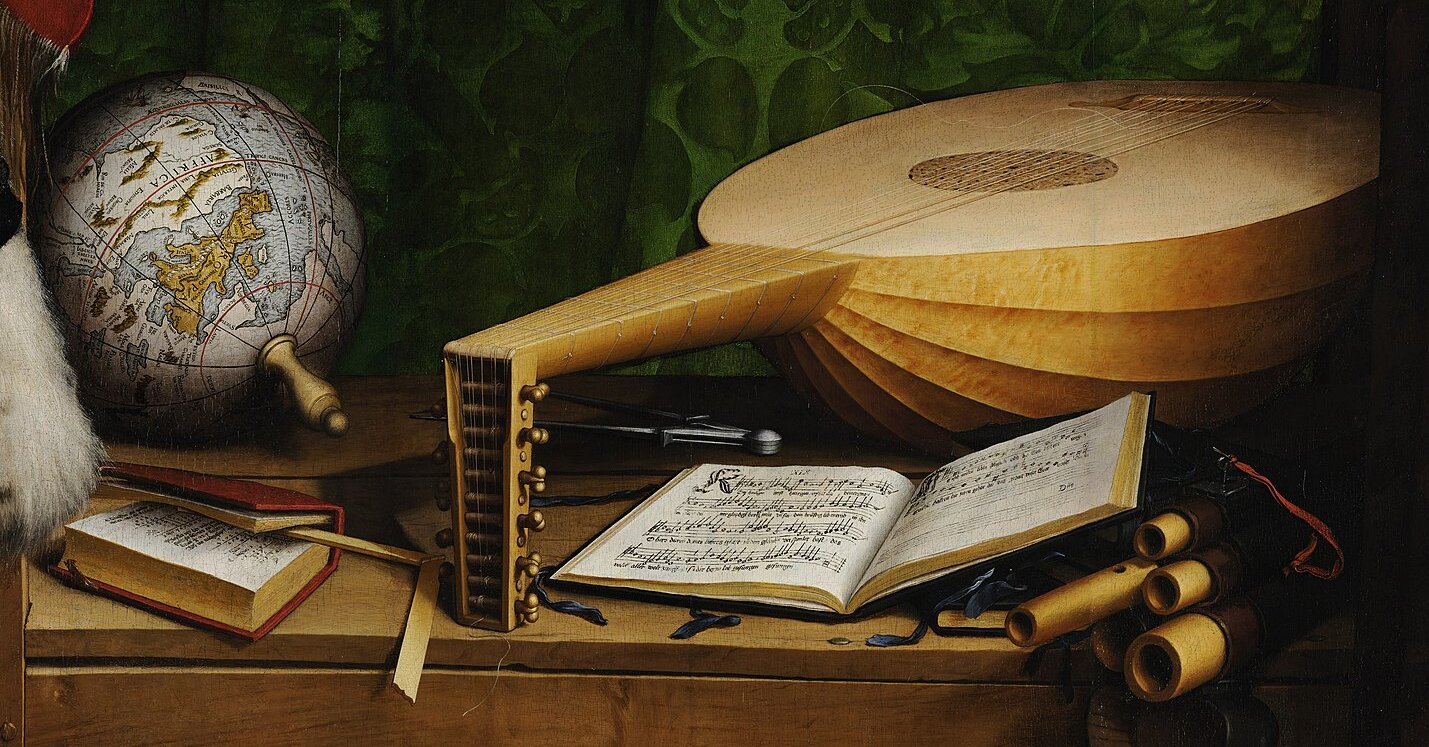
The lower shelf is the earth, and things are going wrong there.
Start with the terrestrial globe. It is upside down by the standards of a modern map, and it is crowded with place names. Among the very few French towns marked on it is Polisy, Dinteville’s family seat, a tiny village that has no business being on a globe at all. It is the sitter’s home address, written into the world.
Next to the globe is a book held open by a set square. It is a merchant’s arithmetic manual by the German mathematician Peter Apian, published in 1527, and it lies open at a page on division. It is hard not to read that as a pun.
Then the lute, foreshortened so precisely that you can count the pegs. Look closely at the strings. One of them is broken. In the 1500s, a lute was the standard image of harmony, and harmony was the standard image of a well-ordered church and state. A lute with a snapped string is discord. It sits beside a case of flutes, and one of the flutes is missing.
A Lutheran hymnbook in a bishop’s portrait
Right in front of the lute lies an open book of music. This is the hymnbook, and it is the most startling object in the picture once you know what it is.
It is a Lutheran hymnal, the book of spiritual songs compiled by Johann Walter and published in Wittenberg in 1524, with music for Martin Luther’s new German church. Holbein painted it open at two hymns, which the National Gallery identifies as “Come Holy Ghost” and “The Ten Commandments,” both in Luther’s German versions. The notes and words are clear enough to read.
A Catholic ambassador, next to a Catholic bishop, with a crucifix in the corner, and the open book is the hymnal of the Reformation. That is not an accident. The hymns Holbein chose are ones that Catholics and Lutherans could both accept: a prayer to the Holy Spirit and the Ten Commandments. Georges de Selve was known for wanting the churches to come back together. Many historians read the open hymnal next to the broken lute as a single statement. The music is still there. The instrument to play it on is broken.
Holbein knew what that split cost. It had already driven him out of Basel.
The floor of Westminster Abbey
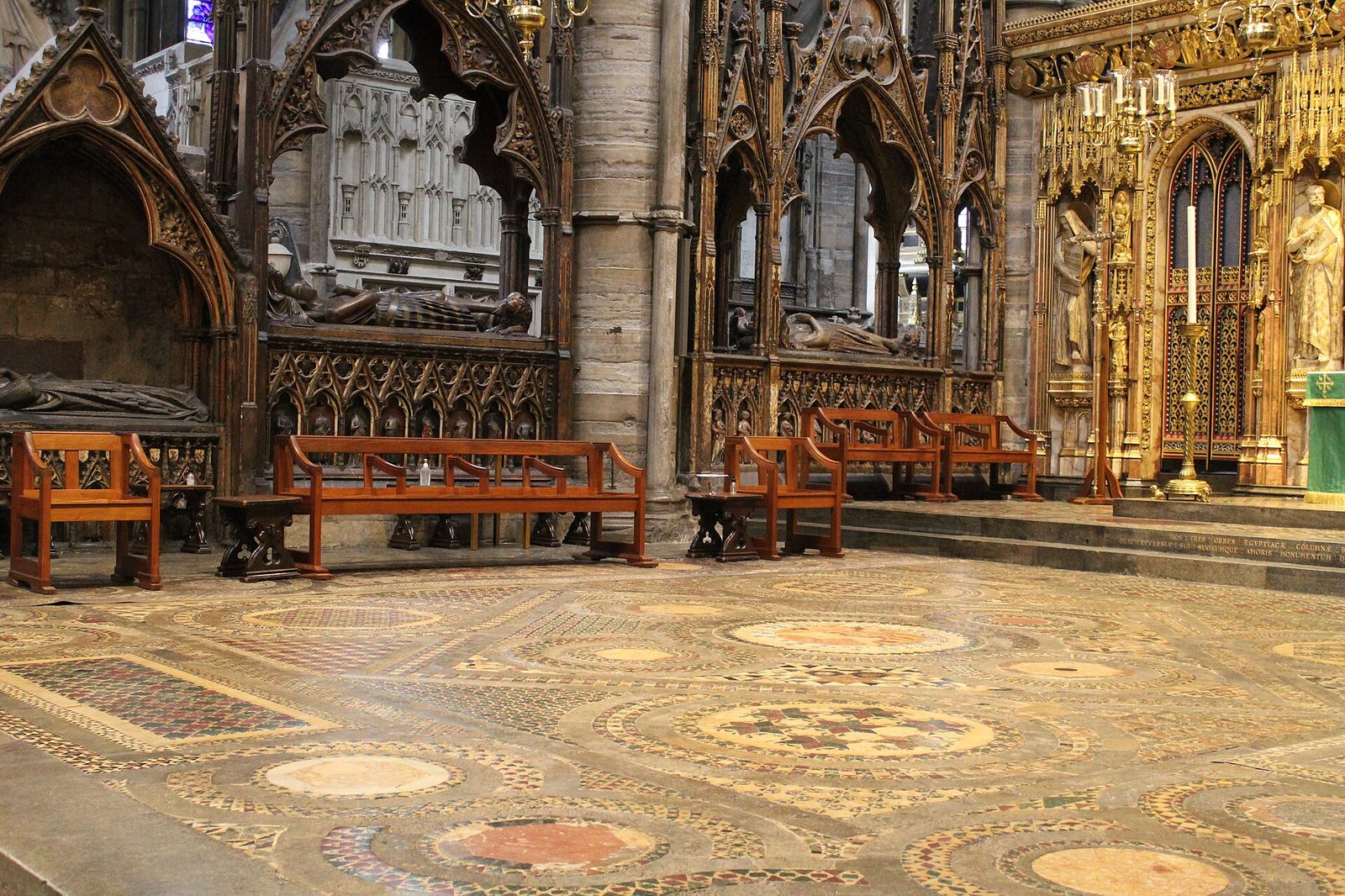
Drop your eyes to the floor, under the skull. The two men are standing on an inlaid marble pavement of circles and lozenges in pink, white and gold. It is based on a real floor. The design comes from the Cosmati pavement in Westminster Abbey, laid in 1268 in front of the high altar by Italian craftsmen working for Henry III. Its medieval inscriptions claimed to hold the plan of the universe, and even the date the world would end.
That was the floor in front of the altar where English monarchs were crowned. On June 1, 1533, Anne Boleyn was crowned queen there, and Dinteville, as the French ambassador, was in London for the celebrations. Eric Ives suggested that the pavement points at that coronation. It is a neat theory, and it fits the year. Holbein put them on the cosmic floor of an English abbey, in the year the English church walked away from Rome.
Somewhere in the shadow on this floor, behind Dinteville, Holbein signed and dated the picture. It is far harder to spot than the skull.
The immigrant painter and the long road to London
Hans Holbein the Younger was born in Augsburg around 1497 and made his name in Basel, where he painted the scholar Erasmus. Erasmus sent him to England in 1526 with a letter of introduction to Thomas More. Holbein came back for good in 1532, as the Reformation in Basel dried up the market for religious art. In 1533 he was not yet the king’s painter. The Ambassadors was his showpiece, proof to anyone in London of what he could do. Within a few years he was painting Henry VIII himself. For the next generation of power portraits, Titian’s Charles V at Mühlberg does it on horseback, fifteen years later.
Dinteville took the painting home to his chateau at Polisy, where an inventory recorded it in 1589. It was sold in Paris in 1787, reached England a few years later, and hung at Longford Castle, the Earl of Radnor’s house in Wiltshire, for most of the nineteenth century. In 1890 the National Gallery bought it, with two other pictures, for fifty-five thousand pounds.
The Ambassadors FAQ
Where is The Ambassadors painting?
It hangs in the National Gallery in London, on Trafalgar Square. The gallery currently lists it in Room 4, but rooms are rehung, so check the floor plan on the day.
Where do you stand to see the skull in The Ambassadors?
Go to the right-hand side of the painting, get close to the wall, and look back down the panel toward the lower left. The National Gallery describes it as looking up at the picture from the bottom right corner. The stretched shape on the floor shortens into a skull as the angle gets steep.
Who are the two men in The Ambassadors?
On the left is Jean de Dinteville, the French ambassador to England in 1533, aged twenty-nine. On the right is his friend Georges de Selve, Bishop of Lavaur, aged twenty-five. Their ages are written on Dinteville’s dagger and on the book under Selve’s elbow.
What does the skull in The Ambassadors mean?
It is a memento mori, a reminder that death waits for everyone, however rich or learned. Because you can only see it from the side, it also works as a surprise for someone walking past the painting.
How big is The Ambassadors?
About 207 by 209.5 centimeters, just under seven feet square, with the two men at roughly life size.
Why is the lute string broken in The Ambassadors?
A lute stood for harmony, so a broken string is usually read as discord, most likely the split between Catholics and Protestants in 1533. It sits next to an open Lutheran hymnbook, which makes the religious reading hard to avoid.
Where to see The Ambassadors in London
The painting is at the National Gallery, and admission to the collection is free. The gallery is open daily from 10 a.m. to 6 p.m., with late opening on Fridays until 9 p.m. A free timed ticket is optional but gets you through security faster. The Sainsbury Wing reopened in 2025 as the main entrance. It is also a stop on our National Gallery audio guide.
The crowd gathers in the center, which is the one place the skull is invisible. The side of the frame is usually empty. Once you are there, with your cheek near the wall and Chiaro running, the story of the rebuilt jaw plays while the smear folds itself into a jaw and an eye socket, which is the only way the restoration really makes sense.
In the same building hangs a much smaller panel full of the same kind of puzzle. Our numbered guide to the Arnolfini Portrait’s hidden details covers Van Eyck’s mirror, a century before Holbein. If seven feet of symbols feels like homework, start with our museum tips for people who think they don’t get art.
What to look for in front of it
Stand in the middle first. Look at Dinteville’s face, then the chain, then the dagger and the number twenty-nine. Cross to Selve and find the twenty-five on his book. Then go up to the top shelf and find the little pillar dial next to the globe, set to a day in 1533. Drop to the lower shelf: Polisy on the globe, “division” in the arithmetic book, the broken string on the lute, the missing flute, the hymnbook open to songs both churches could sing. Then look up into the top left corner, at the cross behind the curtain. Then look at the hat badge.
Then walk to the right-hand edge, and turn around.
From the front, The Ambassadors is a painting about two men who had everything. From the side, it is a painting about the one thing they could not buy. Holbein made the skull invisible to anyone standing still, and perfectly clear to anyone on their way out the door.