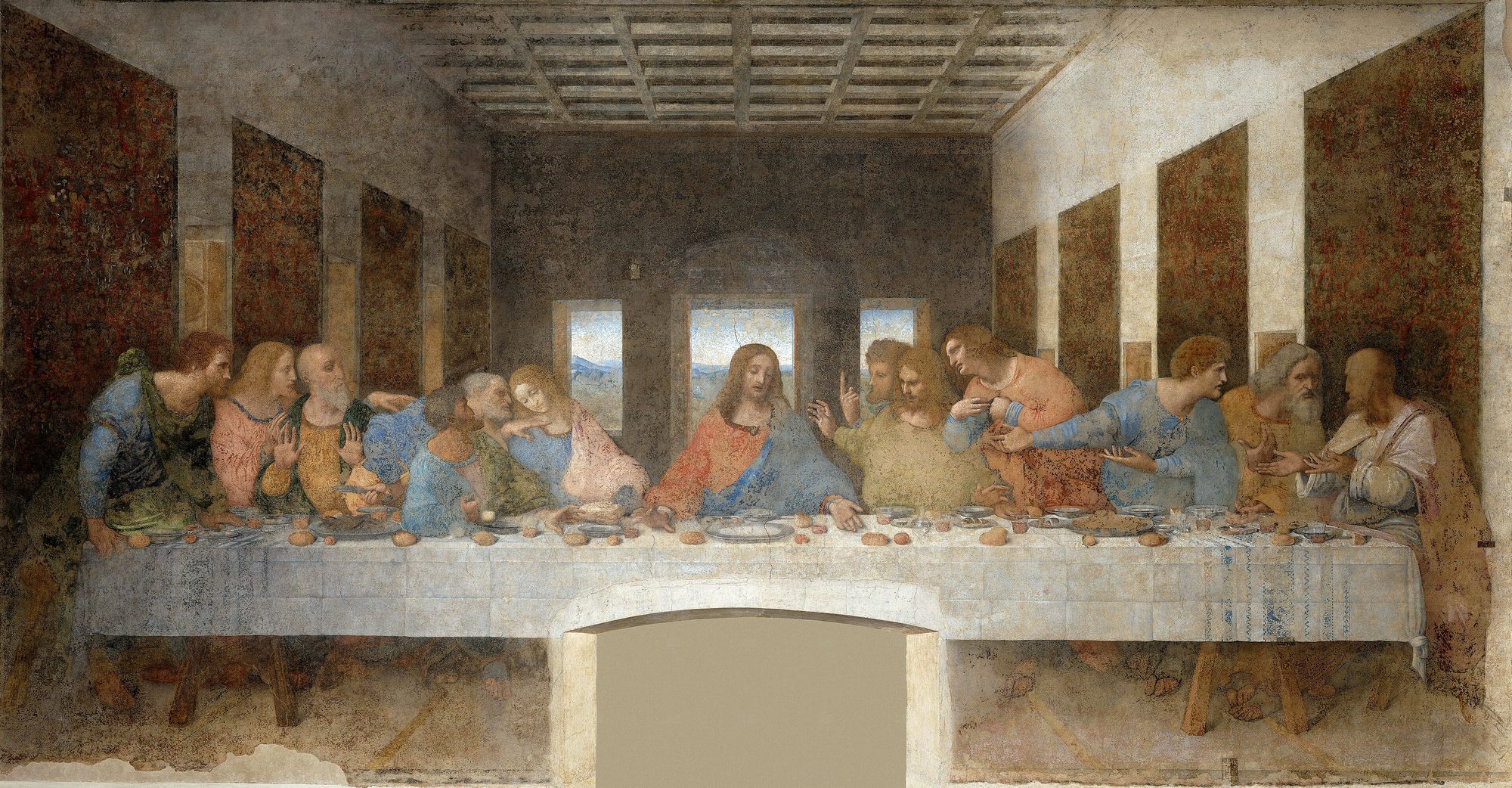
Sometime in the mid-1490s, a teenage Dominican named Matteo Bandello, the nephew of the convent’s prior, watched a painter at work in the dining hall of his convent in Milan. Some days, Bandello wrote later, the man climbed the scaffold at dawn and did not put the brush down until dark, forgetting to eat. Other days he did not paint at all. He stood in front of the wall for hours with his arms folded, looking. Then he would walk in at midday from the other side of town, add a stroke or two to one of the heads, and leave.
The painter was Leonardo da Vinci, and the heads were the twelve apostles. If you have ever stood in front of a print of the painting and asked the obvious question, Last Supper, who is who, you are in good company: for centuries, almost nobody could name more than four of them. Leonardo did not write their names on the wall. The names we use today come from a copy, a disputed drawing and a lot of careful looking. Here they are, numbered, with what each man is doing and why.
This is a painting about thirteen people hearing one sentence, and every reaction is a clue. Once you can name them, the wall stops being a famous image and starts being a scene.
Last Supper who is who, at a glance
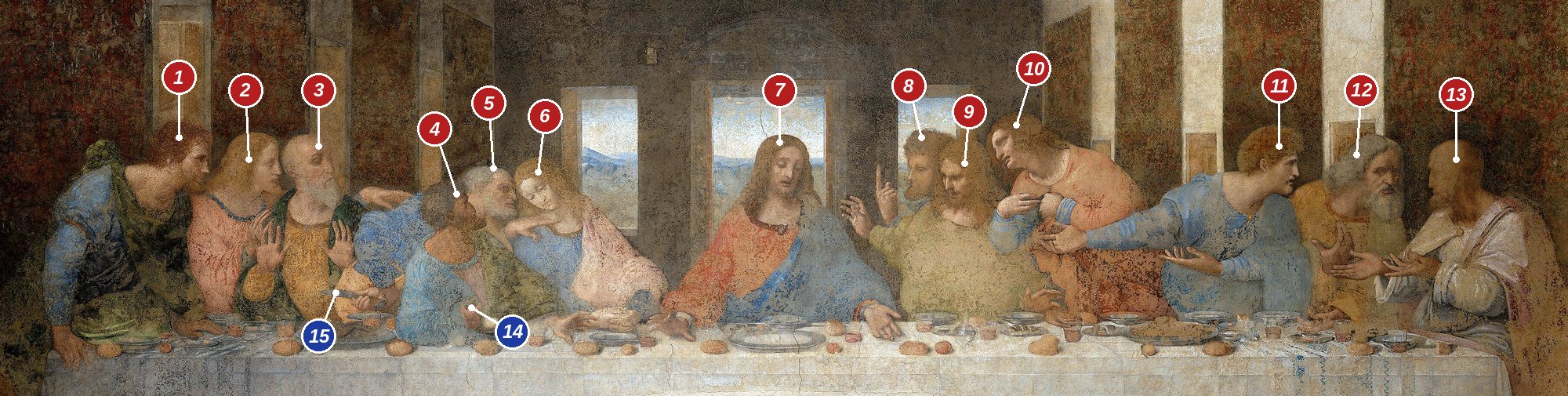
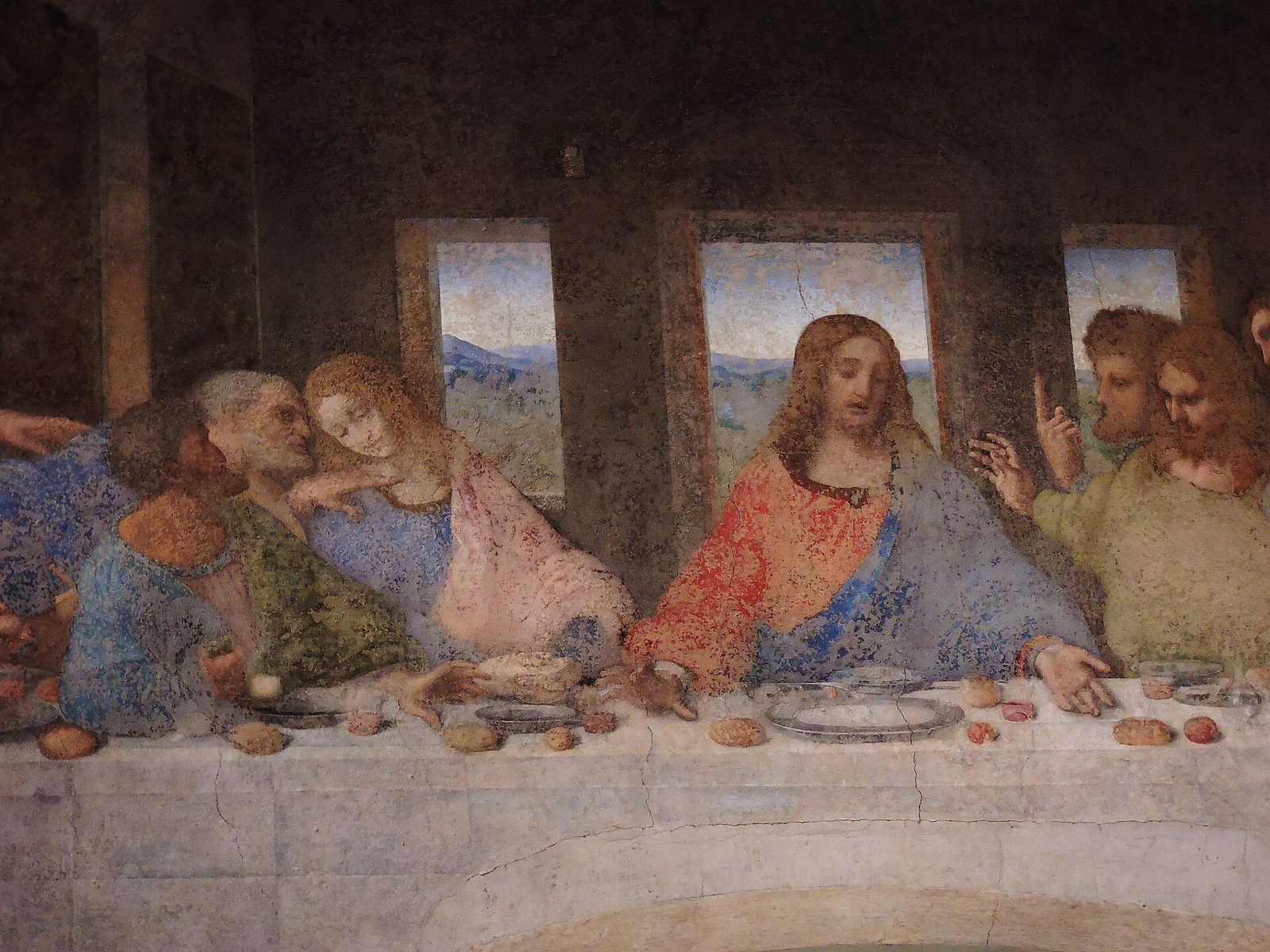
The numbers on the image match this key. Read left to right, the apostles fall into four groups of three, with Christ alone in the middle.
| # | Figure | Where to find him | What he is doing |
|---|---|---|---|
| 1 | Bartholomew | Far left, standing, both hands on the table | Leaning in, as if he has just jumped up |
| 2 | James the Less | Behind Andrew, half hidden | Reaching an arm behind Andrew toward Peter |
| 3 | Andrew | Gray beard, yellow robe | Both palms up and out: not me |
| 4 | Judas Iscariot | Dark face in shadow, leaning back, in blue | Clutching a small bag, elbow on the table |
| 5 | Peter | White hair, pushing forward behind Judas | Whispering to John, a knife in his right hand |
| 6 | John | Young, beardless, eyes lowered, nearest Christ | Leaning away to listen to Peter |
| 7 | Jesus | Center, framed by the middle window | Has just spoken; hands open on the table |
| 8 | Thomas | Behind James the Greater | Index finger raised |
| 9 | James the Greater | Bearded, in green, beside Christ | Arms thrown wide in shock |
| 10 | Philip | Standing, in red | Hands pressed to his chest: is it I? |
| 11 | Matthew | Young, in blue, at the right | Both arms stretched back toward Christ |
| 12 | Jude Thaddeus | Gray beard, between Matthew and Simon | Turned to Simon, one hand raised |
| 13 | Simon the Zealot | Far right end, in profile | Palms open, asking for an explanation |
| 14 | Judas’s money bag | In Judas’s right hand | The purse he kept for the group |
| 15 | Peter’s knife | Behind Judas’s back, blade out | A preview of the garden of Gethsemane |
Where the Last Supper apostles’ names come from
Leonardo labeled nothing. For a long time the only figures everyone agreed on were the four the story makes easy: Jesus in the middle, John beside him, Peter with his white hair, and Judas in the dark.
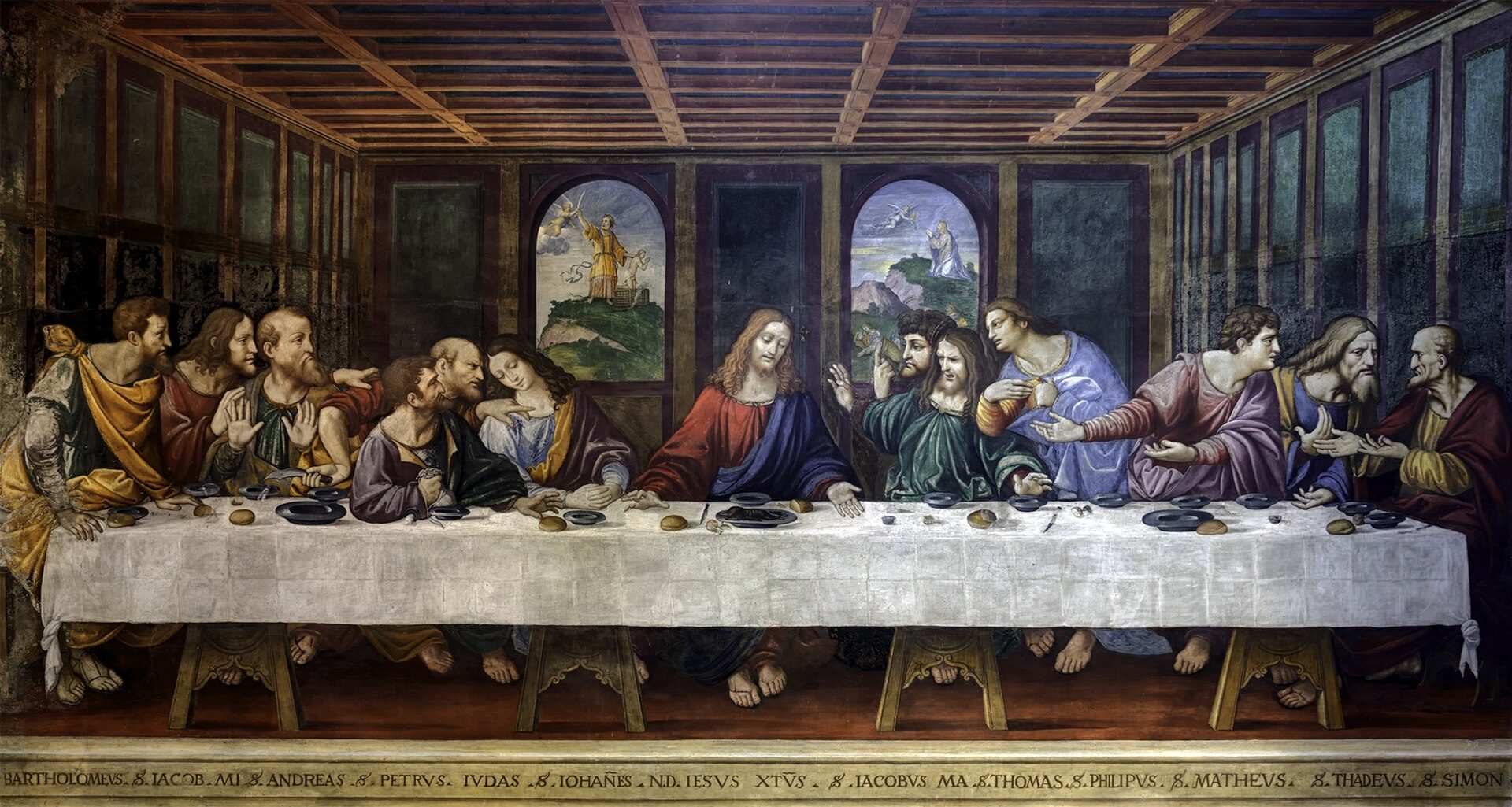
The full roll call comes from a copy. In the parish church of Sant’Ambrogio at Ponte Capriasca, a village in the hills above Lugano in Switzerland, there is a sixteenth-century painted version of Leonardo’s wall, often attributed to his follower Cesare da Sesto. Its painter did what Leonardo would not. Along the bottom edge, under every figure, he wrote a name in Latin capitals: Bartholomeus, Iacobus Minor, Andreas, Petrus, Iudas, Iohannes, and so on to Simon at the far right. It is the closest thing we have to an answer key written while people who had seen the original in good condition were still alive.
A second clue is a red chalk drawing in the Gallerie dell’Accademia in Venice, with names written above nine of the twelve heads and Judas still sitting alone across the table. Scholars argue about whether it is by Leonardo at all. Either way, it shows the old arrangement he threw away.
Leonardo’s own notebooks give us something better than names. They give us gestures. In a page of notes written while he was planning the wall, he described what he wanted his men to do. “One who was drinking and has left the glass in its position and turned his head towards the speaker.” Another twists his fingers together and turns with stern brows to his companion. Another opens his hands, shows the palms, and shrugs his shoulders up to his ears in astonishment. Another whispers in his neighbor’s ear, and the neighbor turns to listen, holding a knife in one hand. Not every line made it onto the wall. Many of them did, and that is how you know the painting is a script.
The Last Supper painting meaning: one sentence, thirteen reactions
The moment is from the Gospels. During the Passover meal, Jesus tells the twelve, “One of you shall betray me.” In the Gospel of John, Peter signals to John, the disciple leaning closest to Jesus, to ask who he means. Matthew adds that the apostles began to ask, one after another, “Lord, is it I?”
Leonardo paints the half-second after the sentence lands. Christ has stopped speaking. His mouth is still slightly open. Around him, the shock moves outward like a ripple in water, and it breaks the table into four waves of three.
That is the big idea, and it is why every later Last Supper looks a little like this one. Before Leonardo, Florentine painters lined the apostles up in a calm row, gave them halos, and sat Judas on a stool on the wrong side of the table so nobody could miss him. Leonardo moved Judas back among his friends. He took away the halos. He made the betrayer give himself away the way a guilty man does in a crowded room: by flinching. That flinch is the meaning. It is not a painting of a sacrament first. It is a painting of what a single sentence does to a room.
Bartholomew, James and Andrew: the end of the table jumps up
Start at the far left. Bartholomew is on his feet, both hands planted on the tablecloth, leaning toward the center as if he did not quite hear. He is the only apostle at this end standing up straight, and he is the bracket that closes the composition on the left.
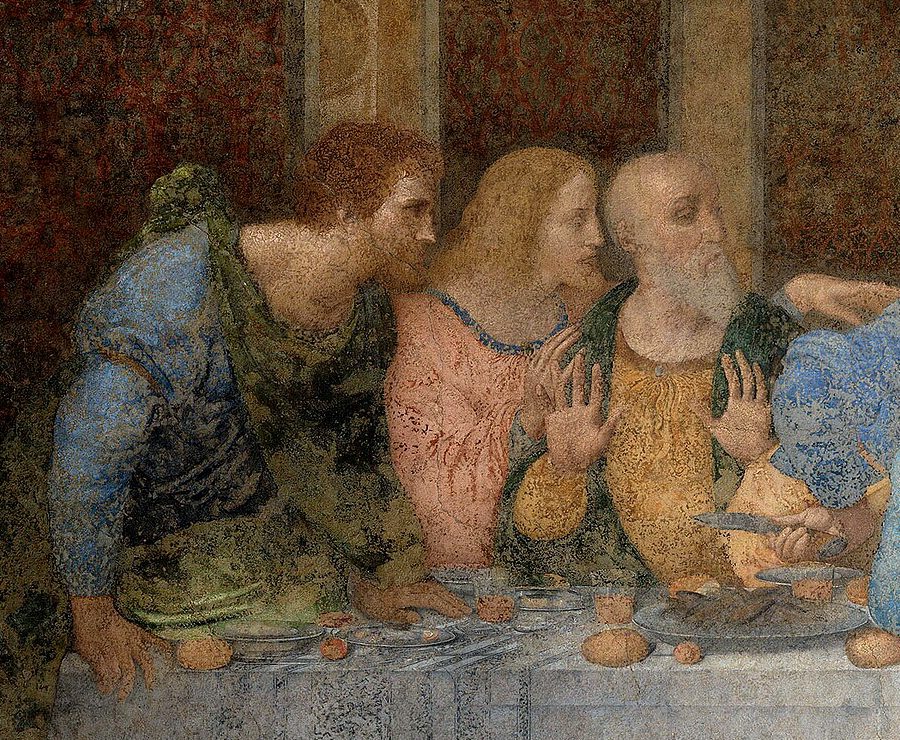
Next to him, half hidden, is James the Less, sometimes called James son of Alphaeus. He is the quiet one. You see mostly his face and an arm that reaches behind Andrew to touch Peter on the back, as if to say: ask him.
Andrew, the older man with the gray beard in yellow, throws up both hands with the palms facing out. It is almost exactly the gesture in Leonardo’s note about the man who shows his palms and shrugs. In any language it means the same thing. Not me.
Judas: the purse, the salt, and the shadow
The second group is the one everybody came for, and it is packed tight. Judas, Peter and John are three heads in the space of a shoulder.
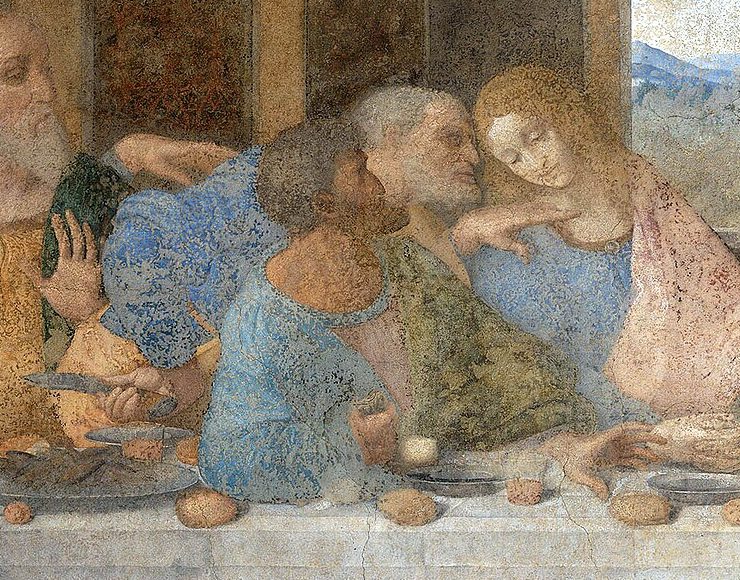
Judas is the man whose face is in shadow. The light in the painting falls from the left, the same side as the refectory’s real windows, and it catches every face in his group except his. He is also the one leaning back while everyone around him leans in. His right hand is closed around a small bag. That is the purse. In the Gospel of John, Judas kept the common money, and the bag has also been read as the thirty pieces of silver he took from the priests.
He is also the only one with his elbow on the table, and that elbow has done some damage. He has knocked over a salt cellar. Spilled salt was already an omen of bad luck, and salt shared at a table was a sign of loyalty, so a spilled cellar at the elbow of a traitor says what the painting does not say out loud. On the wall today it is very hard to make out. The paint there is one of the casualties of five centuries.
There is one more clue, and it is the cleverest. Look along the table toward Christ. Judas’s left hand is reaching for the same dish that Christ’s right hand is moving toward. In the Gospel of Matthew, Jesus names the betrayer this way: “He that dippeth his hand with me in the dish, the same shall betray me.” Leonardo did not need a stool on the wrong side of the table. He needed two hands.
Peter’s knife and the hand that is not a mystery
Peter is the old man with the white hair pushing in behind Judas. He has his left hand on John’s shoulder and his face close to John’s ear. He is doing exactly what the Gospel of John says he did: urging John to ask Jesus who the traitor is.
His right hand is down by his hip, twisted back, and it holds a knife with the blade pointing out. People who meet the painting for the first time often decide the hand belongs to nobody, a floating hand with a weapon. Follow the arm and it is Peter’s, bent awkwardly behind Judas’s back. The knife is a preview. A few hours later, in the garden of Gethsemane, Peter will draw a blade and cut off the ear of the high priest’s servant.
Peter, the man who will deny Christ three times before dawn, sits right behind the man who will betray him. Leonardo has put the betrayer and the denier side by side.
Is that Mary Magdalene? No, and here is why
John sits nearest to Christ, at his right hand. He is young, beardless, with long hair and lowered eyes, and he leans away from Jesus toward Peter. In 2003, Dan Brown’s novel The Da Vinci Code had a character claim that this figure is Mary Magdalene, and that the V-shaped gap between her and Jesus is a secret symbol. Millions of readers went to look.
Art historians are calm and unanimous about it. It is John. Florentine painters had shown him this way for a century: the youngest disciple, smooth-faced and soft-haired, often asleep against Christ’s chest, because the Gospel calls him the disciple Jesus loved. Leonardo trained in Florence. His audience would have recognized the type in a second.
There is also a simple test. Count the people at the table. There are thirteen: Christ and twelve men. If the figure beside Jesus is Mary Magdalene, then one of the twelve apostles is missing from the Last Supper, and the missing one is John, the disciple the Gospel places right at Christ’s side that night. The gap between them is not a code. It is John doing what the text says, leaning over to hear Peter.
The face Leonardo said he could not finish
Christ sits alone in the middle, and Leonardo gives him two things nobody else gets. The first is space. There is a clear gap on either side of him, so his body makes a calm triangle in a room full of motion. The second is the window. The bright opening behind his head, topped by an arch, frames his face the way a halo used to.
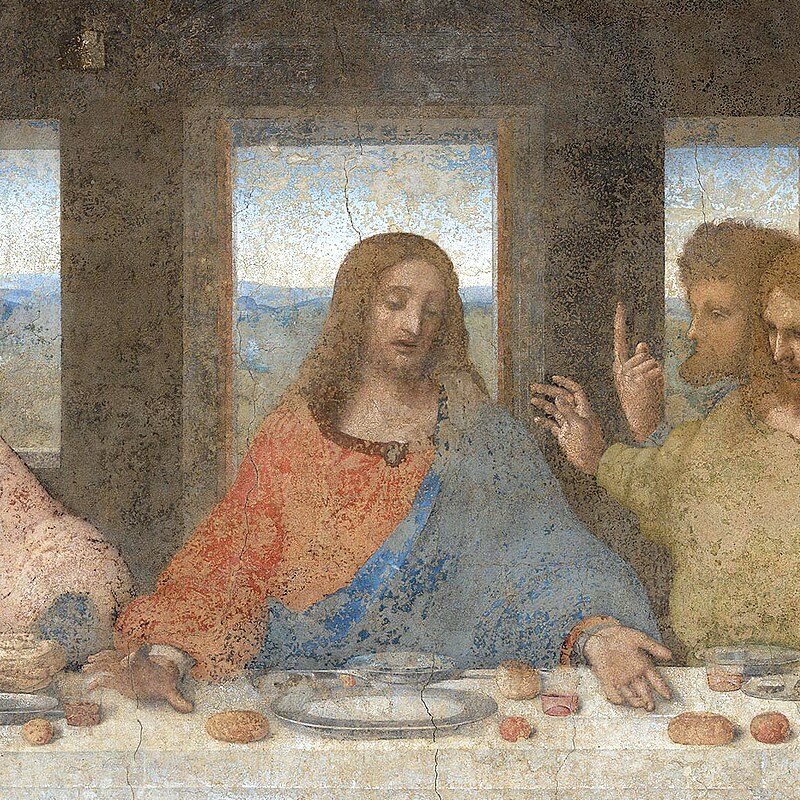
All the lines of the room run to his head. The ceiling beams, the tapestries on the side walls, the edges of the table: follow any of them and you arrive at Christ’s right temple. During the modern restoration, conservators reported a small hole at that point, and the usual explanation is that Leonardo drove a nail there and stretched strings from it to mark the perspective lines on the prepared wall. Whether or not the nail story is exactly right, the effect is not in doubt. Your eye keeps getting pulled back to that face.
Giorgio Vasari, writing in 1550, says Leonardo left the head of Christ unfinished because he did not believe he could give it the divinity it needed. Vasari also tells the best-known story about the commission. The prior of the convent, tired of watching Leonardo stand around, complained to Duke Ludovico Sforza. Leonardo explained to the duke that he was still looking for a face villainous enough for Judas, and that if he could not find one, he could always use the prior’s. The prior stopped complaining. It is a good story. The nineteenth-century editor of Leonardo’s notebooks, Jean Paul Richter, thought it was as unfounded as it was improbable, so enjoy it the way you enjoy most Vasari.
Thomas, James and Philip: the doubter, the shock, the protest
To Christ’s left, the third group surges up and toward him.
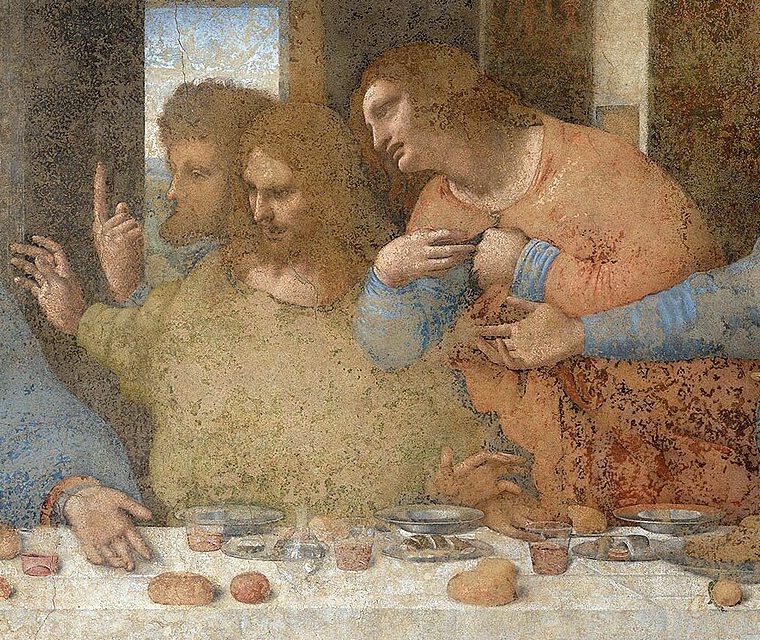
Thomas is the man behind, with one index finger raised in the air. It is the most famous finger in the painting after Christ’s hands, and it is a joke the first audiences would have caught. This is Thomas the doubter, the apostle who, after the Resurrection, will refuse to believe until he puts that same finger into Christ’s wounds. Here it is, already pointing upward, already asking a question.
James the Greater, the bearded man in green right at Christ’s side, has thrown his arms wide in horror. He leans back from the table as if the sentence pushed him. Behind him, Philip is on his feet, young, in a red robe, both hands pressed to his chest. His whole body asks the question from the Gospel of Matthew: Lord, is it I? He is the one apostle who seems more hurt than surprised.
Matthew, Thaddeus and Simon: the conference at the end of the table
The last group at the far right has turned its backs, almost, on the drama. These three are arguing among themselves.
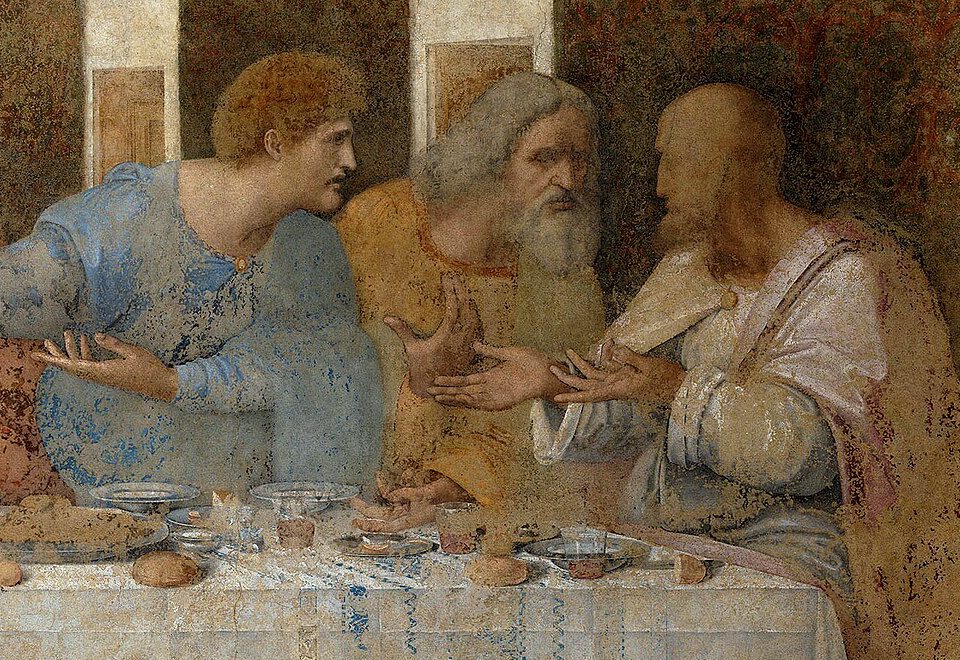
Matthew, young and in blue, is doing two things at once. His arms stretch back toward Christ, both hands pointing at him, while his head turns away to the two older men beside him. He is the reporter: did you hear what he just said? Jude Thaddeus, the gray-bearded man in the middle, has turned to Simon with a raised hand, and his look is suspicious. Simon the Zealot, at the very end of the table, in profile and in white, holds out his open palms. He wants an explanation and he is not going to get one.
Notice how the composition closes. Bartholomew stands bolt upright at the left end. Simon sits square at the right end. Between those two brackets, everything moves.
What is actually on the table
Look down at the plates. For a long time the food on the table was too dirty to read, and people assumed it was the usual bread and maybe lamb. After the restoration, the art historian John Varriano looked closely at the serving dishes and argued that some of them hold slices of grilled eel garnished with orange. Not everyone accepts the eel. The chief restorer, Pinin Brambilla Barcilon, preferred to say simply fish. Either way, it is not the Passover lamb, and it is a reminder that Leonardo set a sacred story at what looks very much like a Milanese dinner.
Why Da Vinci’s Last Supper painting started dying immediately
Here is the wait-really part of the story. The most copied wall in the world was falling apart within twenty years of being finished.
The problem was Leonardo’s method. A true fresco is painted fast, into wet plaster, a patch a day, and the color becomes part of the wall. Leonardo did not want to work fast. He wanted to come in at midday, add one stroke, stand back for a week. So he sealed the dry wall with a ground of gesso, pitch and mastic and painted on top of it with tempera and oil, the way you would paint a panel. It let him work like Leonardo. It also meant the paint was sitting on the wall rather than in it, on a damp wall in a dining hall next to a kitchen.
By 1517 the paint was flaking. In 1556, Vasari described it as a muddle of blots. In 1652 the friars cut a doorway through the bottom of the wall, and took Christ’s feet with it. You can still see the arched outline of that door under the table in every photograph. French revolutionary troops used the refectory as a stable and an armory in 1796. On the night of August 15, 1943, Allied bombs hit the convent and brought down much of the refectory. The wall with the Last Supper stayed up, braced with sandbags and scaffolding.
Then came the cleaning. Between 1978 and 1999, Pinin Brambilla Barcilon spent twenty-one years on the wall, removing centuries of overpaint, glue and grime, and filling the losses with muted watercolor so they would not pretend to be Leonardo. It reopened on May 28, 1999. Critics, much as they did with the Sistine Chapel ceiling, complained that what remains is thin and pale. Defenders answer that what remains is at least Leonardo’s. Both are true. What you see in Milan is a ruin, and it is still the most alive painting of a crowd you will ever stand in front of.
Where is the Last Supper painting? Still on its own wall in Milan
It has never moved. Da Vinci’s Last Supper is painted on the end wall of the refectory, the friars’ dining hall, of the Dominican convent of Santa Maria delle Grazie in Milan, at Piazza di Santa Maria delle Grazie 2. It is about 15 feet high and 29 feet wide. Duke Ludovico Sforza, the ruler of Milan, paid for it as part of a rebuilding of the church he hoped would hold his family’s tombs. Leonardo worked on it from around 1495, and it was finished by early 1498. Ludovico, who rewarded him with a vineyard nearby, lost Milan to the French the following year.
The site is run as the Museo del Cenacolo Vinciano, managed since December 2024 by the Pinacoteca di Brera. As of this writing, it opens Tuesday to Sunday from 8:15 in the morning to 7 in the evening, with last entry at 6:45, and it is closed on Mondays. Booking is mandatory, through the official site, cenacolovinciano.org, which sends you to the museum’s Vivaticket shop. A full ticket has been 15 euros, with a reduced rate for 18 to 25 year olds and free entry for under-18s, who still need a reservation. Tickets are released in blocks every three months, and for spring and summer they can go within hours, so the moment the next quarter opens is the moment to book. Prices and hours change, so check the official site before you go.
The visit itself is strict. You go in with a group of up to forty, through glass chambers that filter the air, and you get fifteen minutes in the refectory. Then the next group comes in. People who have flown across an ocean for this are often startled by how fast it goes.
Behind you, on the opposite wall, is a second painting most visitors forget to turn around for: a Crucifixion signed and dated 1495 by Giovanni Donato da Montorfano. Down in its lower corners, almost gone, are kneeling portraits of Ludovico, his wife Beatrice d’Este and their two sons, which the museum believes Leonardo probably added himself. Like Veronese’s Wedding at Cana, the Last Supper was made for a room where monks ate. It makes full sense only when you picture the friars below it, eating at their own long tables.
What to look for in your fifteen minutes
Fifteen minutes is enough if you do not spend the first five on photos. Stand well back from the wall, so all thirteen fit in your eye at once, and work through it in this order.
First, find Judas by the light, not the face. He is the only one in shadow. Then find his bag, and his left hand reaching for the dish Christ is reaching for.
Second, follow Peter’s arm down to the knife behind Judas’s back.
Third, find Thomas’s finger and Philip’s hands on his chest, and notice that the group to Christ’s left is all moving toward him while the group on his right is all leaning away.
Fourth, look under the table at the arch of the old doorway. That is where Christ’s feet used to be. The Ponte Capriasca copy still has them.
The room has no labels on the wall, and the clock is running the whole time. Chiaro was built for exactly this kind of window: photograph the wall and the twelve names come back in the order you are looking at them, with Judas’s purse and Peter’s knife pointed out while you still have time to find them. If you prefer paper, keep the numbered key above open on your phone.
If you are building a Leonardo trip, the Milan wall pairs naturally with the portrait he started a few years later in Florence, the one that became the most famous painting in the world. And if you want to see what Leonardo’s face looked like to the painters who revered him, Raphael gave it to Plato in The School of Athens, painted in Rome about a decade after the Last Supper was finished. For more paintings decoded figure by figure, see Famous Paintings, Every Figure Identified.
Bandello’s painter, the one who stood for hours in front of the wall with his arms folded, was not wasting time. He was waiting for the sentence to land on each face, one by one. Five hundred years and a bomb later, it is still landing.