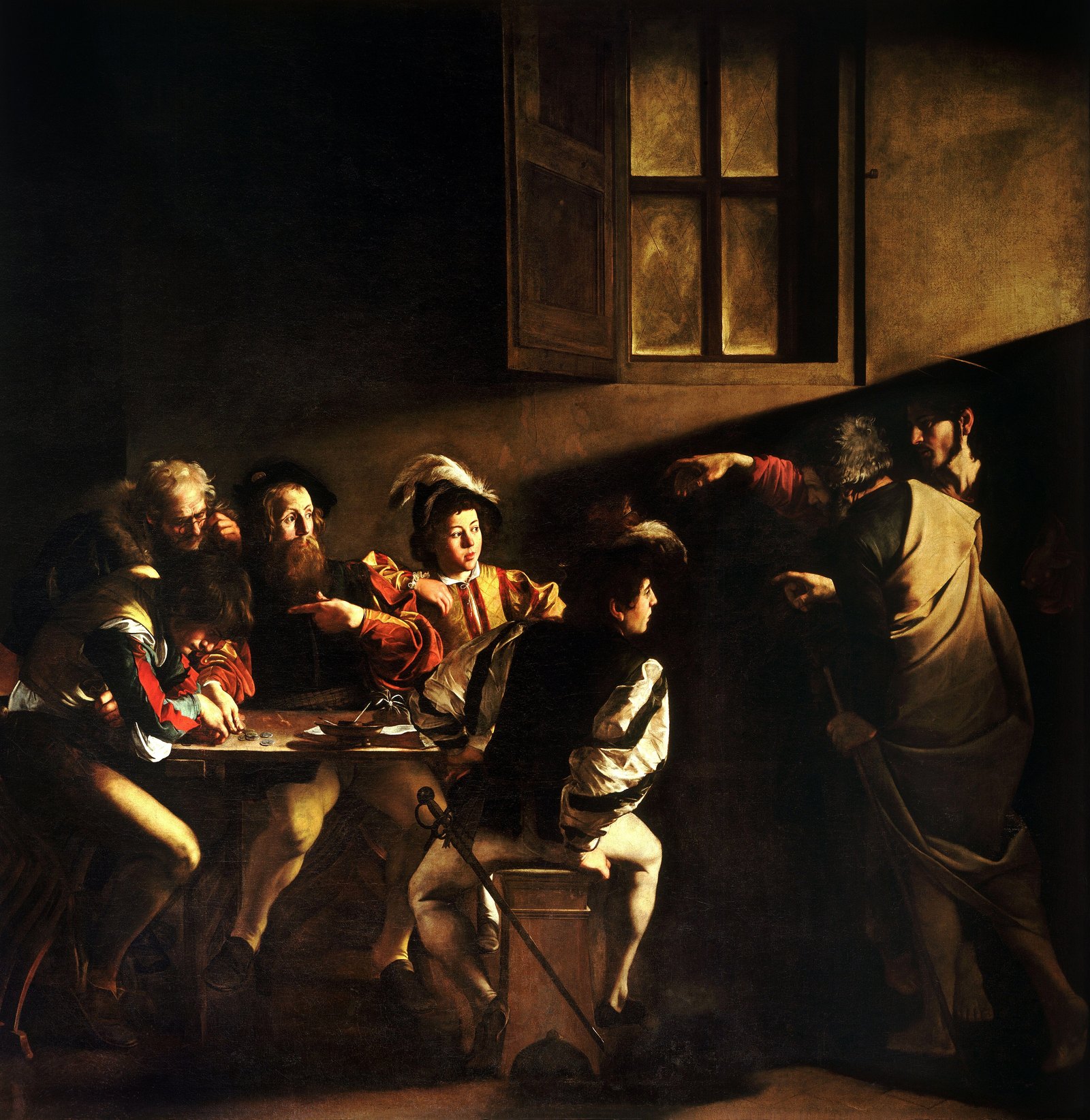
Somewhere in Rome around 1599, five men are counting money in a back room. Two of them are teenagers dressed like they spent their wages on sleeves. One is an old man in spectacles. One has a copper beard. One has not looked up from the coins. Then two barefoot strangers walk in from the right, and one of them raises an arm and points. That is the whole story of The Calling of Saint Matthew. A tax collector named Matthew is sitting at his table. Jesus says “Follow me.” He gets up and goes.
There is just one problem. Four hundred and twenty-five years later, people still argue about which of the five men is Matthew.
The Calling of Saint Matthew hangs in a side chapel of a French church two blocks from Piazza Navona, and you can see it for free. It was Caravaggio’s first big public commission, his first painting with this many figures, and the picture that made him the most talked-about painter in Rome. It also hides a borrowed hand from the Sistine Chapel, a beam of light that comes from the wrong place, and a pointing finger that may be aimed at the wrong man. Here is who is who, and how to make up your own mind.
The Calling of Saint Matthew, figure by figure
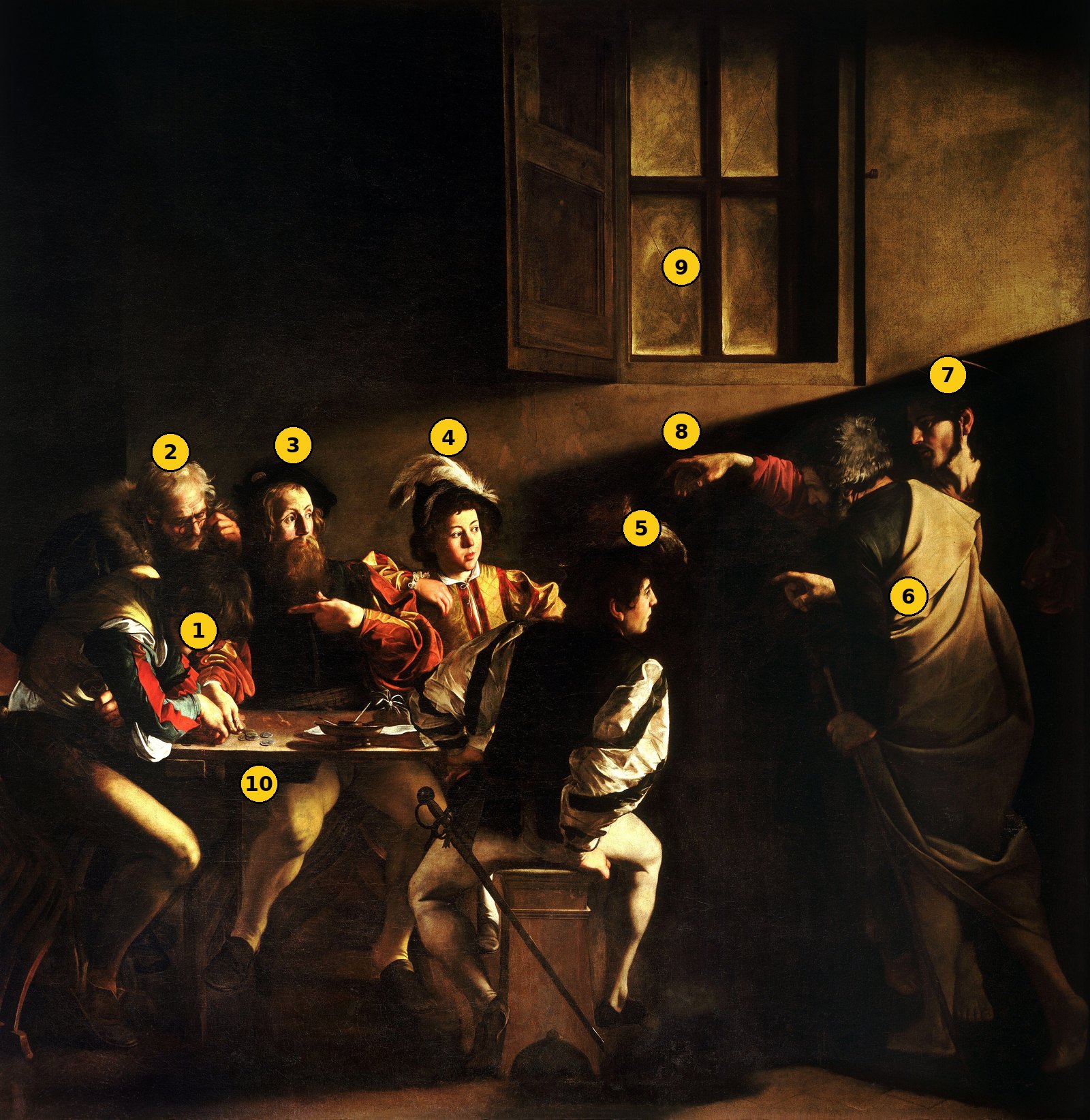
The numbers on the image match this key. Where scholars disagree, the table says so.
| # | Who | Where to find him | Notes |
|---|---|---|---|
| 1 | The young man counting coins | Far left, slumped over the table | Matthew, for a minority of scholars |
| 2 | The old man with spectacles | Behind him, peering at the money | A tax office clerk |
| 3 | The bearded man | Center, pointing at his own chest or at the boy beside him | Matthew, for most scholars |
| 4 | The boy in the plumed hat | Leaning on the bearded man’s shoulder | Looks straight at Christ |
| 5 | The youth with the sword | On a stool, back half-turned to you | Armed, wary, the first to react |
| 6 | Saint Peter | Right, in the ochre robe, with a staff | Possibly added during painting |
| 7 | Christ | Behind Peter, face half in shadow | A halo so faint it is easy to miss |
| 8 | Christ’s hand | Reaching across the dark wall | A quotation from Michelangelo’s Adam |
| 9 | The window | Top center, shutters open | Clouded panes. Not the light source |
| 10 | The coins | On the table, under the young man’s fingers | What the whole argument is about |
Who’s at the table: a tax office in 1600
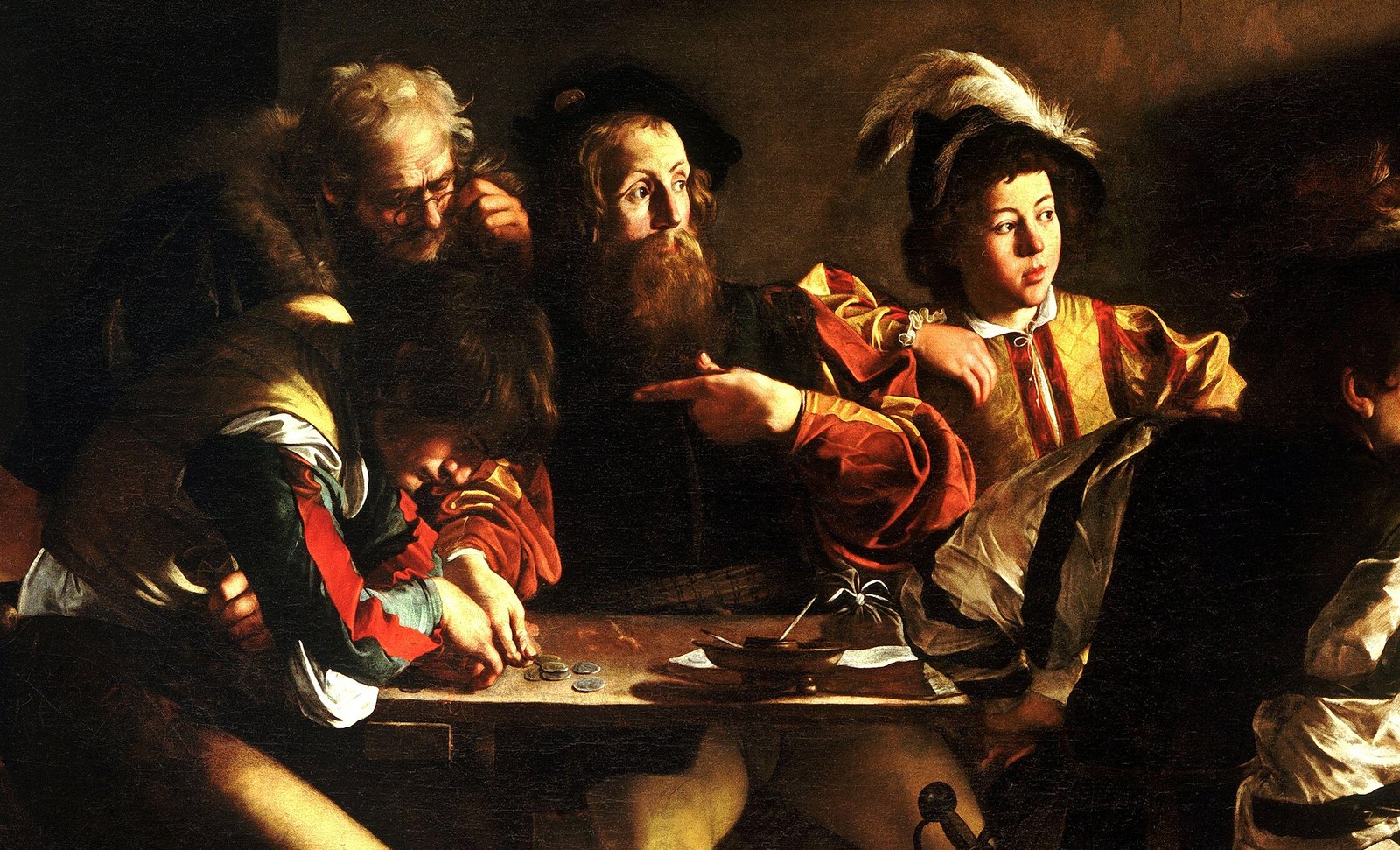
The first surprise is the clothes. Nobody at that table is dressed for the Bible. The boy in the plumed hat wears a striped doublet with puffed sleeves. The youth on the stool has slashed white sleeves and a sword at his hip. The bearded man has a velvet beret and a fur-trimmed coat. These are Roman street clothes from around 1600, the kind of thing you would have seen outside the church door the week it was unveiled.
Only the two figures on the right are dressed in plain, ageless robes, and only they are barefoot. Caravaggio split the picture in half, and the split is in the costume department. On the left, the present. On the right, eternity, walking into the present without knocking.
Matthew’s job matters here. Mark and Luke call him Levi. He is a publican, a tax collector for the Roman occupiers, which in first-century Galilee made him roughly as popular as a loan shark. The Gospel of Matthew tells the event in one verse, chapter nine, verse nine: Jesus saw a man named Matthew sitting at the tax booth, said “Follow me,” and Matthew got up and followed him. That is all the text gives you. Everything else, the table, the coins, the feathered hat, Caravaggio invented.
Which one is Matthew? The case for the bearded man
For most of the painting’s life, nobody thought there was a question. Matthew is the bearded man in the middle, figure 3. Christ points at him, and he points at himself, eyebrows up, as if to say “Who, me?” It is the most theatrical gesture in the room, and it sits right at the center of the composition, where a painter usually puts his protagonist.
The strongest evidence is in the same chapel. Caravaggio painted two more pictures of Matthew for the same patrons: The Martyrdom of Saint Matthew on the opposite wall and The Inspiration of Saint Matthew over the altar. In both, Matthew is a bearded, balding older man. Defenders of the traditional view point out that a painter working on a three-part cycle would not change his hero from a teenager into a graybeard between scenes. The American art historian Irving Lavin made this case at length in 1993, and most specialists still follow it. A recent Polish study that goes back over the whole dispute comes down, again, on the side of the traditional identification.
The gesture helps too. Christ’s finger and the bearded man’s finger form a kind of conversation across the dark. One points. The other points back at himself. Read that way, the painting is about the split second of recognition, the moment a man realizes the call is for him.
The case for the young man counting coins
Now look again at figure 1. The young man at the far left end of the table has not noticed anything. His head is down. His hands are on the coins. He is the only person at the table who does not react to the two strangers at all.
In 1988 the art historian Angela Hass published a reading that flipped the scene. In her version, the bearded man is not pointing at himself. He is pointing at the youth next to him, and the gesture means “Him?” The bearded man is a fellow publican, startled that Christ wants the kid. And the kid, still bent over the money, is Matthew in the last second of his old life, before he looks up. Other scholars, among them the German art historian Andreas Prater, argued along similar lines.
It is not a crazy reading, and you can test it in front of the canvas. Follow the bearded man’s index finger. It curls back toward his own chest, but it also lines up neatly with the slumped young man’s head. Follow Christ’s hand. It is aimed down the length of the table, and the person at the far end of that line is the boy with the coins. And the beam of light lands on the boy’s arms and hands, not just on the bearded man’s face.
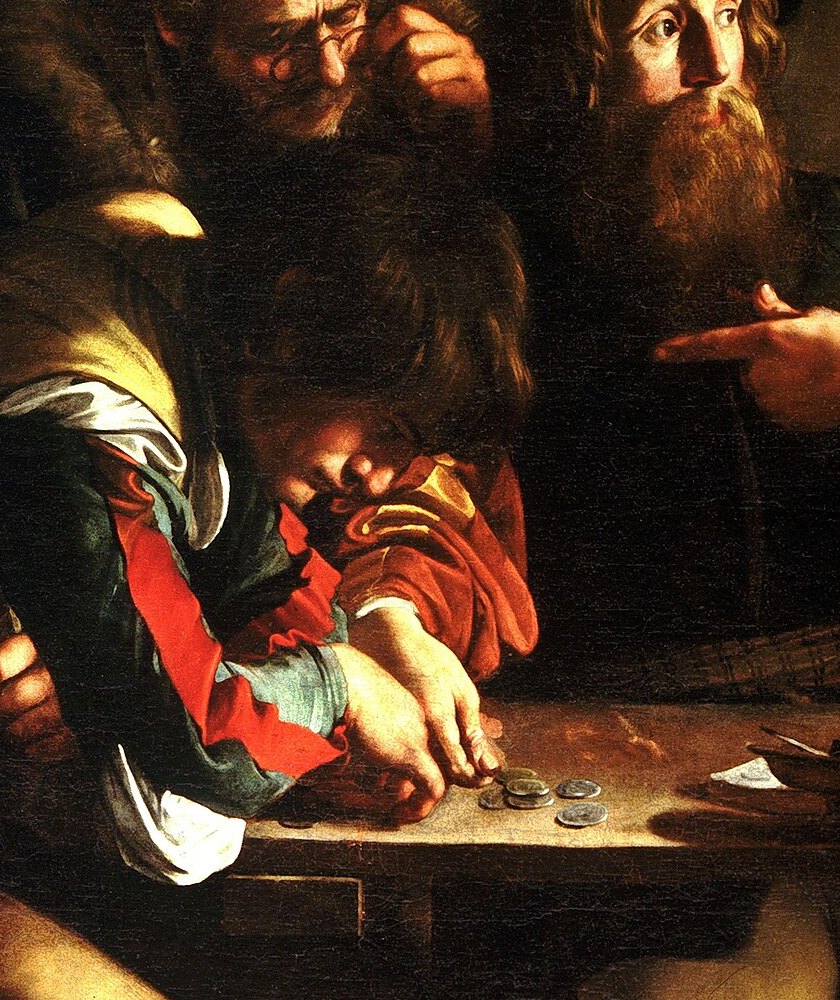
The young-man reading also has a famous unofficial supporter. In 2013, the Jesuit editor Antonio Spadaro interviewed the newly elected Pope Francis, who had stayed near San Luigi dei Francesi on his trips to Rome and used to go in to look at the painting. “That finger of Jesus, pointing at Matthew. That’s me. I feel like him. Like Matthew,” he said. Then he added: “It is the gesture of Matthew that strikes me: he holds on to his money as if to say, ‘No, not me! No, this money is mine.’” Francis did not say which figure he meant. But the man in the painting whose hands are still holding on to the money is the one at the end of the table.
So who is right?
Here is where we land. The bearded man is the better-supported answer, and the companion paintings are hard to argue with. If you are asked on a quiz, say figure 3.
But the young man is the more interesting answer, and that is why the debate will not die. Caravaggio did not put a halo or a label on anyone at the table. He painted a room where five men hear the same call and only one of them is meant to stand up, and he left you in the position of the other four, trying to work out who it is for. Several scholars now suspect the ambiguity is not an accident. Whether Caravaggio meant it or not, it is the reason people still stand in front of this canvas for twenty minutes.
Christ’s hand is Adam’s hand
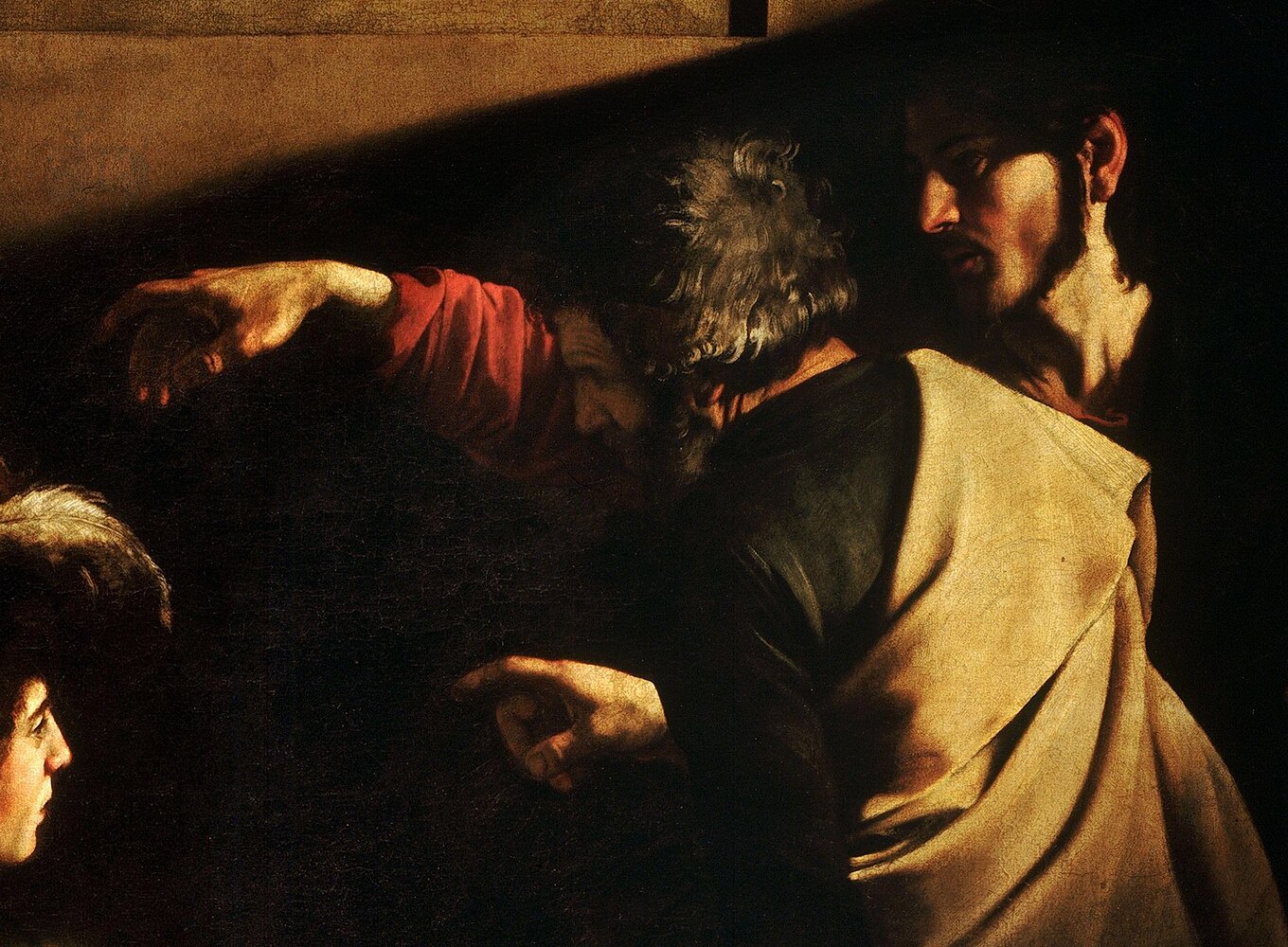
Look at Christ’s right hand, figure 8. It does not jab. The wrist is soft, the fingers relaxed, the index finger extended almost lazily. If you have seen the Sistine Chapel ceiling, you have seen that hand before. It is Adam’s hand from Michelangelo’s Creation of Adam, flipped into a mirror image, painted about ninety years earlier and about a mile away.
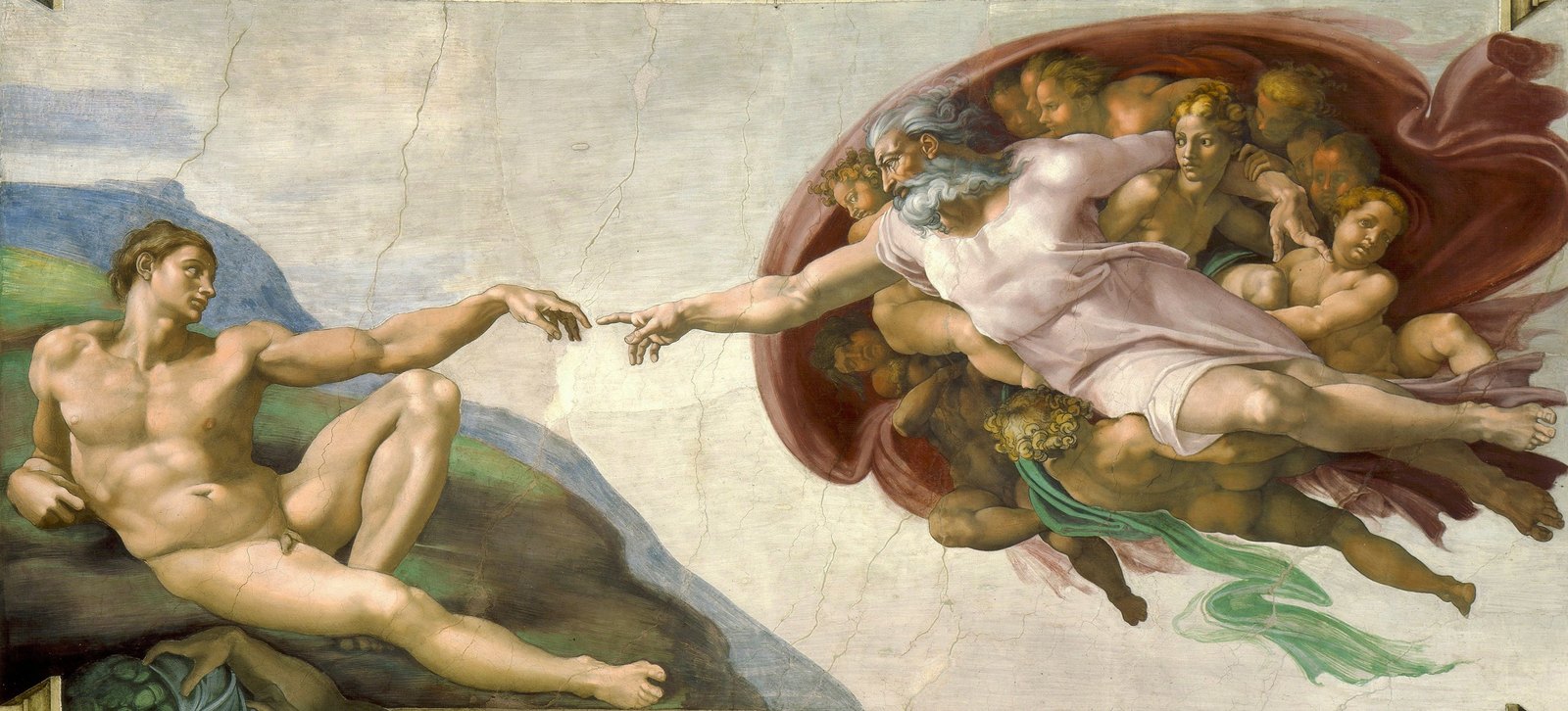
Every educated viewer in Rome in 1600 would have caught the quotation. The theology behind it is neat. Saint Paul calls Christ the second Adam, the new man who undoes the first man’s fall. On the Sistine ceiling, Adam’s hand is the one waiting to receive life. In San Luigi, the same hand belongs to Christ, and now it is the one giving life away. A man is being created again, at a tax collector’s table, out of a crook. We wrote about the other strange thing hiding in the Sistine fresco separately. It is worth reading before you see both pictures on the same trip.
There is another hand right under it. Saint Peter, figure 6, the gray-haired man in the ochre robe, makes a smaller, clumsier copy of the same gesture. He is the disciple echoing the master, a beat behind. Several accounts of X-ray studies report that Peter was not in Caravaggio’s first layout and was added while the picture was underway, perhaps to fill out the right side, perhaps because the church fathers wanted the Church’s first pope in the scene. Either way, Christ is almost hidden behind him. You get one shoulder, one profile, a halo so faint it is nearly a rumor, and that hand.
The light that comes from nowhere
Everyone talks about the light in this picture. Fewer people notice that it makes no sense.
There is a window in the painting, figure 9, right at the top center. It is dark. Its panes are oiled paper or clouded glass, and nothing is coming through them. The real light enters from somewhere high on the right, above Christ’s head, outside the frame. It cuts a hard diagonal across the back wall, running almost exactly parallel to Christ’s arm, and lands on the faces at the table. The beam and the arm travel together. The light is the call.
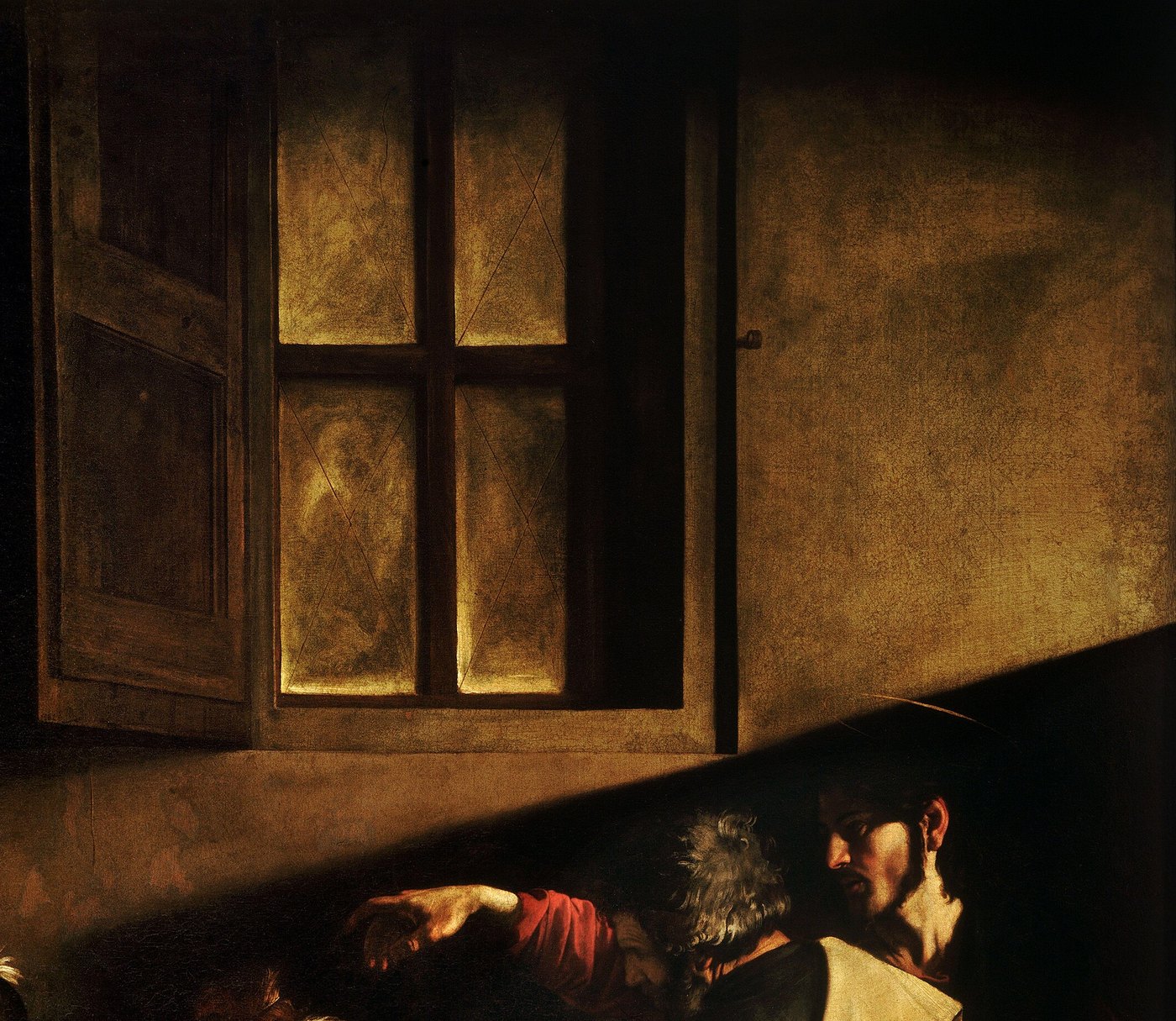
Then there is the trick of the room itself. The painting hangs on the left wall of the Contarelli Chapel. The chapel’s real window is above the altar, to the painting’s right. So the painted light falls into the picture from the same direction as the daylight that falls into the chapel. Caravaggio designed the beam for the wall it would hang on. Stand in the chapel on a bright morning and you can feel the picture plug into the building.
This is the technique the textbooks call tenebrism: most of the canvas sunk in near-black, a few things dragged into a harsh, theatrical spotlight. Caravaggio did not invent dark backgrounds. What he did, here, for the first time on this scale, was make the darkness part of the story. Half the room cannot see what is happening. That is the point.
The chapel that waited fifteen years
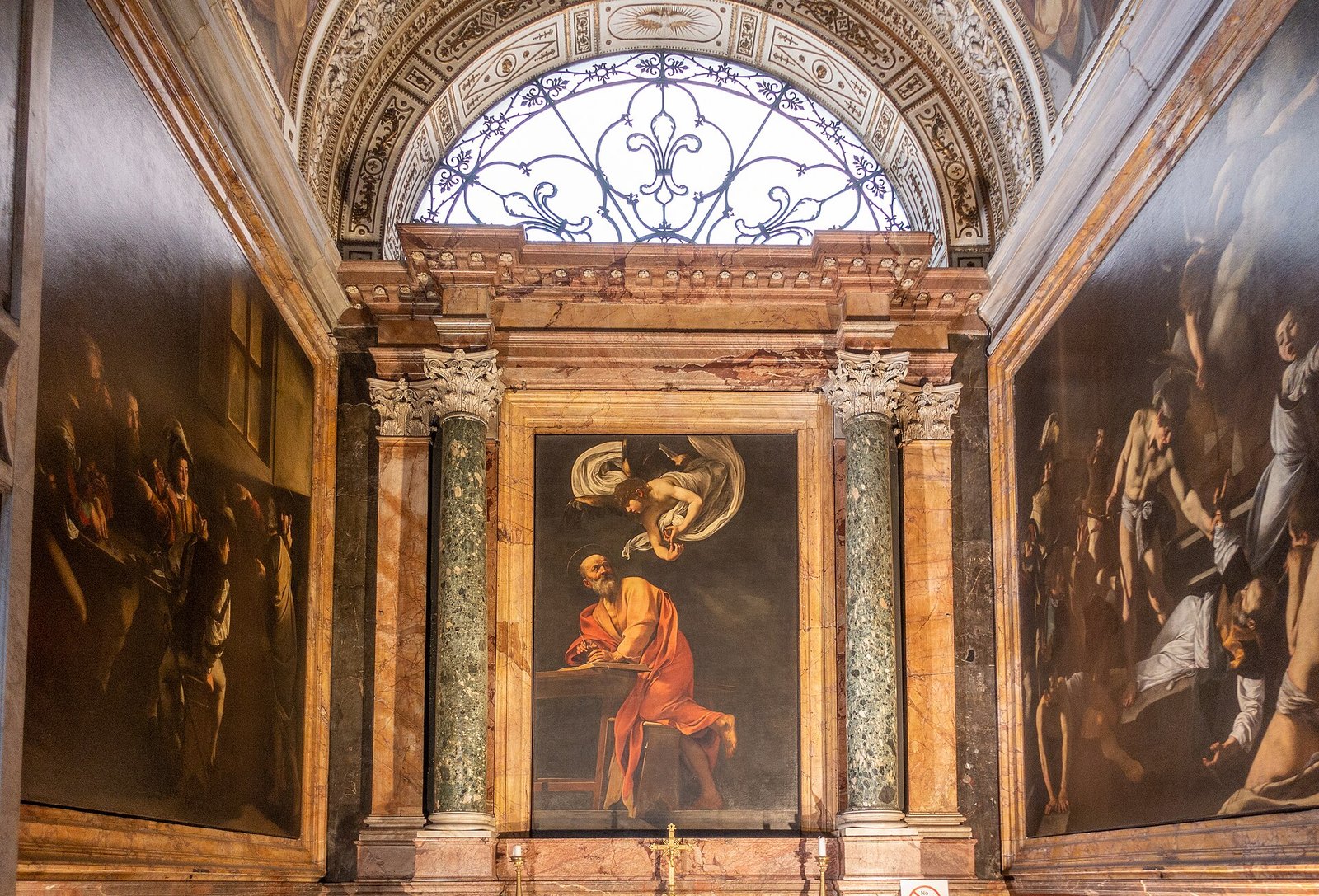
The chapel was paid for by a Frenchman. Matthieu Cointrel, a French cardinal whom the Romans called Matteo Contarelli, bought it in 1565 and left money in his will for scenes from the life of his name saint. He died in 1585. Then nothing happened for a long time. The vault was frescoed in the early 1590s by Giuseppe Cesari, the Cavaliere d’Arpino, the most fashionable painter in Rome, who was supposed to do the walls too. He never got around to them. He was too busy.
Here is the irony. A few years earlier, a broke young painter from Lombardy had worked in Cesari’s studio, painting fruit and flowers in the backgrounds of other people’s pictures. His name was Michelangelo Merisi, from the town of Caravaggio. By the late 1590s he was living in the palace of Cardinal Francesco Maria del Monte, a sophisticated collector who lived a few steps from San Luigi. In July 1599, with the Jubilee year of 1600 about to bring pilgrims flooding into Rome, Caravaggio got the contract for the two side walls. He was twenty-seven. The Calling of Saint Matthew, Caravaggio’s first public church commission, was delivered within a year. His final payment came in July 1600.
The canvas is about ten and a half feet tall and eleven feet wide, the biggest thing he had ever painted. Until then he had been known for half-length pictures of pretty boys with lutes and fruit. Suddenly he had to manage an eleven-foot stage, a crowd, and a sacred story. The other wall gave him far more trouble. X-rays of The Martyrdom of Saint Matthew show he scrapped at least one full composition before he got it right.
The Calling of Saint Matthew painting made him overnight. According to his rival and first biographer, Giovanni Baglione, the old painter Federico Zuccari came to look, said he saw nothing in it but the manner of Giorgione, and walked off. Baglione did not like Caravaggio, and the story may be sharpened. But the crowds came, and so did the commissions. Within a few months of the final payment, Caravaggio signed a contract for two more saints, Peter and Paul, for the Cerasi Chapel in Santa Maria del Popolo.
The Calling of Saint Matthew and its two companions
The Calling is one third of a trilogy, and it is best seen as one. If you are planning a whole day of these pictures, our guide to every Caravaggio in Rome maps the route from this chapel to the others.
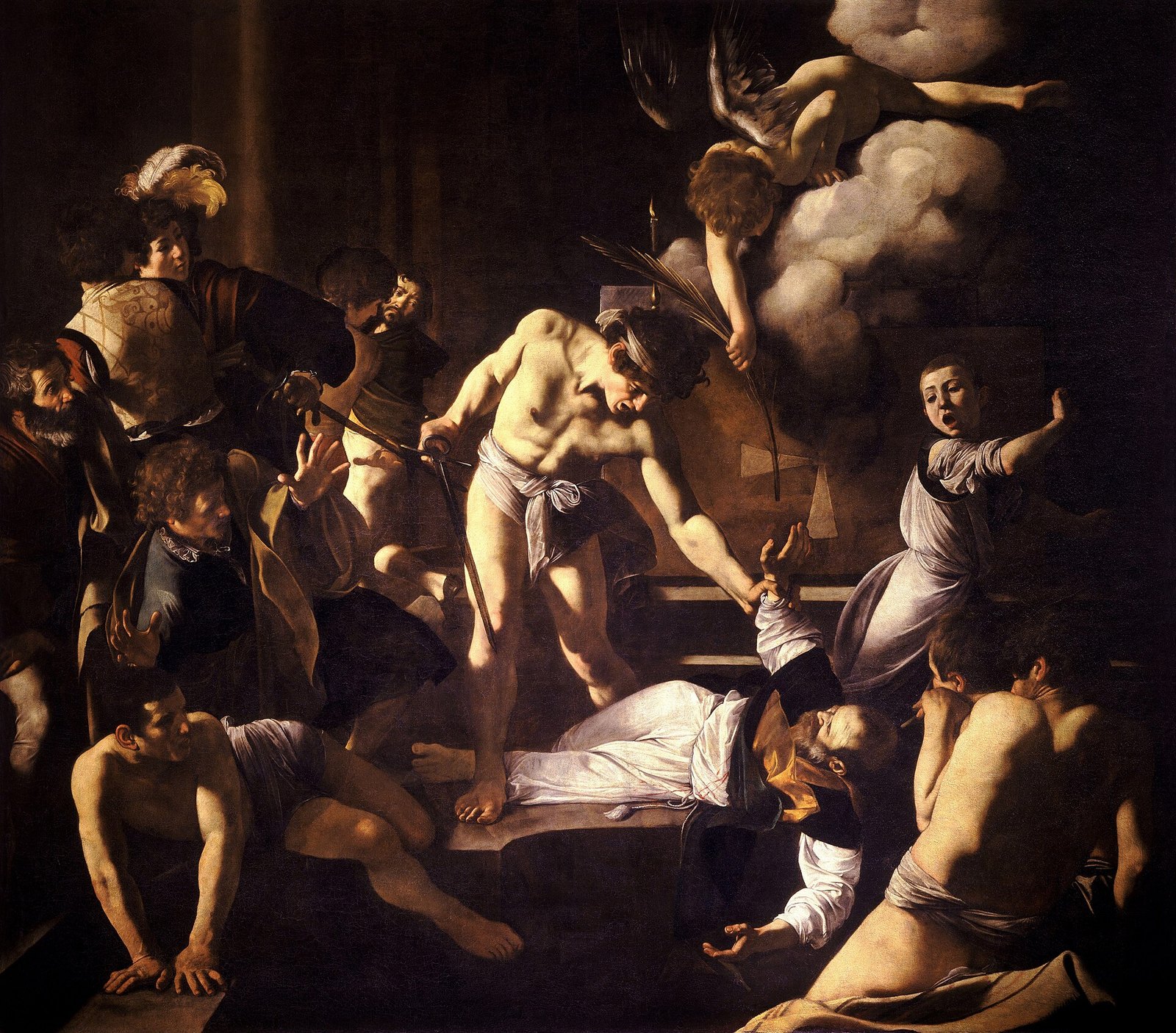
On the opposite wall, The Martyrdom of Saint Matthew shows the end of the story. An old, bald, bearded Matthew is pinned on the steps of an altar by a near-naked executioner, while the congregation scatters in panic and an angel leans down from a cloud to hand him a martyr’s palm. Look at the back left of the crowd. A bearded man with a pained expression glances over his shoulder at the killing. That is generally taken to be Caravaggio himself, watching his own painting happen.
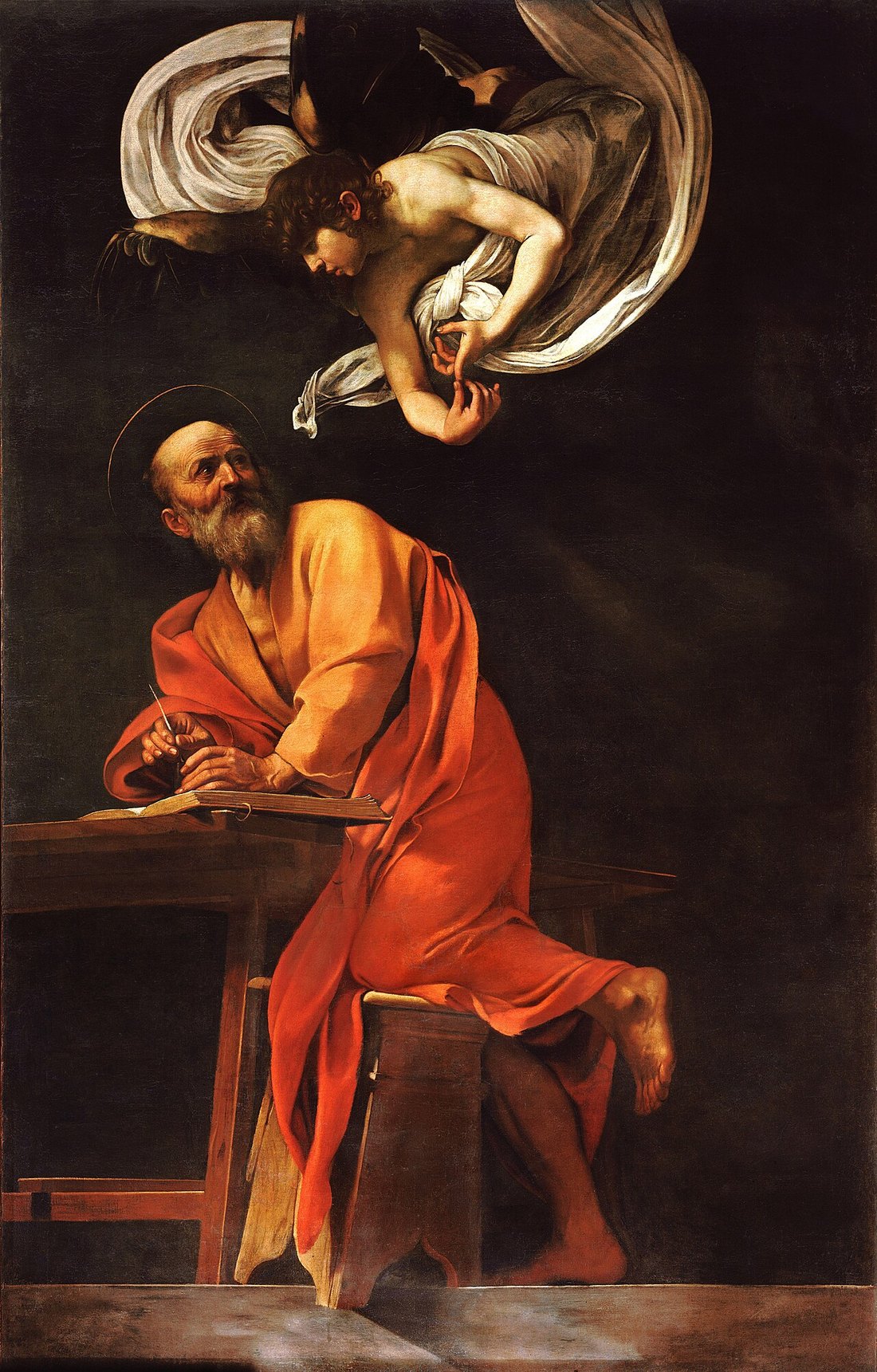
Above the altar, The Inspiration of Saint Matthew shows the saint writing his Gospel while an angel counts off the points on its fingers like a tutor. This is the second version, from 1602. The first version had a peasant-like Matthew with dirty bare feet and an angel guiding his hand like a child’s. The clergy rejected it as undignified. It went to a private collector, ended up in Berlin, and was destroyed in 1945. What hangs there now is the polite replacement, with one rebellious detail: Matthew’s stool is tipping off the edge of the step, toward you.
Put the three side by side and the question from the first picture gets a little clearer. In both companion paintings, Matthew is an old, bearded man. The strongest argument for figure 3 is hanging on the walls around him.
Where to see The Calling of Saint Matthew
The painting is exactly where Caravaggio delivered it, in the Contarelli Chapel of San Luigi dei Francesi, the French national church in Rome. The church is on Piazza di San Luigi de’ Francesi, between Piazza Navona and the Pantheon, which makes it an easy stop between the Pantheon and lunch.
That is how we found it ourselves. In January 2025, when Chiaro was still in beta, we were standing in front of the Pantheon and asked it where we should go next, somewhere close by. It sent us a few minutes’ walk away, to this church and this painting. We walked in without knowing what was waiting at the end of the left aisle, dropped a coin in the box, and took the photo below when the lights came on.
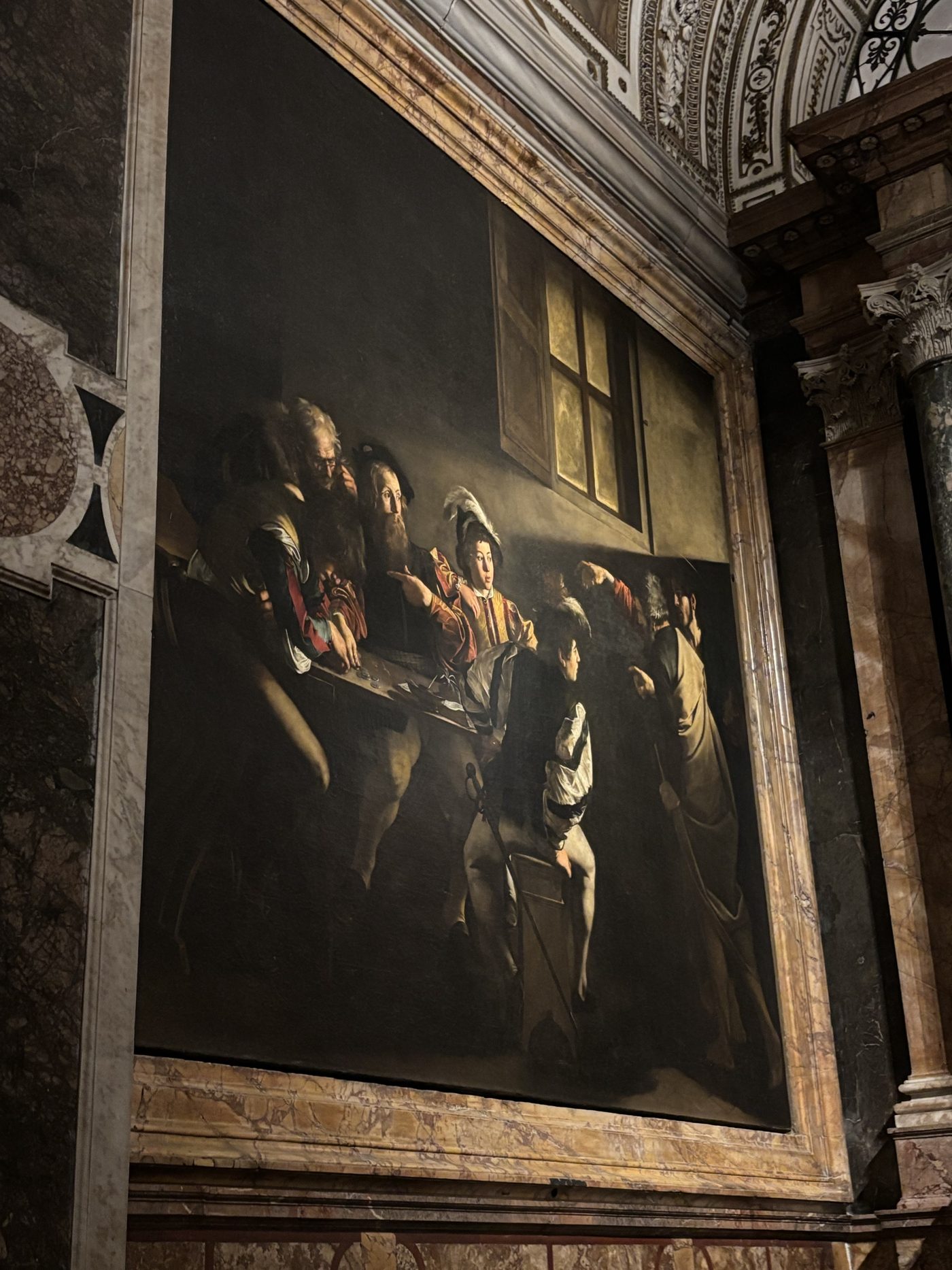
Entry is free. Walk in, go down the left aisle to the last chapel before the high altar, and you will find a small crowd and a coin box. The chapel is kept dim. Feed a coin into the box and floodlights switch on for a couple of minutes. Bring a few euro coins, because the lights always go off at the worst moment, and somebody in the crowd will be grateful when you put in another.
The church is usually open every day, with a long midday closure: roughly half past nine to quarter to one, then again from about half past two until early evening, with shorter hours on Sundays. Published times vary from source to source and change for Masses and holidays, so check the church’s own site, saintlouis-rome.net, before you go. It is a working church. Cover shoulders and knees, and do not expect to get near the chapel during a service.
The best time is first thing in the morning, before the walking tours arrive from Navona, or the last hour before the afternoon closing. Stand to the left of the chapel opening for The Calling. You will be looking at it at the same raking angle as the daylight from the altar window, which is the angle Caravaggio painted the beam for.
If this figure-by-figure way of looking works for you, Raphael’s School of Athens, across the river in the Vatican, gets the same numbered key, and the whole series is collected in Famous Paintings, Every Figure Identified.
What to look for when the lights come on
You get a couple of minutes per coin, so spend them in order.
First, find the young man at the end of the table. Ignore everyone else for ten seconds. Watch his hands on the coins. Ask yourself whether he is about to look up.
Second, the two pointing fingers. Christ’s, soft, borrowed from Adam. The bearded man’s, bent back toward himself, or toward the boy. Decide where you think it is aimed. There is no wrong answer that a serious scholar has not also given.
Third, the beam. Trace it from the upper right corner, along the line of Christ’s arm, down onto the faces at the table. Then turn around and look at the real window over the altar. Same direction.
When the floodlights click off, the chapel goes back to dim, and Chiaro is useful precisely here: with the canvas half in shadow again, it can walk you around the table in your ear, figure by figure, from the old man’s spectacles to the boy’s coins, while your eyes are still adjusting to the dark.
Then stay a moment longer in the dark. It is what Caravaggio intended anyway. Five men sit in a room they think is ordinary. Four of them will go on counting money for the rest of their lives. One of them is about to stand up, push back his stool, and walk out the door behind two barefoot strangers. Four centuries on, we still cannot agree which one. Maybe that is the point. The call never comes with a name on it.