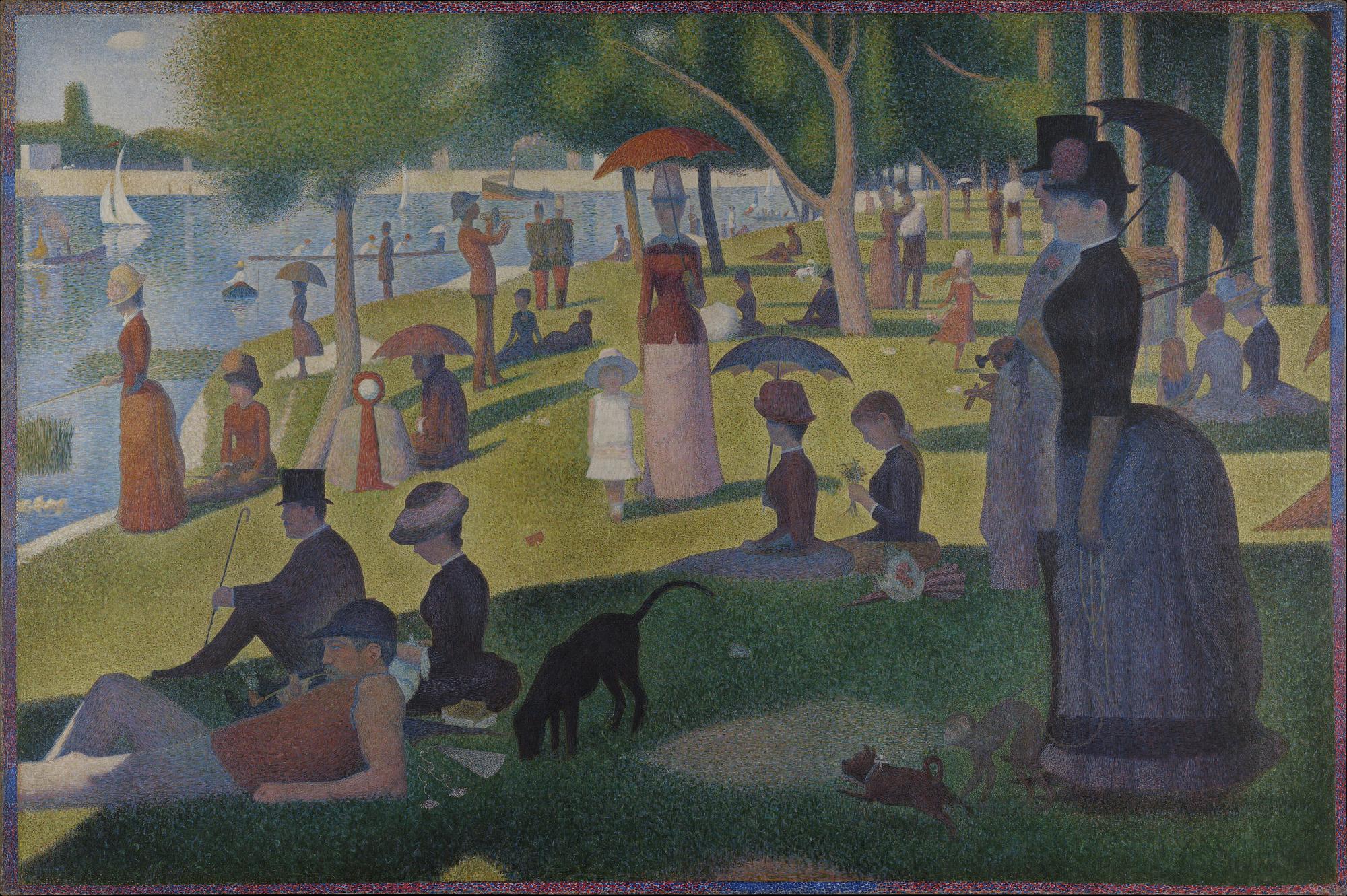
In the spring of 1884, a twenty-four-year-old Parisian named Georges Seurat started carrying a box of small wooden panels across the Seine to an island just outside the city walls. The island was called La Grande Jatte. On Sundays it filled with clerks, shopgirls, soldiers, boatmen, nursemaids, families and, people said, women who were not there for the view. Seurat sat in the grass and painted them on panels the size of a postcard. Then he spent two years in the studio turning them into a canvas ten feet wide.
The result is A Sunday on La Grande Jatte, and almost nobody in it is doing anything. A man reclines with a pipe. A woman holds a fishing rod over the water. Another woman stands in profile with a monkey on a leash. A little girl in white walks toward you. Everyone else is frozen in place, as if the whole island had been told to hold still for a photograph that took two years to develop. The painting now hangs in the Art Institute of Chicago, and once you start numbering the figures, the stillness starts to look less like a picnic and more like a puzzle.
A Sunday on La Grande Jatte at a glance
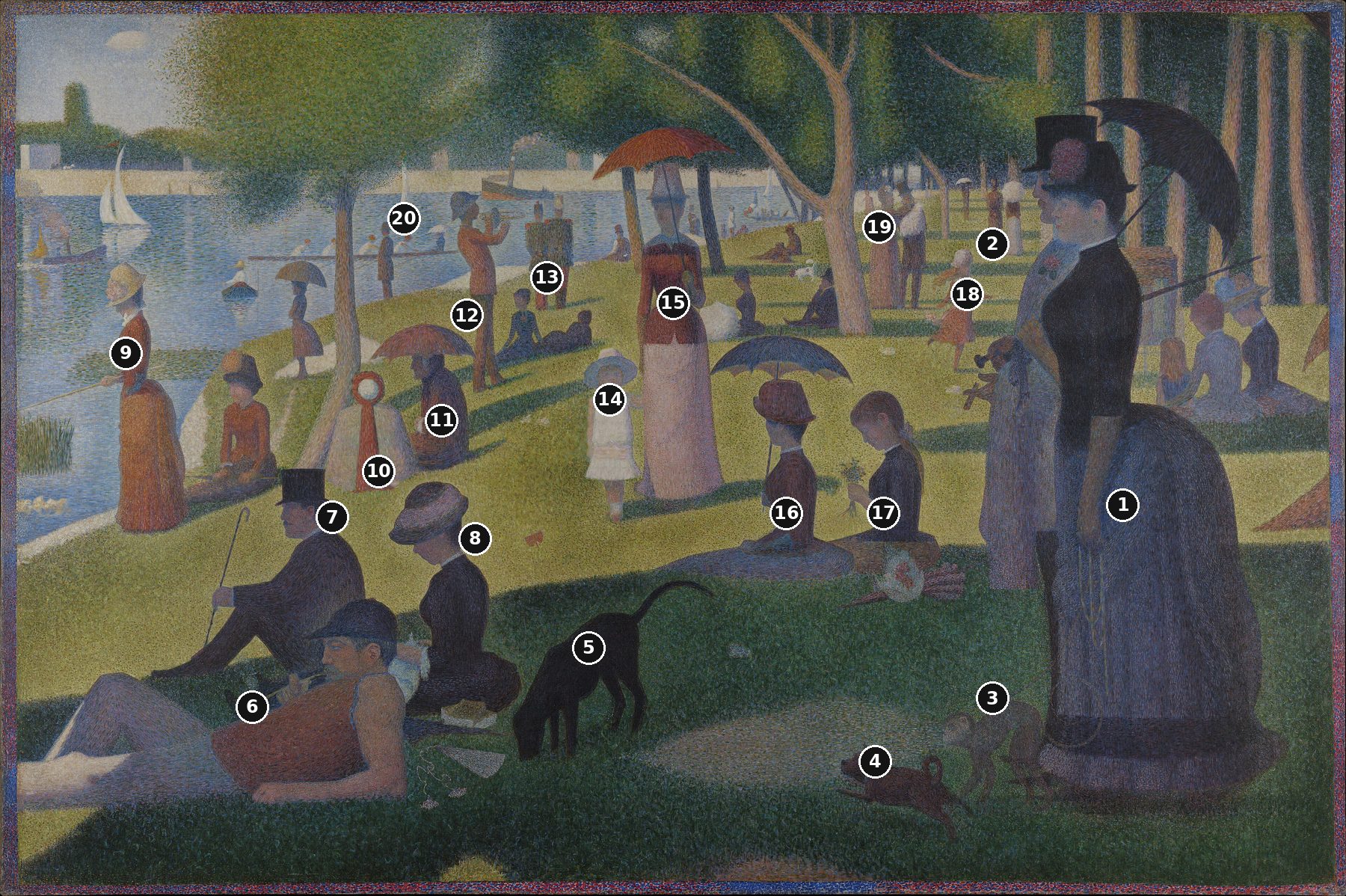
Seurat gave none of these people names, so the key names them by what they are doing. The numbers match the image above.
| # | Figure | Where to find them |
|---|---|---|
| 1 | The woman with the monkey | Far right, in profile, huge bustle, dark parasol |
| 2 | Her companion | Behind her, in a top hat, a cigar in his hand |
| 3 | The monkey | At her feet, on a leash |
| 4 | The pug | Lower right, bounding toward the black dog |
| 5 | The black dog | Lower center, nose in the grass |
| 6 | The boatman | Lower left, sprawled in a sleeveless shirt, with a pipe |
| 7 | The gentleman in the top hat | Behind the boatman, seated, holding a cane |
| 8 | The woman with her needlework | Beside him, head bowed, a fan and a book in the grass |
| 9 | The woman fishing | Left, at the water’s edge, rod held out over the river |
| 10 | The nursemaid | Left of center, back to you, red ribbons down her back |
| 11 | The old woman | Beside the nursemaid, under an orange parasol |
| 12 | The trumpeter | Upper left, horn raised to the river |
| 13 | Two soldiers | Beside the trumpeter, standing at attention |
| 14 | The girl in white | Center, walking toward you |
| 15 | Her mother | Beside her, in pink and red, orange parasol |
| 16 | The woman under the blue parasol | Center right, seated in the grass |
| 17 | The girl with the bouquet | Beside her, head down over a few flowers |
| 18 | The running girl | Middle distance, right, in orange |
| 19 | The couple with the baby | Far middle distance, right, the man holding the child |
| 20 | The rowing crew | On the river, upper left |
There are dozens more figures in the shade and on the far bank. These twenty are the ones Seurat built the painting around.
The woman with the monkey, and the man with the cigar
Start on the right. The tallest figure in the painting is a woman in perfect profile, number 1, in a fitted black jacket and a bustle so exaggerated it looks like architecture. In one hand, a dark parasol. In the other, a leash. On the end of the leash is a monkey.
The monkey, number 3, took Seurat a while. In the large study now at the Metropolitan Museum of Art in New York, the animal at her feet is a vaguer orange shape with a curling tail. In the finished painting it is unmistakably a monkey, and Parisians in 1886 would have had an opinion about that.
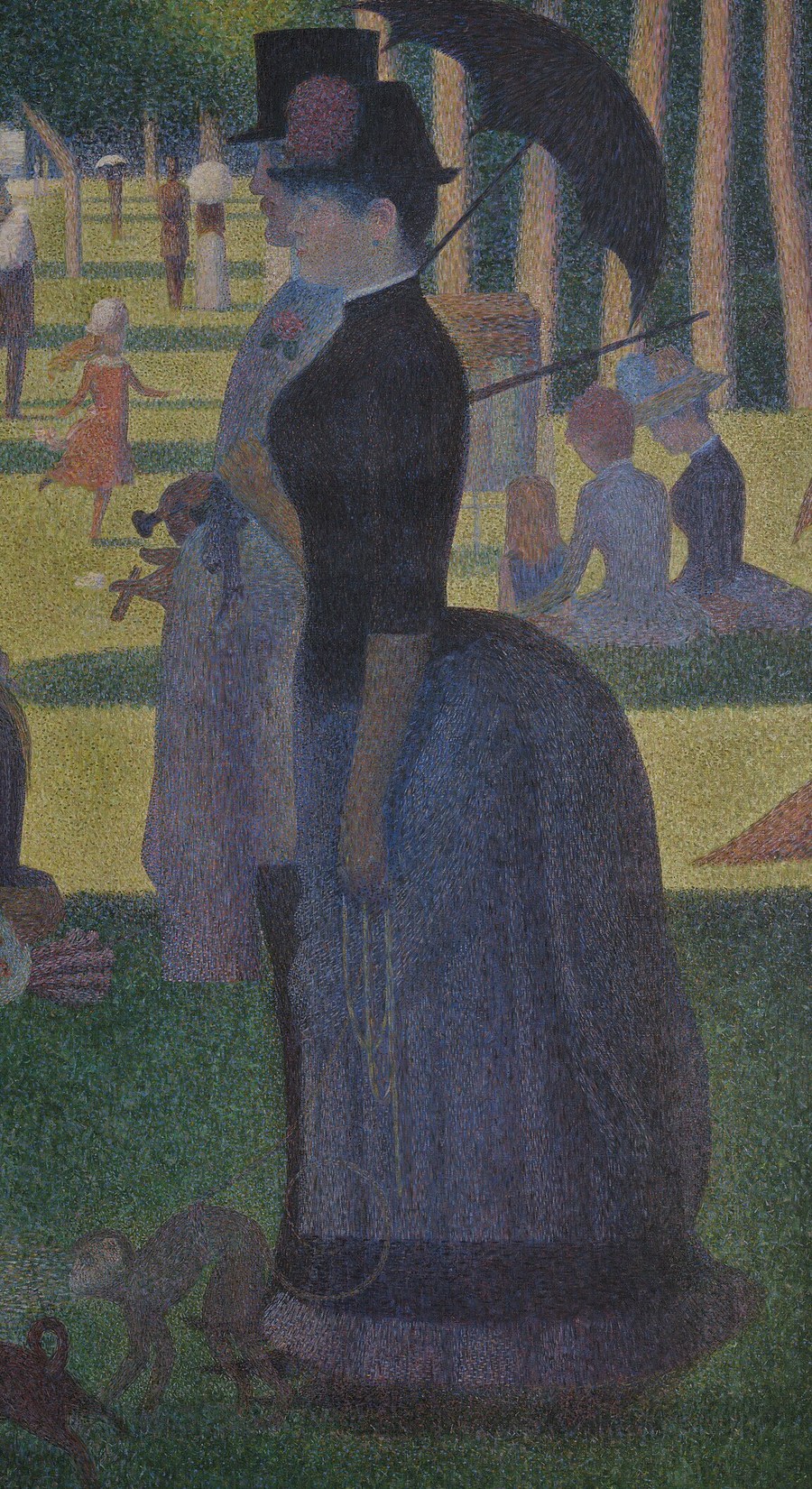
Monkeys had stood for lust and vanity in European painting for centuries. And in the slang of the 1880s, a kept woman could be called a singesse, a female monkey. That is why many historians, including the curators at the Fitzwilliam Museum in Cambridge, have suggested the woman is a prostitute or a mistress, on the arm of the man who pays for her. Her companion, number 2, stands half hidden behind her, in a top hat, a cigar in his hand.
There is a gentler reading. The same curators suggest Seurat may simply have been mocking fashion: the stiff British manners Parisians were aping, the bustles, the pets, the Sunday promenade as a parade of status. Either way, Seurat put the most loaded person on the island in the most prominent place.
Look down. The pug, number 4, is mid-leap, bounding across the grass toward the black dog, number 5, which has its nose in the turf and belongs to nobody. A pampered lapdog with a ribbon, a stray with no collar. It is a small class joke, played out by animals.
Fishing for what on A Sunday Afternoon on the Island of La Grande Jatte
Now cross to the water. At the far left, at the very edge of the bank, is number 9: a woman in a russet dress and a straw hat, holding a long thin rod out over the Seine. She is the only person in the painting doing any kind of sport, and she is dressed for a garden party.
This is where the painting gets its most quoted joke. In French, pêcher means to fish. Pécher, with a different accent, means to sin. The island was known in the 1880s as a place where men could meet women for hire, and a woman fishing alone on its bank was, the argument goes, fishing for something other than perch. It is a reading, not a fact; Seurat left no note. But he did put a fisherwoman and a woman with a monkey at the two edges of his picture, like a pair of brackets around everyone else.
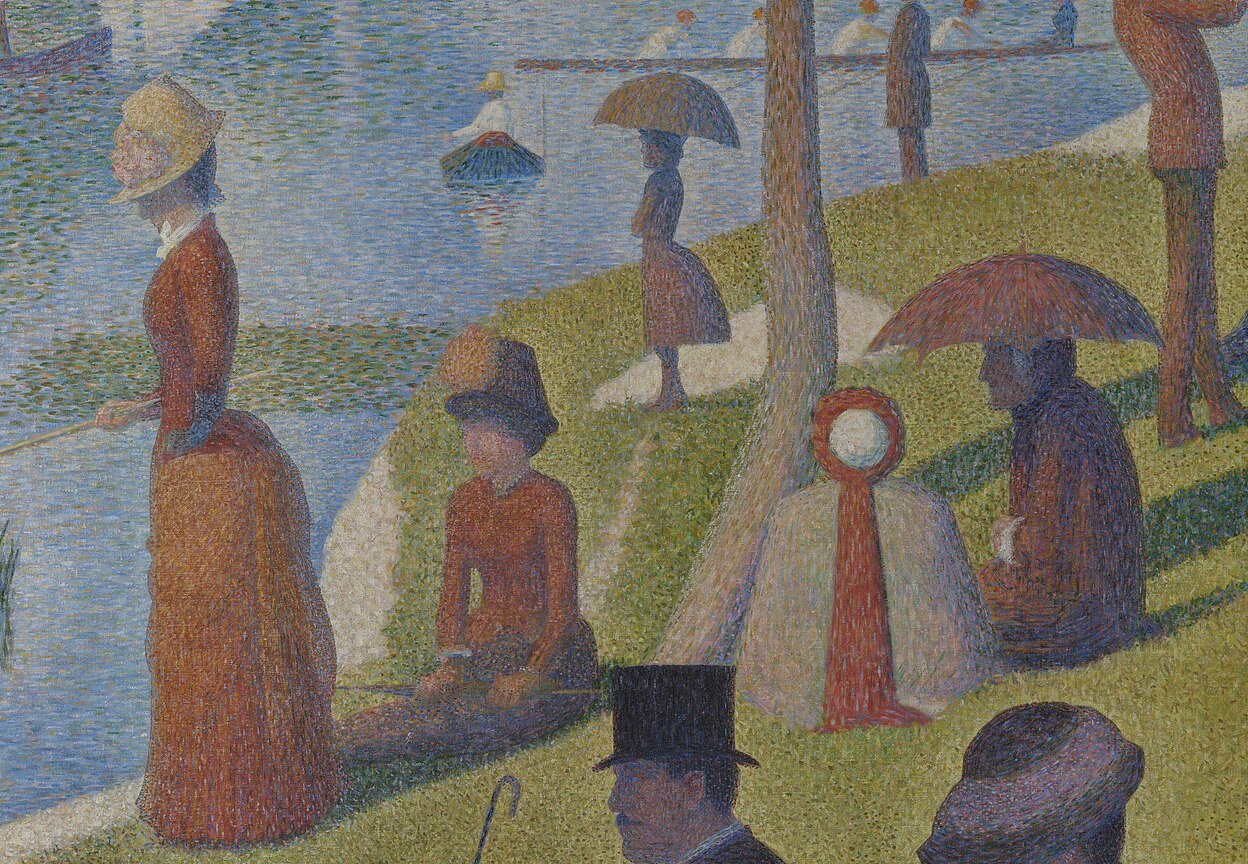
Just up the slope sits number 10, one of the strangest shapes in nineteenth-century painting. She is a nursemaid, seen entirely from behind, and she is almost pure geometry: a cone of pale shawl, topped by a round cap, with two long red ribbons running down her back. Wet nurses in Paris were often country women, and their costume, ribbons included, announced the job at a glance. Seurat turned her into a pyramid. Next to her, number 11, an old woman in black hunches under an orange parasol. She might be the nursemaid’s employer. She might just be tired.
The boatman, the gentleman and the black dog
The lower left corner is the painting’s most carefully staged social comedy. Three people sit in the shade, close enough to touch, and nobody acknowledges anybody.
Number 6, sprawled across the foreground, is a boatman. He wears a sleeveless shirt and a cap, and he is smoking a pipe. He is almost certainly working class, a canotier, one of the rowers of the Seine. Behind him, number 7, sits a gentleman in a top hat, upright, holding a cane, staring at the water. Beside him, number 8, a woman in black bends over something in her lap, needlework of some kind, with a closed book and a folded fan in the grass at her side.
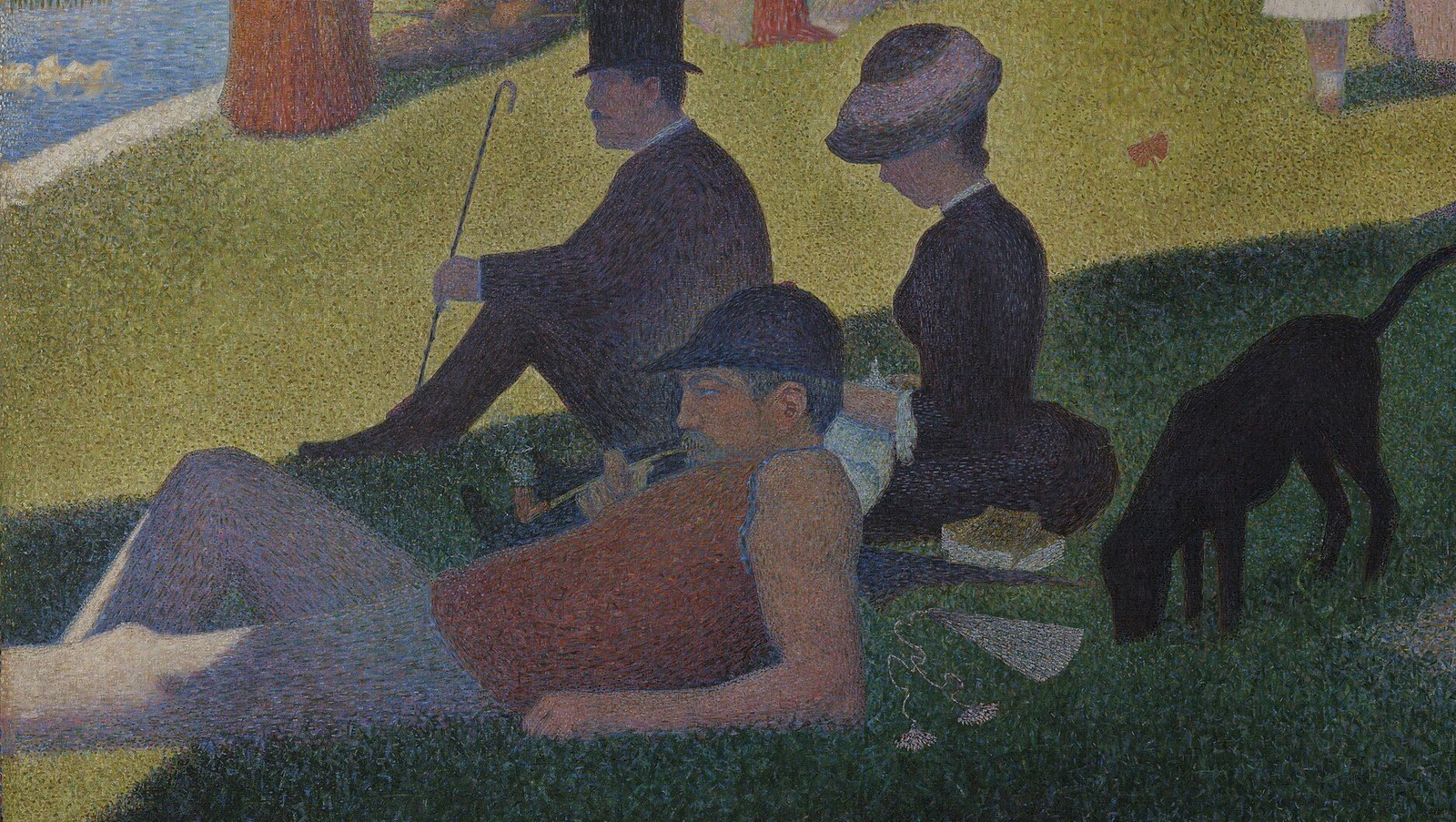
They share one patch of shadow and nothing else. Seurat was famously private, but one friend called him a Communard, a man of the left, and this corner reads like an argument made without words. On La Grande Jatte the classes sat on the same grass. They just did not talk.
The trumpeter, the soldiers and the girl in white
Up the slope, number 12 is a man in an orange coat with a horn raised to his lips, playing out across the water. Next to him stand number 13, two soldiers in red trousers, straight as posts. They are off duty, but they still stand at attention.
Then the center. Number 15 is a tall woman in pink and red holding an orange parasol, walking toward us. Number 14, holding her hand, is a little girl in a white dress and a wide pale hat. She is the brightest patch in the middle of the painting, and the one figure in the crowd who looks straight out of the canvas at you.
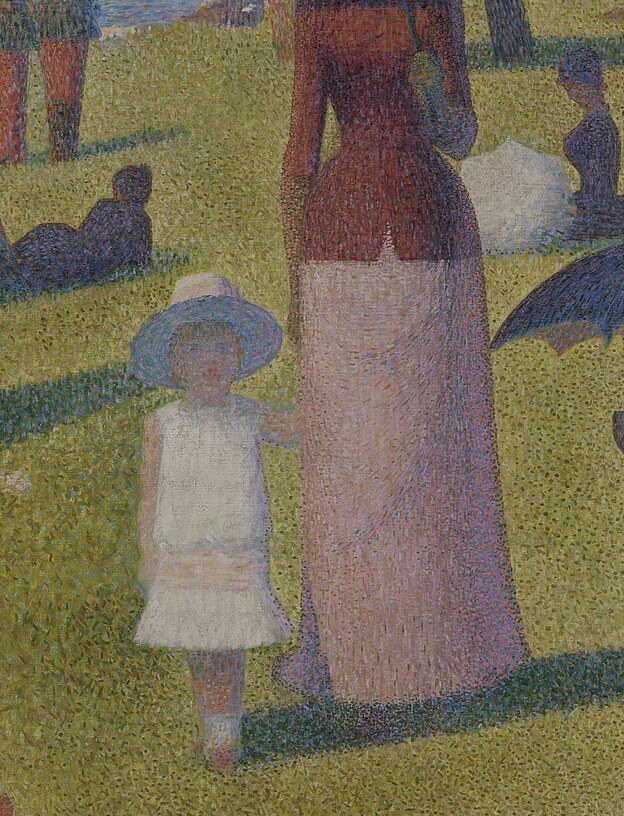
Americans of a certain age know her already. In the 1986 film Ferris Bueller’s Day Off, Cameron stands in front of this painting at the Art Institute while the camera cuts closer and closer to the little girl in white, until her face dissolves into dots. It is exactly what happens in the room. The closer you get to her, the less of her there is.
To her right, number 16 sits in the grass under a blue parasol, and number 17, a girl with a long braid, bends over a little bouquet of flowers. Behind them, number 18 is a girl in orange, running. She is the only person on the island in motion. Far behind her, number 19 is a couple, the man holding a baby in white, and on the river at upper left, number 20, a rowing crew leans into its oars. Even the rowers look still.
Why everyone on La Grande Jatte stands like a statue
The stiffness is deliberate. Seurat told the poet and critic Gustave Kahn that his model was the Panathenaic procession, the parade of citizens carved on the frieze of the Parthenon. He wanted, he said, to make modern people file past the way the figures on that frieze do, in their essential form. So he gave his Parisians strict profiles and strict frontal poses, and almost nothing in between.
Some critics in 1886 compared the figures to Egyptian reliefs and wooden toys. Others saw the point. The critic Félix Fénéon, writing about Seurat and his circle that year, gave the new style a name that stuck: Neo-Impressionism. It is the branch of Post-Impressionism we untangled in our piece on Impressionism versus Expressionism, and A Sunday on La Grande Jatte is its founding document.
Two years, sixty studies and a technique called pointillism
Seurat did not paint the big canvas on the island. He worked on it in the studio in two campaigns, from May 1884 to March 1885 and from October 1885 to May 1886. Alongside, he made something like sixty preparatory works. Counts vary, but they include around thirty small oil sketches on wooden panels, which he called croquetons, roughly as many conté crayon drawings, and three large studies on canvas.
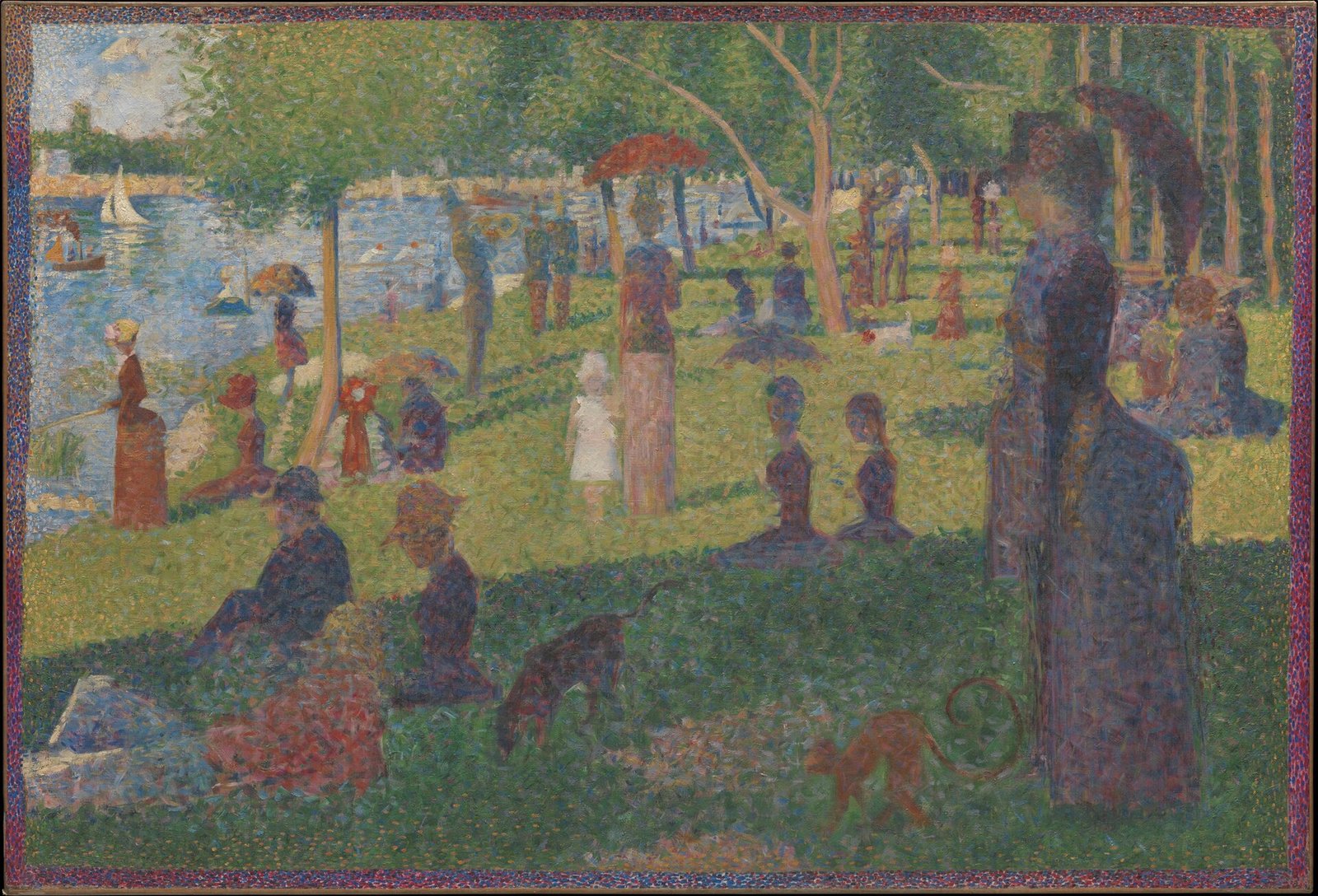
The most complete of the large studies is in the Met. Next to the finished picture, its figures are looser and softer, and the animal at the woman’s feet has not yet become a monkey.
Here is the surprise. The dots, the thing everyone remembers, came late. In the first campaign Seurat painted the canvas in short criss-cross strokes and mixed some of his colors on the palette, including dull earth pigments like ochre. Only in the second campaign did he go over large parts of the surface with small, nearly uniform dots of pure color, trusting the viewer’s eye to blend them. He called the method chromoluminarism. The world came to call it pointillism. One estimate puts the number of dots at around two hundred and twenty thousand.
Seurat had read the color theorists Michel Eugène Chevreul and Ogden Rood, and he believed a dot of orange beside a dot of blue would make both vibrate in a way no mixed paint could. Other painters were soon trying it. Vincent van Gogh, newly arrived in Paris, painted a self-portrait in Seurat’s dots before he broke them into his own swirling strokes.
The yellow that turned brown
There is one problem with all that science. For the sunlit grass in the middle of the painting, Seurat used a new pigment called zinc yellow, a zinc chromate that was bright, lemony and modern. It was also chemically unstable. Over time its chromate turns to dichromate, and the bright yellow darkens toward ochre and brown. The change had already started in Seurat’s own lifetime. The patches of brilliant sunlight he painted in 1885 are now a duller, olive green.
What you see in Chicago is not quite what Seurat saw. For the museum’s 2004 exhibition, Seurat and the Making of La Grande Jatte, a team including the color scientist Roy Berns made a digital reconstruction of the canvas with its original yellows restored. It is a strange thing to know about a painting famous for its light: the light is the part that is fading.
A painted border and a white frame
Walk close to the edge of the canvas and you will find the last thing Seurat did to it. Around 1888 and 1889, two or three years after the first showing, he took the painting off its stretcher, restretched it to give himself a margin, and painted a border of dots all the way around. The border is mostly red, orange and blue, and it shifts as it goes, answering the colors of the painting next to it.
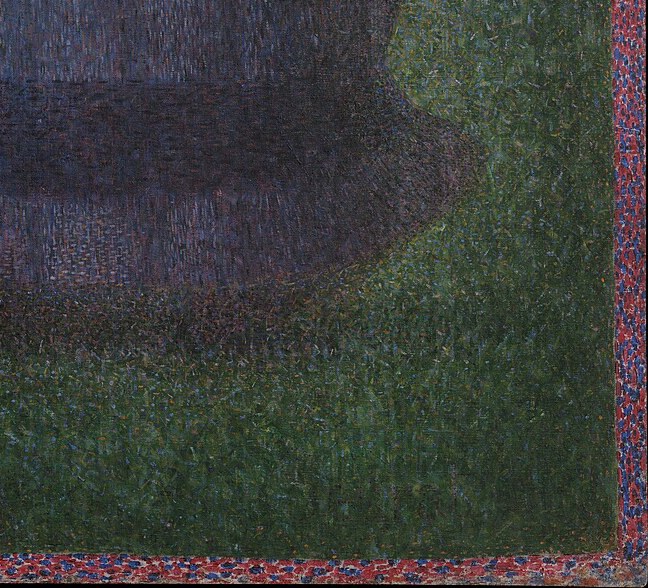
The border was meant as a transition between the painting and its frame. Seurat had shown La Grande Jatte in a plain white frame, not gilded wood, which was a provocation in 1886. That frame was lost, and Seurat died in March 1891, at thirty-one, after a sudden illness, before he could make a new one. In 2022 the Art Institute rehung the painting in a new white frame designed to come as close as conservators could to what he seems to have wanted.
How the painting got to Chicago, and why it never leaves
La Grande Jatte made its debut at the eighth and last Impressionist exhibition in Paris, in May 1886, hung with work by Paul Signac and Camille Pissarro, the old Impressionist who had championed the young dot painters. It was a declaration of war on the movement that hosted it.
After Seurat’s death it stayed in France for three decades. From 1900 it belonged to the family of Lucie Cousturier, a painter in Seurat’s circle. In 1924 the Chicago collectors Frederic Clay Bartlett and Helen Birch Bartlett bought it, on the advice of the Art Institute’s curators, for a price usually given as twenty thousand dollars. Helen died the following year, and in 1926 Frederic gave their collection to the museum in her memory.
It has left once. In 1958 it was lent to the Museum of Modern Art in New York, and on April 15 a fire broke out there, killing a worker. The painting, on a floor above the fire, was carried out to the Whitney Museum next door, undamaged. It has not traveled since.
In 1984 Stephen Sondheim and James Lapine turned it into the Broadway musical Sunday in the Park with George, which won the Pulitzer Prize for Drama. That is why so many Americans call it by the wrong title.
La Grande Jatte FAQ
Where is A Sunday on La Grande Jatte?
In the Art Institute of Chicago, at 111 South Michigan Avenue. It has been in the museum’s collection since 1924 and was last listed in Gallery 240, with the museum’s Impressionist and Post-Impressionist paintings, though rooms can change.
How big is A Sunday on La Grande Jatte?
It measures 207.5 by 308.1 centimeters, about six feet ten inches tall and just over ten feet wide. Most people are surprised by the size; the figures in the foreground are close to life-size.
Who is in A Sunday on La Grande Jatte?
Ordinary Parisians on a Sunday outing, not named portraits: the woman with the monkey and her companion, the woman fishing, the boatman, the gentleman in the top hat, the nursemaid, the trumpeter, two soldiers and the girl in white, all numbered above.
What does the monkey mean in La Grande Jatte?
Monkeys were an old symbol of lust and vanity, and in 1880s Paris slang a kept woman could be called a singesse, a female monkey. Many historians read the woman with the monkey as a mistress or prostitute; others see Seurat mocking fashionable manners. He never said which.
Why is it called A Sunday on La Grande Jatte — 1884?
The museum’s title includes the date because the scene is set in 1884, the summer Seurat began working on the island. He kept painting it until 1886 and added the border around 1888 and 1889.
What to look for when you see it
Most people see this painting from the middle of the room, take a photo and move on. Seurat built it to be seen from two other places.
First, stand well back, ten or fifteen feet, and let the dots melt. Find the two brackets, the monkey on the right and the fishing rod on the left, and notice how nearly everyone between them faces the river or faces you, never each other.
Then walk right up to it. Look at the girl in white, number 14, and watch her vanish into specks of white, pink, blue and orange. Look at the sunlit grass in the middle and try to imagine it as lemon yellow instead of olive. Then go to a corner and find the painted border, with its dots changing color as they travel along the edge.
Chiaro is useful at exactly that close-up distance, when the figures have dissolved and the key is in your other hand: the story of the singesse and the leash plays while you are looking down at the monkey’s curled back, which from two feet away is just a cluster of brown and orange dots.
Go early on a weekday if you can. The Art Institute usually opens at 11 a.m., with later hours on Thursdays, and adult general admission was 32 dollars when we last checked, less for Illinois residents. Hours and prices change, so check the museum’s site before you go. The Art Institute of Chicago page on our site has La Grande Jatte as one of its audio stops, so you can hear the story before you get there.
If you like reading a crowd this way, the same numbered approach takes apart Rembrandt’s Night Watch, Raphael’s School of Athens and more in our series Famous Paintings, Every Figure Identified. And if you want to place Seurat among the painters he was arguing with, start with our guide to the Impressionist painters who showed at those eight Paris exhibitions.
Seurat spent two years making everyone on the island hold still, and the yellow has been moving ever since. The girl in white has not. She is still walking toward you, holding her mother’s hand, the only person on La Grande Jatte who noticed someone was watching.