In the spring of 399 BC, in a prison cell in Athens, a seventy-year-old man was told it was time. He had been convicted of impiety and of corrupting the young. The sentence was death by hemlock. He had spent his last day arguing with his friends that the soul cannot die. Then the cup came. He took it, according to the man who told the story, “quite readily and cheerfully,” and drank.
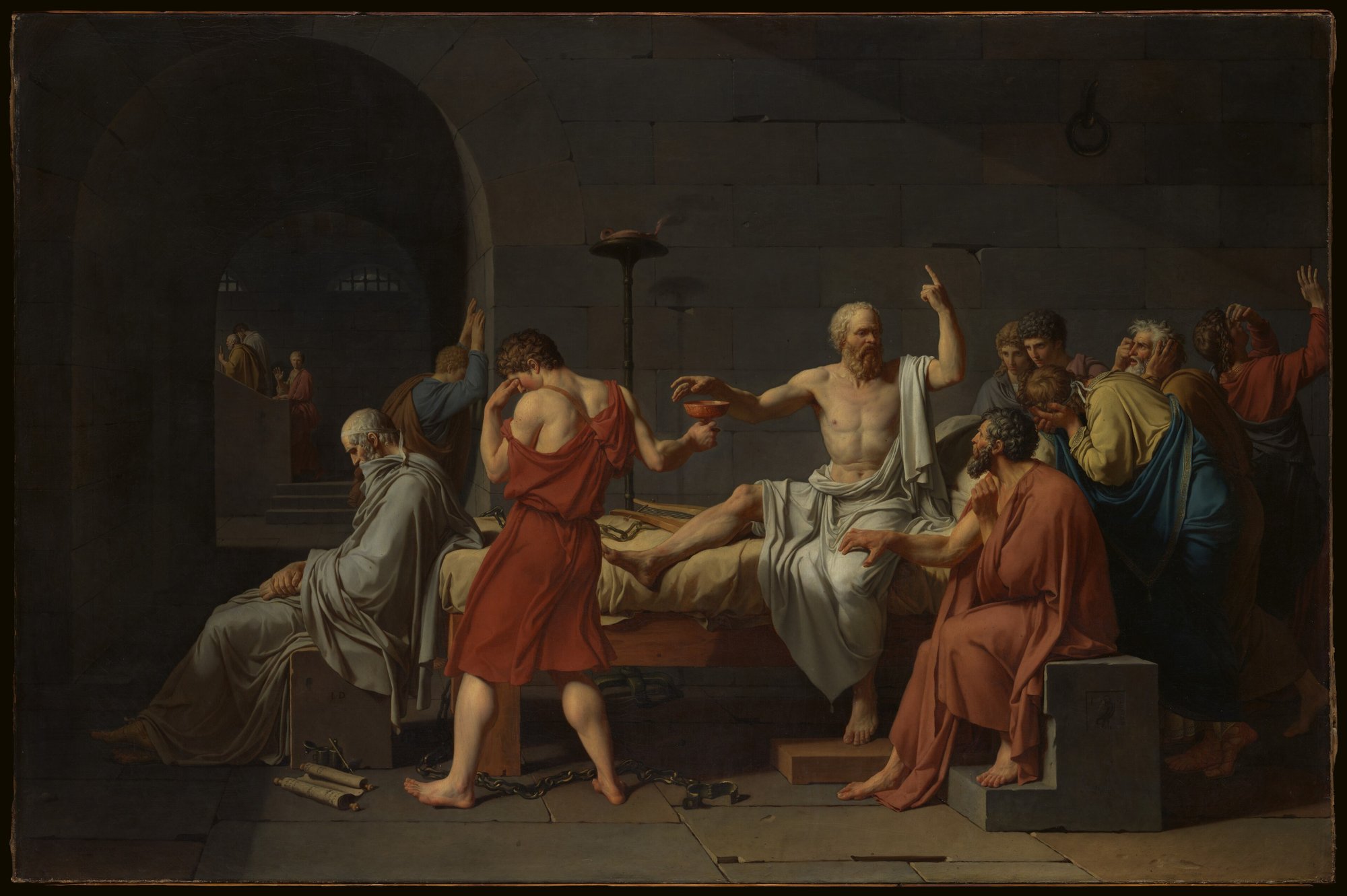
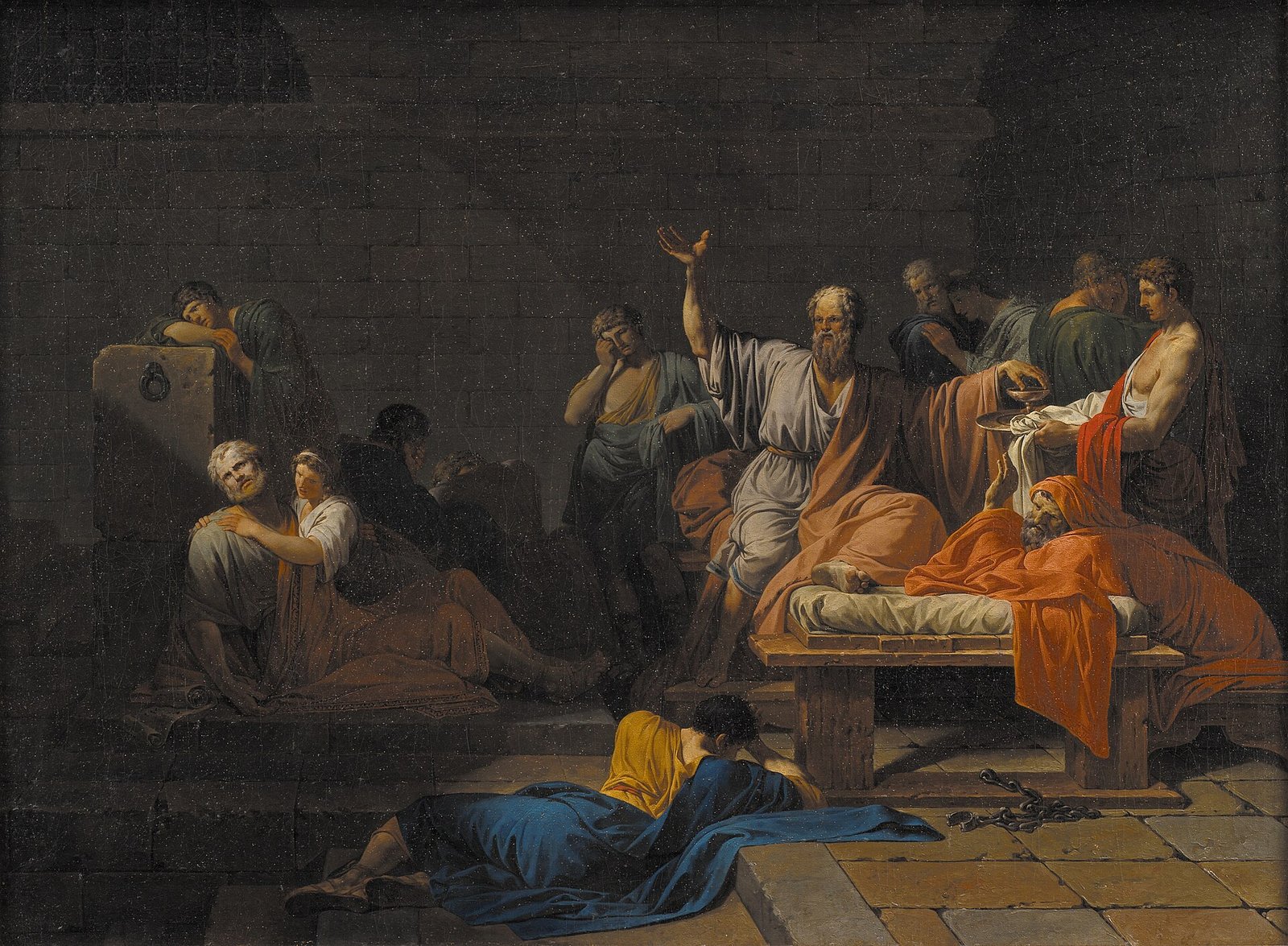
Twenty-two centuries later, a French painter put that moment on a canvas a little over six feet wide. The Death of Socrates painting, finished by Jacques-Louis David in 1787, is the most argued-over deathbed in Western art, and it hangs today in the Metropolitan Museum of Art in New York. It looks like a history lesson. It is actually a puzzle with fifteen pieces: a philosopher in mid-sentence, a friend whose hand is in a strange place, a weeping jailer, a woman on the stairs, a lyre, a set of chains, and an old man at the foot of the bed who, by his own account, was not in the room.
The Death of Socrates painting at a glance
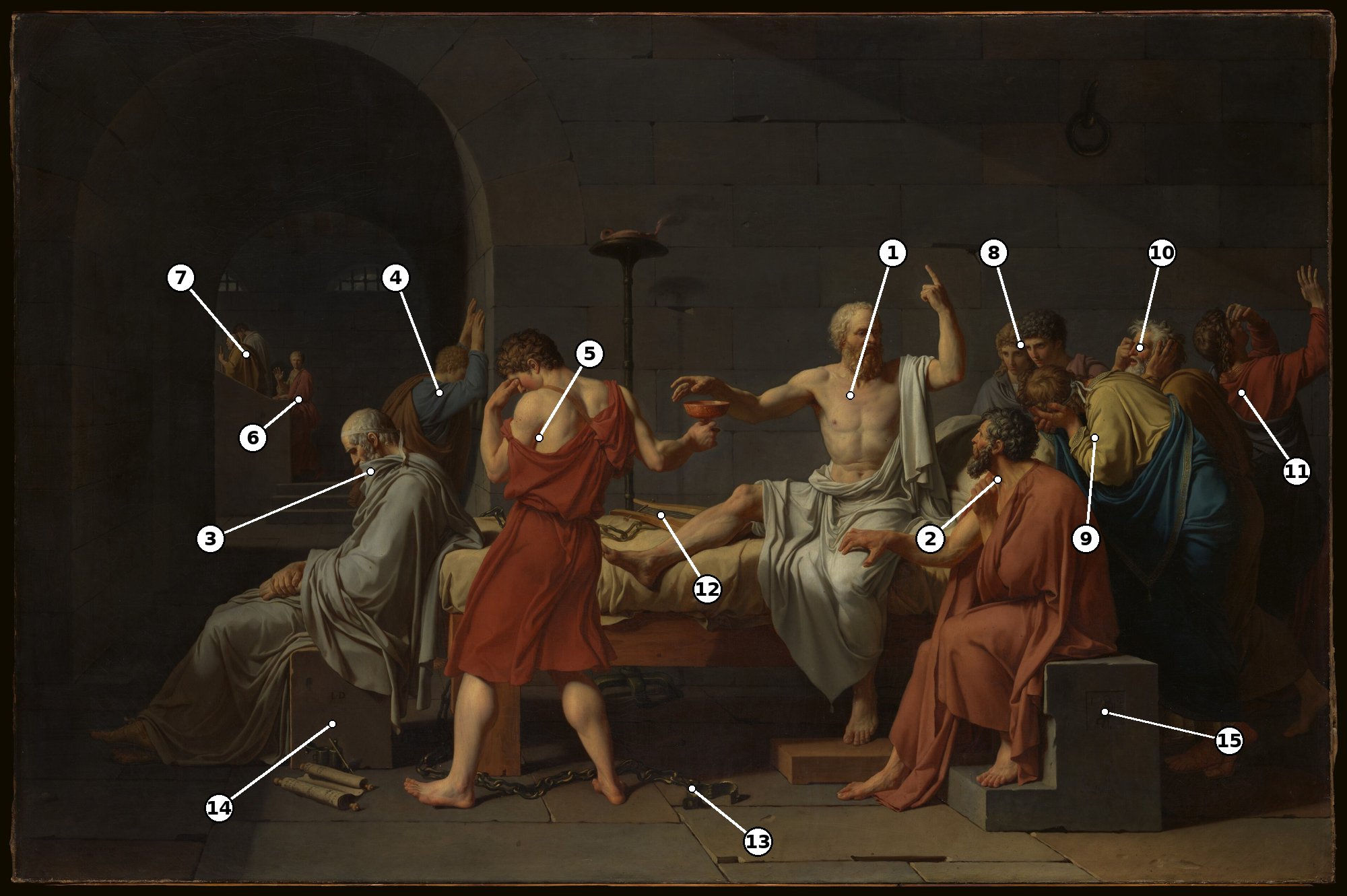
The numbers on the image match this key. The names come from Plato’s dialogue Phaedo, which is David’s script, and from the way art historians have read the painting since 1787. David left no list, so where a name is a reading rather than a certainty, the table says so.
| # | Figure | Who it is | Where to find him |
|---|---|---|---|
| 1 | Socrates | The philosopher, aged about seventy | On the bed, finger raised, hand hovering over the cup |
| 2 | Crito | His oldest friend, the same age as Socrates | Seated on the stone bench, right, hand on Socrates’s thigh |
| 3 | Plato | The author of the story, painted old and absent in spirit | Slumped at the foot of the bed, left |
| 4 | Apollodorus | The disciple who could not stop crying | Behind Plato, arms pressed against the wall |
| 5 | The man with the cup | The prison servant, usually called the jailer | Center left, in red, turning his face away |
| 6 | Xanthippe | Socrates’s wife, by the usual reading | In the archway, at the top of the stairs, hand raised |
| 7 | Two men on the stairs | Not identified; often read as her escort | In the archway, climbing away |
| 8 | Two young disciples | Not identified | Behind the bed, the only calm faces in the room |
| 9 | The disciple hiding his face | Not identified | Right, bent double in yellow and blue |
| 10 | The old man clutching his head | Not identified | Right, white-haired, hands at his temples |
| 11 | The young man in red | Not identified | Far right, arms thrown up against the wall |
| 12 | The lyre | Socrates’s last project | On the bed, beside his leg |
| 13 | The chains | Removed that morning | Under the bed and across the floor |
| 14 | Pen, ink and “L.D” | David’s initials, under Plato | On Plato’s bench, lower left |
| 15 | The owl and “L. David” | The emblem of Athens and David’s full signature | On Crito’s bench, lower right |
Socrates, talking to the end
Start in the middle, where David wants you. Socrates sits bolt upright on the bed, his white cloak falling off one shoulder. His left hand points at the ceiling. His right hand reaches toward the cup without looking at it. He is still teaching.
That gesture is the whole painting, and it was not David’s first idea. The poet André Chénier, a friend of the young aristocrats who commissioned the picture, is said to have suggested it: Socrates should take the cup while still making his point, so that the act of dying becomes an afterthought to the argument. In Phaedo, the order is different. The talk about the immortality of the soul comes first, then the bath, then the farewells, then the poison. David collapsed a whole day into one second.
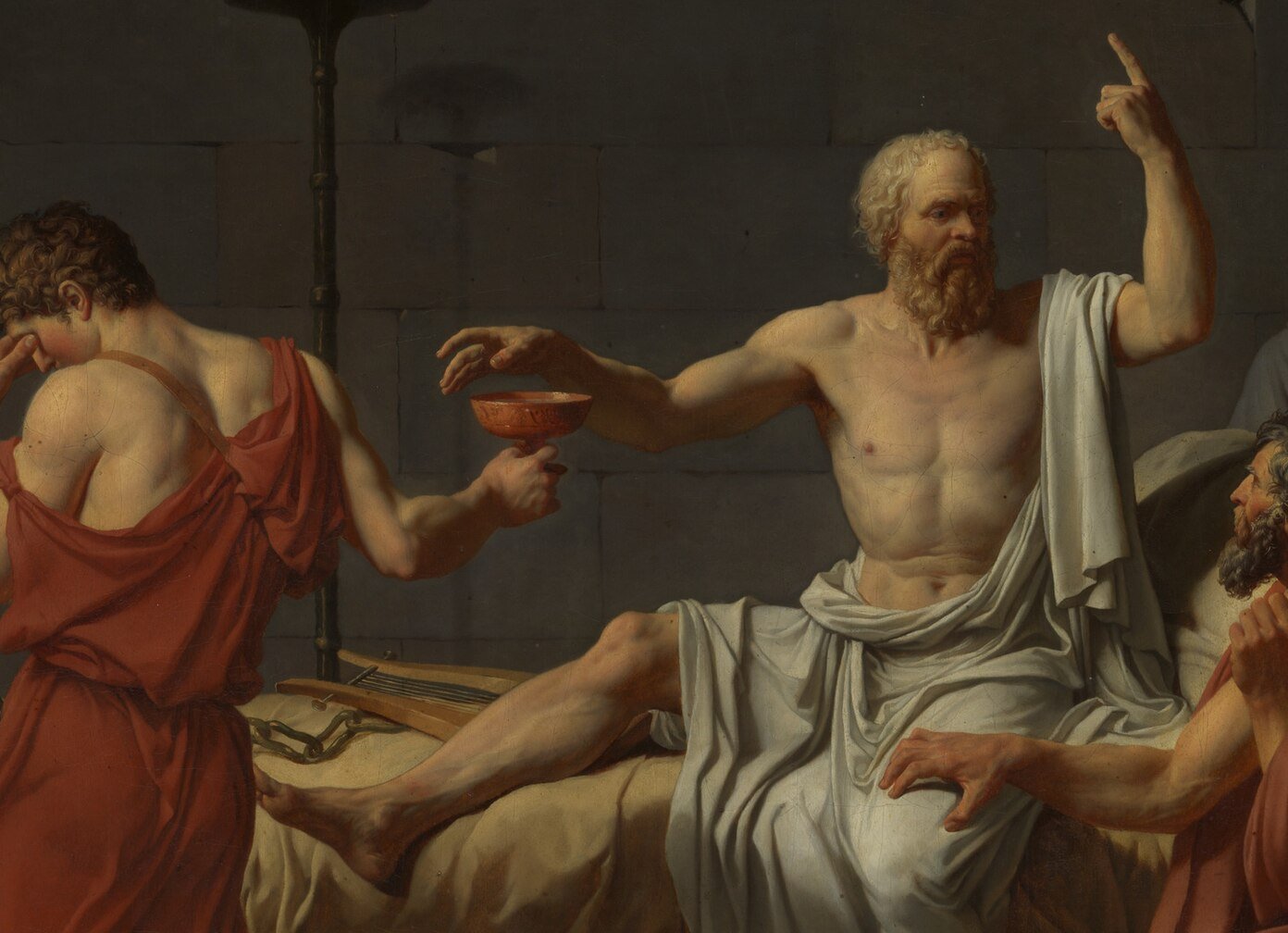
Look at the body. The real Socrates was famous for his ugliness. In Plato’s Symposium, the young general Alcibiades compares him to a satyr, snub-nosed and bulging-eyed. David gave him the torso of a gym instructor. The head comes from ancient portrait busts, but the chest and arms are pure ideal. This is not a portrait of a man. It is a portrait of a principle, and principles do not have bellies.
Crito, and the hand on the thigh
The man seated on the stone block to the right is Crito. He was the same age as Socrates, from the same district of Athens, and rich. A few days earlier, in the dialogue that carries his name, Crito had come to the prison before dawn with a plan to bribe the guards and smuggle Socrates out of the city. Socrates said no. Escaping, he argued, would break the laws that had raised him.
So Crito sits here as the friend who lost the argument. His face is turned up to Socrates, his fist pressed under his chin, his eyes locked on the face that is about to stop talking. And his right hand rests on Socrates’s thigh.
That hand has a source. In Phaedo, after Socrates drinks, the man who gave him the poison presses his feet and then his legs, asking if he can feel anything, tracking the numbness as it climbs. When the cold reaches his waist, Socrates uncovers his face and speaks his last words. They are addressed to Crito: “Crito, we owe a cock to Asclepius. Pay it and do not neglect it.” Then Crito closes his friend’s eyes and mouth. David gives Crito the touch, placed exactly where the cold will rise. Read it as grief or as a hand already feeling for the end; either way, it is the most physical thing in the painting.
Plato, older than he was and not in the room
Now go to the far left. At the foot of the bed, wrapped in a gray cloak, a white-haired man sits with his back to everything. His head is bowed. His hands rest in his lap. He is the only figure in the room who is not reacting. That is Plato.
Here is the “wait, really?” moment. Plato was not there. In Phaedo, the narrator lists the friends who came that day, and then adds a line that scholars have puzzled over for two thousand years: “Plato, I believe, was ill.” And he was not old. In 399 BC, Plato was somewhere around twenty-eight. David painted him as an old man, at the age when he would have been writing the dialogue that turned this death into literature.
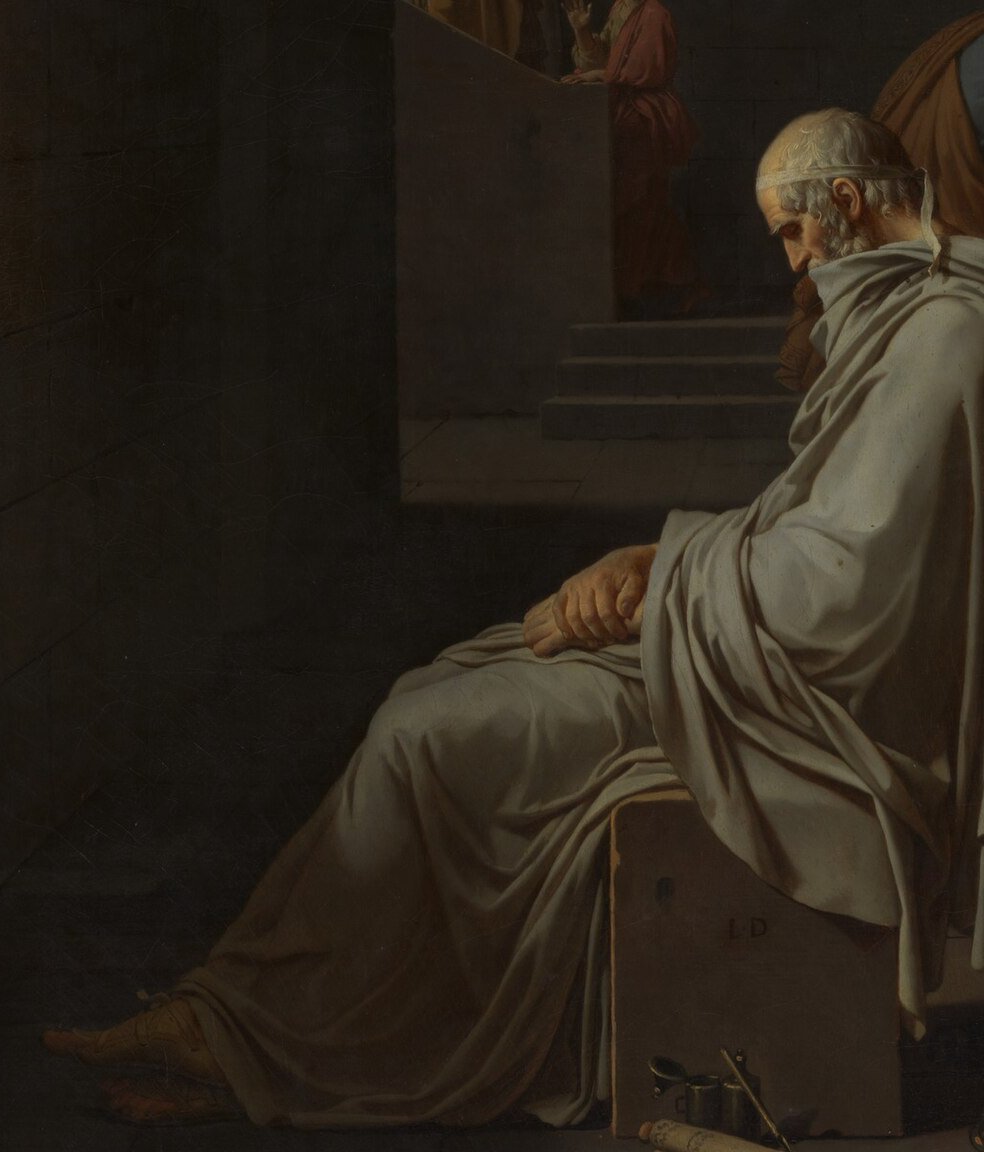
The Met’s own description says it plainly: Plato is there not as a witness but as the author whose text preserved the story. Look at the floor by his bench. There are scrolls, an inkwell and a pen. He is the writer, sitting at the edge of his own scene, remembering it. The painting is, in a sense, happening inside his head.
And on the side of his bench, in small dark capitals, David painted two letters: “L.D,” for Louis David, the name he signed with in the 1780s. The initials sit under the author. Hold that thought for the far end of the room.
Apollodorus and the jailer who could not look
Behind Plato, a young man in blue throws his forearms against the wall of the arch and buries his face. That is usually identified as Apollodorus. In Phaedo, he is the one who cries all day. When Socrates finally drinks, Apollodorus breaks into a howl that, the narrator says, made cowards of them all. Socrates scolds him. He had sent the women away, he says, precisely so that nobody would carry on like this. A Benedictine scholar who advised David, Father Jean Adry, is said to have asked that Apollodorus be shown visibly overcome.
In front of them, in a red tunic, stands the young man holding out the cup. He cannot look. His free hand covers his eyes, and his back is turned to the man he is killing. Most guides call him the jailer. Phaedo actually has two men here. One is the servant of the Eleven, the Athenian prison officials, who comes in late in the day, tells Socrates he is the gentlest man ever held in that prison, bursts into tears and walks out. The other is the man who brings and gives the poison. David seems to have folded the two into one figure: the hand that delivers death, attached to a face that refuses to watch.
Xanthippe, waving from the stairs
Through the arch on the left, at the top of a flight of steps, a woman in red turns back and lifts her hand. Two men are already climbing away ahead of her.
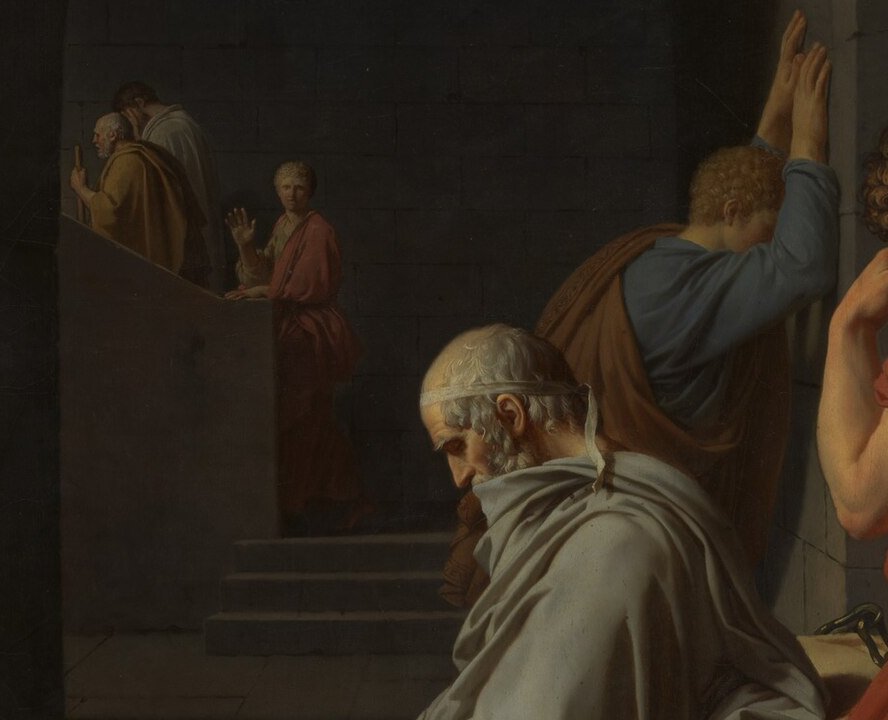
She is almost always identified as Xanthippe, Socrates’s wife. Later writers turned her into the shrew of philosophy. Phaedo is gentler. She is there at dawn with their youngest son in her arms. She cries out that this is the last time he will talk to his friends, and Socrates asks Crito to have someone take her home. Later in the day the women of the family come back, he speaks with them, and he sends them away again.
David put her farewell at the back of the painting, small and lit from behind, and made it the only gesture in the room aimed away from Socrates. Not every writer agrees she is Xanthippe; some descriptions skip her entirely. But a woman leaving the cell while the men stay is exactly the order of events in Plato’s text.
The disciples David never named
On the right, the room comes apart. Behind the bed, two young men stand side by side, the only composed faces in the group, watching Socrates as if they were still taking notes. In front of them, a figure in a yellow robe and a blue cloak bends almost double, his face in his hands. Next to him, a white-haired man claws at his own temples. At the far edge, a young man in red flings his arms up against the wall.
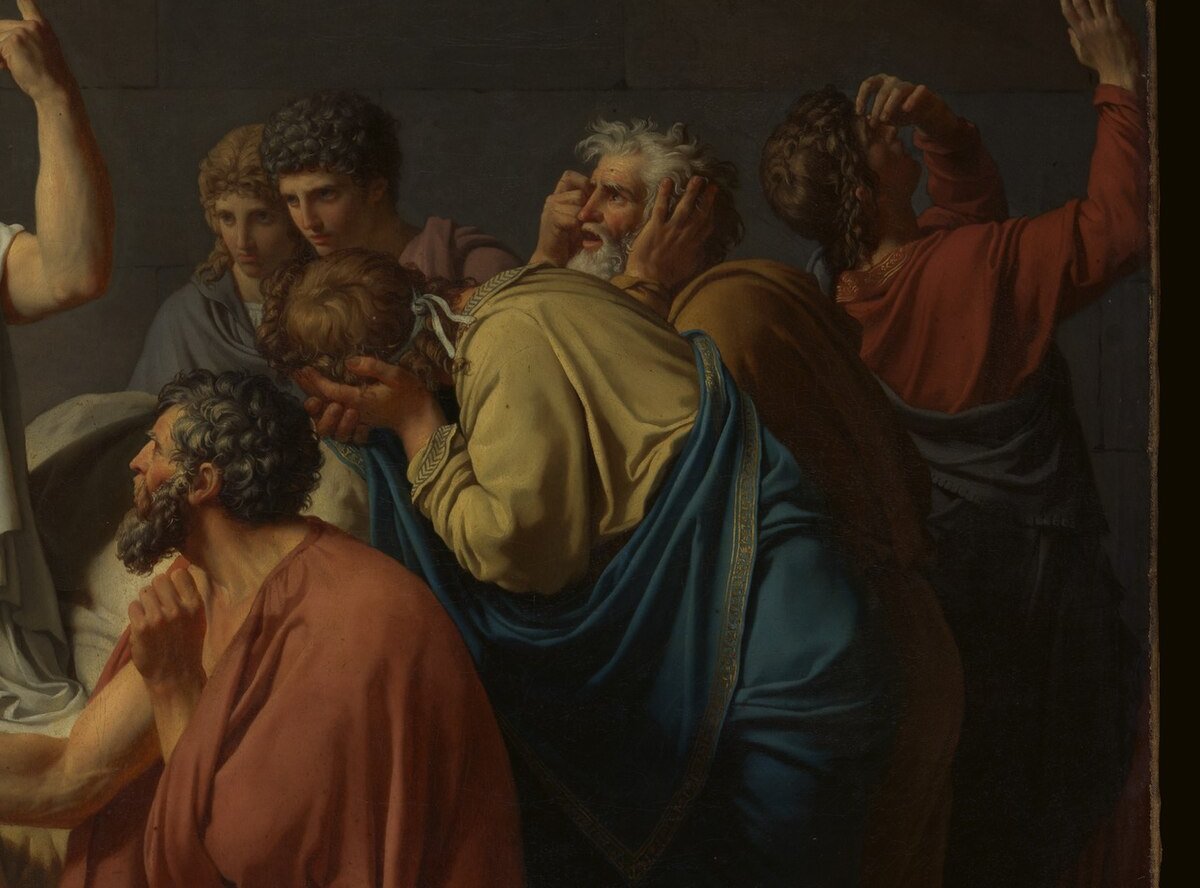
Phaedo gives names for this crowd. Crito’s son Critobulus was there, and Hermogenes, Epigenes, Aeschines, Antisthenes, Ctesippus and Menexenus, and two young men from Thebes named Simmias and Cebes, who do most of the arguing in the dialogue. Phaedo himself, the narrator, was sitting by the bed while Socrates stroked his hair. David gave none of them labels. Anyone who tells you which face is Cebes is guessing.
What David did give them is a range. Grief in this painting climbs a ladder from left to right. Plato is still. Apollodorus hides. Crito holds on. The group on the right rises to a pitch of collapse. And in the middle of it all, the one man who should be afraid is the one man who is calm.
Twelve around the master
Count the people in the painting who are not Socrates. Crito, Plato, Apollodorus, the man with the cup, the woman on the stairs and the two men with her, and the five on the right. That makes twelve.
Twelve followers around a teacher on the last day of his life, one of them handing over the instrument of his death. The parallel with the Last Supper is hard to miss once you see it. David had studied the subject in Rome. He made a copy after Valentin de Boulogne’s Last Supper in 1779, a few years before he began work on Socrates. Did he land on twelve on purpose? He never said so, and no document proves it. But if you want to compare the two rooms, our guide to who is who in The Last Supper is a good place to start.
The lyre and the chains
Two objects on the bed tell the story of the morning.
The first is the chains. They lie across the mattress, under the frame and in a loop across the floor, with one open shackle by the leg of the bed. In Phaedo, the officials remove them at dawn. Socrates sits up, rubs his leg and starts the day by remarking how strange it is that pleasure and pain always seem to follow each other. David left the first event of the day in plain sight.
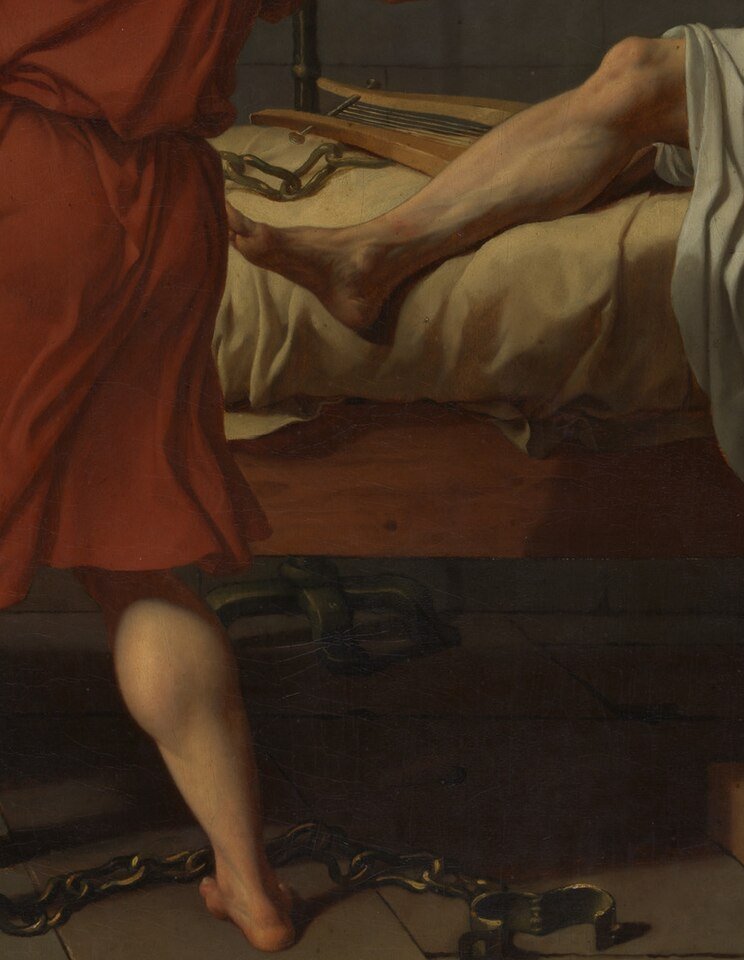
The second is the lyre, lying beside his leg. It is the strangest object in the room, and it comes straight from the text. In prison, Socrates had started writing poetry for the first time in his life. He told his friends that a recurring dream kept ordering him to “make music,” and that he had always thought philosophy counted. Now, just in case, he was putting Aesop’s fables into verse and writing a hymn to Apollo. A seventy-year-old philosopher, in a cell, waiting to die, learning a new art to satisfy a dream. That is the lyre.
Two signatures, two friends
Now go back to the stone block where Crito sits. On its side, David carved a little panel with an owl, the bird of Athena that the Athenians stamped on their coins, and a few Greek letters beside it. Under the owl, in a slanting script, is his full signature: “L. David.”
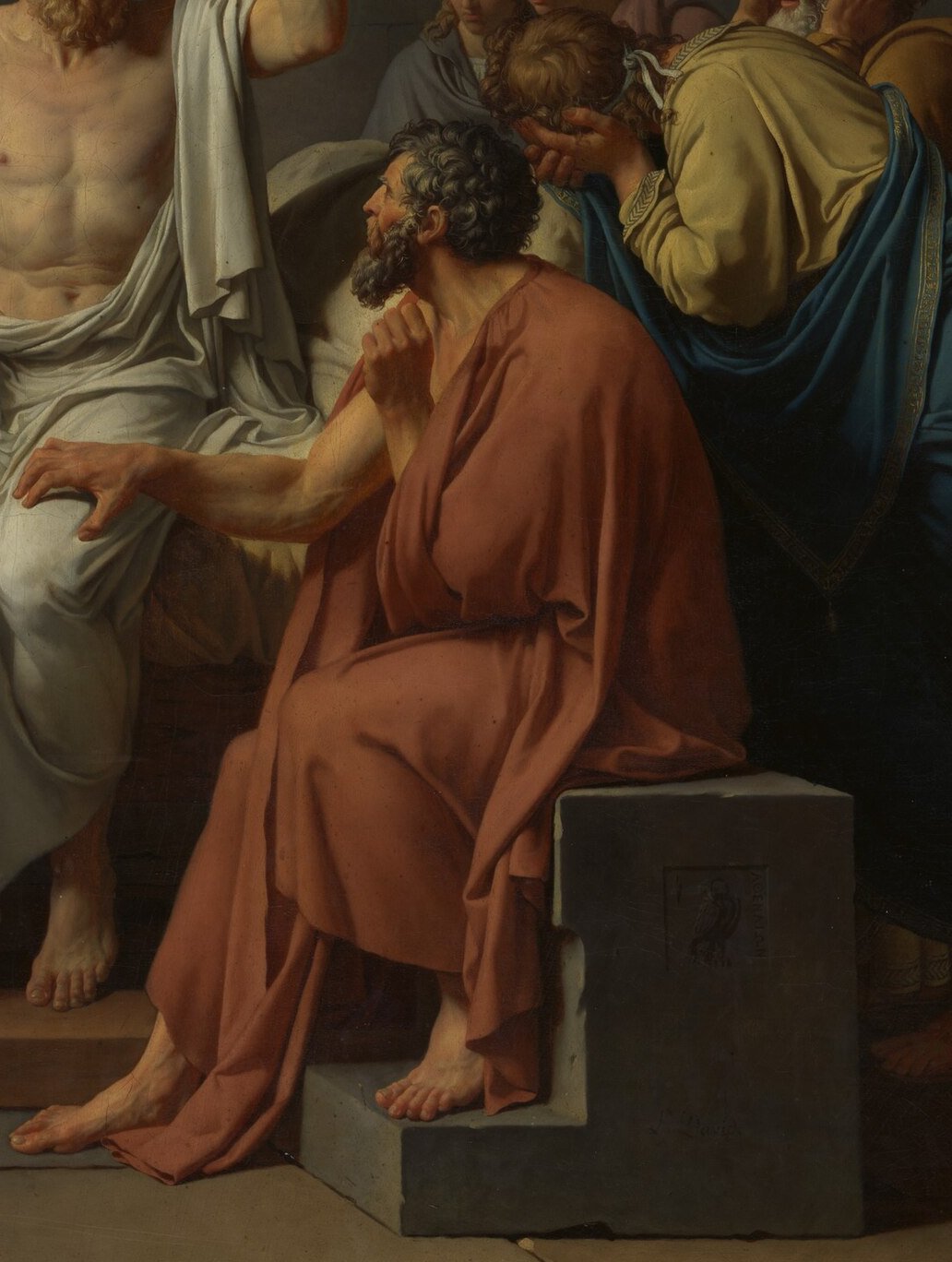
So the painting is signed twice. The initials go under Plato, the author of the story. The full name goes under Crito, the friend who could not save him. The usual reading is that David was paying his debt to his source with the initials and putting himself, name and all, with the man who loved Socrates most and touched him last. That is a reading, not a confession. But painters who sign a picture twice, on two different benches, rarely do it by accident.
Chiaro is built for details at this scale: in the gallery, the owl and the “L. David” on Crito’s block are each smaller than a playing card, and the story of the two benches plays in your ear while you hunt for them.
A rival, a commission and the guillotine
David did not paint Socrates for the king. The commission came from the Trudaine family, rich young liberals who held a literary salon in Paris; sources still disagree on which of the brothers, Charles-Louis or Charles-Michel, actually placed the order. It was a private picture for a private house.
The royal version was by someone else. Pierre Peyron, David’s rival for prizes since their student days, had been commissioned by the king’s director of buildings to paint the same subject. Both pictures went on view at the Paris Salon of 1787, at the Louvre. The comparison was a massacre. Peyron’s is a busy, shadowy scene with Socrates half-hidden in a crowd. David’s is a frieze, every figure lined up parallel to the picture plane, lit like a stage. Critics took David’s side. Joshua Reynolds, the president of the Royal Academy in London, is reported to have called David’s the greatest effort of art since the Sistine Chapel and Raphael’s rooms in the Vatican. Thomas Jefferson, then the American minister in Paris, singled out David’s as the best thing in the Salon.
Peyron’s painting is now in the Statens Museum for Kunst, the national gallery of Denmark in Copenhagen, which says plainly on its label that most viewers in 1787 thought he lost.
Two years before this, David had made his name with another antique sermon in paint, the Oath of the Horatii. Socrates is the quieter sequel. It is about a man who dies for the law rather than a man who kills for it. Then history caught up with the picture. During the Revolution, David became a deputy, voted for the execution of Louis XVI and sat on the Committee of General Security, one of the two committees that ran the Terror. In July 1794, in the last days of the Terror, both Trudaine brothers were guillotined. So was André Chénier, the poet who had suggested Socrates’s gesture. The painter of a picture about a just man executed by the state was, that summer, part of the state doing the executing. Days later, Robespierre fell, and David himself went to prison.
He came out, painted The Coronation of Napoleon, and died in exile in Brussels in 1825. The painting stayed in the Trudaine family’s heirs’ hands and passed through French collections until 1931, when the Met bought it.
The Death of Socrates FAQ
Who is in The Death of Socrates?
Socrates on the bed, his friend Crito with a hand on his thigh, Plato at the foot of the bed, Apollodorus against the wall, the young man holding the cup, and a woman on the stairs usually identified as Socrates’s wife, Xanthippe. The other disciples are not named in the painting.
Where is The Death of Socrates painting?
It is in the Metropolitan Museum of Art in New York, in the European Paintings galleries; the Met’s online record lists it in Gallery 634. The museum bought it in 1931.
How big is The Death of Socrates?
It measures 129.5 by 196.2 centimeters, about four feet three inches high and six feet five inches wide.
Why is Plato old in The Death of Socrates?
Because David painted him as the author, not as a witness. Plato was about twenty-eight in 399 BC, and his own dialogue says he was ill and absent that day. David shows him at the age he wrote the story, with pen and scrolls at his feet.
What does The Death of Socrates mean?
It shows a man choosing death over breaking the law, still arguing for the immortality of the soul as he reaches for the poison. In 1787, two years before the Revolution, that read as a sermon on civic virtue and keeping your principles.
Where did David sign The Death of Socrates?
Twice. The initials “L.D” are on the bench under Plato, and the full signature “L. David” is on the stone block under Crito, beneath a small carved owl of Athens.
What to look for at the Met
Stand back first. From across the gallery, the picture reads as a shallow stage, lit from high on the left, and everything on it points at the gap between Socrates’s fingers and the cup.
Then go close and take the painting in three stops. The cup: Socrates’s hand hovers over it without touching, and the young man holding it has his eyes covered. The bench under Plato: the scrolls, the inkwell and the “L.D.” The block under Crito: the owl and “L. David.” Between the two signatures you have walked from the author of the story to the friend who lived it, which is the route David laid down.
Before you leave, look up at the arch on the left and find the woman on the stairs. She is the one person walking out of the painting, and she is the only one looking back. The Met stop for The Death of Socrates starts from the same raised finger. If you want more crowds taken apart one face at a time, the whole series is collected in Famous Paintings, Every Figure Identified.
Socrates never wrote a word. Everything we know about his last day comes from the man at the foot of the bed, the one with his head down, the one who was not there. David put him in anyway, gave him a pen, and signed his initials underneath.