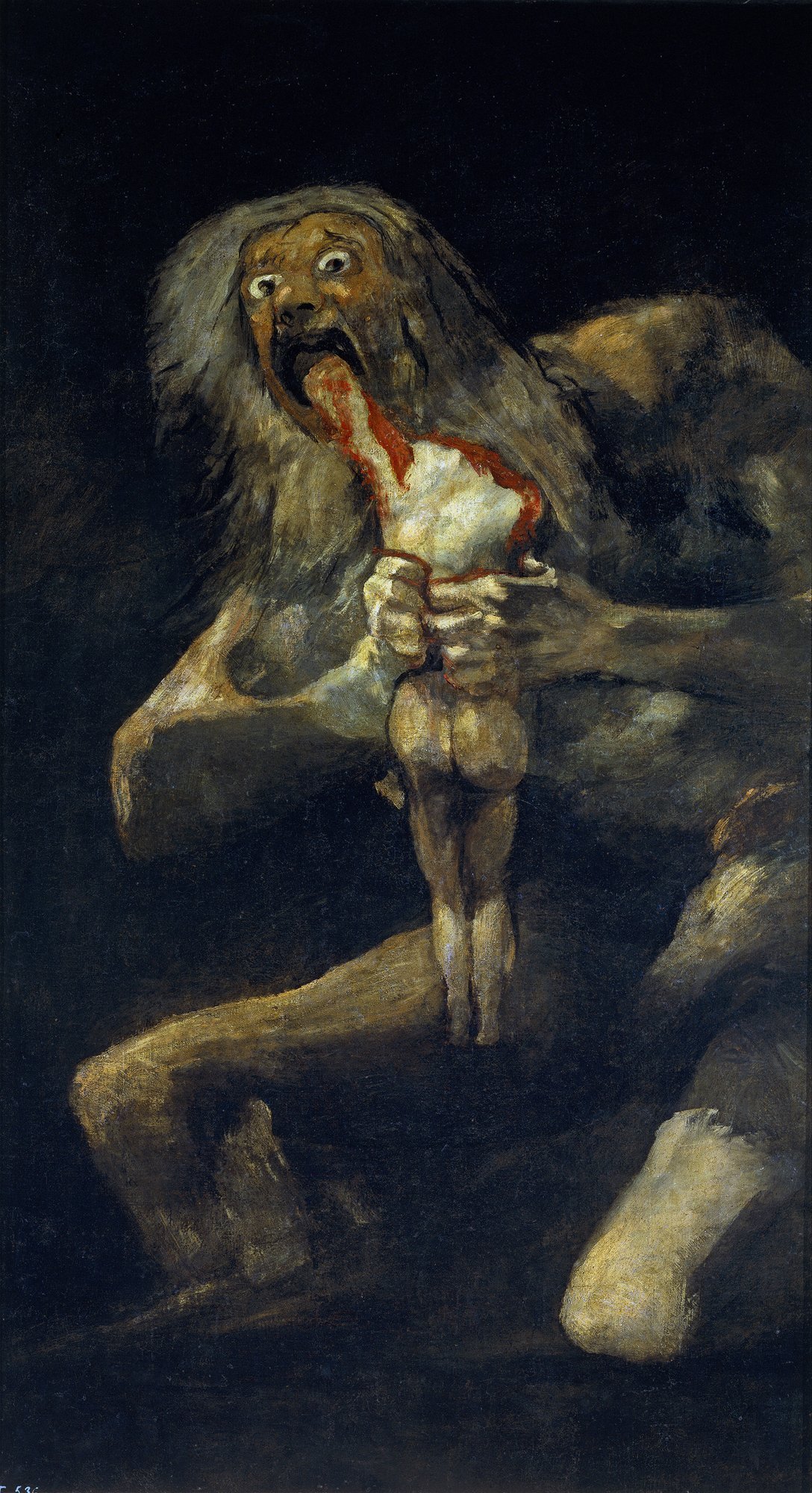
Picture an old man eating his supper. He is in his seventies, almost completely deaf, and he lives in a two-storey farmhouse on the far bank of the Manzanares river, looking back across the water at Madrid. On the wall of the room where he eats, to the left of the window, a grey giant crouches out of the dark with a headless body in his fists. The giant’s eyes are wide open. His mouth is full. The old man painted him there himself, directly onto the plaster, and as far as anyone knows he never told a single person why.
The old man was Francisco de Goya, and the picture is Saturn Devouring His Son. It is the best known of the fourteen Black Paintings, the murals Goya made for the walls of his own house sometime around 1820 to 1823. He never exhibited them, never wrote about them, and never gave them titles. Every name they carry was given after his death. The most famous horror image in Western art was, for its first fifty years, wall decoration in a private home.
That is the strange thing to hold onto. This was never meant to be a museum painting. It was meant to be lived with. Today it hangs in Room 67 of the Prado, on the ground floor, a short walk from the Third of May 1808, and millions of people a year file past a picture designed for an audience of about three.
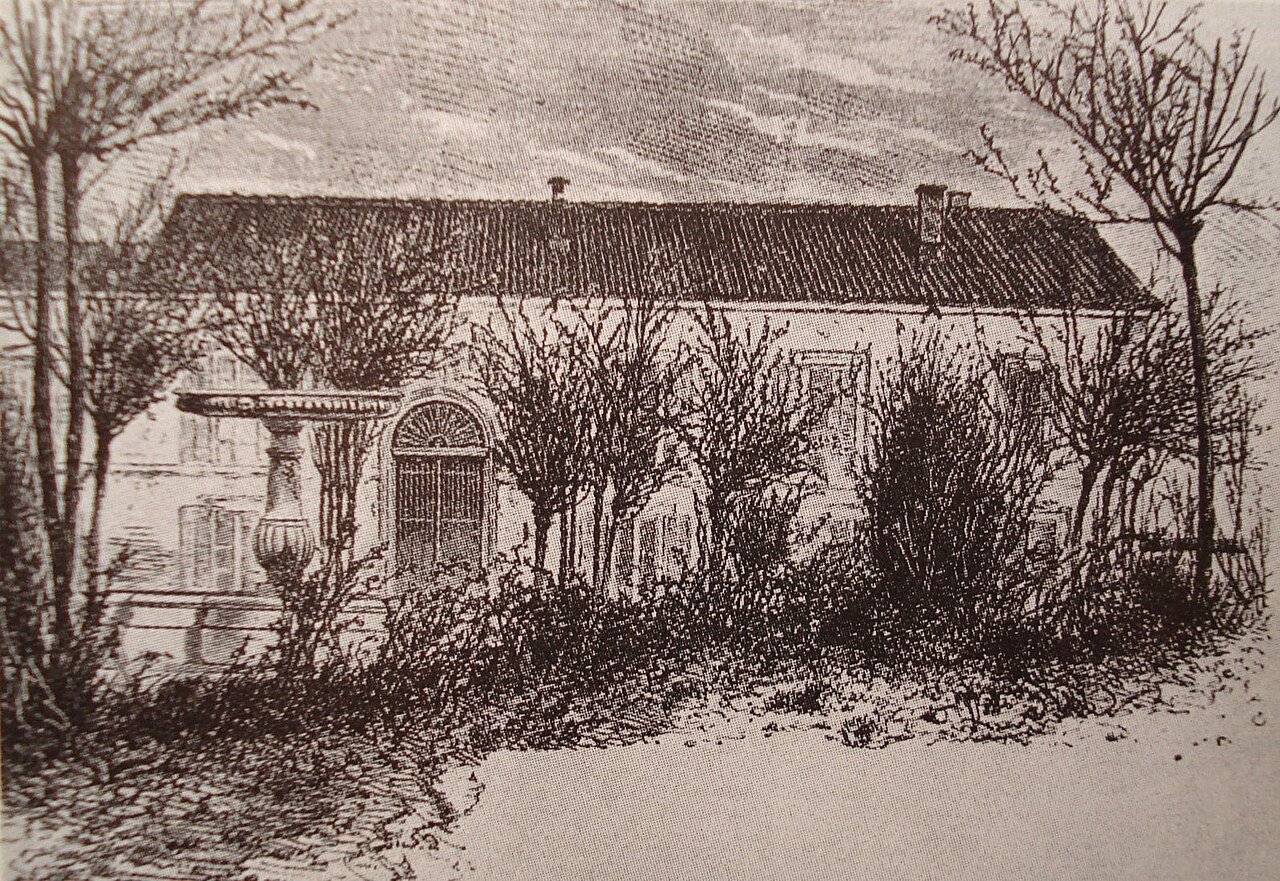
The house of the deaf man
Goya bought the house in February 1819, when he was seventy-two. It stood on the west bank of the Manzanares, near the Segovia bridge, with a view over the meadows of San Isidro. Locals already called it the Quinta del Sordo, the Deaf Man’s Villa. The joke is that the name came with the property. The previous owner had been deaf too. Goya, who had lost his hearing after a mysterious illness in 1792 and 1793, simply fitted the description.
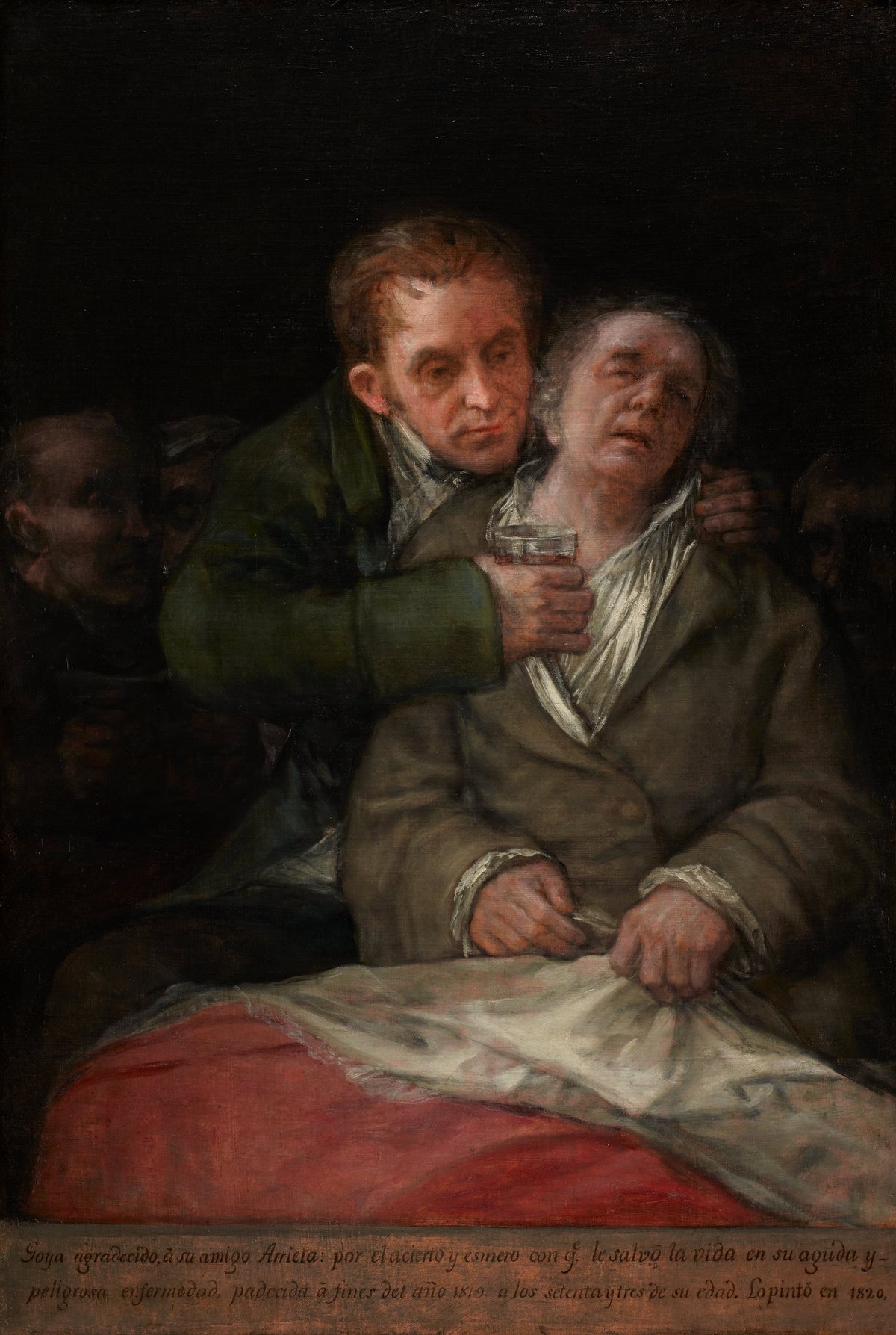
He moved in with Leocadia Weiss, a much younger woman who was still legally married to someone else, and her young daughter Rosario, who may have been Goya’s own child. At the end of 1819 he fell gravely ill. He survived, and in 1820 he painted a thank-you picture to his doctor, Eugenio García Arrieta, showing himself slumped and grey while Arrieta holds a glass to his lips. The inscription says the illness came at the end of 1819, “at seventy-three years of age.” The Black Paintings almost certainly came after that brush with death.
Here is a detail most accounts skip. Goya did not paint on bare walls. The rooms already had pleasant country scenes on them, small figures in landscapes, and the Black Paintings went on top. Some scholars think Goya painted the cheerful versions first and then covered them. Nigel Glendinning, the British Goya specialist, thought the landscapes were already there when he bought the house. Either way, somebody took a sunny room and painted it black.
Saturn was on the ground floor, in the room usually described as the dining room. Six murals shared that space. Leocadia, dressed in mourning, leaned on a mound by the door. Two old men stood opposite. The long walls held a witches’ sabbath and a nightmare pilgrimage to San Isidro. And on the short back wall, flanking the window, were two scenes of a body and a mouth: Judith cutting off the head of Holofernes on the right, and Saturn eating his child on the left.
The Saturn Devouring His Son story, from Hesiod to a dining-room wall
The myth is older than Rome. In Hesiod’s Theogony, written in Greece around 700 BC, the Titan Cronus takes power by castrating his own father, the sky god Uranus, with a sickle. Then comes the prophecy. One of Cronus’s own children will overthrow him the same way. So every time his wife Rhea gives birth, Cronus swallows the baby. Hestia, Demeter, Hera, Hades, Poseidon. Five children, gone. When the sixth arrives, Rhea hands her husband a stone wrapped in swaddling clothes, and he swallows that instead. The real baby is hidden on Crete. He grows up to be Zeus, forces his father to vomit up his siblings, and the war that follows puts the Olympian gods in charge of the universe.
The Romans folded Cronus into their own farming god, Saturn, the one who gave his name to the Saturnalia festival and to Saturday. Somewhere along the way, Cronus also got tangled up with Chronos, the Greek word for time. By the Renaissance the two had merged completely. Saturn became Father Time, an old man with a scythe and an hourglass, and the cannibal story became an allegory everybody understood. Time eats everything it makes.
Notice one thing about the ancient version. Cronus swallows his children whole. That is the entire point of the story: they survive inside him and come back out. Goya’s Saturn does not swallow anything whole. He tears. He chews. The body in his hands will not be coming back.
What Goya left out
Stand in front of the picture and run through the checklist a nineteenth-century viewer would have expected. Scythe? None. Hourglass? None. Wings, a cloak, a throne, a Mount Olympus, a sky? Nothing. There is a body, a giant, and black. That is the whole painting.
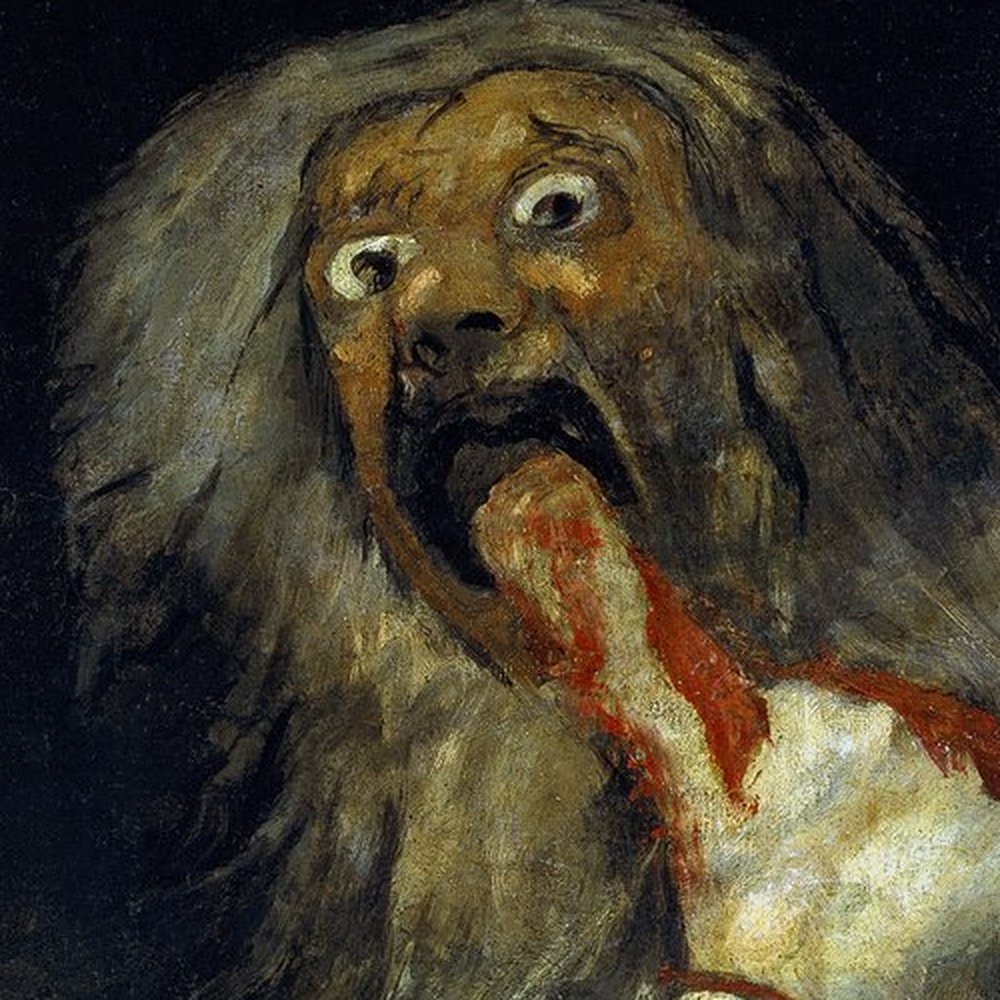
Look at the eyes first, because everybody does. They are not the eyes of a predator. They are huge, white, and terrified. This is a creature who knows exactly what he is doing and cannot stop. The American art historian Fred Licht pointed out how much the missing attributes matter: without the scythe and the hourglass, he argued, the title itself “may very well be misleading.” We call it Saturn because the inventory made after Goya’s death called it Saturn. Goya called it nothing.
Then look at the body. It is not a baby. It is an adult-proportioned figure, already headless, the right arm gone, the left arm halfway into the giant’s mouth. Blood runs in thin red streaks down both sides of the torso. There has been a long, unresolved argument about whether the victim is even male. The art historian John Ciofalo reads the curve of the hips and legs as female. Others see a young man. Honestly, the paint does not settle it, and the fact that it does not settle it is part of why the picture refuses to sit still.
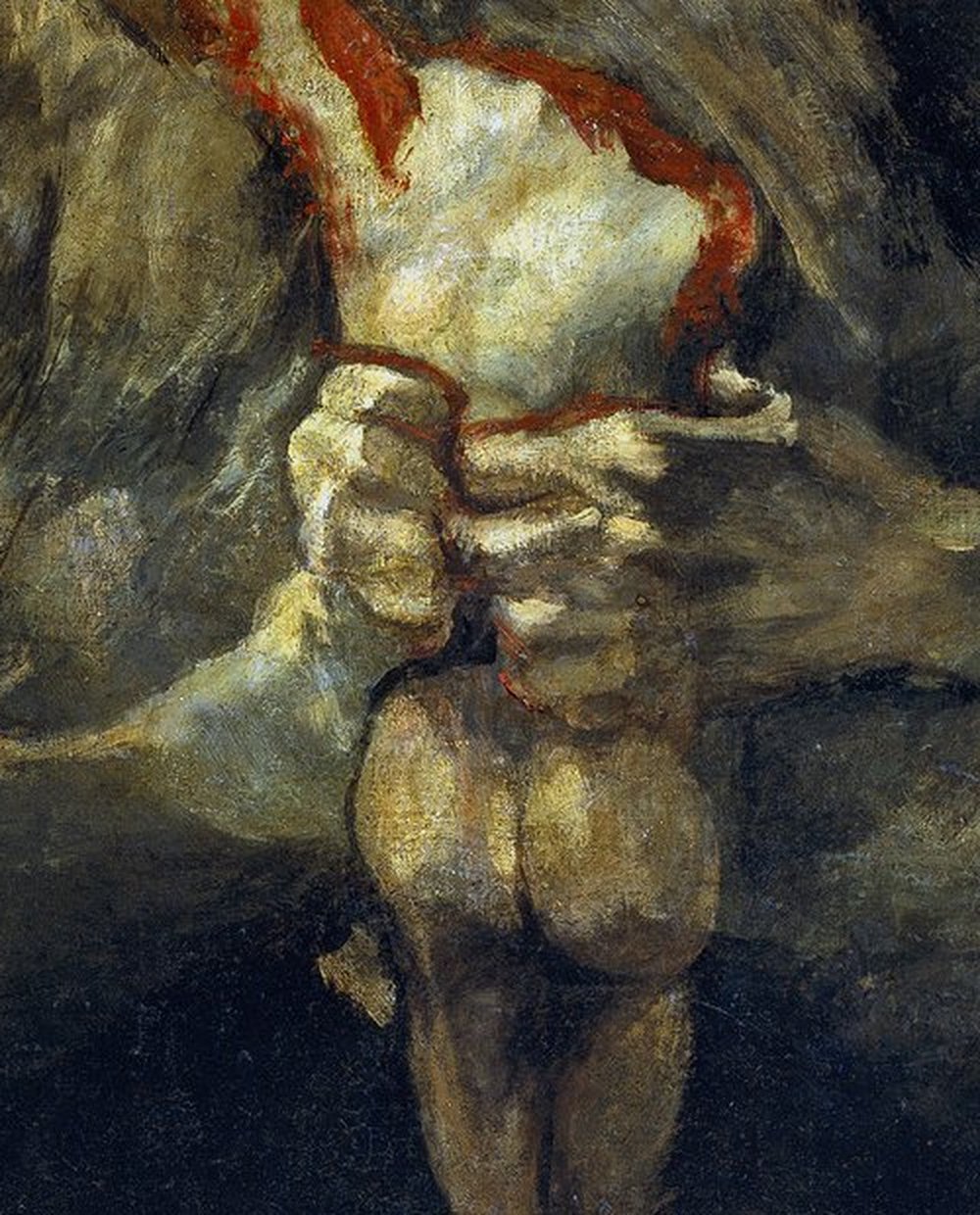
And look at the hands. The knuckles are pale with pressure. The fists close around the waist so hard the flesh seems to fold. Goya had drawn this subject once before, in red chalk, around 1796 or 1797: a Saturn biting a leg while holding a second child. It is a competent, almost academic drawing. Nothing in it prepares you for the grip in the mural. Twenty-odd years, two wars and two near-fatal illnesses separate the two pictures, and you can feel every one of them in those hands.
Hacked off the walls
Goya never came back for his murals. In 1823 the brief liberal government in Spain collapsed, a French army restored King Ferdinand VII to absolute power, and liberals started disappearing. That September Goya signed the house over to his grandson Mariano. In 1824 he left for France, and he died in Bordeaux on April 16, 1828. The pictures stayed on the walls, in a house that changed hands several times, slowly flaking.
In 1867 the French writer Charles Yriarte visited and described what he saw. Around 1874 a photographer named Jean Laurent came in with his camera and recorded the murals where they stood, the only record we have of them in their original setting. His photograph of Saturn is grainy and grey, with the painted border that framed the mural on the wall still visible around it.
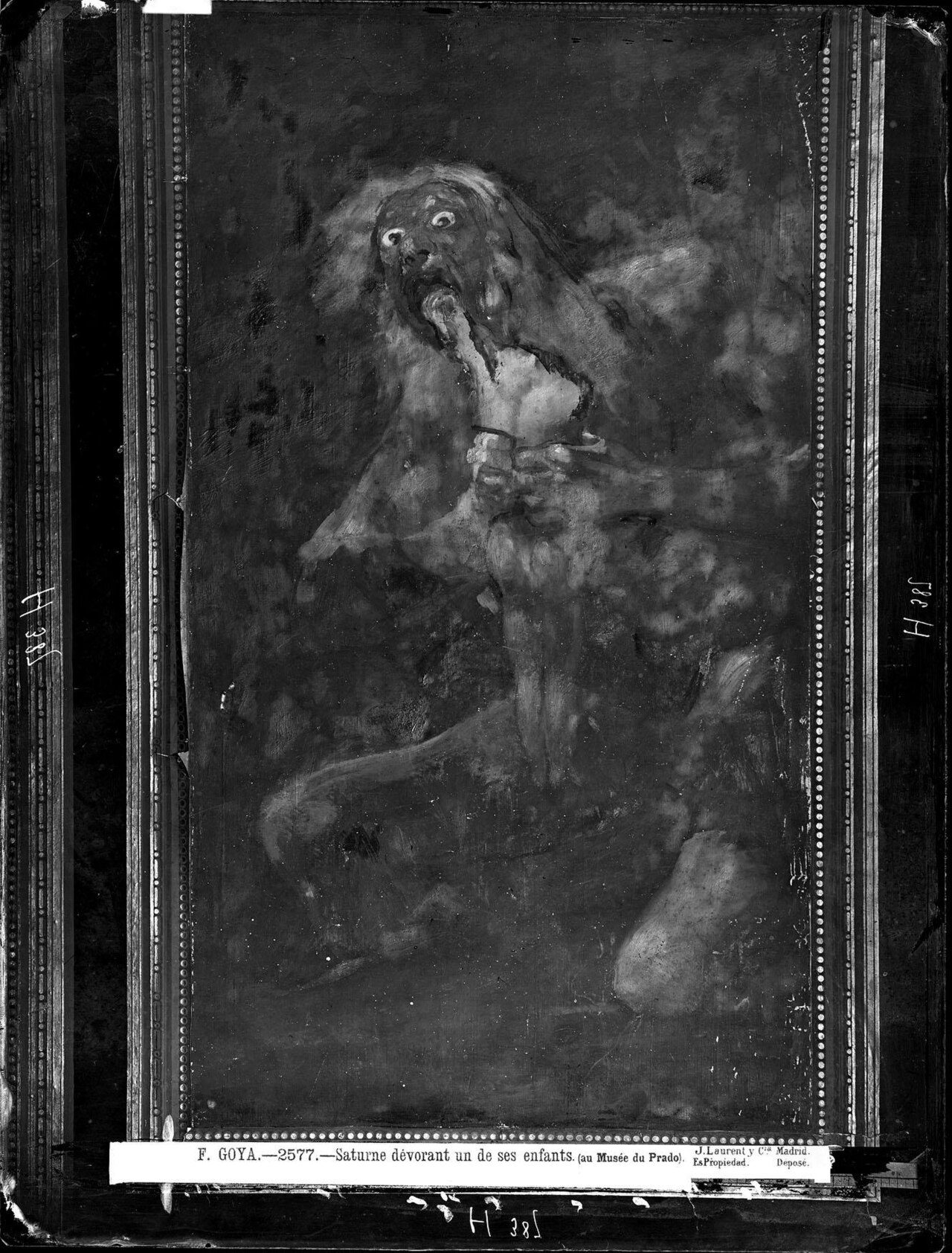
The man who sent Laurent was Baron Frédéric Émile d’Erlanger, a French banker of German origin who had bought the house. He wanted the murals off the walls and onto canvas, partly to save them and partly to sell them. The job went to Salvador Martínez Cubells, the Prado’s restorer, starting in 1874. The paint was lifted from the plaster and backed with canvas, a brutal operation that cracked and stripped parts of every picture. Martínez Cubells then retouched what was damaged. D’Erlanger showed the transferred Black Paintings at the Paris World’s Fair of 1878, where, by most accounts, nobody wanted them. In 1881 he gave all fourteen to the Spanish state.
So the Saturn you see today is Goya’s paint, but not untouched Goya. Which brings us to the most notorious claim about it. It has been said for decades that Goya’s original showed the giant with an erection, and that it was painted out during the transfer, possibly at the client’s request. The critic Robert Hughes repeats the story in his book on Goya. People who set the canvas beside Laurent’s photograph have argued about the groin area for years, and the photograph is too murky to settle it. Nobody has proof of exactly what was on the wall. If it was there, it would change the picture from a scene of hunger to something even worse, a scene of appetite in every sense, and that may be why the story has proved so hard to kill.
One more wrinkle, for completeness. In 2003 the Spanish art historian Juan José Junquera argued that the house had only one floor in Goya’s day, so the upper-floor murals could not be his, and suggested Goya’s son Javier as the real painter. Glendinning answered him at length, and the Prado treats the Black Paintings as Goya’s. That is where the consensus sits.
Saturn Devouring His Son meaning: pick your nightmare
Because Goya left no notes, every reading is a reading. Here are the four that matter, and where we land.
Time eats everything. This is the classical meaning, the one the title points to. Saturn is Chronos, and Chronos devours what he creates. It fits an old man who had just nearly died. It is also the least interesting reading, because the painting has deliberately thrown away every symbol of time it could have used.
Spain eats its own children. Goya painted these walls between roughly 1820 and 1823, during the Liberal Triennium, the three years when Spain had a constitution, and the old order was preparing its comeback. He had already lived through the French occupation and recorded its atrocities in the etchings called the Disasters of War. A country in which Spaniards kept killing Spaniards, a crown that turned on the people who fought for it: the political reading is natural, and it is the one most guides lead with. It is also a little too neat. Nothing in the painting is a flag.
Old age, illness and the fear of madness. Goya was deaf, recovering from an illness that nearly killed him, sharing a house with a much younger woman, and watching friends go into exile. Saturn’s eyes are the eyes of someone who is horrified by himself. Some writers have connected the subject to Goya’s own family. He and his wife Josefa Bayeu had several children, and only one, Javier, survived to adulthood.
An inversion of an old slander. Licht offered a darker idea: that the image turns around the old antisemitic blood-libel pictures, which slandered Jews as eaters of Christian children, and hands the crime back to a figure of power. He admitted he could not prove it, and he also warned that we should take the title “with a grain of salt.”
Here is where we come down. The painting is not about one thing, because it was never made to explain itself to anyone. It is one of the most private pictures ever made: an image Goya chose to look at while he ate. Whatever he was afraid of, he wanted it in the room with him. That is the real meaning, and it is more disturbing than any allegory.
Rubens’s Saturn devouring his son, and why it is less frightening
Goya had a model, and it belongs to the same museum. Around 1636 to 1638, Peter Paul Rubens painted his own Saturn for Philip IV’s hunting lodge, the Torre de la Parada, in the hills outside Madrid. It was part of a huge cycle of mythological scenes the lodge commissioned from Rubens and his workshop. When the lodge was damaged in the War of the Spanish Succession, the pictures moved into the royal collection, which is where Goya, the court painter, would almost certainly have seen it.
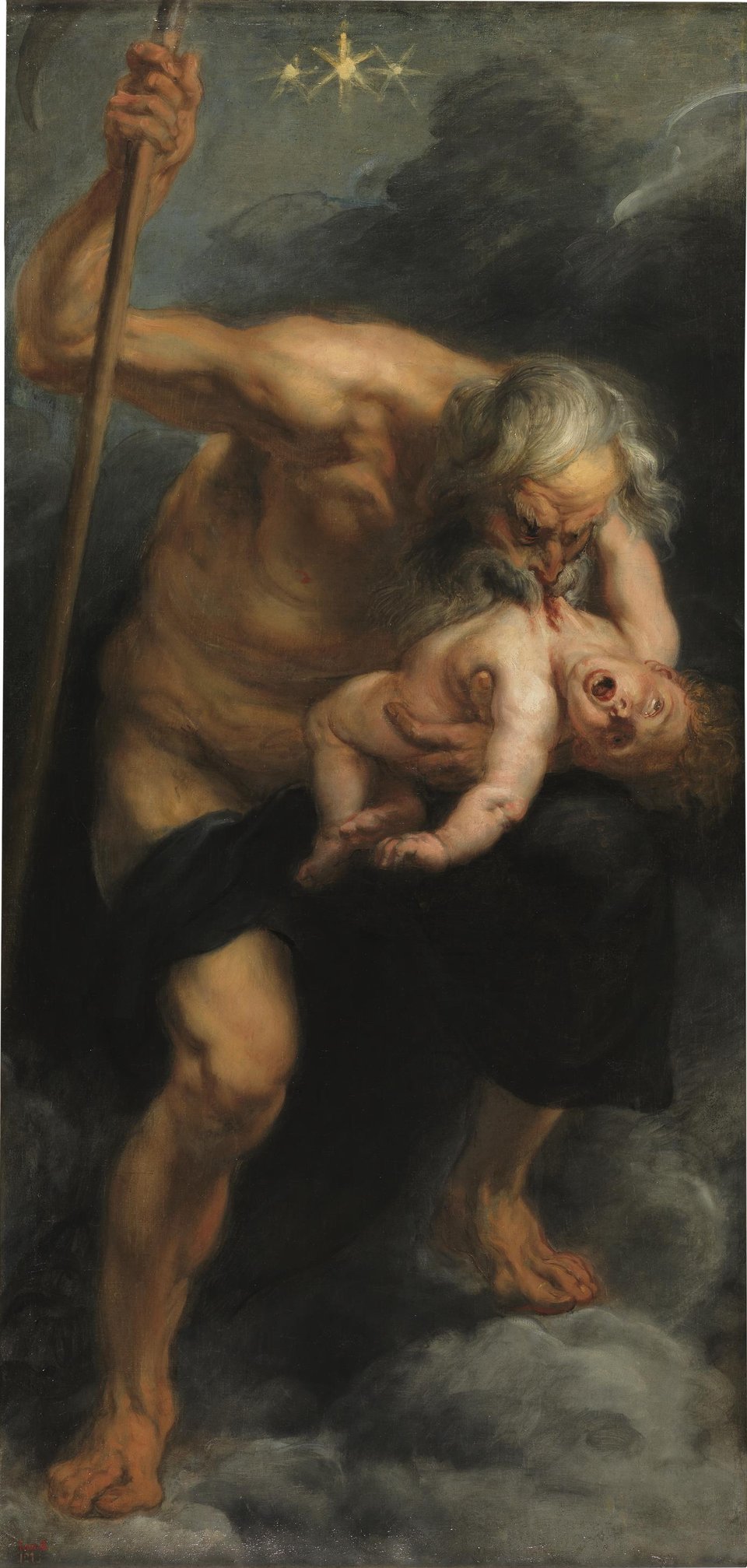
Rubens’s version has everything Goya’s lacks. The god leans on his scythe. He has a dark cloak and a bank of clouds to stand on. He is muscular, healthy, and calm. And the child is very much alive, a screaming baby with its head thrown back while the old man bites into its chest. In some ways the Rubens is crueller, because the victim feels pain. But it is a picture of an event. You understand it, you admire the brushwork, you move on.
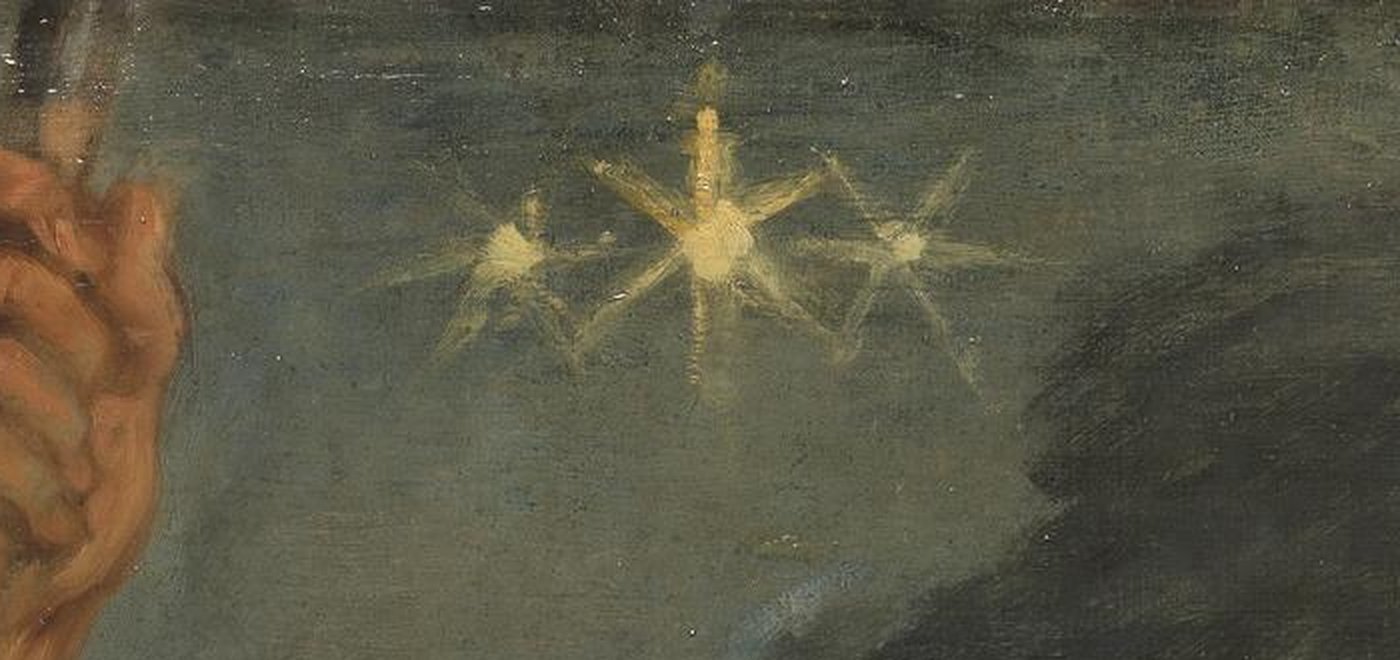
Look up, too. Above Rubens’s Saturn sit three bright stars in a line. The middle one is bigger than the other two. That is the planet Saturn as Galileo described it in 1610, when his telescope was too weak to resolve the rings and showed him one body flanked by two smaller ones. A Flemish painter, working for a Spanish king, slipped the latest astronomy into a Greek myth.
Goya took the subject and stripped out every comfort Rubens offered: the attributes, the sky, the living victim, the clear story. What is left is not a god. It is a man-shaped thing in the dark who has already gone too far. Put the two side by side and you can watch the Baroque turn into the modern in a single subject.
From dining room to reaction image
The afterlife has been strange. The picture that Goya hid on a dining-room wall is now one of the most shared images on the internet, cropped, captioned and recycled as a joke about everything from finishing a sandwich to the end of a semester. People who could not name another painting in the Prado know this one.
That would probably have amused Goya more than it offends us. He was a satirist long before he was a painter of horrors. His Caprichos etchings, published in 1799, mocked priests, doctors, aristocrats and fools with the same sharp line. The meme is a cheap echo, but it is an echo of something real: the image is so strong that it survives being turned into a punchline.
Where is Saturn Devouring His Son?
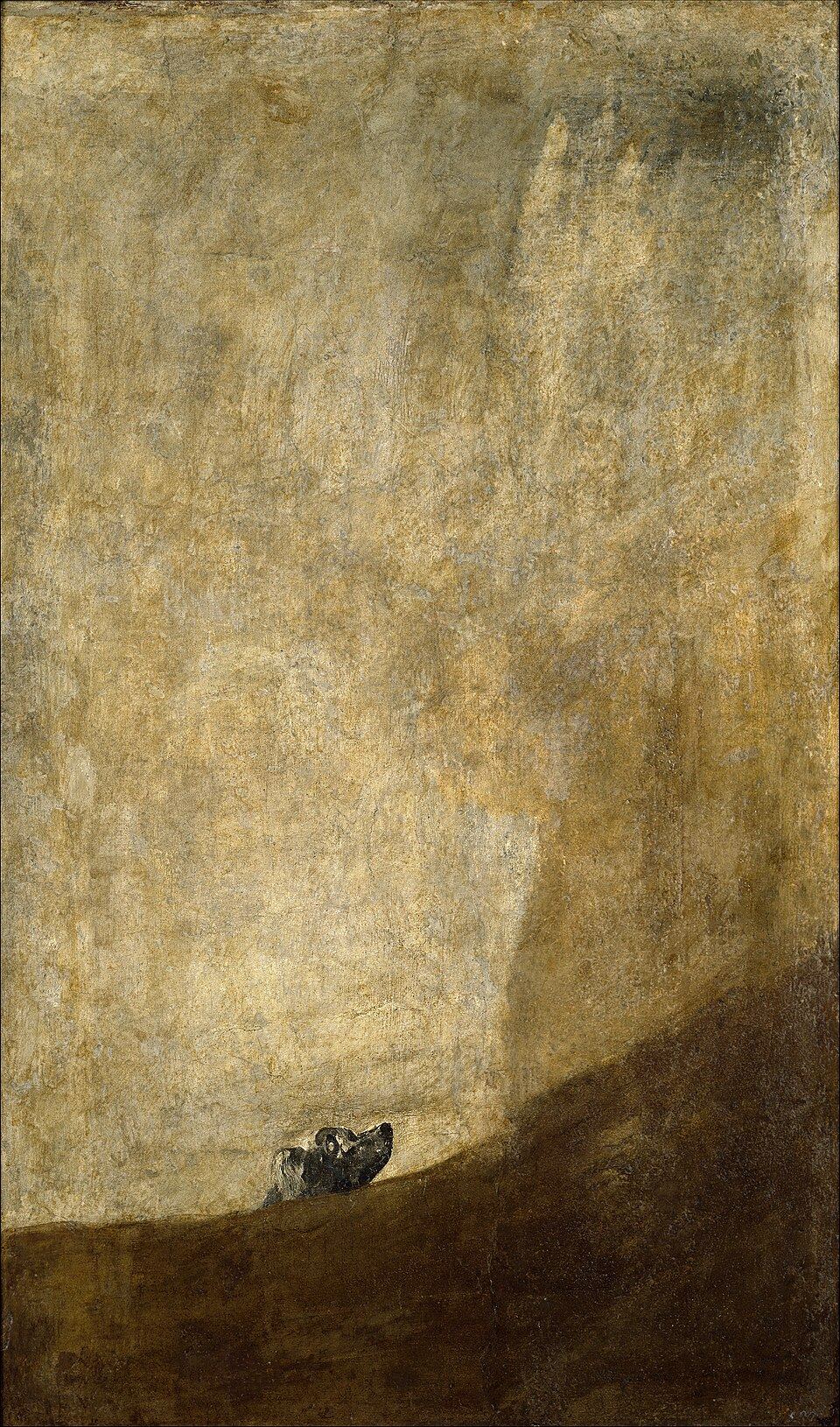
The painting is in the Museo del Prado in Madrid. The Black Paintings occupy Rooms 66 and 67 on the ground floor of the main Villanueva building, and Saturn is in Room 67. The Prado roughly mirrors the two floors of the house, so the ground-floor murals and the upper-floor murals sit together as they did in the Quinta del Sordo. If you can, walk them in order: the dining-room pictures first, then the upstairs ones, ending at The Dog, the small head peering out of an empty brown field that many people end up liking best.
Expect it to be smaller than you imagined. The canvas is 143.5 by 81.4 centimetres, about four feet eight by two feet eight. On a phone screen Saturn looks monumental. In the room he is roughly your height if you crouched, which is in a way worse. It is a picture made to be seen from a dinner table.
A few practical notes. The Prado is open Monday to Saturday from 10 a.m. to 8 p.m. and on Sundays and holidays until 7 p.m., and the permanent collection is free for the last two hours of every day, which means long queues at exactly that time. Photography is not allowed in the galleries, so you will be looking with your eyes, which is the right way to see this one anyway. The Prado visiting guide has the tickets, entrances and timing, and the Prado highlights walk puts the Black Paintings in context with Velázquez and Bosch upstairs. The Rubens Saturn belongs to the same collection, though the Prado rotates what hangs, so check the online collection before you go if seeing both on the same day matters to you. Our free Prado audio guide also has a dedicated stop for Saturn, and it plays in your browser.
What to look for
Stand back first, at about the distance you would sit across a table, because that is where Goya expected you. From there the painting is mostly black, and the figure seems to lunge out of it. Then step closer and find the eyes, the knuckles, and the thin red lines running down the victim’s back, which are put down almost casually, the way you would draw a vein. Look at the bottom left, where the giant’s knee dissolves into the dark, and notice how little Goya bothered to finish. Chiaro is useful at exactly that distance, because the story of the dining room, the window between Saturn and Judith, and the Laurent photograph gets told while you are looking at the gripping hands, which is the detail that tells you the picture is about compulsion rather than hunger.
Then, before you leave the Black Paintings, find Judith and Holofernes. In the house, the two hung on either side of the same window. One is a woman killing a man with a blade. The other is a father eating his child. Goya ate his dinner between them for the last few years he lived in Spain.
The core of it fits in one sentence. The most famous horror picture of the nineteenth century was painted by an old man for his own wall, and the face he gave his monster is the face of someone who cannot believe what he is doing.