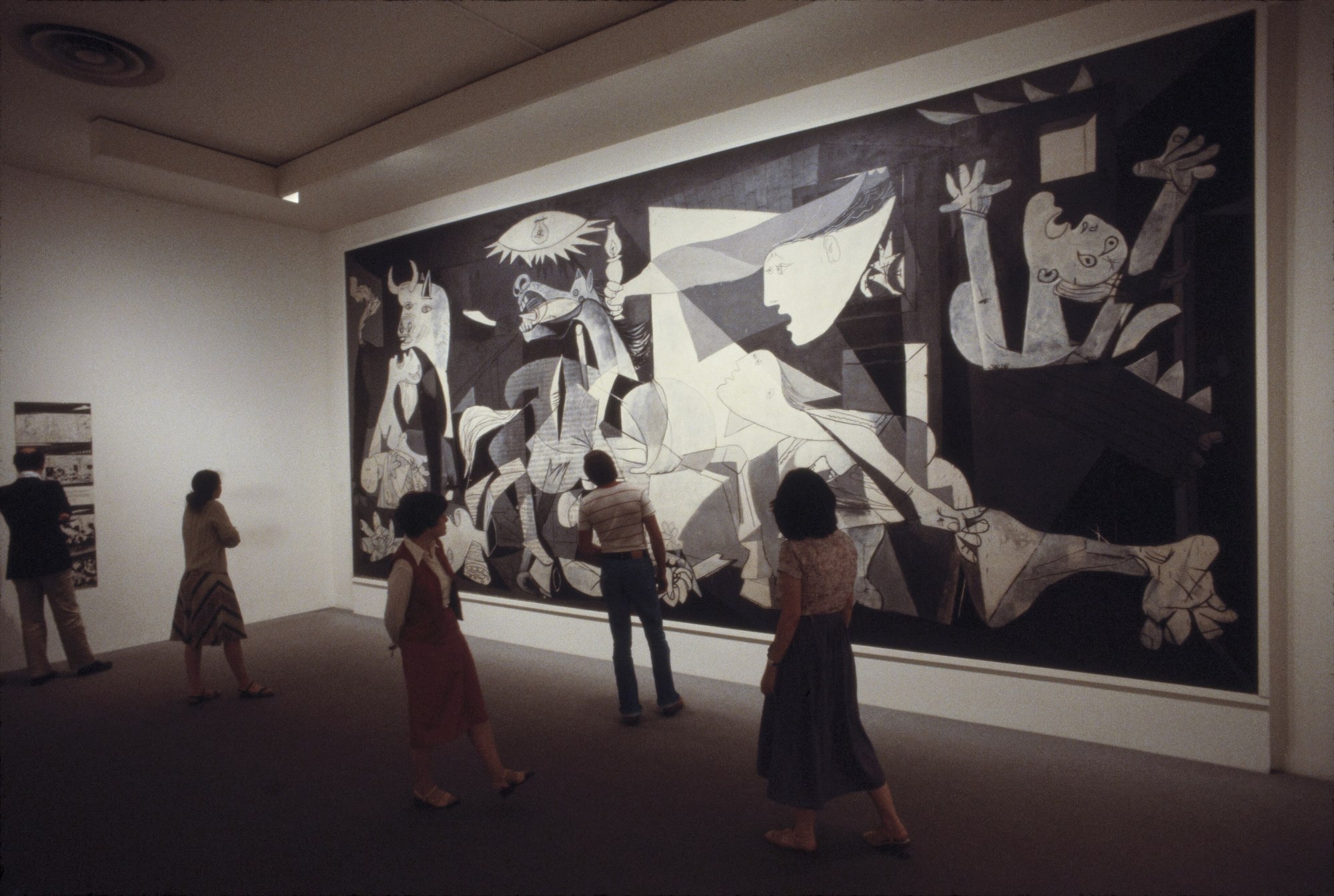
The rented attic at 7 rue des Grands-Augustins in Paris was too low for the canvas Pablo Picasso wanted to paint. Its wooden beams sat below 3.49 metres, so Picasso had to tilt his nearly eight-metre stretcher backward against the rafters like a leaning ladder. Reina Sofía conservators confirmed that tilt in 2012, when an automated scanner named Pablito mapped old tack holes and a slight crease along the top edge. From his first sketches on May 1 to the finished mural on June 4, 1937, Guernica took thirty-five days, with Picasso painting against that slanted canvas from May 11 onward.
Since January he had been stalling on a mural commission from the Spanish Republican government for the Paris International Exposition. On April 18 and 19 he finally sketched quiet studio allegories of a painter and his model and set them aside.
Then came Monday afternoon, April 26, 1937, market day in the Basque town of Gernika. Bombers from Nazi Germany’s Condor Legion and Fascist Italy’s Aviazione Legionaria flew over the town in waves for more than three hours, testing high-explosive and incendiary carpet bombing on civilians for General Francisco Franco. That night George Steer, a twenty-seven-year-old South African correspondent for The Times of London and The New York Times, drove into the burning ruins and picked up aluminum German incendiary tubes stamped “Rheindorf 1936.” He wired his dispatch from Bilbao on April 27, putting Gernika on front pages in London, New York, and Paris on April 28. Picasso saw the photographs in the Paris evening paper Ce Soir. On May 1 he drew his first six studies: five rapid pencil sketches on blue paper and a sixth in oil and graphite on plywood.
Why is Guernica in black and white?
Dora Maar, the surrealist photographer who found Picasso the rue des Grands-Augustins studio, photographed the canvas across seven progressive stages published alongside the finished state in Cahiers d’Art in 1937. One of her intermediate photographs shows patterned wallpaper cutouts pinned to the canvas, and the Spanish writer José Bergamín recalled Picasso testing bright scraps of colored paper on it too. Picasso tore them all off.
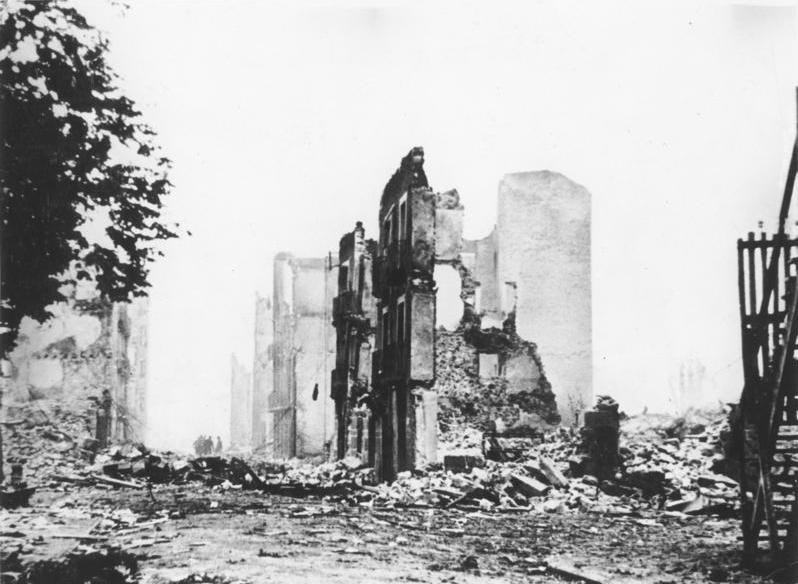
Color failed for two reasons. Although the Reina Sofía catalogs the painting as oil on canvas, Picasso ordered specially formulated matte Ripolin house paint so that no glossy glare would break up a twenty-five-foot wall. Nor had he seen the fires himself. Like readers across Paris, London, and New York, he met the raid through coarse black-and-white halftones in Ce Soir, L’Humanité, and Le Figaro. Step close to the horse in the middle of the canvas and you see hundreds of short vertical black strokes marching in neat columns across its hide, like lines of newspaper type.
Ten figures and symbols across the mural
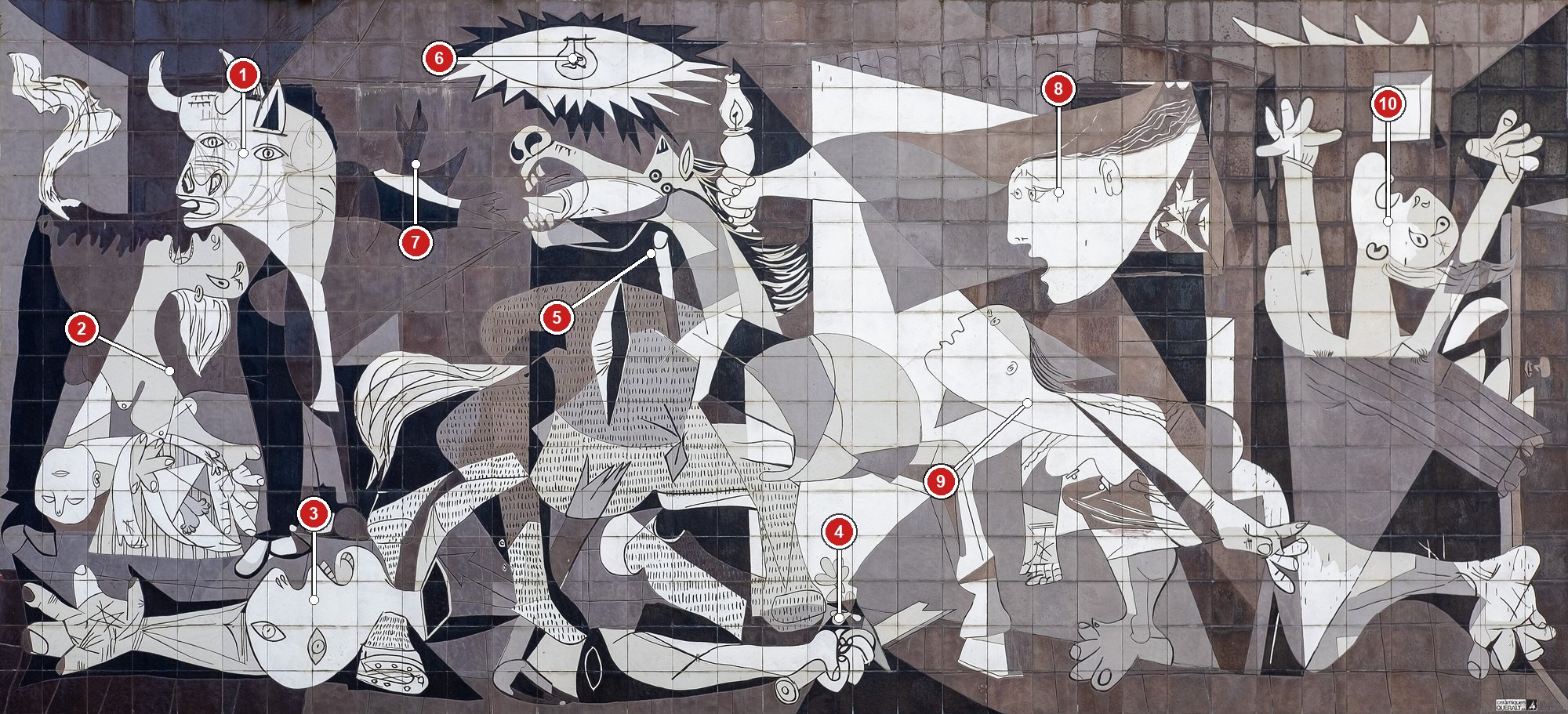
Nine animate figures and two light sources fill the continuous canvas, arranged in three triptych-like vertical sections from left to right. Picasso hated reducing them to a code. Pressed by MoMA director Alfred H. Barr Jr. in May 1947 to explain them, he replied through his dealer Daniel-Henry Kahnweiler that “this bull is a bull and this horse is a horse,” leaving viewers to read the symbols for themselves. Fifteen other crowded works get a numbered breakdown in our Famous Paintings, Every Figure Identified index.
| # | Figure or symbol | Where to find it | What to notice |
|---|---|---|---|
| 1 | The Bull | Upper left | White head turned outward, horns curved up, tail rising like smoke |
| 2 | Mother and dead child | Far left, directly beneath the bull | Head thrown back screaming, tongue shaped like a dagger, limp child across her knees |
| 3 | Dismembered soldier | Bottom left foreground | Hollow severed head and outstretched left hand scored with crossed fate lines |
| 4 | Broken sword and flower | Bottom center, in the soldier’s right fist | Shattered blade gripped tight, with a faint five-petaled flower sprouting beside it |
| 5 | The Screaming Horse | Dead center, heart of the pyramid | Gaping diamond wound in its flank, dagger tongue, coat covered in vertical newsprint dashes |
| 6 | The Electric Lightbulb | Top left-center | Bare filament bulb inside a jagged almond eye-sun; Spanish bombilla puns on bomba |
| 7 | The Wounded Bird | Dark wall between the bull and the horse | Black silhouette on a table with one bright white slash across its open beak and body |
| 8 | Woman with an oil lamp | Sweeping in from an upper window at right-center | Long arm thrusting a lit flame right up against the electric bulb, witness to the carnage |
| 9 | The Staggering Woman | Lower right-center | Dragging a swollen knee forward from the rubble, neck craned toward the lamp |
| 10 | Woman on fire, arms raised | Far right, inside burning rafters | Falling through triangular flames, both hands thrown straight into the air |
Left section: the broken warrior, the mother, and the bull
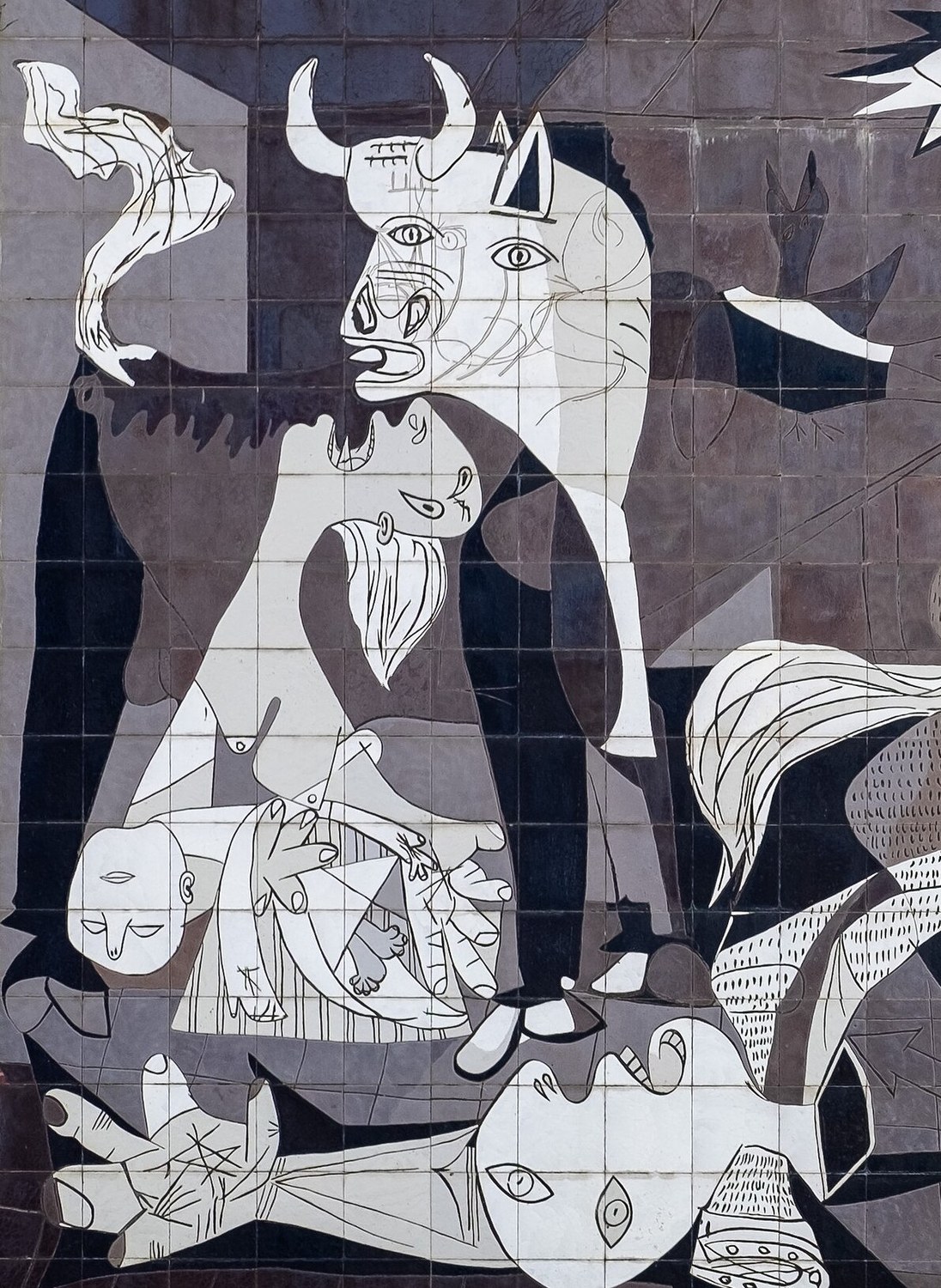
Along the bottom left lies the only fighter in the picture, broken into hollow pieces like a toppled plaster statue. His open left palm is scored with frantic lines, while his severed right arm reaches toward the middle of the floor clutching a snapped sword. A sword cannot touch a Heinkel bomber. Behind his knuckles rises the pale outline of a five-petaled flower, the sole living plant on the canvas.
In Dora Maar’s May 11 first-state photograph, that soldier raised a clenched Republican fist straight up through the middle of the composition. Picasso painted the salute out and laid the shattered blade flat on the ground, a change Chiaro walks you through while you stand in front of the finished canvas in Madrid.
Above the soldier’s arm kneels a screaming mother cradling her upside-down dead child, her eyes slipped sideways like teardrops and her tongue shaped like an iron spike. Over both of them looms the bull, untouched by the blast. In Maar’s early photographs the bull’s body faced right; Picasso later swung its dark rump into the left corner so its white neck towered over the mother. Anthony Blunt, citing Picasso’s 1945 remark to Jerome Seckler, read the bull as “brutality and darkness.” Juan Larrea, who helped organize the 1937 Spanish Pavilion, argued instead that the bull stood for the stubborn endurance of Spain’s people, while the gored horse was the innocent victim. Alone among the nine figures, the bull looks straight out at us.
Center section: the horse, the hidden bird, and the lightbulb
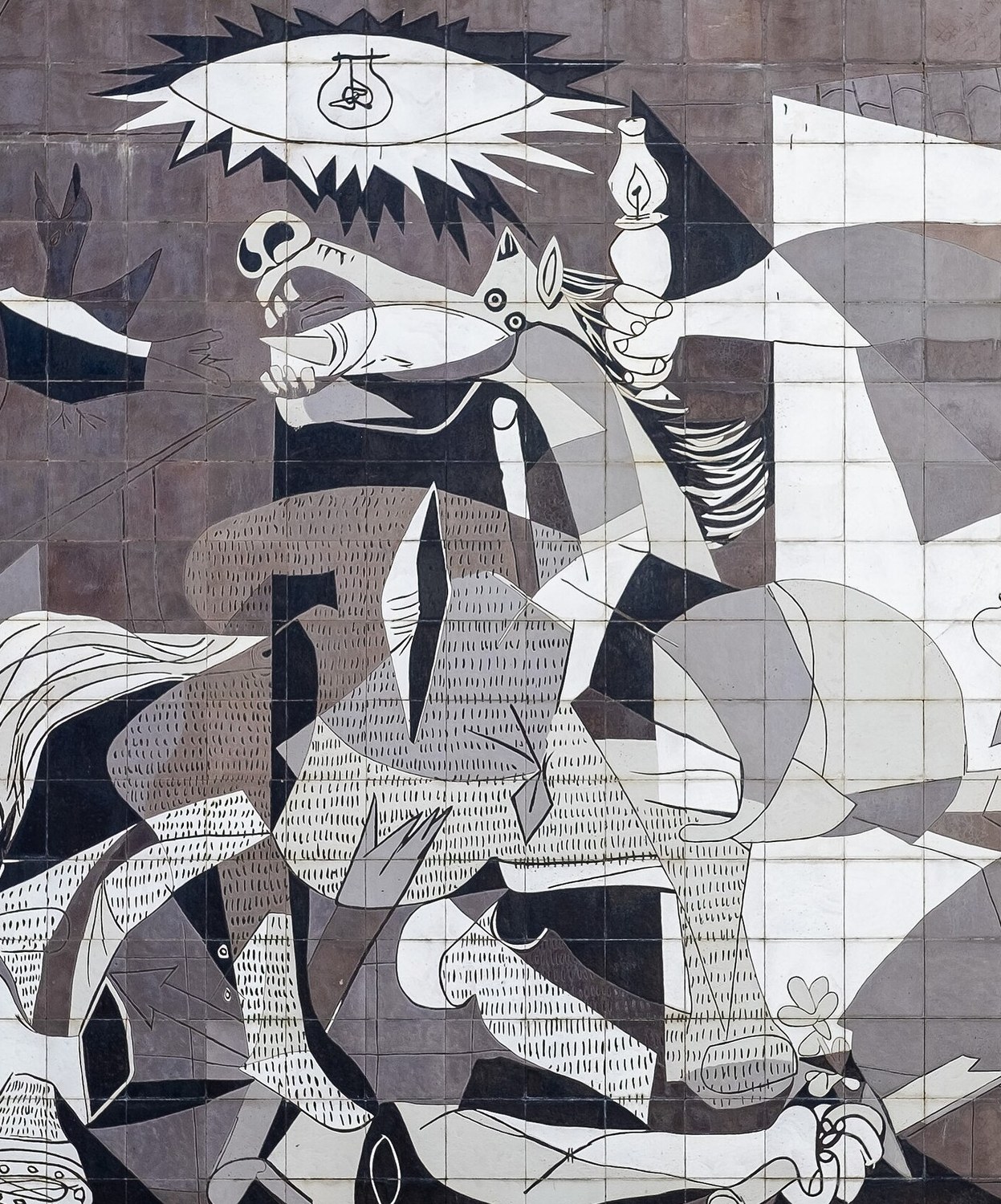
Picasso built the center around a classical Greek pediment triangle, anchored at its apex by the thrusting oil lamp, filled at its heart by the rearing horse, and pinned at its base corners by the soldier’s hand and the staggering woman’s trailing foot. A diamond gash splits the horse’s flank and a lance shaft pierces its back. In 1945 Picasso told Seckler plainly that the horse represents the people.
Look into the dark gap between the bull’s neck and the horse’s nose. A bird stands on a tabletop, painted almost the same charcoal tone as the wall except for a bright white slash across its chest and open beak.
Overhead hangs a jagged almond eye with a bare electric bulb, una bombilla in Spanish, in place of a pupil. In Dora Maar’s stage-two photograph, that spot held a conventional radiant sun before Picasso turned it into an eye and screwed a filament bulb inside. As the art historian Eberhard Fisch observed, bombilla sits one syllable away from bomba, turning modern technology into a cold eye staring down at the room it wrecked.
Right section: the oil lamp and Goya’s raised arms
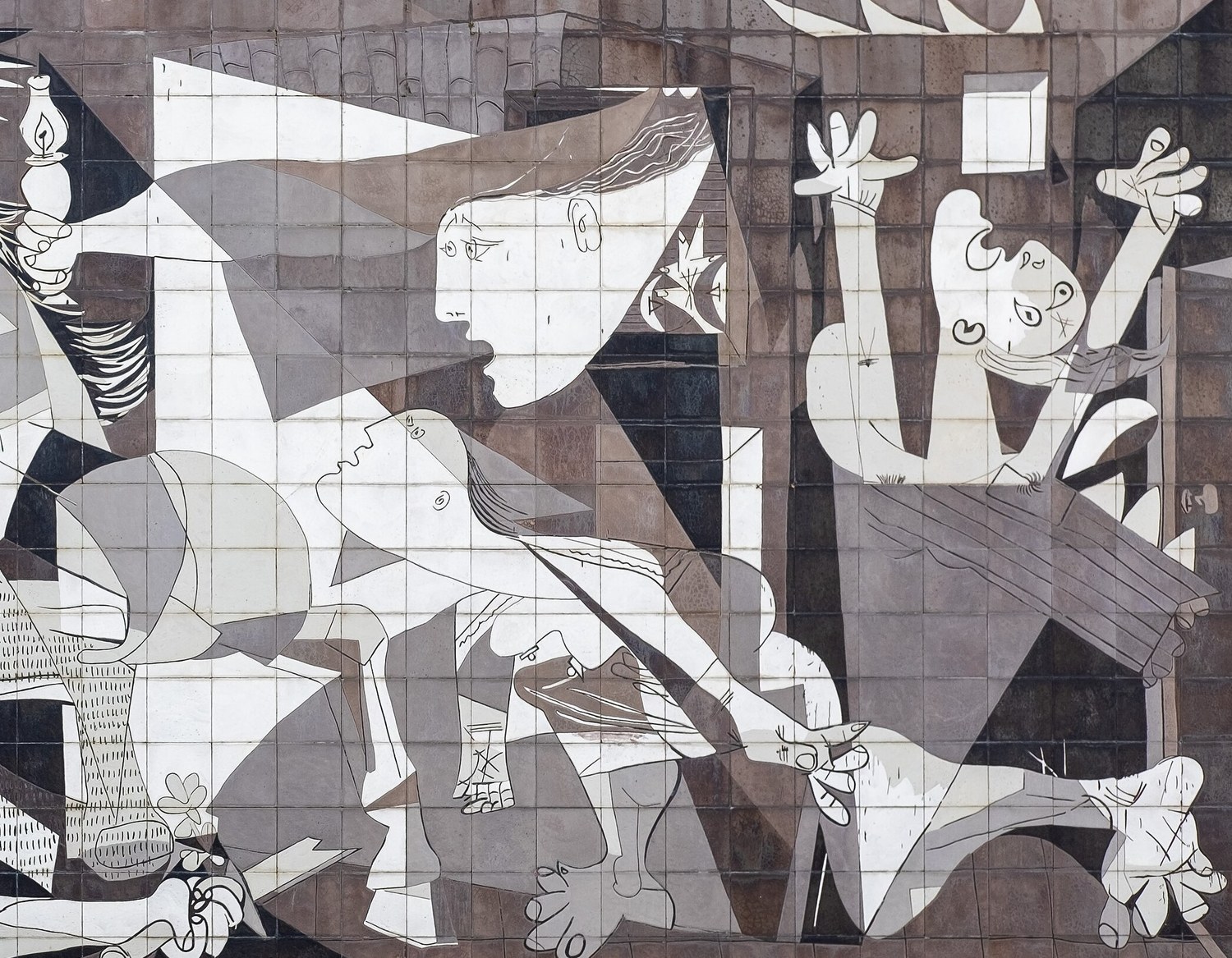
From an upper window on the right, a woman with a Greek profile sweeps inward and holds a small oil lamp right up beside the electric bulb. Below her, a second woman drags a swollen knee out of the rubble toward the flame. At the far right edge, trapped inside burning rafters, a third woman throws both arms straight up toward the ceiling.
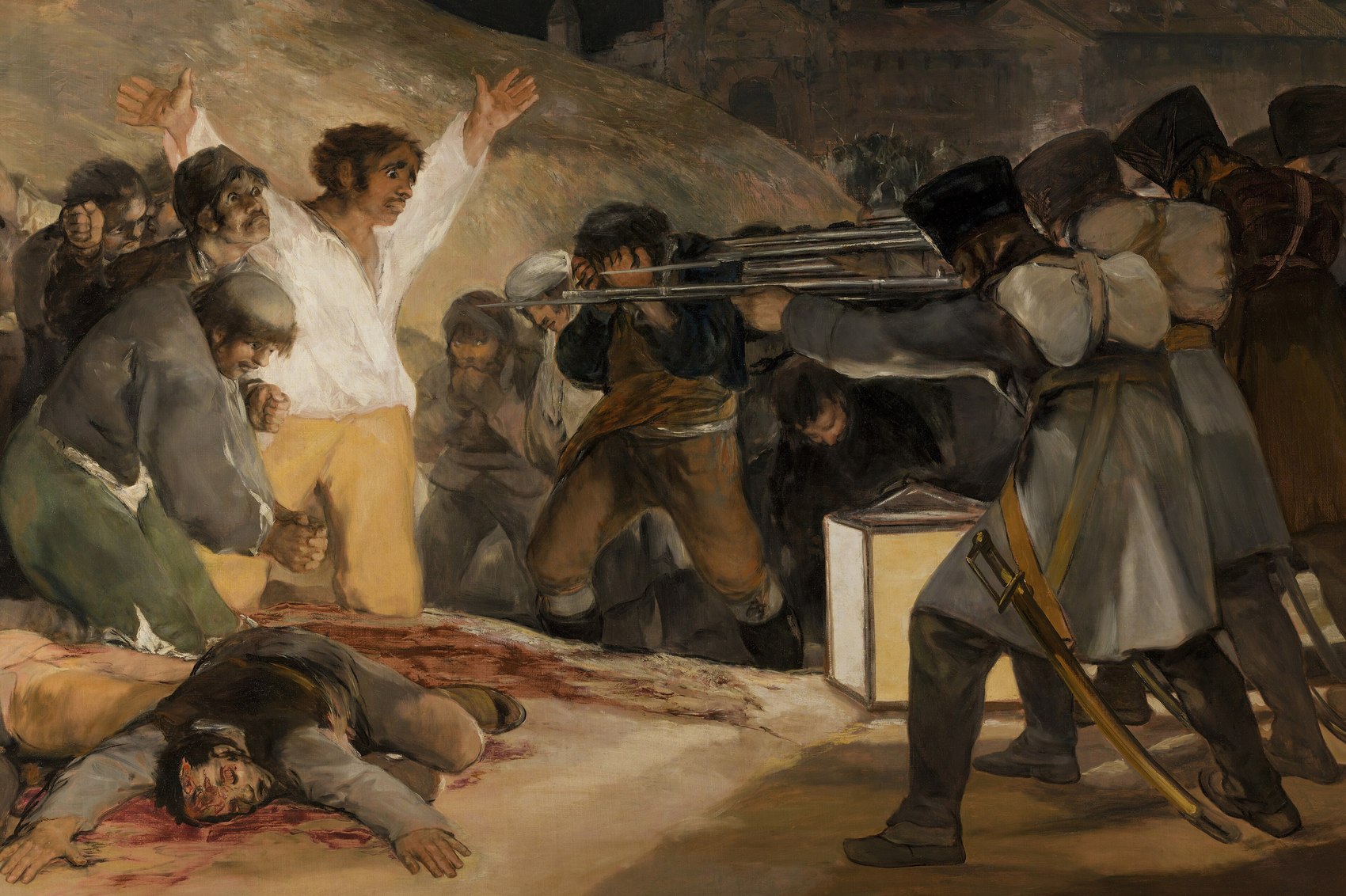
Ten minutes north up the Paseo del Prado at the Prado Museum hangs the source of those lifted hands. Picasso quoted the kneeling prisoner in the white shirt from Goya’s Third of May 1808, tying Franco’s bombers in 1937 to Napoleon’s firing squads in 1808. If you walk north to compare them, Goya’s dark late murals including Saturn Devouring His Son hang on the ground floor nearby, and our Prado highlights guide maps the rest of the building.
Did Picasso really say “No, you did”?
After the Paris World’s Fair closed in late 1937, Guernica toured Scandinavia, Britain, and the United States to raise money for Spanish relief; at London’s Whitechapel Gallery, East End workers paid admission with a pair of boots for Spanish refugees. When Franco won the Civil War and World War II began in 1939, Picasso placed the canvas on extended loan at the Museum of Modern Art in New York.
Meanwhile in occupied Paris, a famous rumor spread. Interviewing Picasso for Les Lettres Françaises in March 1945, Simone Téry asked him whether a Gestapo officer visiting his rue des Grands-Augustins studio had pointed to a reproduction of Guernica, asked, “Did you do that?” and received the answer, “No, you did.” Picasso laughed and answered, “Yes, it’s true, more or less true.” When Germans visited pretending to admire his paintings, he told Téry, he handed them postcard reproductions of Guernica and said, “Take them, souvenirs, souvenirs!”
In 1970 and 1971, through his lawyer Roland Dumas, Picasso set down in writing that the painting could not enter Spain until “public liberties” and democratic institutions returned. Picasso died in April 1973. Franco died in November 1975. On September 10, 1981, rolled inside a temperature-controlled crate aboard an Iberia Boeing 747 named Lope de Vega, Guernica landed at Madrid’s Barajas Airport, hung behind bulletproof glass at the Casón del Buen Retiro, and moved in 1992 to the Museo Reina Sofía.
Which room is Guernica in at the Reina Sofía?
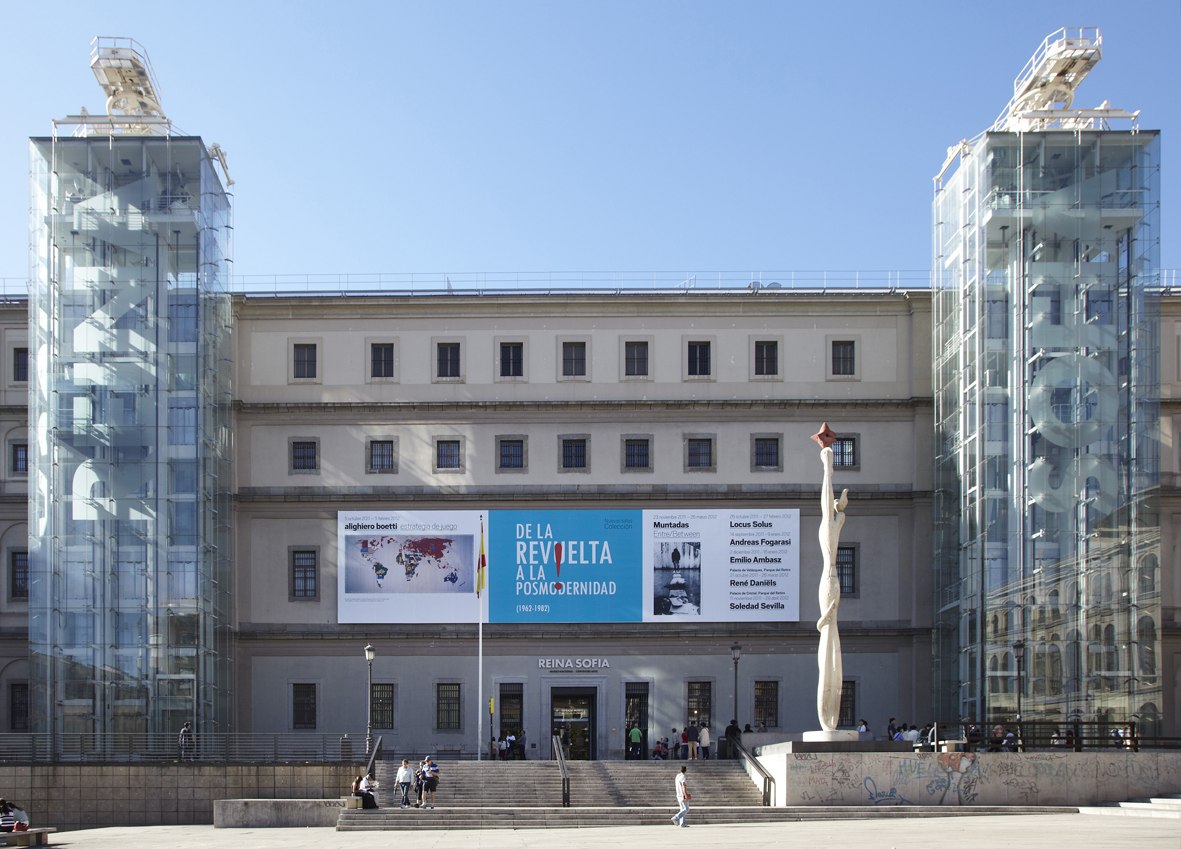
Guernica hangs in Room 205.10 on Floor 2 of the Sabatini Building at the Museo Nacional Centro de Arte Reina Sofía, Calle de Santa Isabel 52, opposite Atocha station. Room 205.10 and adjoining Room 205.09 also display Dora Maar’s twenty-eight vintage gelatin-silver prints alongside Picasso’s May 1937 sketches, including his May 2 graphite Study for the Horse Head II on blue paper.
The museum opens Monday and Wednesday through Saturday from 10:00 a.m. to 9:00 p.m., and Sunday from 10:00 a.m. to 2:30 p.m. It closes every Tuesday. General online tickets cost 12 euros, and entry is free during the final two hours before closing with a timed pass reserved on museoreinasofia.es. The canvas measures 349.3 by 776.6 centimetres and hangs without glass now; since September 2023, visitors in Room 205.10 have been allowed to photograph it without flash.