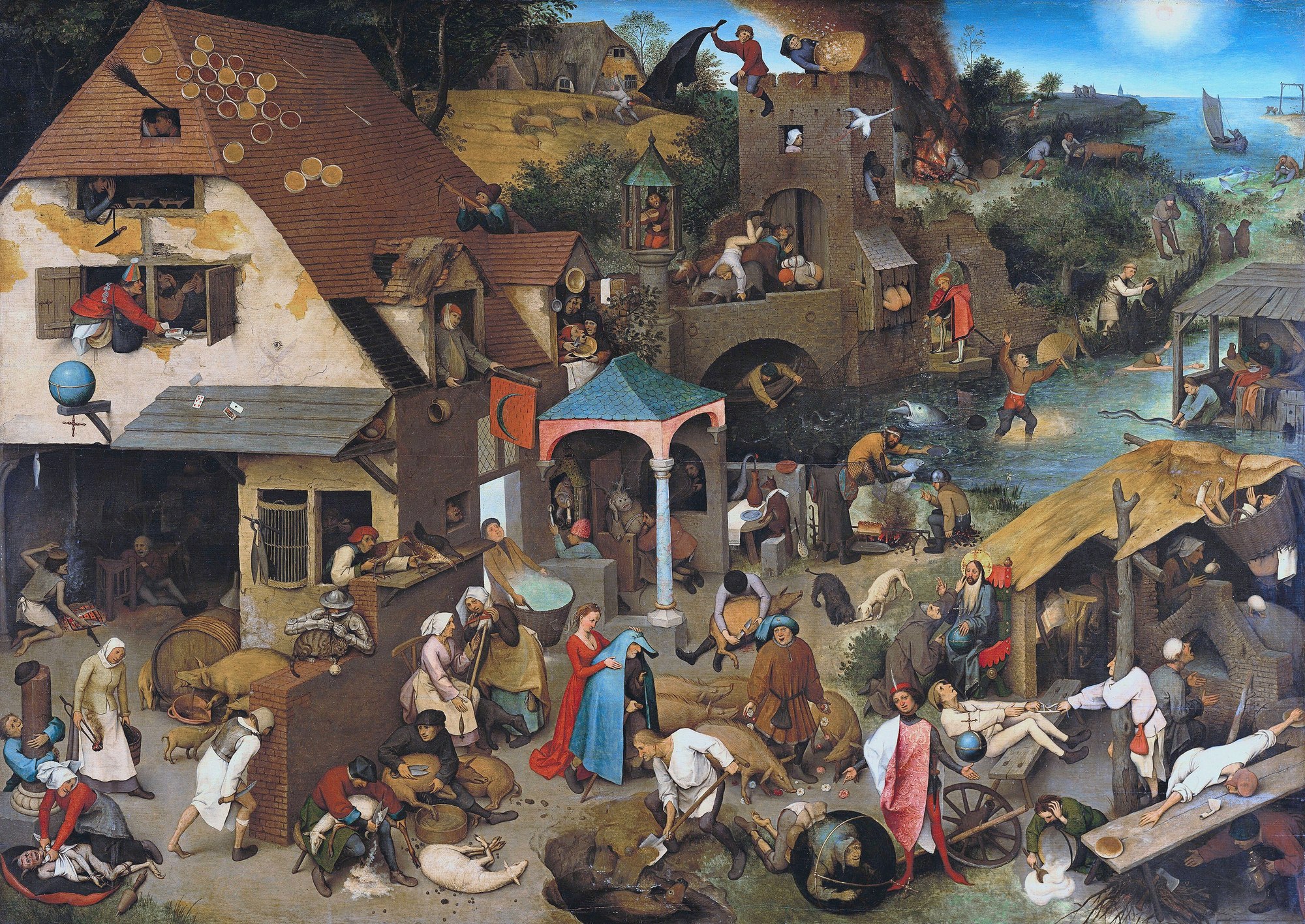
In 1558, the Antwerp printmaker Frans Hogenberg etched a popular two-plate broadsheet showing forty-odd everyday proverbs acted out by Flemish villagers. Beside every figure he lettered the exact Dutch phrase so nobody could miss the point. One year later, Pieter Bruegel the Elder took an oak panel more than five feet wide, signed it BRVEGEL 1559 in the lower right corner, crowded well over a hundred idioms into one sunlit coastal town, and left off every written label.
Why Antwerp hung proverbs in the dining room
Sixteenth-century Antwerp loved proverbs the way humanists loved Greek epigrams, ever since Desiderius Erasmus began publishing his classical Adagia in 1500 and sparked a craze that turned everyday idioms into dinner-table philosophy. Nobody in Bruegel’s lifetime called this panel Netherlandish Proverbs. Seventeenth-century Antwerp estate records listed such pictures as De Blauwe Huyck, The Blue Cloak, or in French as Le Monde renversé, The Topsy-Turvy World.
Today the oak panel hangs in Cabinet 7 of the Gemäldegalerie at Berlin’s Kulturforum, Matthäikirchplatz, ten minutes on foot west of Potsdamer Platz near Jan van Eyck’s Madonna in the Church and Hugo van der Goes’s Monforte Altarpiece. Doors open Tuesday through Sunday from 10:00 a.m. to 6:00 p.m., and close every Monday; regular tickets cost 14 euros, or 7 euros reduced, with free entry under 18 on smb.museum. Compared with the crowded Bruegel room in Vienna, Berlin’s side cabinets stay quiet enough to lean in close and spot two tiny playing cards on the wooden lean-to roof on the left.
Gemäldegalerie curator Rainald Grosshans cataloged more than a hundred distinct Dutch and Flemish expressions across those 117.2 by 163.8 centimetres, roughly 115 to 120 in modern scholarly counts. Because Bruegel stripped Hogenberg’s Dutch captions away, modern visitors miss the spoken game Antwerp hosts played at dinner, which is where pointing Chiaro at the oak panel helps: you can listen through the main scenes and ask aloud about any tiny unnumbered villager.
Twenty proverbs to orient the village
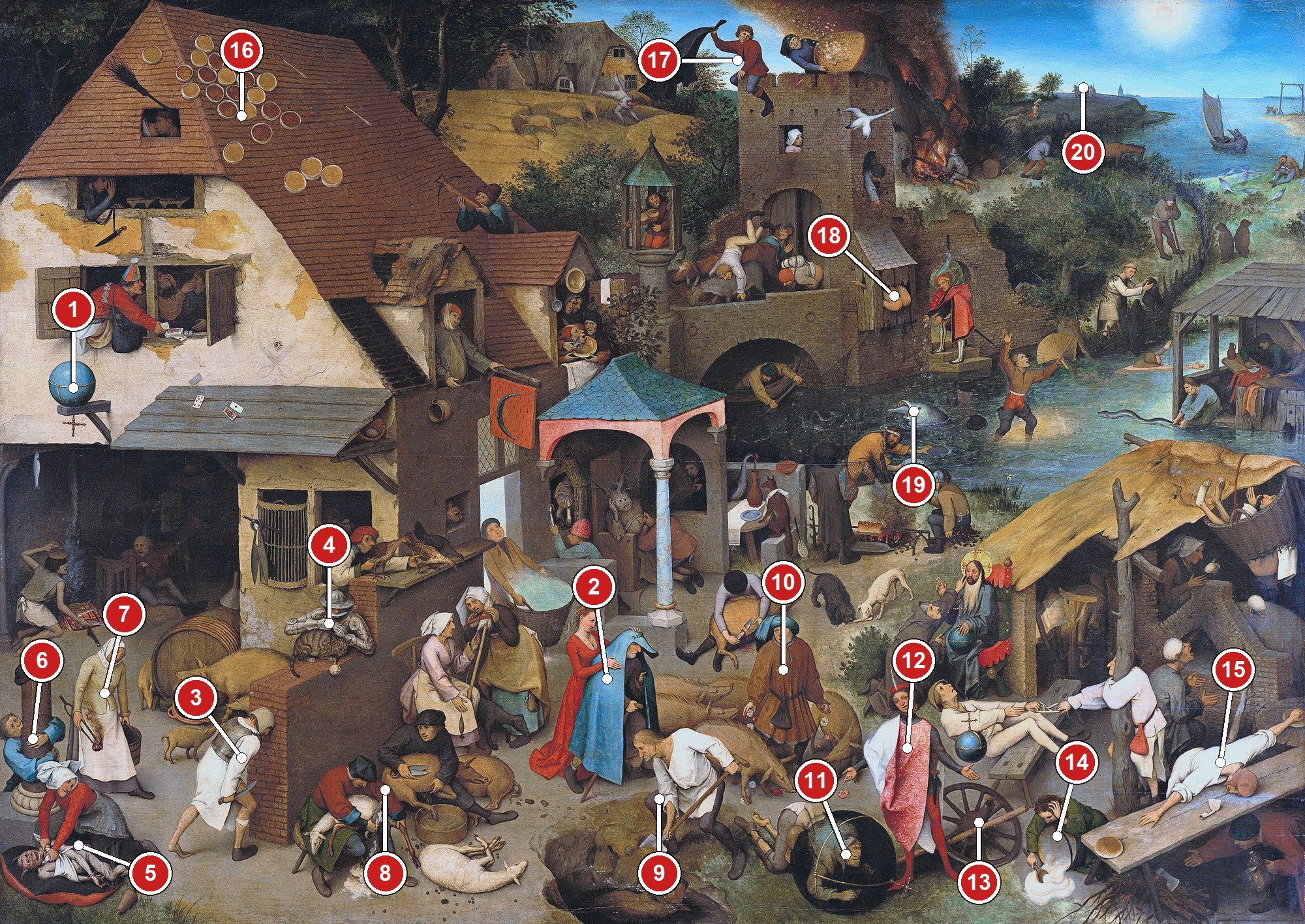
Once twenty scenes lock the map in place, the rest of the village stops swimming before your eyes; fifteen other canvases, panels, and frescoes get figure-by-figure guides in Famous Paintings, Every Figure Identified.
| # | Proverb on the panel | Where to find it | What it means |
|---|---|---|---|
| 1 | The world turned upside down | Blue orb with a cross under the left inn window | Everything in human life is backwards from how it ought to be |
| 2 | She hangs the blue cloak on her husband | Center foreground, woman in red | She is deceiving and cuckolding her older husband |
| 3 | Banging one’s head against a brick wall | Lower left, man in breastplate with leg bandage and knife | Trying by brute force to achieve the impossible |
| 4 | Armed to the teeth, belling the cat | On top of the brick wall, man in armor | Gearing up fiercely to attempt a reckless, foolish plan |
| 5 | She could tie the devil to a cushion | Bottom left corner, woman wrestling a demon | Stubborn obstinacy that intimidates even Hell itself |
| 6 | A pillar-biter | Far left edge above the demon, man in blue biting stone | A sanctimonious religious hypocrite |
| 7 | Carrying fire in one hand and water in the other | Left foreground, woman with tongs and bucket | Two-faced; saying one thing and plotting its opposite |
| 8 | One shears the sheep, the other shears the pig | Bottom left-center, two seated men with shears | One person takes all the profit while the other gets only noise |
| 9 | Filling the well after the calf has drowned | Bottom center, peasant with a spade over a pit | Taking precautions only after the disaster has already struck |
| 10 | Casting roses before swine | Center-right, man in blue cap scattering flowers | Wasting fine things on people who cannot value them |
| 11 | One must stoop to get through the world | Bottom right-center, man bent double inside a glass globe | Succeeding in worldly affairs requires humiliating compromises |
| 12 | Spinning the world on one’s thumb | Right foreground, dandy in a pink-and-white cloak | Having every advantage so the whole world dances to your tune |
| 13 | Putting a spoke in someone’s wheel | Wagon wheel beside the dandy’s red hose | Deliberately sabotaging someone else’s plan |
| 14 | Crying over spilled porridge | Bottom right, man scraping white mush off the dirt | Once damage is done, you can never gather it all back |
| 15 | Unable to reach from one loaf to the next | Slanted table at bottom right, man stretching between two breads | Living paycheck to paycheck, unable to make ends meet |
| 16 | A roof tiled with tarts | Top left gable roof covered in round pastries | Living in absurd abundance, like the mythical Land of Cockaigne |
| 17 | Hanging one’s cloak to the wind | High on the stone turret roof, man with black cape | Shifting opinions whichever way power happens to blow |
| 18 | Two fools defecating through one hole | Wooden latrine jutting off the turret wall | Inseparable cronies who agree on everything |
| 19 | Big fish eat little fish | River at right-center, giant silver fish surfacing in the water | The powerful devour the weak |
| 20 | If the blind lead the blind, both fall in the ditch | Tiny silhouettes on the far upper-right horizon | Ignorant leaders guiding equally ignorant followers to ruin |
How Bruegel turned labeled broadsheets into a silent game
Beneath the shuttered left window of the ruined inn hangs an imperial orb topped by a cross, hung upside down so its cross points into the dirt. Everything below obeys that topsy-turvy sign, starting at the brightest patch of scarlet and blue in the center foreground. A young woman in a red gown drapes a hooded blue cloak over her stooped husband. In sixteenth-century Dutch, putting the blue cloak on someone meant cuckolding him: blue stood for deceit, and red stood for sin and vanity.
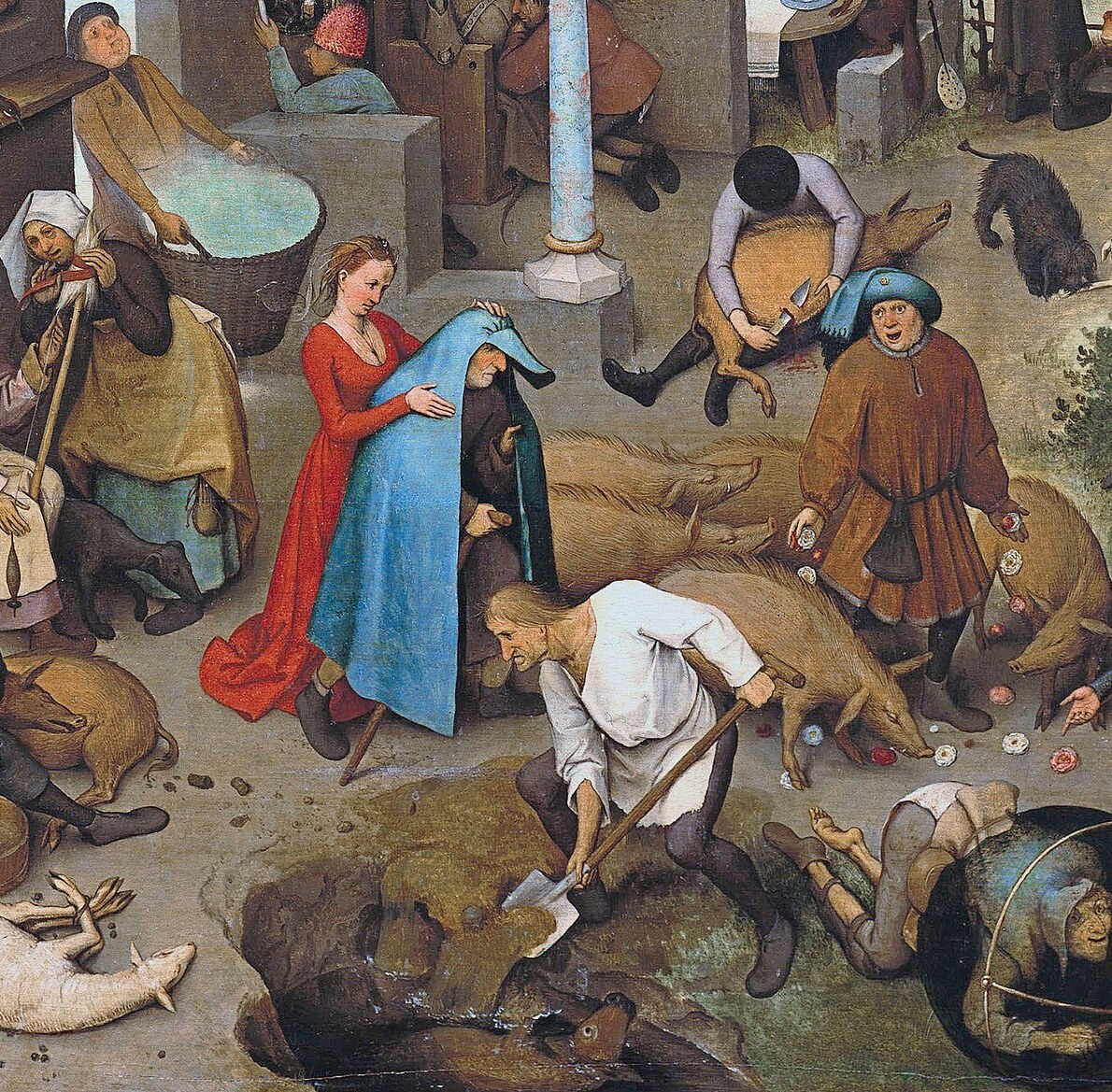
Look at how the Flemish broadsheet tradition handled the same joke. In the etched broadsheet below, a later Antwerp edition published by Theodoor Galle after the sixteenth-century print format, the wife and husband stand stiffly on a flat strip of ground with “Dese hangt haren man de blaeu huycke om” etched beneath their shoes.
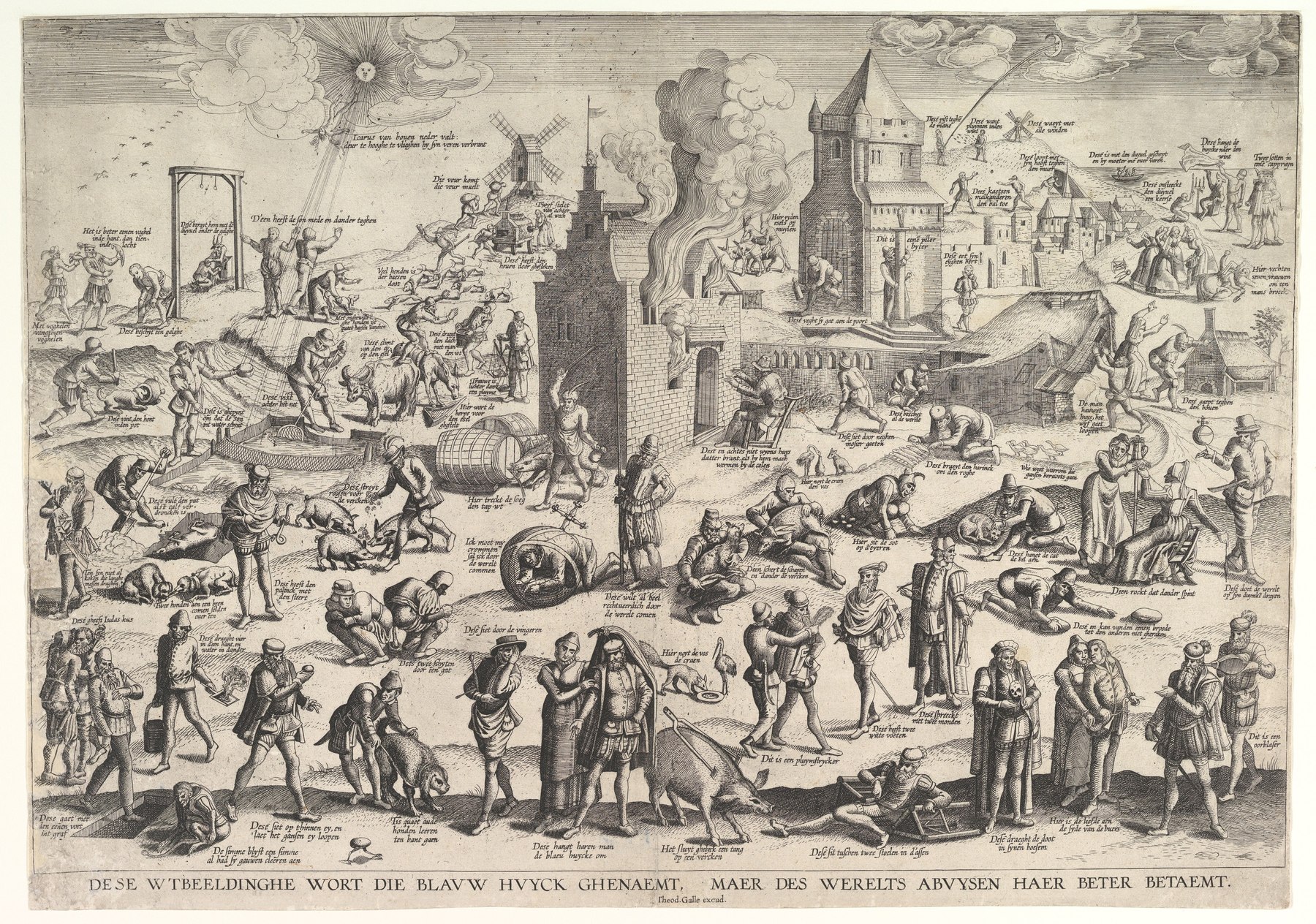
Bruegel gave those flat paper figures real weight, receding sea air, and deadpan faces. Nobody winks at the viewer. Folly is simply the village’s daily work, and Bruegel trusted Antwerp collectors like Niclaes Jongelinck, who owned Bruegel’s winter landscape and Babel panels, to recognize each idiom over wine without a caption.
What infrared scans caught under the oil
Even Bruegel kept improvising after his drawing was finished. A 1997 infrared reflectography study of the Berlin panel, published by art historian Rebecca Duckwitz, revealed a careful preparatory underdrawing across the oak boards alongside last-minute changes painted straight in oil. Up inside the green-roofed pillory atop a stone column between the inn and the turret bridge, where a fiddler plays on the pillory in mockery of shame, Bruegel drew the man’s legs stretched out and then tucked them underneath him in paint. He painted a green hedge over an underdrawn brick wall. Over by the stone tower door on the right, he added a villager reverently kissing the iron door-ring, an old Dutch image of sycophancy, straight from the brush with no underdrawing at all.
Belling the cat, biting the pillar, and big fish in the river
The lower-left corner packs eight of the panel’s best-known proverbs, including three idioms English speakers still use every day, into roughly four square feet of oak.
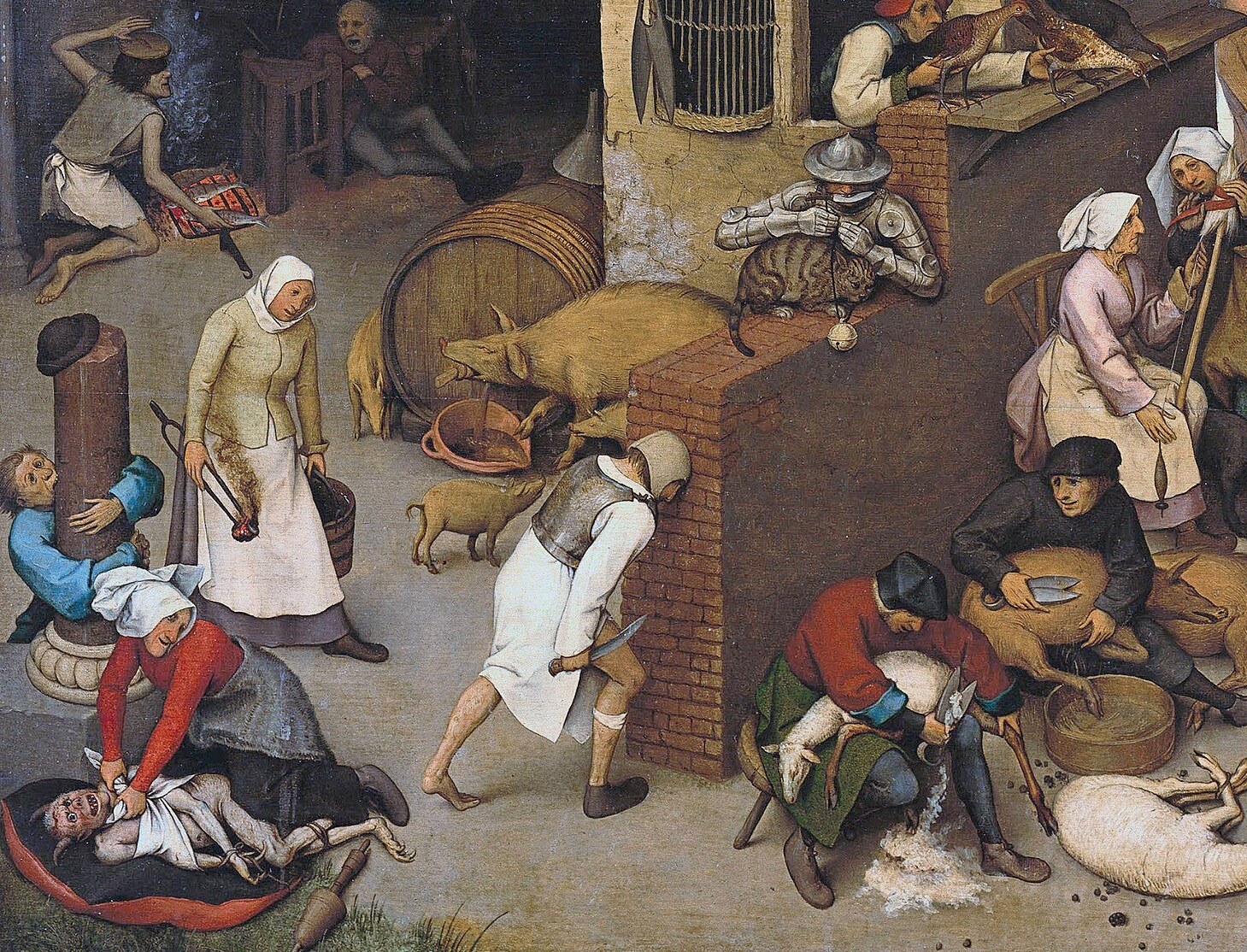
A hothead in a white shirt, steel breastplate, and shin bandage rams his head into red brick with a dagger in his hand. One foot wears a shoe and the other is bare, folding a second proverb about lost balance into one body. Above him on the masonry, a knight in plate armor clamps a knife between his teeth and leans down to tie a brass bell onto a cat. At the far left edge, a bareheaded man in blue sinks his teeth into a stone church pillar: een pilaarbijter, still a Dutch word for a pious churchgoing hypocrite. Even Hell loses down here; in the corner below him, a fierce housewife straps a howling grey devil wrapped in a white cloth flat onto a dark red-backed cushion.
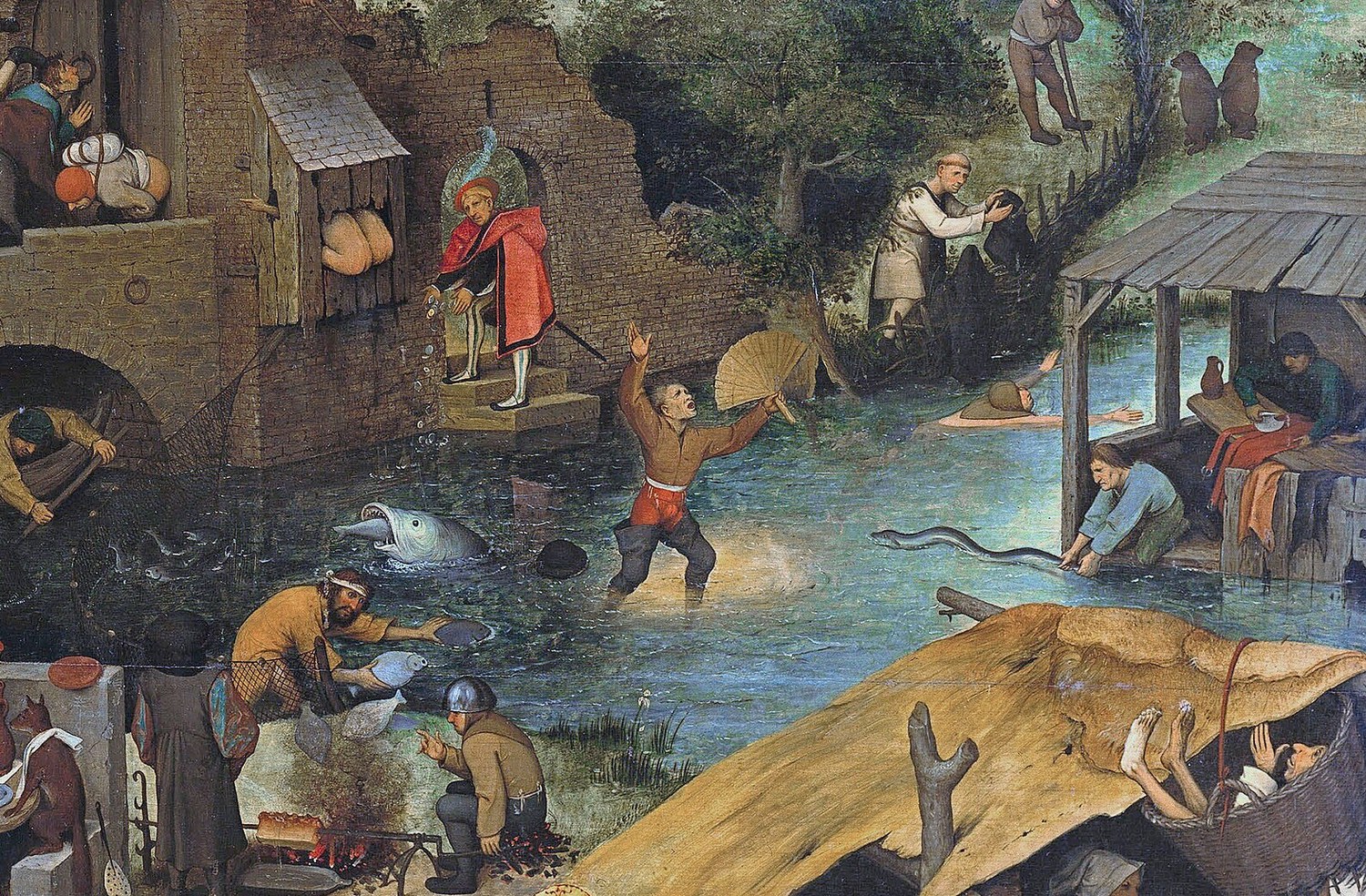
Scan rightward from the inn roof, tiled with nearly two dozen round tarts, to the stone turret over the river. Halfway down that turret, two bare backsides poke out of one wooden latrine chute, acting out “they shit through one hole,” sixteenth-century Dutch for two cronies who agree on everything. Out in the current below them, a giant silver fish breaks the surface gulping down a smaller fish headfirst. Bruegel had drawn that ancient Latin proverb in 1556 for an engraving Hieronymus Cock published in 1557 under the name of Hieronymus Bosch, whose Garden of Earthly Delights at the Prado in Madrid is the clear ancestor of this village.
Three orbs at the bottom and three blind men on the horizon
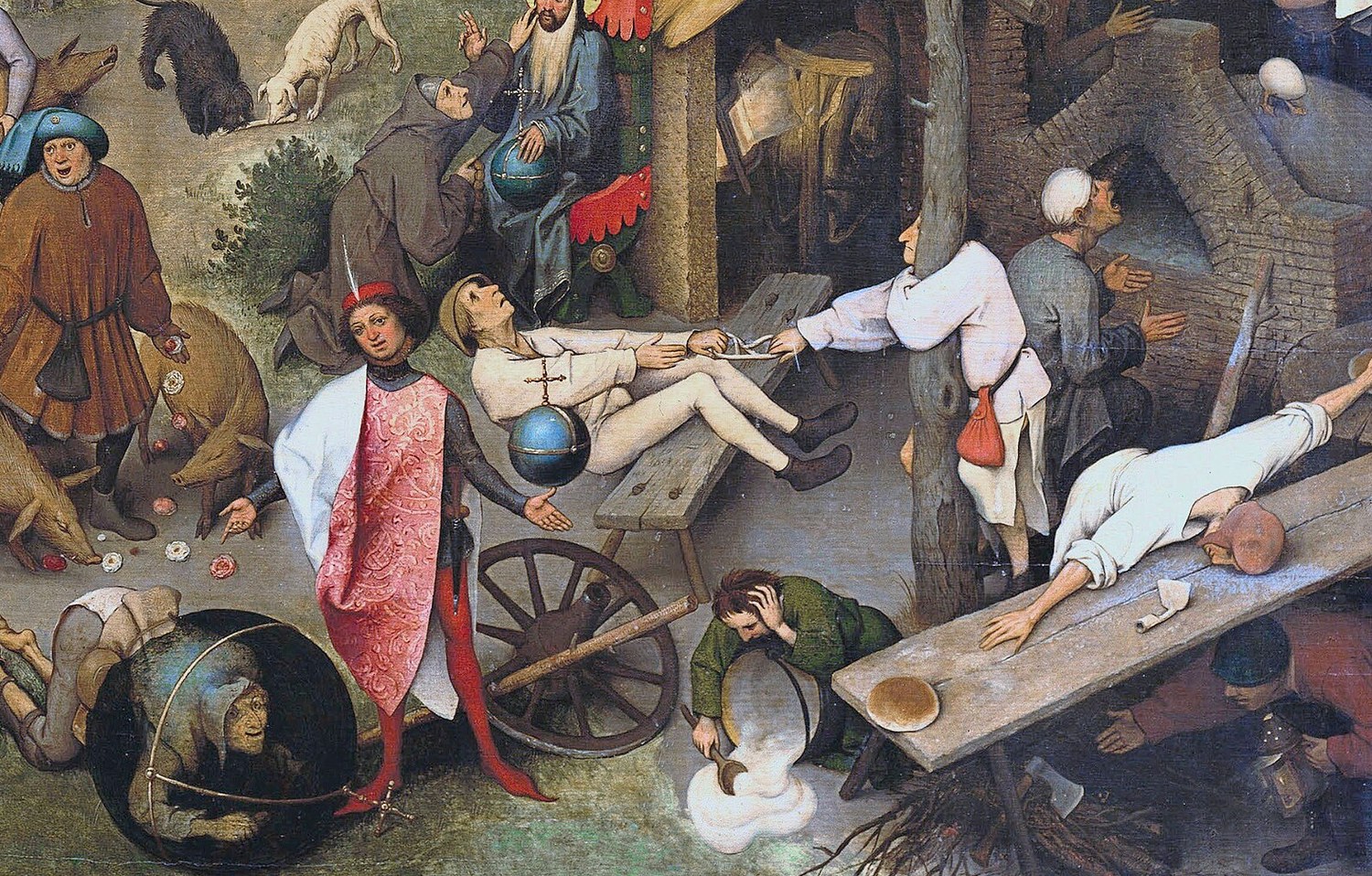
Three more globes answer the upside-down inn sign in the bottom-right corner. One barefoot villager bends double to crawl through a dark orb because “you have to stoop if you want to get through the world.” Beside him, a dandy in crimson hose spins a smaller globe on his upturned thumb even as a stick jams the wagon wheel by his ankle. To the right, one peasant scrapes up spilled porridge and another strains between two loaves on a slanted table; directly behind the dandy under a thatched shed, a monk ties a false flaxen beard onto Christ as the Lord holds a third orb on his knee.
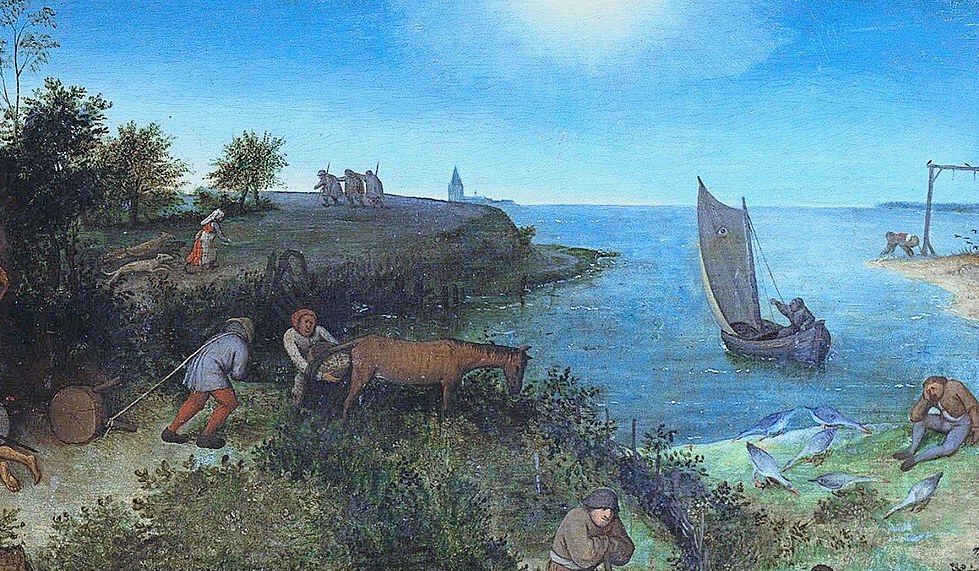
Now lift your eyes all the way to the sea bluff at upper right. Just left of a coastal gallows where a defiant criminal squats pants-down, acting out “he shits on the gallows,” three tiny figures barely a fingernail tall shuffle forward in single file beside a church spire. It is the Gospel parable of the blind leading the blind. Nine years later, in 1568, the year before he died, Bruegel pulled those three specks off the horizon and turned them into The Blind Leading the Blind at Capodimonte in Naples, a five-foot linen canvas of six stumbling blind men first rehearsed here in just over a centimetre of paint.