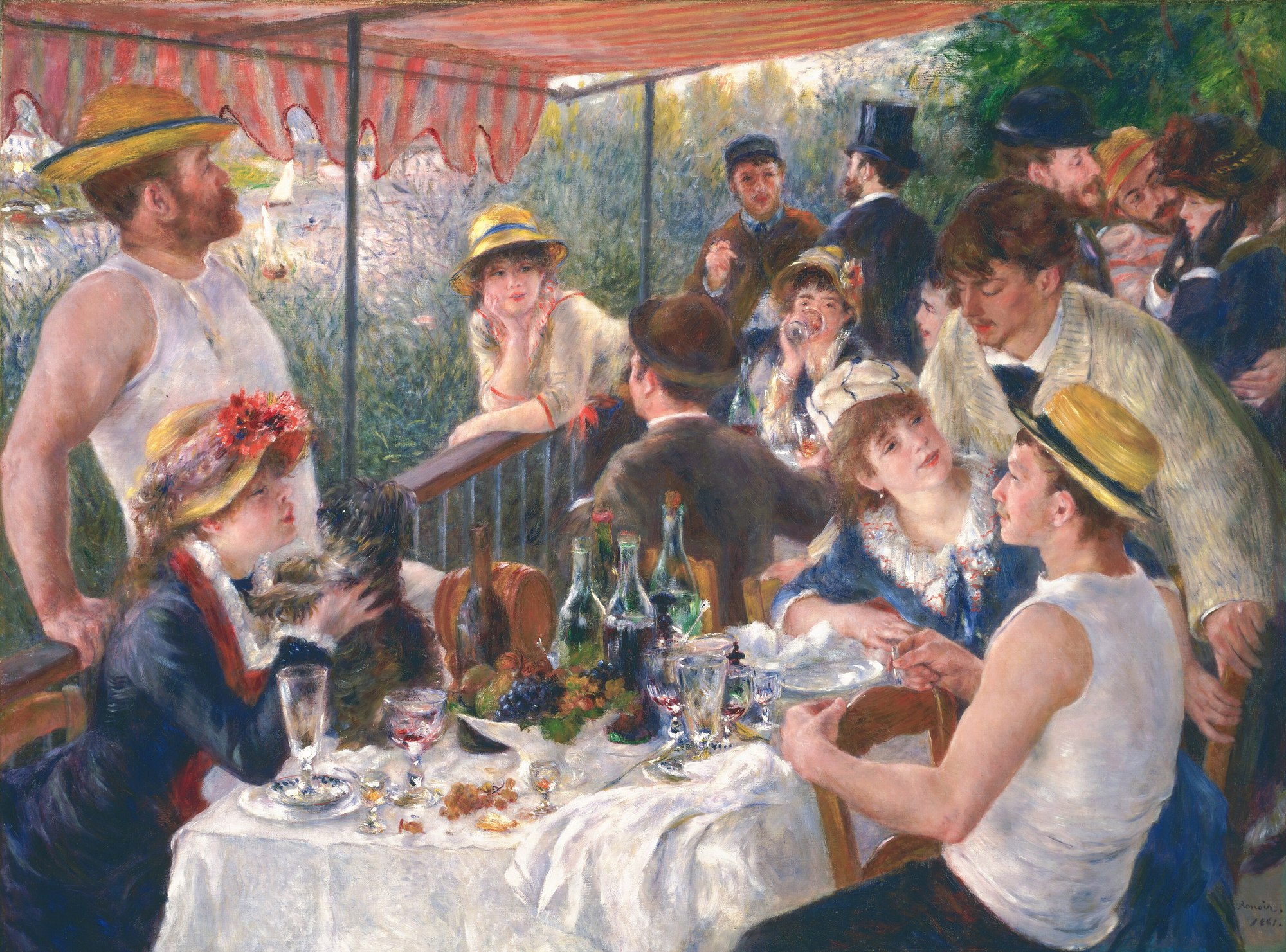
On July 9, 1923, the American collector Duncan Phillips agreed to pay 125,000 dollars to the sons of Paris dealer Paul Durand-Ruel for a single Renoir canvas. Durand-Ruel had bought it straight from the artist on February 14, 1881 for 6,000 francs, sold it briefly to Parisian banker Ernest Balensi, bought it back in April 1882, and kept it in his own Paris apartment until he died forty years later. Writing the day after the deal closed, Phillips predicted that “people will travel thousands of miles to our house to see it,” the brick family home near Dupont Circle in Washington, D.C. that he had opened as a museum in fall 1921.
They still do. Upstairs in Gallery 201 of the Goh Annex at The Phillips Collection, 1600 21st Street NW, five minutes on foot from Dupont Circle Metro, a cushioned bench faces Luncheon of the Boating Party across an intimate room. The actor and collector Edward G. Robinson said he visited for over thirty years, standing before it “hour after hour, day after day, plotting ways to steal it.” The Phillips Collection hangs Gallery 201 like a room in a private home, with no numbered diagram beside the frame, so opening Chiaro on that bench lets you match nearly every face around the wine bottles to its real name while keeping your eyes on the paint. Hours run 10:00 a.m. to 5:00 p.m. Tuesday to Saturday and 11:00 a.m. to 5:00 p.m. on Sunday, with Mondays closed, free third-Thursday evenings from 5:00 p.m. to 8:00 p.m., and regular tickets at 20 dollars for adults, 10 dollars for students, and free for ages 18 and under.
Why this lunch never happened on one Sunday
The sunny afternoon in Le Déjeuner des canotiers was an illusion built across months. Starting in the late summer of 1880, thirty-nine-year-old Pierre-Auguste Renoir was behind on rent, tired of society portraits, and hauling a big canvas twenty minutes west of Paris by train to the Maison Fournaise in Chatou. In a September 1880 letter to his patron Paul Bérard, Renoir wrote that he had been itching to paint a boating picture there for a long time: “I’m not getting any younger, and I didn’t want to defer this little festivity which later on I won’t any longer be able to afford.”
Friends came out to Chatou on separate days into autumn as weather shifted and models missed trains, before cold weather drove Renoir back to his Paris studio over the winter. Technical imaging by Phillips Collection head of conservation Elizabeth Steele shows how much Renoir changed on the fly. X-radiographs reveal another woman facing forward in a dress with three-quarter-length sleeves originally painted in the left foreground chair; in a letter to Bérard, Renoir complained about a model who annoyed him, scraped her off, and put Aline Charigot in her seat. Even the red-and-white striped awning overhead was brushed in late over already painted sky and river trees.
While Renoir was still alive in 1912, the German art historian Julius Meier-Graefe published names for thirteen of the sitters, leaving one moustached profile at the back unnamed and bringing the balcony crowd to fourteen. That 1912 roll call turned the Chatou terrace into one of the rare nineteenth-century canvases where nearly every guest has a real biography attached, alongside the ensemble portraits gathered in Famous Paintings, Every Figure Identified.
Who is at the table at the Maison Fournaise
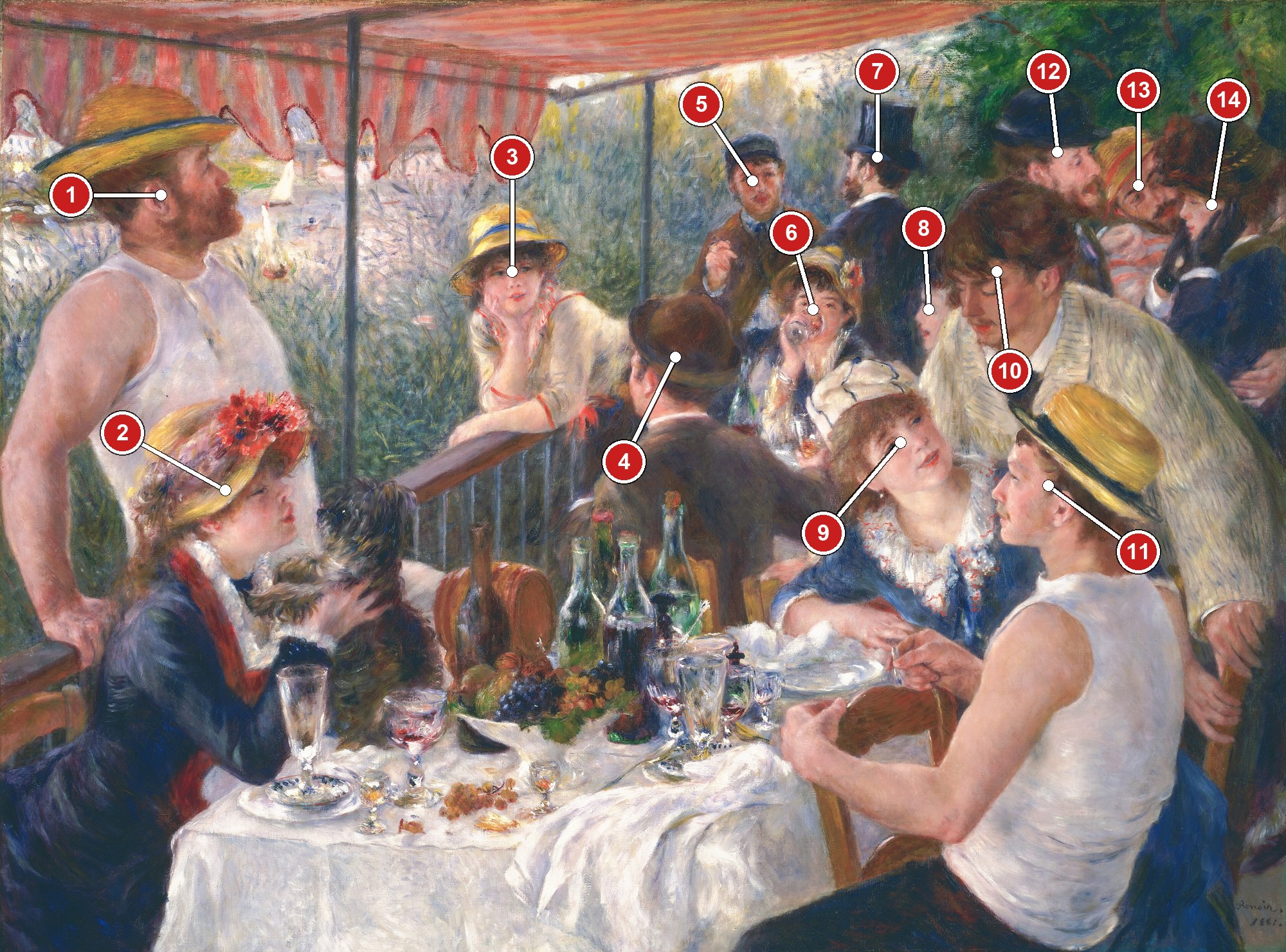
Reading from the river rail on the left to the shaded corner on the right, each marker pairs with a guest below.
| # | Sitter | Who they were in real life | How to spot them |
|---|---|---|---|
| 1 | Alphonse Fournaise Jr. | Son of the restaurant owner, in charge of boat rentals | Far left, leaning against the rail in a white sleeveless rowing singlet and straw hat |
| 2 | Aline Charigot | Twenty-one-year-old seamstress from Essoyes; married Renoir in 1890 | Left foreground in a flower-trimmed hat, lifting a tiny affenpinscher dog to her cheek |
| 3 | Louise-Alphonsine Fournaise | Daughter of the proprietor, Alphonse’s sister | Center-left, leaning against the wooden rail in a yellow boater, chin resting on her hand |
| 4 | Baron Raoul Barbier | Former cavalry officer, horseman, and ex-mayor of colonial Saigon | Center, seated with his back turned to us in a brown jacket and round hat |
| 5 | Jules Laforgue | Twenty-year-old Symbolist poet, critic, and secretary to Charles Ephrussi | Center background, wearing a soft dark cap and brown jacket |
| 6 | Ellen Andrée | Popular Parisian stage actress and mime, born Hélène André | Center middle ground, raising a clear wineglass to her lips |
| 7 | Charles Ephrussi | Wealthy art historian, collector, and future editor of the Gazette des Beaux-Arts | Center-right background, dressed formally in a black top hat and dark coat |
| 8 | Unidentified man in profile | The fourteenth guest, omitted from Meier-Graefe’s 1912 list, possibly critic Georges Rivière | Moustached profile half-hidden behind Adrien Maggiolo’s right shoulder |
| 9 | Angèle Legault | Former florist, café-concert singer, actress, and artist’s model | Right-center at the table in blue with a white ruffled collar, looking up to her left |
| 10 | Adrien Maggiolo | Royalist journalist and director of the paper La France nouvelle | Standing in a pale striped jacket, leaning down over Angèle’s shoulder |
| 11 | Gustave Caillebotte | Wealthy Impressionist painter, patron, and racing yachtsman | Right foreground, straddling a reversed chair in a white singlet and flat straw boater |
| 12 | Eugène Pierre Lestringuez | Civil servant at the Ministry of the Interior and student of the occult | Upper right, wearing a dark bowler hat and laughing toward Jeanne Samary |
| 13 | Paul Lhote | Close friend of Renoir, journalist, short-story writer, and world traveler | Upper right in a tilted straw hat and striped shirt, leaning close to Samary |
| 14 | Jeanne Samary | Celebrated twenty-three-year-old comedic actress at the Comédie-Française | Far upper right in a dark feathered bonnet, pressing her black-gloved hands to her ears |
Seamstresses, boatmen, and a collector in a silk top hat
New rail lines out of Gare Saint-Lazare mixed Parisian classes on the riverbanks every Sunday, and Renoir packed that whole mix onto one terrace. At lower left in a navy dress and flower-trimmed hat, Aline Charigot lifts a tiny affenpinscher dog to her nose. Born in the Champagne village of Essoyes, she had joined her mother in Montmartre in 1874 and met Renoir near his rue Saint-Georges studio in 1879. Nine years after Chatou, on April 14, 1890, they married and raised three sons, including the film director Jean Renoir, staying together until her death in 1915.
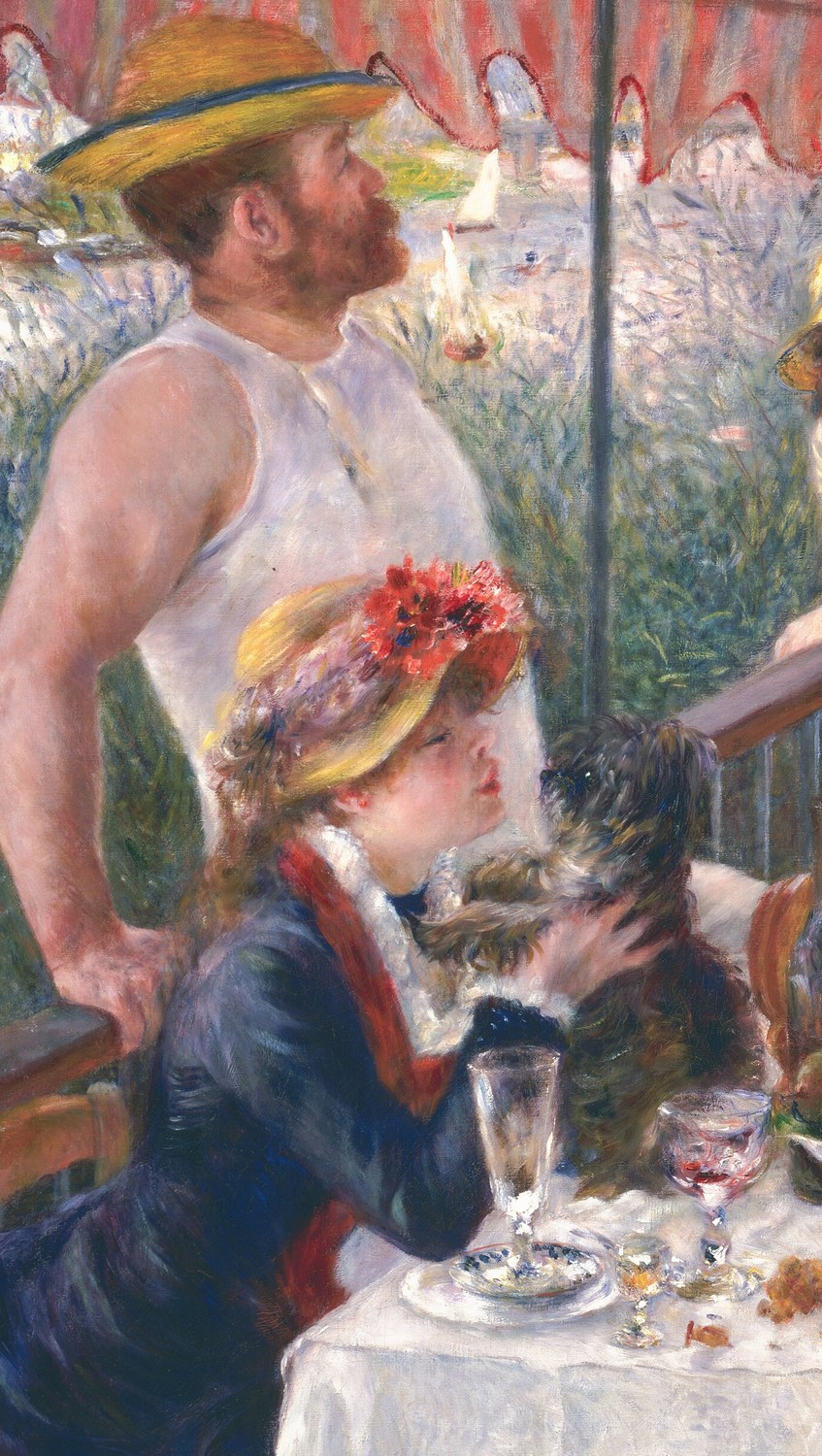
Above Aline leans Alphonse Fournaise Jr., whose father Alphonse Sr., a riverboat carpenter, had bought this restaurant beside the Chatou bridge in 1857. His bright white rowing singlet answers Gustave Caillebotte’s matching jersey at bottom right.
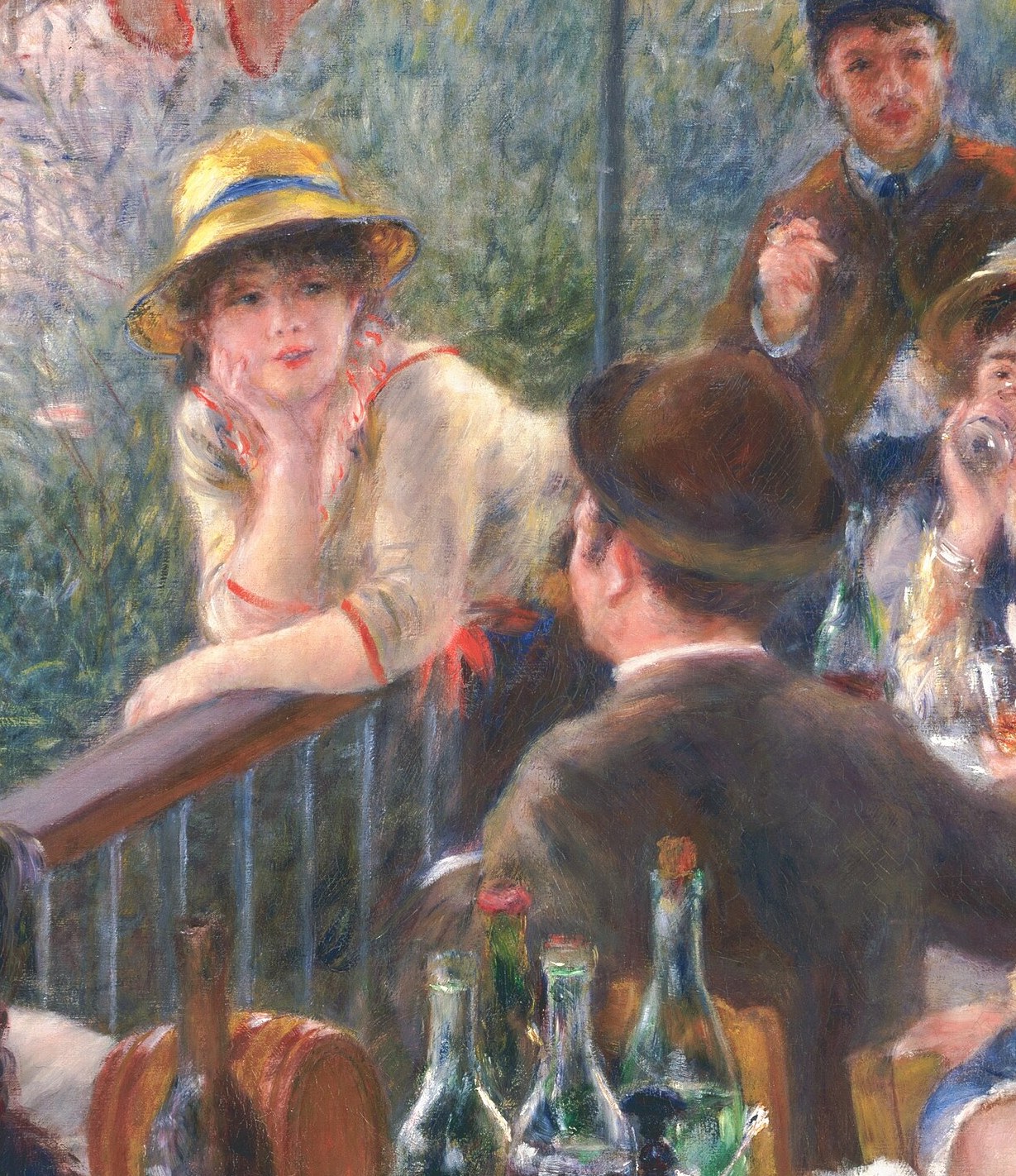
Inward along the rail, Alphonse’s sister Louise-Alphonsine rests her cheek on her hand as she listens to Baron Raoul Barbier, a former cavalry officer and ex-mayor of colonial Saigon who helped Renoir coax models out from Paris. Behind her, the diagonal wooden balustrade divides river air from human clutter much like Paolo Veronese’s marble rails in The Wedding at Cana at the Louvre, a feast painting Renoir revered.
Past Barbier’s shoulder, one guest dresses for a boulevard salon instead of a boathouse. Among the straw boaters and bare arms, Charles Ephrussi wears a black silk top hat and dark coat. Born into an Odessa grain-banking family, he collected the Japanese netsuke carvings made famous in Edmund de Waal’s memoir The Hare with Amber Eyes, edited the Gazette des Beaux-Arts, and inspired part of Marcel Proust’s Charles Swann. Steele’s infrared scans show Renoir first painted Ephrussi facing outward in three-quarter view, then turned him in profile toward his shy twenty-year-old secretary, the Symbolist poet Jules Laforgue.
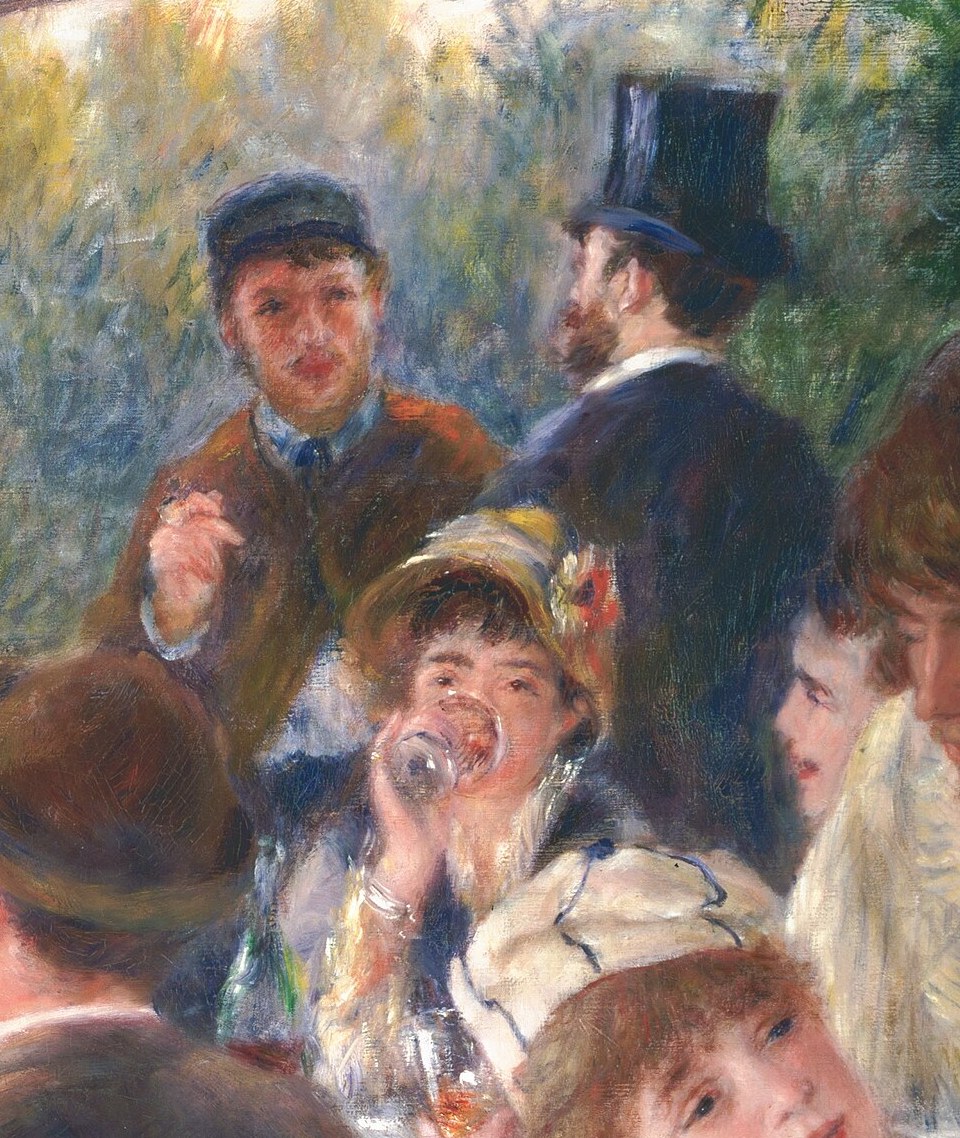
Directly below them, the stage actress Ellen Andrée sips from a clear wineglass. In Jean-Pierre Jeunet’s 2001 film Amélie, a reclusive painter copies this canvas every year for twenty years and admits she is the one figure who still slips away from him, inside the party yet lost in her own thoughts.
Just to the right of Ellen, peeking behind Adrien Maggiolo’s shoulder, is the mystery fourteenth guest. Phillips curator Eliza Rathbone notes how closely his thin moustache and brow match Renoir’s 1877 profile portrait of the critic Georges Rivière.
Caillebotte’s bequest and the Montmartre regulars
Gustave Caillebotte anchors the right foreground, straddling a reversed cane chair in a flat boater. He was Renoir’s steadiest ally: godfather to Renoir’s eldest son Pierre, the friend who named Renoir executor of his will, and the collector whose bequest of more than sixty works by Monet, Degas, Manet, Cézanne, Pissarro, Sisley, and Renoir forced France to hang Impressionist painters in public museums.
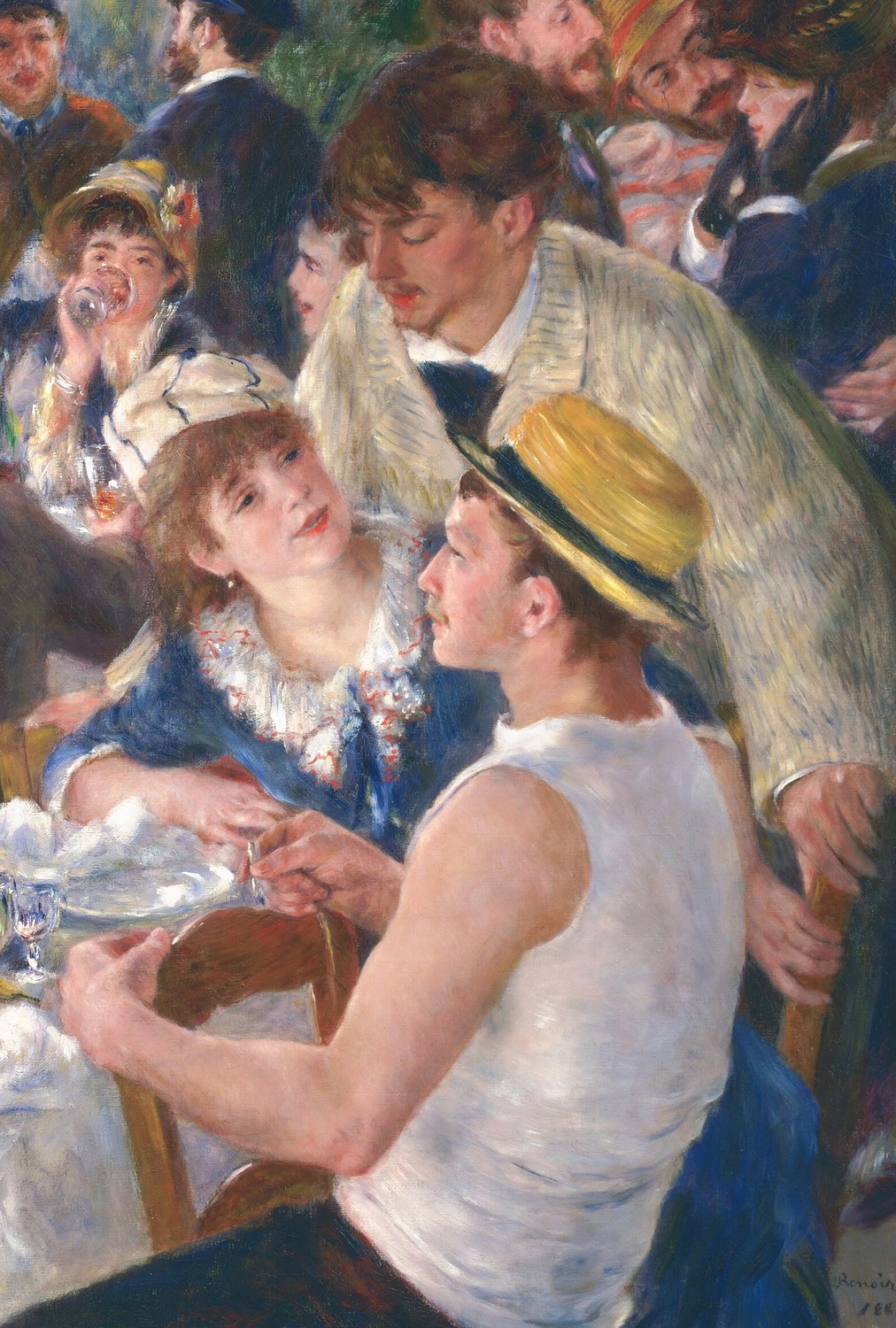
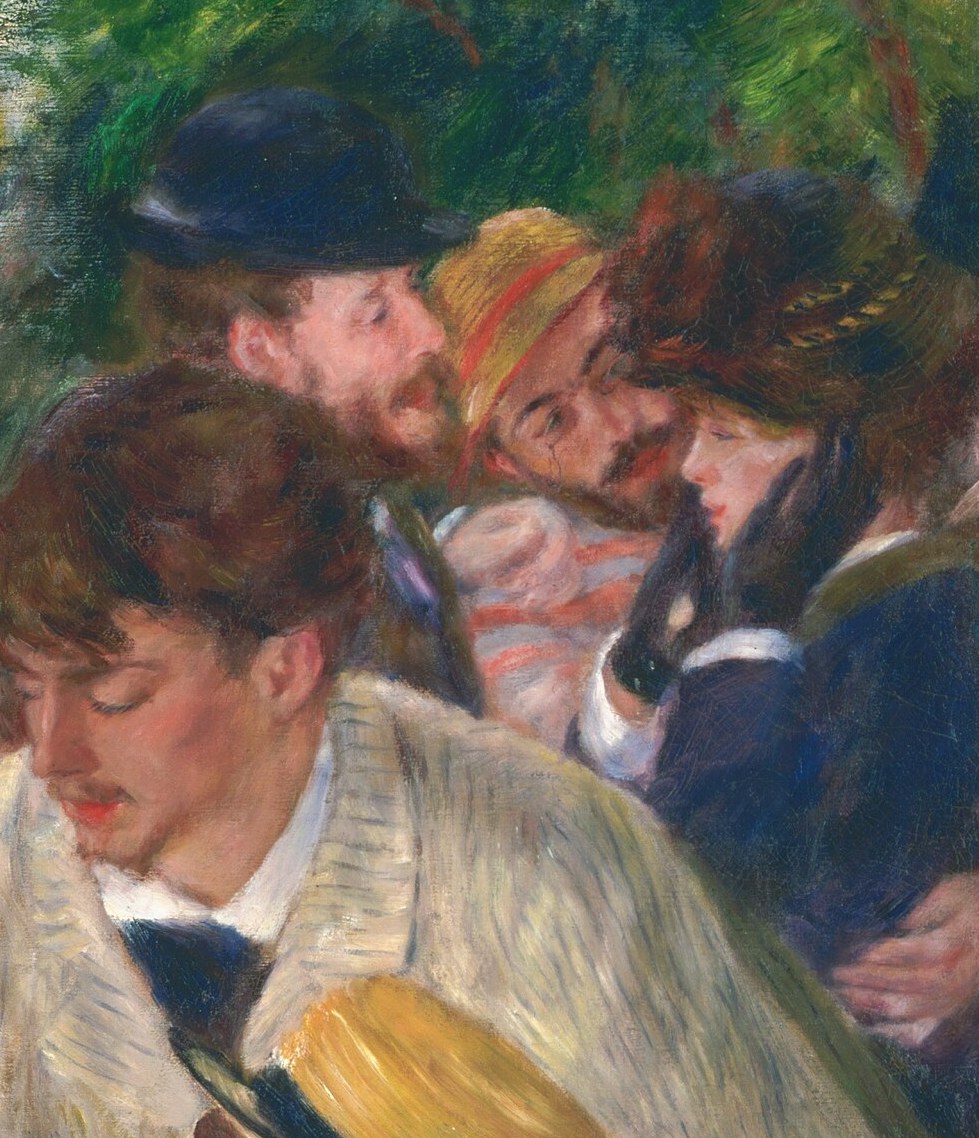
Across Caillebotte’s chair back, the actress and model Angèle Legault tilts her head toward royalist journalist Adrien Maggiolo, director of La France nouvelle, whom older English books often miscalled Antonio. Behind Maggiolo in the upper-right corner, Interior Ministry clerk Eugène Pierre Lestringuez and writer Paul Lhote lean in close to Comédie-Française star Jeanne Samary. Lhote posed again in 1883 as the partner in Renoir’s Dance in the Country, and both men later signed as witnesses at Renoir and Aline’s 1890 wedding. Samary presses her black-gloved hands to her ears in mock exasperation; she died of typhoid fever in 1890 at thirty-three.
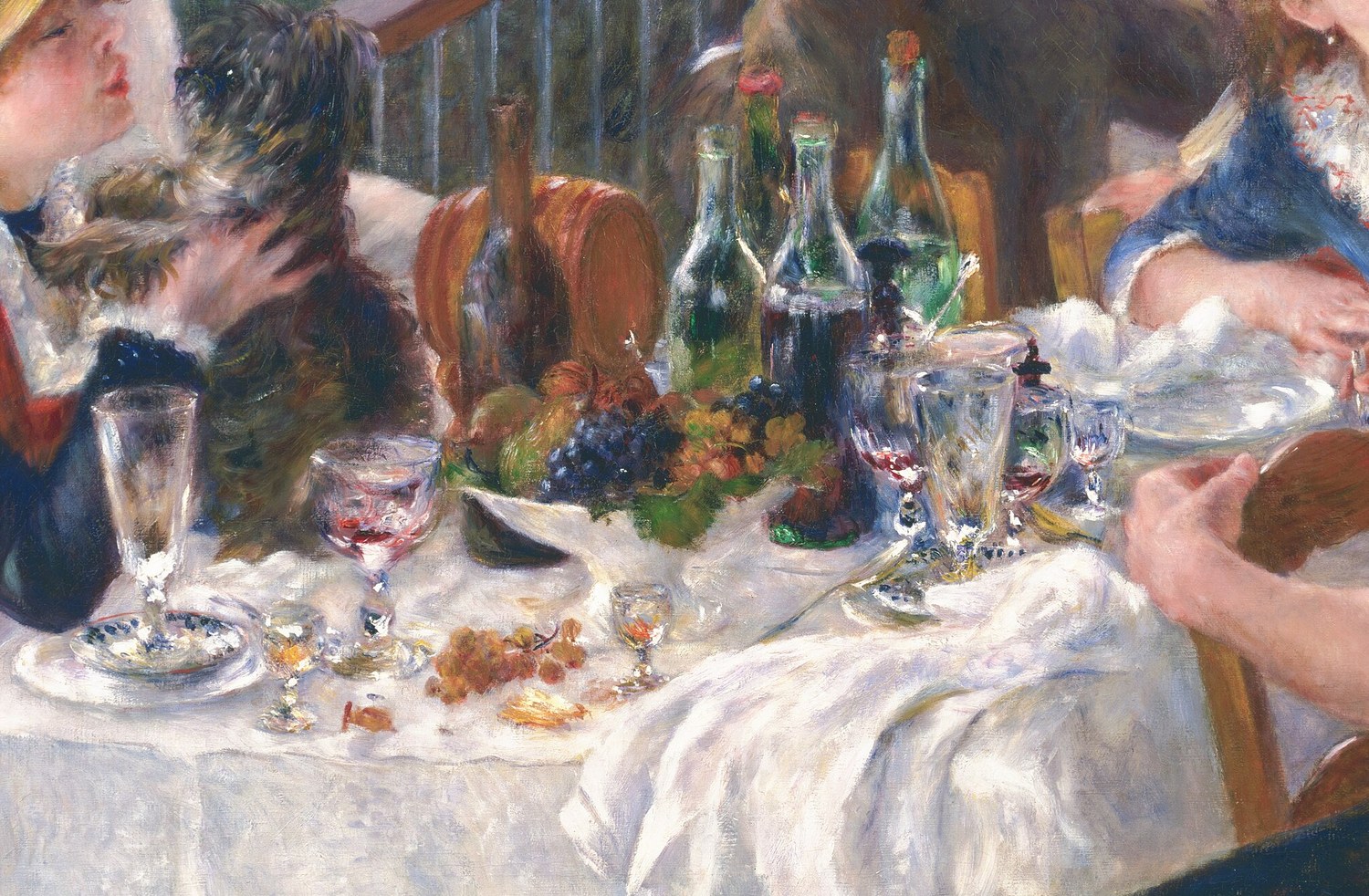
At the center of all fourteen gazes sits the crumpled white cloth itself. Reviewing the Seventh Impressionist Exhibition on March 11, 1882, the critic Armand Silvestre praised Renoir’s “true drawing” built from “the juxtaposition of hues and not of line,” nowhere clearer than in the half-empty wine bottles, cognac glasses, grapes, and peaches throwing colored light across the linen.
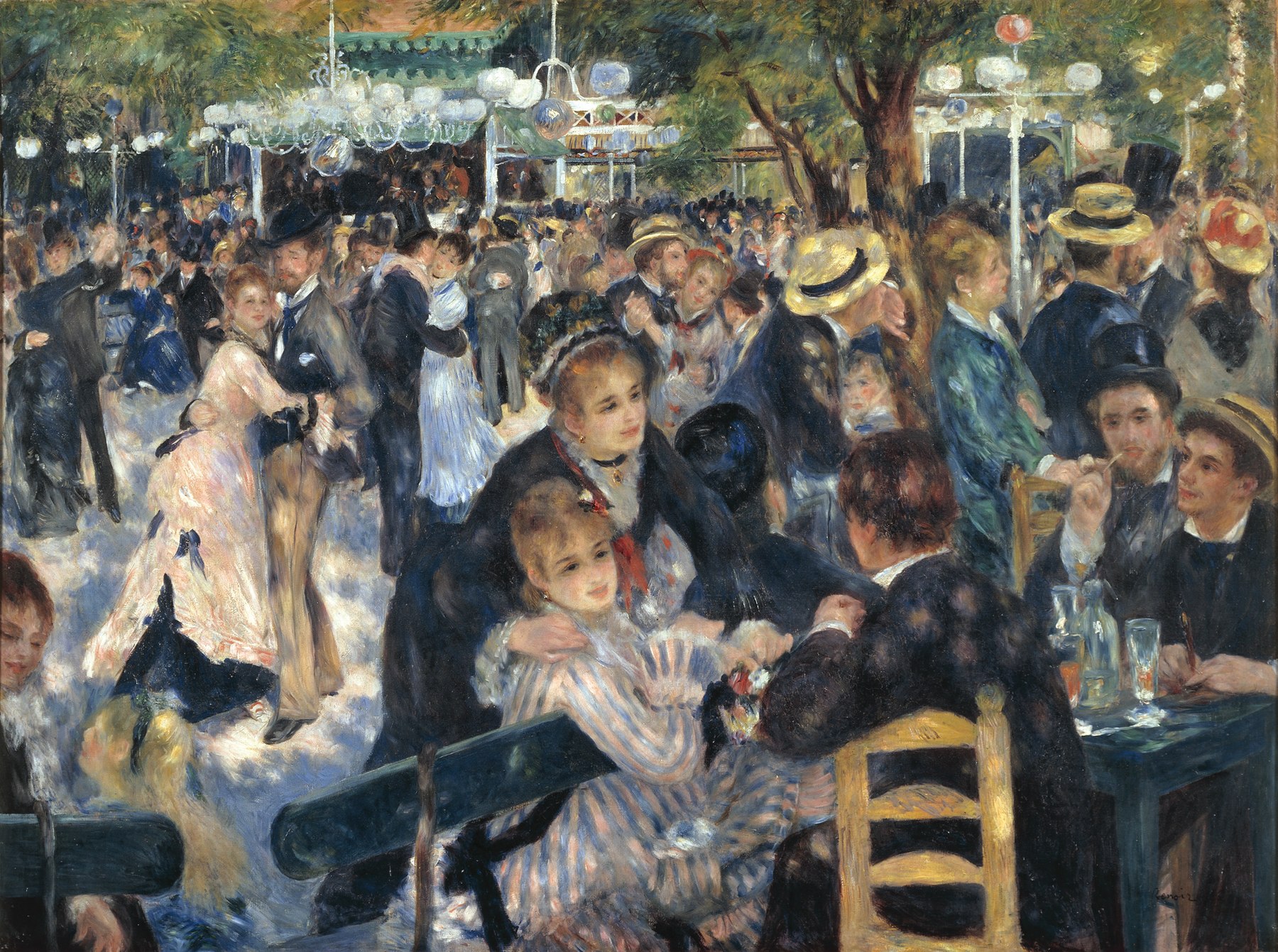
Four summers before Chatou, Renoir had painted several of these same Montmartre regulars in Bal du moulin de la Galette, one of Caillebotte’s gifts to France now hanging on the top floor of the Musée d’Orsay. Our Musée d’Orsay guide covers that top-floor room, where Lestringuez, Lhote, Georges Rivière, and Jeanne Samary’s younger sister Estelle all turn up four summers younger. Where the 1876 dance melts edges under acacia shade, Chatou locks its crowd into firm pyramids, far warmer than the solitary Paris counter Édouard Manet painted the next year in A Bar at the Folies-Bergère.
Out on the Île des Impressionnistes in Chatou, the restored Maison Fournaise still serves lunch above the water. Renoir himself barely stayed to watch the paint dry. Eighteen days after delivering the canvas to Durand-Ruel on February 14, 1881, he stepped off a boat in Algiers on March 4 to paint North African light.