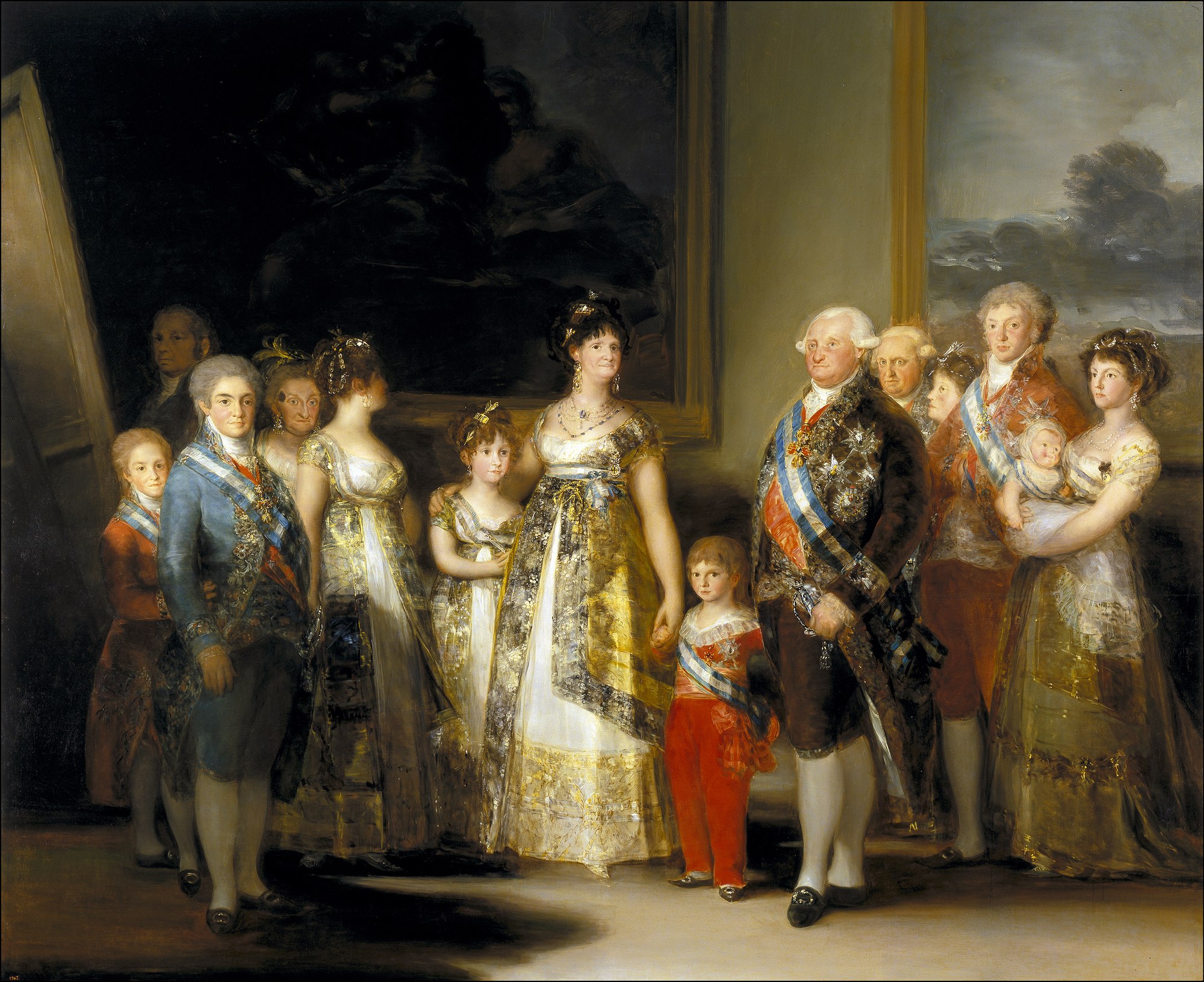
In Madrid’s royal palace archives sits an itemized expense sheet signed by Francisco de Goya on July 23, 1800. He billed the crown 980 reales for ten small canvases and stretchers, 420 reales for wooden crates and freight, 860 reales for one giant canvas, 1,140 reales for four carriage trips, and 2,114 reales to the Madrid colourman Manuel Ezquerra y Trápaga for colours and painting supplies. Stone deaf for the previous seven years after a near-fatal illness in Cádiz, the fifty-four-year-old First Court Painter had just returned from the royal spring palace at Aranjuez.
Queen María Luisa of Parma had set the job in motion on April 22, 1800, writing from Aranjuez to her favorite and former prime minister, Manuel Godoy, that King Charles IV wanted Goya to paint “all of us together” once he finished the portrait of Godoy’s wife. Rather than make Spain’s Bourbons stand together for weeks, Goya painted their heads one by one on red-primed canvases. By June 9 the Queen reported back to Godoy that the studies were finished and “all very lifelike.” Goya assembled the three-metre canvas in his Madrid studio over the next year, delivered it in mid-1801, and submitted his final bill that December. Neither the King nor the Queen recorded a single complaint.
Later in the nineteenth century, a quip routinely attributed to the French poet Théophile Gautier, though absent from his published Spanish travelogue, mocked the King and Queen as looking like “the corner baker and his wife after they have won the lottery.” Visitors still look at the slack chins, the dark patch on an aunt’s temple, and a young woman turning her face into the wall, and assume Goya slipped a cruel satire past a foolish monarch. Curators at the Museo del Prado, led for decades by Goya specialist Manuela Mena Marqués, reject that myth. In the Spanish court tradition of Velázquez, Goya painted the Bourbons’ plain features closely from life without flattering them, trusting their diamonds and ribbons of chivalry to signal royal rank.
Where it hangs in Room 032 at the Prado
At the Prado, The Family of Charles IV hangs in Room 032 on the first floor of the Villanueva Building. Five of Goya’s surviving 1800 Aranjuez oil sketches hang right beside it: María Josefa, Antonio Pascual, Carlos María Isidro, Francisco de Paula, and Luis of Parma. Seeing those warm studies on reddish ground next to the finished portrait settles the caricature debate at once. Goya transferred each head angle onto the big canvas without twisting a single mouth.
The Prado opens Monday to Saturday from 10:00 a.m. to 8:00 p.m., and Sundays and holidays from 10:00 a.m. to 7:00 p.m. General admission is 15 euros. Permanent-collection rooms are free during the final two hours on regular days, from 6:00 p.m. to 8:00 p.m. Monday through Saturday and 5:00 p.m. to 7:00 p.m. on Sundays and public holidays, though lines form early at the Puerta de Goya ticket booths. Our Prado visiting guide and Prado highlights guide cover entry timing and surrounding rooms.
Every figure in The Family of Charles IV, left to right
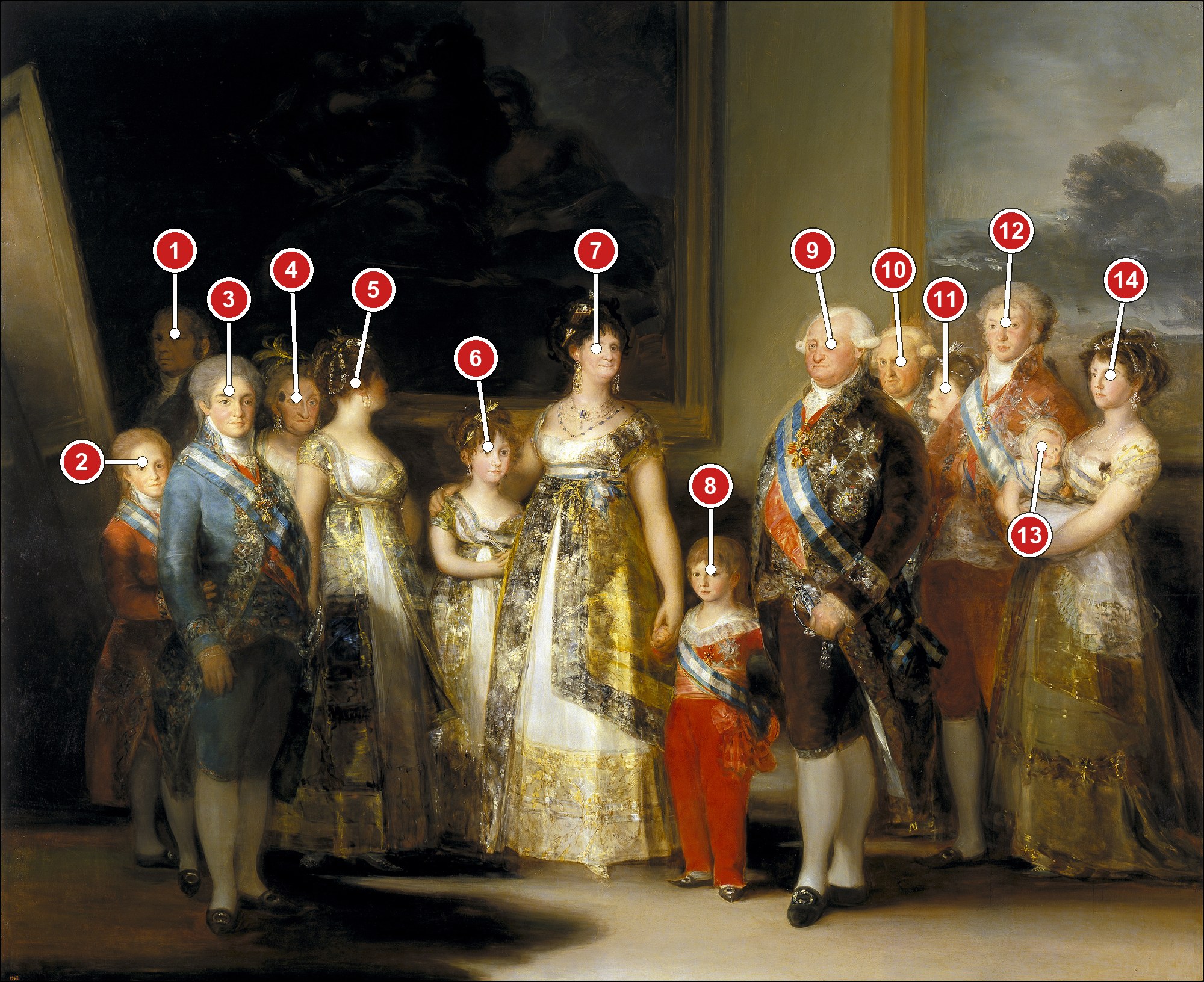
Every male royal whose chest is visible wears the sky-blue-and-white sash of the Order of Charles III. Four of them, Ferdinand, Francisco de Paula, King Charles IV, and Don Luis, plus the red ribbon glimpsed at Antonio Pascual’s collar, also wear the Golden Fleece. Every female royal whose dress shows wears the purple-and-white sash of the Order of Noble Dames of Queen María Luisa, founded at the Queen’s request on April 21, 1792; for other court and crowd ensembles decoded the same way, see Famous Paintings, Every Figure Identified.
| # | Figure | Relation to King Charles IV | How to spot them |
|---|---|---|---|
| 1 | Francisco de Goya | First Court Painter | Half-hidden in deep shadow at the far left behind a tall tilted canvas |
| 2 | Infante Carlos María Isidro | Second surviving son, aged twelve | Red coat at the far left, peering out from behind his older brother’s waist |
| 3 | Ferdinand, Prince of Asturias | Eldest surviving son and heir, future Ferdinand VII, aged fifteen | Stepping forward on the left in a powder-blue velvet coat |
| 4 | Infanta María Josefa | Unmarried elder sister of the King, aged fifty-five | Feathered hairpiece and a large black round patch on her right temple |
| 5 | Unidentified future bride | Intended Princess of Asturias | Young woman in white and gold turning her face completely away from us |
| 6 | Infanta María Isabel | Youngest surviving daughter, aged ten | Standing in white under her mother’s protective right arm |
| 7 | Queen María Luisa of Parma | Wife and first cousin of the King, aged forty-eight | Dead center, gold-and-black gown, diamond arrow pinned in dark curls |
| 8 | Infante Francisco de Paula | Youngest son, aged six | Bright scarlet one-piece suit, holding his mother’s left hand |
| 9 | King Charles IV | King of Spain, aged fifty-one | Stepped forward right of center, dark brown coat encrusted with stars |
| 10 | Infante Antonio Pascual | Younger brother of the King, aged forty-four | Wide eyes peering out just over the King’s left shoulder |
| 11 | Infanta Carlota Joaquina | Eldest daughter, future Queen of Portugal, aged twenty-five | Shown strictly in profile with a diamond arrow and jewelled band in her hair |
| 12 | Don Luis, Prince of Parma | Son-in-law and the Queen’s nephew, future King of Etruria, aged twenty-six | Tallest figure on the right, in an orange-red embroidered coat |
| 13 | Infante Carlos Luis | Baby grandson, six months old | Wrapped in white lace in his mother’s arms, already wearing a royal sash |
| 14 | Infanta María Luisa Josefina | Daughter, Princess of Parma, aged seventeen | Far right, holding her infant son with a small tender smile |
Goya in the dark and the missing mirror
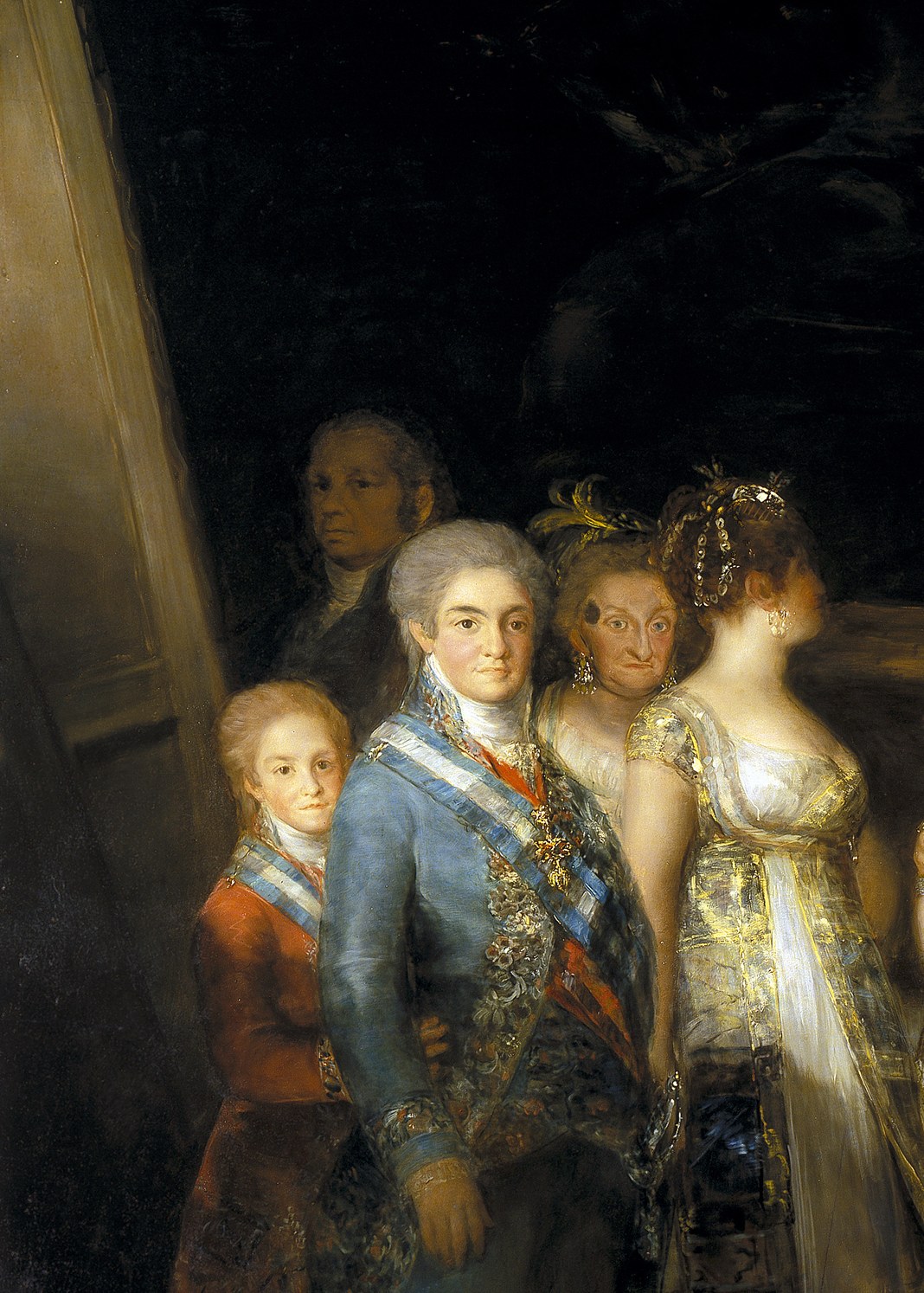
Goya placed himself in the brown shadow behind Prince Ferdinand’s shoulder, looking outward behind the wooden stretcher of a tall upright canvas. His hands stay hidden behind the frame and young Don Carlos.
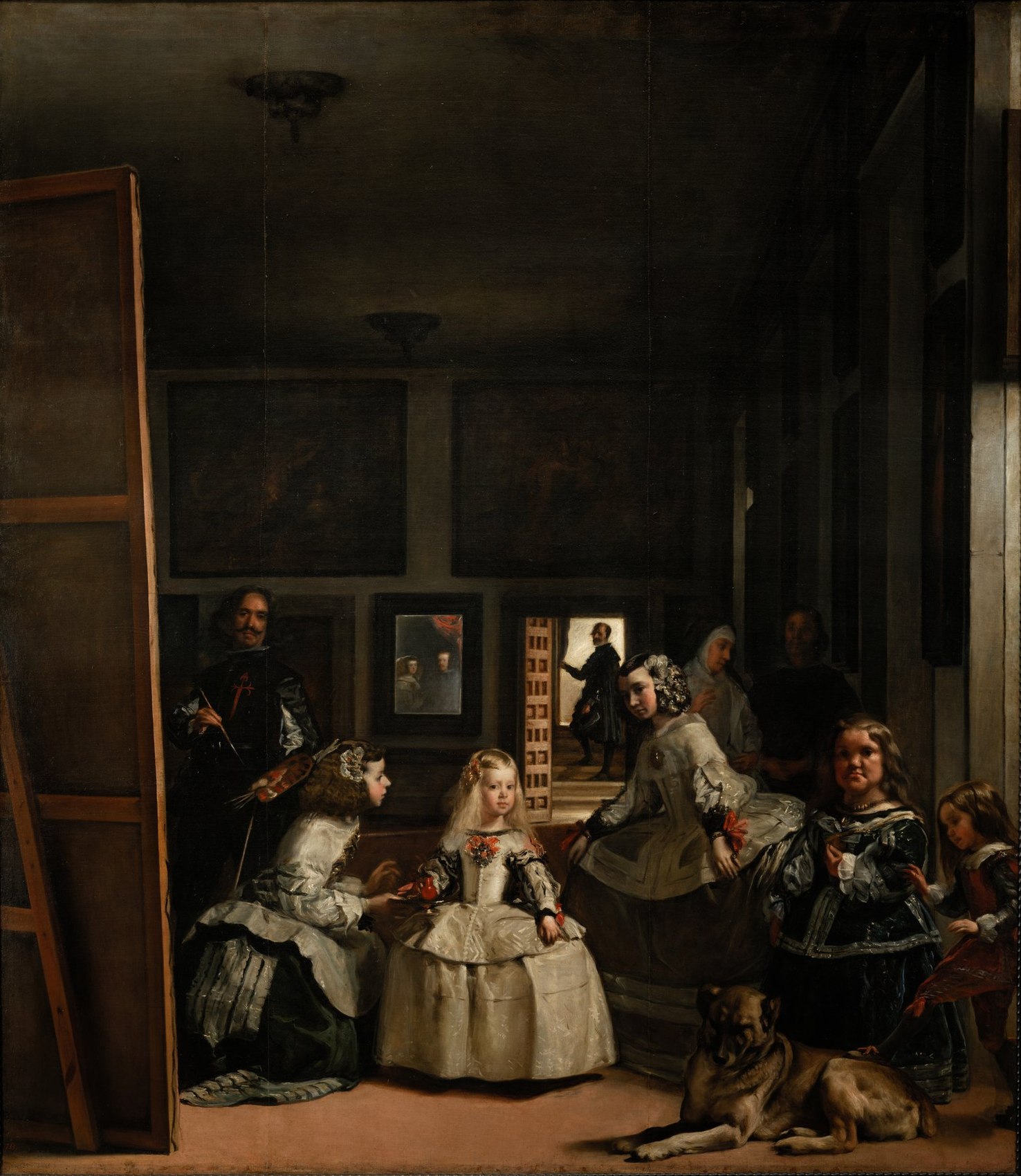
Every courtier in 1801 caught the reference. In 1656 Diego Velázquez had painted himself behind a towering canvas on the left edge of Las Meninas, which hung in Madrid’s royal palace where Goya had copied it in an etching around 1778.
Yet Goya turned Velázquez’s room inside out. Velázquez gave Philip IV’s court a deep hall with doors, windows, and a glowing mirror on the rear wall. Goya removed the back mirror altogether. He pressed Charles IV’s family into a shallow strip of sunlit floor in front of two dark, unreadable background canvases. For all thirteen Bourbons to face us while Goya looks in the same direction from behind them, they must be facing a giant mirror standing where we stand.
Rival brothers and a bride with no face
Two young brothers on the left hold Spain’s nineteenth-century civil wars between them. Ferdinand, Prince of Asturias, steps forward in powder blue with his right arm relaxed at his side. Eight years after these sittings, he overthrew his father in the Mutiny of Aranjuez, walked into Napoleon’s trap at Bayonne, yielded Spain to Joseph Bonaparte, and returned in 1814 as King Ferdinand VII to restore the Inquisition and drive Goya into exile in Bordeaux. His younger brother Carlos María Isidro holds onto Ferdinand’s waist in red; when Ferdinand died in 1833, Carlos refused to recognize Ferdinand’s daughter Isabella II and sparked three bloody Carlist Wars.
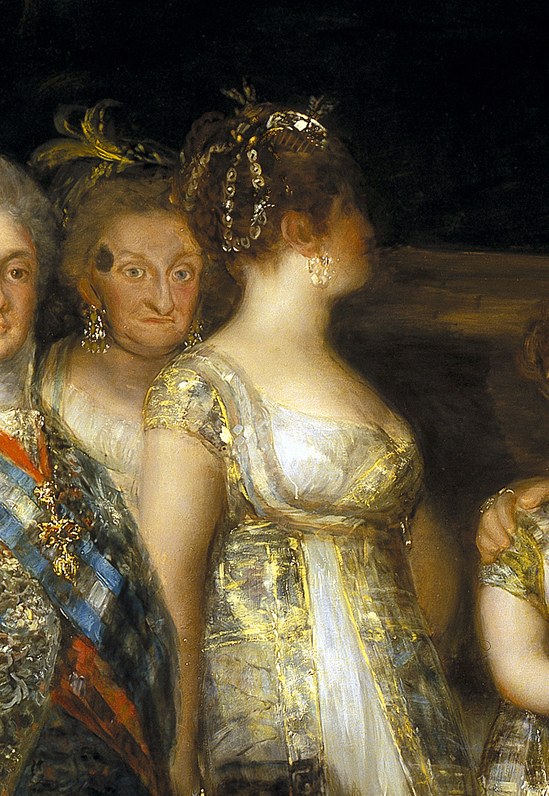
Infanta María Josefa, the King’s unmarried elder sister, looks out behind Ferdinand wearing yellow-and-white feathers and a round black disk on her right temple. Eighteenth-century courtiers wore small velvet beauty patches called lunares, and doctors stuck larger black taffeta plasters of resin or opium onto temple sores and headaches. She died in December 1801, months after the portrait was finished.
Beside her stands Goya’s oddest solution. A tall young woman in diamonds and the Queen’s purple-and-white sash turns her head completely to the wall, showing only dark curls, an ear, and the line of a jaw. Ferdinand had no betrothed bride yet in 1800, so Goya painted a placeholder body whose face could be added once a marriage treaty was signed. Ferdinand married Princess Maria Antonia of Naples in October 1802. Nobody ever called Goya back to paint her face in.
Queen María Luisa at the center
Queen María Luisa holds the exact center of the canvas, directly under the seam between the two background paintings where court protocol normally placed the king. Lit brighter than anyone else, she wears a high-waisted French Empire gown of gold tissue and black lace that showed off the arms she remained proud of at forty-eight, after twenty-four pregnancies and fourteen live births. A diamond arrow glitters in her dark curls, a French fashion representing Cupid’s dart. A decade later Goya mocked that same ornament by pinning an identical diamond arrow into the hair of a grinning crone in Time and the Old Women.
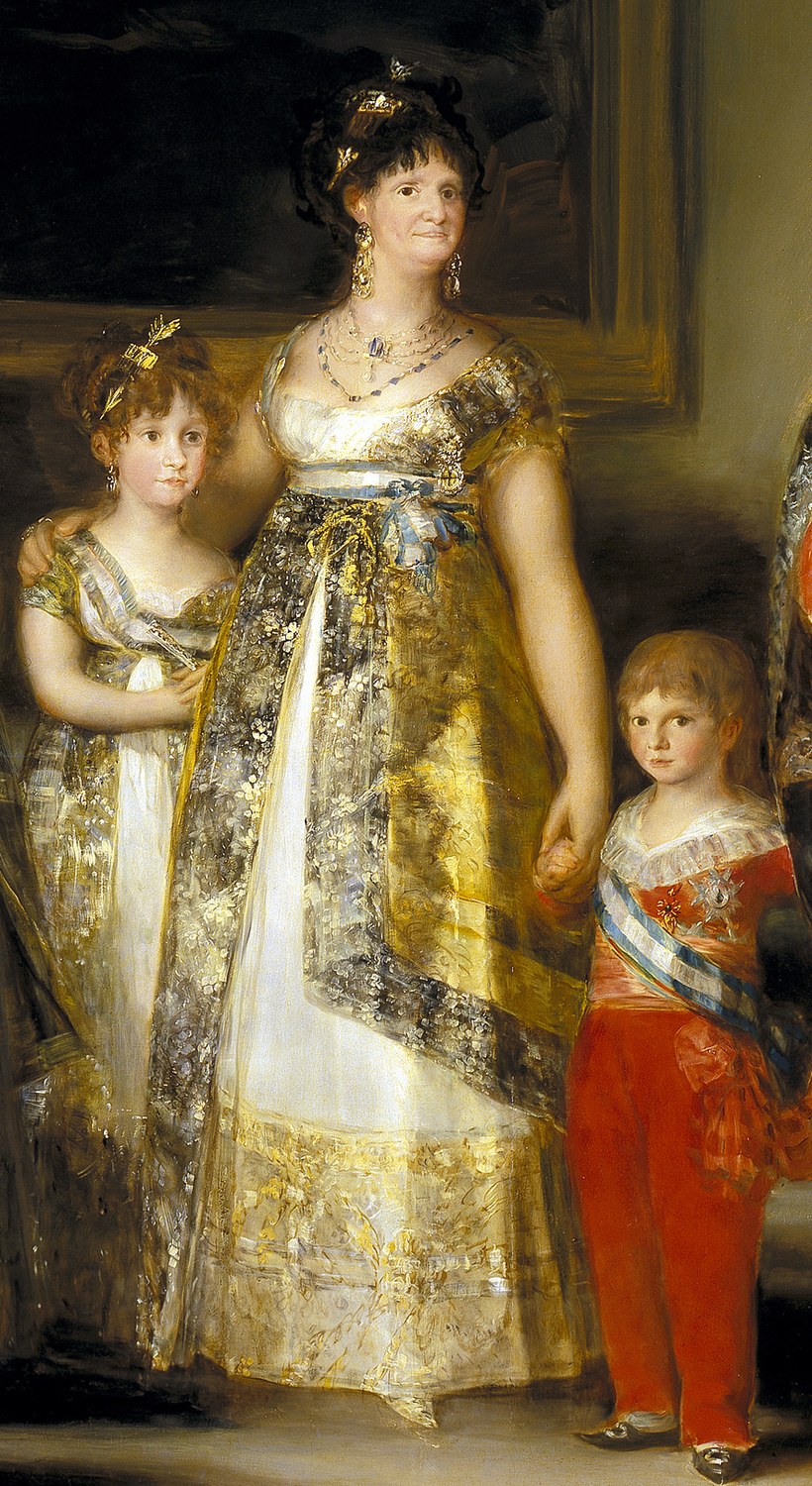
French envoy Jean-François de Bourgoing and other foreign diplomats in Madrid recorded that María Luisa and Godoy ran Spain while the amiable Charles IV hunted every afternoon in all weather. Even so, her central place fits Bourbon dynastic logic. She is the living trunk of the family tree, linking the heirs on the left with her youngest surviving children: María Isabel under her right arm and little Francisco de Paula in bright scarlet at her left hand. Reported tears from Francisco de Paula when French soldiers led him out of the Madrid palace on May 2, 1808 helped ignite the Dos de Mayo uprising. In the Prado today, Chiaro connects that boy in red directly to Room 064 downstairs, where Goya painted the slaughter of May 2 and May 3, and on to Room 067, where the fourteen murals from Goya’s country house include Saturn Devouring His Son.
What to look for on the right side from one metre away
King Charles IV steps half a pace forward on the right, his calm ruddy face floating above silver stars, the Golden Fleece, the Order of Charles III, the red sash of Saint Januarius, the French Order of the Holy Spirit, and the badge of the Spanish Military Orders. Walk to within a metre of the surface and that court jewellery breaks apart into loose, buttery strokes of white, pale yellow, ochre, and vermilion dragged on with a loaded brush, straight out of late Velázquez.
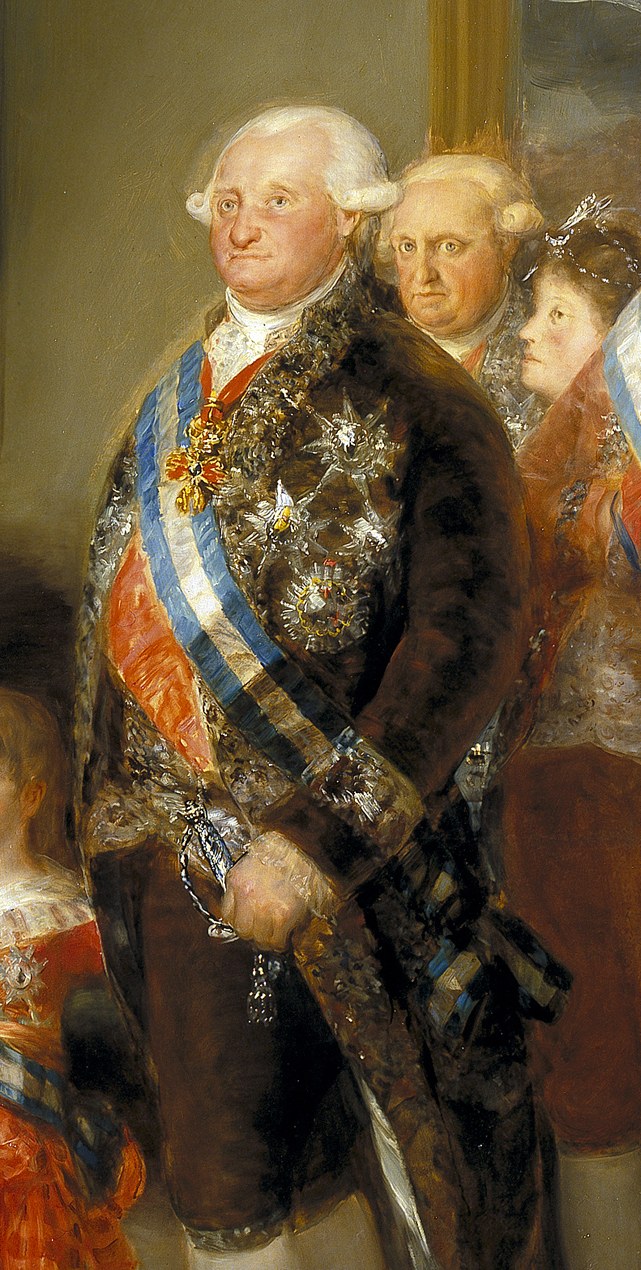
Over the King’s left shoulder peers his younger brother Antonio Pascual, who passed quiet palace days binding books, embroidering, and turning wood on a lathe before backing hardline absolutism later on. Beside him, the King’s eldest daughter Carlota Joaquina appears in flat profile. Living in Lisbon in 1800 as wife of the Prince Regent of Portugal, she missed the Aranjuez sittings, so Goya copied her profile from an earlier Madrid portrait.
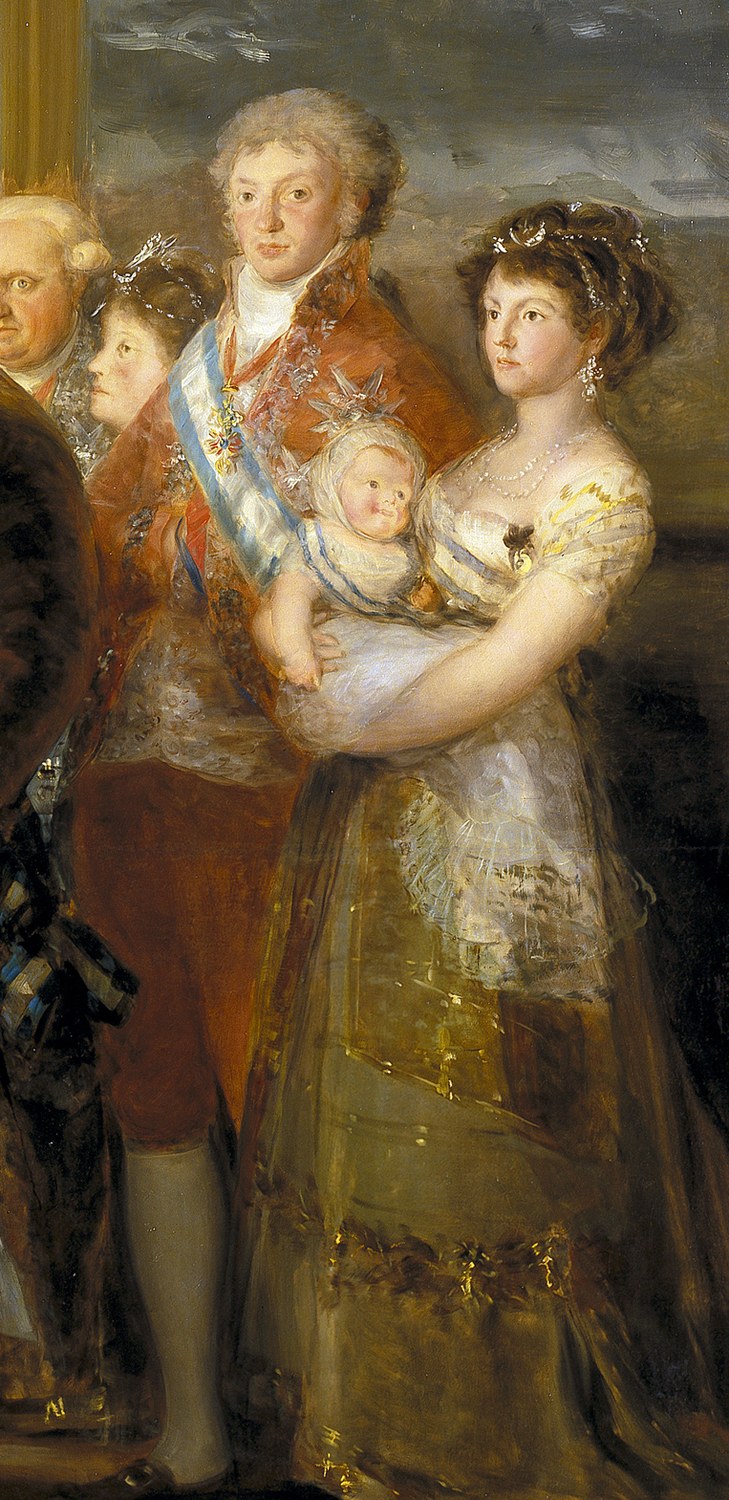
At the far right stand Don Luis of Parma and his young wife Infanta María Luisa Josefina, whom Napoleon made King and Queen of Etruria in Tuscany the following year. In her arms rests wide-eyed baby Carlos Luis, wrapped in white christening lace and already strapped into a miniature blue-and-white Charles III sash. Goya’s brush softens visibly on the baby and his mother, giving the right edge of this airless court room its only unguarded smile.